MEET CATEKCNC

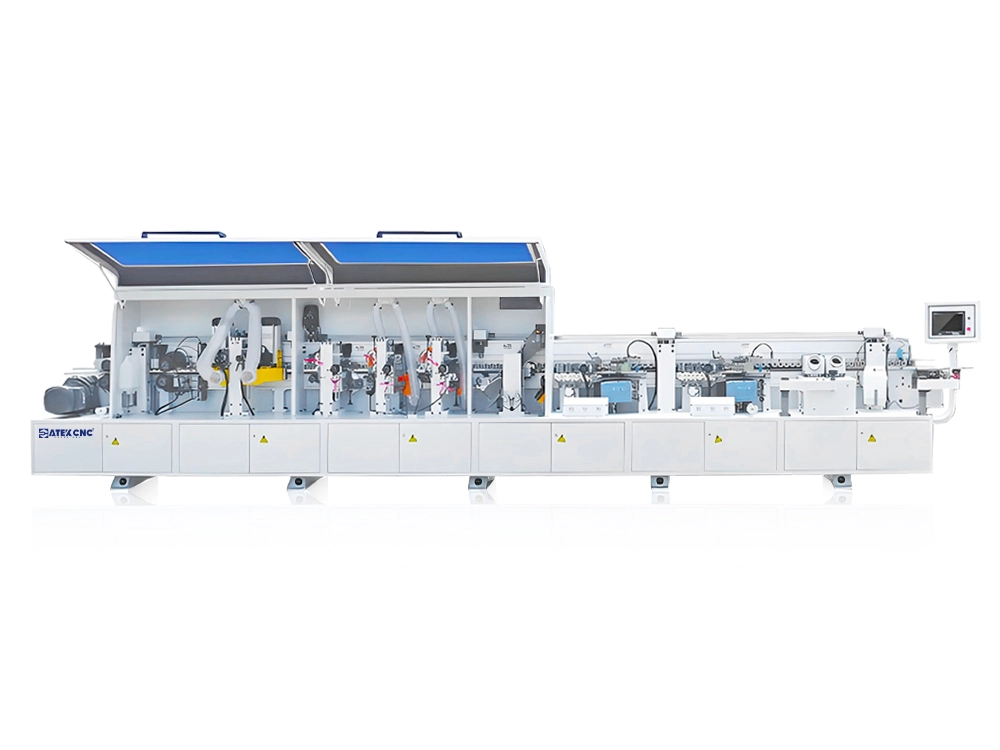
Multifunctional Automatic Edge Banding Machine for Furniture

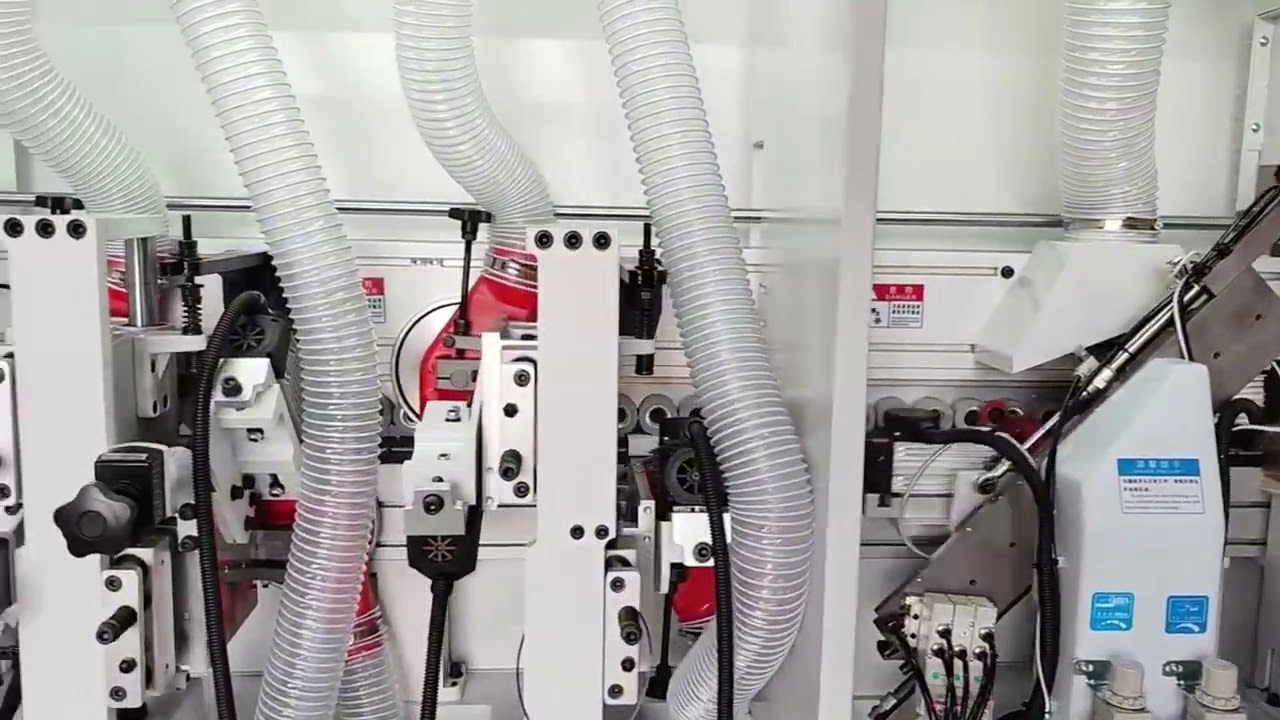
Automatic edge banding machines are designed specifically for edge banding of panel furniture. They are primarily used for automated edge banding of cut, exposed edges of man-made panels such as MDF, OSB, and melamine boards. Through automated mechanical operation, the edge bander machine automatically completes all operations, including feeding and positioning, evenly applying hot-melt adhesive, cutting and laminating edge banding tape, flush-cutting excess edge banding at the front and rear ends, trimming and leveling the upper and lower edges, scraping and de-glueing edges, and surface polishing. It can also be expanded with functions such as beveled edge banding, laser edge banding, side drilling, and horizontal grooving. The entire process is fully automated, requiring no human intervention. Edge banding not only conceals the internal structure of the panel to enhance its appearance and texture, but also isolates moisture, prevents deformation due to moisture, and enhances edge wear resistance. It is widely used in the production of custom wardrobes, cabinets, office furniture, and other furniture. Automatic edge bander are key equipment for ensuring product quality and production efficiency in modern panel furniture production lines.

Showing 1–12 Of 1 Results

CHOOSING AUTOMATIC EDGE BANDING MACHINES FOR FURNITURE MAKING

In the manufacturing process of panel furniture, board edge banding is a crucial procedure, the quality of which directly affects the final quality and pricing of the furniture. A high-quality edge bander machine can not only significantly enhance product quality but also strengthen the corporate brand image, helping you capture a larger market share. The introduction of fully automatic edge banding machines has brought revolutionary changes to the panel furniture industry, making the production process more efficient, the edge bander precise and environmentally friendly, especially suitable for large-scale batch production.

Currently, there is a wide variety of edge banding machine models on the market. When selecting one, it is necessary to carefully compare the functions and performance of the machines, as well as evaluate the scale of the supplier and their after-sales service capabilities. Additionally, the edge bander's price is an important consideration. Avoid blindly pursuing the highest configuration; although high-end fully automatic edge banding machines offer more comprehensive functions and superior performance, they also come with a relatively higher price. It is essential to choose the most suitable edge bander based on your production needs and budget to improve production efficiency, reduce costs, and enhance product quality.

If you are planning to purchase a fully functional and cost-effective edge banding machine to enhance your furniture manufacturing business, it is recommended that you read this guide in detail. Through this guide, you will gain a comprehensive understanding of the various functions, components, working principles, and maintenance of fully automatic edge bander machines.

What Is an Edge Banding Machine?

An edge banding machine is a critical piece of equipment in the production of panel furniture. By using an edge bander to seal the edges of furniture, it not only enhances the aesthetic appearance of the board edges but also achieves higher sealing and durability, effectively providing waterproof and moisture-proof properties, thereby extending the service life of the boards. It is suitable for straight and curved edge banding of various types of boards such as MDF, OSB, solid wood boards, plywood, multi-layer boards, and aluminum honeycomb panels.

The fully automatic edge banding machine is controlled by a control system that manages the entire machine's operation and parameter adjustments. It can accommodate various types and thicknesses of materials, utilizing an efficient mechanical system to achieve fully automated production. During operation, the machine's feeding system automatically transports the board into the machine. The board undergoes gluing and edge band pressing, where the edge band is precisely adhered to the board's edge. It then moves into functional zones where processes such as trimming and buffing are performed, resulting in a smooth and robust edge banding effect.

The fully automatic edge banding machine can complete large volumes of work in a short time. Its automated operation effectively reduces the need for manual intervention and minimizes the possibility of operational errors, significantly cutting labor costs while ensuring more stable and reliable edge banding quality. This improves product consistency, making it highly suitable for production factories manufacturing panel furniture such as furniture and cabinets.

What Are the Functions of Edge Banding Machine?

The edge banding machine has many functions, which vary depending on the model. The basic functions include pre-milling, gluing, pressing, trimming, rough trimming, fine trimming, scraping, and buffing. On this basis, optional features such as laser edge banding, side drilling, bevel edge banding, a PUR melting unit, a flat scraping device, servo conveyor edge banding, a cleaning unit, a preheating device, horizontal grooving, double glue pot, upper glue pot, contour tracking chamfering, and a double guide rail trimming device can be added. Through different functional combinations and automated processes, the edge of the plate can be sealed, protected, and beautified.

  • Pre-milling: The spindle drives the milling cutter to trim the edge of the processed plate to eliminate corrugated marks, burrs, or non-vertical edges after cutting, ensuring that the edge of the plate is perpendicular to the edge banding. The pre-milling function ensures that the edge band fits tightly with the plate, improving the overall aesthetics.

  • Gluing: Using a precise heating and glue feeding system, the glue door is controlled by a cylinder to ensure that the glue is evenly applied to the edge of the edge banding and the board edge, thereby enhancing the adhesion between the edge banding and the board edge. At the same time, it is equipped with a temperature control system that can automatically adjust the temperature of the sol.

  • Pressing: Use a pressing roller to squeeze the edge banding tightly to the edge of the board.

  • End cutting (cutting the edge banding strips front and back): Use linear guides to guide and control the edge banding strips, combine automatic template tracking and high-speed spindles for precise cutting, and cut off the excess part of the edge banding strips that exceed the length of the board to ensure that the edge banding strips are aligned with the edge of the board. This can effectively avoid misalignment or unevenness caused by the edge banding strips being too long, ensure the neatness and flatness of the edge banding, and improve the aesthetics of the board edge banding.

  • Rough trimming: Use a 15° flat knife and a high-speed air-cooled spindle to quickly remove excess material above and below the edge banding of the board, while leaving some trimming allowance for fine trimming. Rough trimming can remove most of the excess edge banding material and avoid the veneer from breaking due to direct fine trimming.

  • Fine trimming: This process utilizes automatic template tracking and an R-shaped finishing cutter to remove the trimming allowance at both the top and bottom left by rough cutting. It ensures the edge banding width matches the panel width precisely, eliminates roughness and unevenness along the edges, and results in a smooth, burr-free end surface.

  • Edge scraping: Use the edge scraping device to eliminate the unevenness and roughness such as ripples and burrs produced during the rough and fine trimming process, ensure the close fit between the edge banding strip and the board, ensure the smoothness of the edge banding and the surrounding parts of the board, and improve the overall aesthetics of the edge banding.

  • Buffing: Use a cotton buffing wheel or cloth wheel, drive the buffing wheel to rotate at high speed through a motor, and finely grind and polish the edge of the board to improve the smoothness and overall effect of the edge of the board.

  • Horizontal slotting: Using a high-speed air-cooled spindle to drive the milling cutter, horizontal slots can be directly opened on the side or bottom of the plate, making the subsequent installation of the fixed structure easier. It can also meet the slotting needs of aluminum alloy edging of door panels and support groove processing of different depths.

  • Side drilling function: Used to automatically drill holes on the side of the board after edge banding is completed. The drilling position, depth and diameter are set through the control system, and the side holes of the hardware three-in-one link parts of furniture such as wardrobes and cabinets are automatically processed to save subsequent drilling time.

  • Laser edge banding: Laser edge banding is an advanced edge banding technology in panel furniture. Unlike ordinary edge banding, laser edge banding requires the use of special laser edge banding tape. During operation, a laser beam is used to instantly melt the polymer functional layer on the laser edge banding tape, so that the edge banding tape and the panel are joined together. Laser edge banding can eliminate the need for hot melt adhesive and there is no need to heat the glue pot in advance. It can be used immediately after turning on the machine. The production process is cleaner, environmentally friendly, and odorless. In addition, the appearance of the laser-edge-banded panel is more beautiful, the edge banding strip is completely integrated with the panel, without any glue residue, the edge is more rounded and smooth, and the waterproof and moisture-proof performance is better.

  • Bevel edge banding: The bevel edges of the furniture are banded and the beveled surfaces are covered with edge banding tape. The bevel edge banding machine is equipped with a 45° sawing unit, which can automatically bevel the panels. At the same time, the glue-coating and pressing structure can be tilted from 0 to 45° and can be adjusted according to different angles. It is also equipped with an edge banding slotting unit, which automatically slots the edge banding where it needs to be folded, ensuring that the edge banding fits perfectly with the panel when it is bent. The bevel edge banding process can form a smooth bevel on the bevel edge of the panel, replacing the traditional door handle design to achieve a handle-free effect, making the furniture look more concise and modern, and is very suitable for drawers and cabinet doors that do not require handles.

  • PUR sol machine: A core machine dedicated to processing PUR hot melt adhesive. It precisely controls the melting and delivery of glue through the control system to achieve efficient and high-quality edge sealing technology. The PUR sol machine uses a fully enclosed system. The glue melting process is isolated from the air, which can effectively prevent the glue from oxidizing and hardening after contact with air, ensuring the stability of the glue. At the same time, infrared sensing is used to automatically control the amount of glue, so that the glue can be applied more evenly to achieve a more perfect edge sealing effect.

  • Flat scraping device: It can finely process the edge of the board after edge banding is completed. It can control the contact force between the blade and the board through air pressure to scrape off the burrs, ripples and residual glue on the edge of the edge banding strip, thereby improving the aesthetics and sealing of the board edge banding.

  • Servo belt feeding: Driven by a servo motor, it intelligently conveys edge banding and is equipped with multiple independent channels. Each channel can store edge banding of different colors, materials, and thicknesses. It is controlled by the control system to automatically match the processing technology of the board and switch to the edge banding of the corresponding channel. The servo belt feeding function can accurately control the speed and position of the conveying edge banding, ensuring the perfect fit between the edge banding and the board to avoid waste.

  • Cleaning device: Before the polishing process, the cleaning agent is automatically sprayed on the plate to dissolve the glue and impurities remaining on the outside of the plate, so as to achieve better subsequent polishing effect.

  • Preheating device: It is mainly used to solve the problem of weak hot melt adhesive bonding caused by low board temperature in low temperature environment. The heating system instantly heats the board edge and edge band to increase the temperature, preventing the glue from cooling down quickly due to low temperature, which affects the bonding strength.

  • Double glue pot system: The double glue pot system of the edge banding machine contains two independent glue pots, which can be used to store different types or colors of glue respectively to meet different types of edge banding requirements. There is no need to frequently clean the glue pots, reducing the time for glue replacement and glue waste.

  • Upper glue pot device: The upper glue pot installed above the equipment has the advantages of rapid dissolution, precise control of glue amount and easy cleaning compared to the traditional lower glue pot. It effectively solves the problems of glue leakage, residual glue carbonization and difficulty in cleaning of the lower glue pot, and can significantly improve the edge banding quality.

  • Profiling and tracking chamfering device: Through the coordinated work of four sets of high-speed motors, sensors monitor the shape changes of the board in real time and automatically adjust the trajectory of the cutter heads. The four sets of cutter heads automatically perform profiling and tracking on the edges of the board to ensure that the chamfering and edge banding are completed simultaneously, making the edge lines of the board smoother and ensuring the close fit between the edge banding and the board, thereby improving the aesthetics and durability of the board.

  • Dual-guide end-cutting unit: Uses two sets of linear guide rail systems separated at the front and back, which are responsible for cutting the front and back edge bands of the plate respectively. The front guide rail is responsible for cutting the front end of the plate, and the rear guide rail is responsible for cutting the back edge band. They operate synchronously and dividedly. Compared with single-guide rail cutting, the double guide rails can reduce the spacing between workpieces and achieve higher cutting speed.

What Types of Edge Bander Are There?

  • Portable manual edge bander machine: Used for edge bander of straight and curved frames of furniture. It is compact, flexible to operate and low in cost. After installing the edge bander bracket, the operation method is similar to that of the automatic curved and straight line edge banding machine. The edge bander shape needs to be manually controlled, and the edge bander speed and quality are relatively low.

  • Semi-automatic edge banding machine: Mainly used for straight edge banding of panels. The machine functions generally only include bas ic functions such as gluing, trimming, and polishing. Manual assistance is required to complete some subsequent processes. It is suitable for work scenarios with low precision requirements.

  • Linear edge banding machine: Specially designed for banding the straight edges of panels, it can complete all edge banding processes in one go, including pre-milling, gluing, edge banding, trimming, rough trimming, fine trimming, scraping, grooving, and buffing. It is highly efficient, fast, and offers stable precision.

  • Bevel edge banding machine: Suitable for 0-45° bevel edge banding, used for handleless drawers, cabinet doors and other designs, equipped with a 45° bevel cutting unit, which can adjust the edge banding angle, easy to use and fast.

  • Curved special-shaped edge banding machine: Suitable for edge banding of various curved and special-shaped plates, such as round, oval and other special-shaped plates, with simple operation and strong stability.

What Industries and Materials Are Edge Banding Machines Suitable For?

Edge banding machines are mainly used in furniture manufacturing, architectural decoration and wood product processing industries. They can be used to process various wood panels and achieve efficient and precise edge processing through edge banding materials such as PVC and wood strips. They are key machines in the woodworking industry.

Applicable materials: Wood, MDF, OSB, particleboard, plywood, multilayer board, polymer board, aluminum honeycomb, and other various board materials.

Application Industries:

  • Furniture manufacturing: Panel furniture, wardrobes, cabinets, doors, office furniture, tatami mats, TV stands, bookcases, wine cabinets, and other solid wood furniture and custom panel furniture.

  • Architectural decoration: Edge banding for wall panels, doors and windows, ceilings, and decorative panels.

  • Wood products processing: Edge banding for tables, chairs, wooden components, and handicrafts.

  • Other industries: Interior panels for automobiles and ships, and decorative edge banding.

Technical Parameter Configuration of Fully Automatic Edge Banding Machine

Type Fully automatic edge banding machine
Brand CATEK CNC
Function Pre-milling, Gluing, Pressing, Trimming, Rough trimming, Fine trimming, Scraping, Buffing, Laser edge banding, Side drilling, Bevel edge banding, PUR glue melting system, Scraper, Servo-driven feeding, Cleaning, Preheating, Horizontal grooving, Dual glue tank, Top-mounted glue tank, Contour tracing and chamfering, Dual-guide trimming
Minimum edge banding width ≥40mm
Minimum edge length ≥30mm
Edge banding thickness 10-60mm
Edge banding material thickness 0.4-3mm
Maximum edge banding speed 26m/min
Available glue types EVA hot melt adhesive, PUR polyurethane hot melt adhesive, transparent hot melt adhesive, HMPU hot melt adhesive, etc.
Available sideband types PVC edge banding, ABS edge banding, acrylic edge banding, wooden edge banding, melamine edge banding, metal edge banding, PET edge banding, etc.
Price range 3600USD-55000USD

What Is the Price of Edge Banding Machine?

There is a wide variety of edge bander models, and different models correspond significantly varying functions,processing efficiency, and edge banding types. Portable handheld edge banders suitable for simple straight and curved edge banding are priced from just $200 to $600. Semi-automatic edge banders, which are affordable and easy to operate, range from $500 to $1,800. An entry-level basic fully automatic edge banding machine with six functions (pre-milling, end-cutting, rough trimming, fine trimming, scraping, buffing), such as the CK-506-J automatic model, is priced at $4,800. Entry-level basic fully automatic edge banding machine typically come with 6 or 8 standard functions and are generally priced between $4,800 and $9,500.Before finalizing the purchase of a fully automatic edge banding machine, it is essential to carefully consider the required functions, configurations, control systems, etc., based on your current or planned business needs. Additionally, since more features often mean higher operating costs, it is important to also factor in long-term operational expenses, maintenance costs, and the cost of wear-prone parts.

A fully automatic edge banding machine capable of handling 0-45° bevel edge banding is priced at $9,500.A multi-function automatic edge bander suitable for both straight and bevel edge banding is priced at $11,000.An advanced laser fully automatic edge banding equipped with laser edge banding functionality ranges from $22,000 to $55,000.A straight and curve edgebander designed for curved and arc edge banding is priced at $7,700.

The optimal eight-function edge banding machine is priced between $9,500 and $12,000.If you choose to equip it with an optional PUR glue melting system, an additional $3,000 will be required.Common consumables such as milling cutters, scrapers, and buffing wheels typically range from $5 to $80 each.With numerous configurations and functions available, the fully automatic edge banding machine can be freely customized according to your specific processing needs and preferred specifications.Different businesses or individuals have varying production needs for edge banding machines, making the selection of the most suitable model a challenging task.If you only occasionally require edge banding during work and do not demand high speed or precision, a manual edge bander will suffice.For individual furniture makers or small studios, a compact and portable manual or semi-automatic edge bander may be the most appropriate choice.If you are a medium-sized furniture manufacturer with batch processing requirements, a standard 6-function or 8-function edge banding machine will likely meet your needs.For large-scale furniture manufacturing enterprises planning to build fully automated production lines or requiring high-speed, high-efficiency, and high-quality edge banding, a high-speed laser fully automatic edge banding machine with laser edgebanding functionality would be the ideal solution.When selecting an edge banding machines, it is essential to clearly define your production requirements and consider factors such as work efficiency, machine stability and durability, price versus value, and after-sales service.By understanding your specific production needs, you can choose the most suitable edgebander to better support your furniture manufacturing and renovation projects.

How to Choose the Most Suitable Edge Banding Machine?

When choosing a fully automatic edge banding machine, you need to consider multiple factors, including edge banding machine performance, functions, price, after-sales service and actual production needs.

  1. Clarify your production needs: Choose the most suitable edge banding machine based on your needs and budget to improve efficiency. Avoid blindly pursuing multi-functionality or high-spec features.

  2. Consider machine performance: The performance of the edge banding machine will directly affect production efficiency and product quality. When choosing, you should pay attention to the machine's working speed, size range and other functions.

  3. Evaluate the ease of operation: When choosing, you should consider whether the machine is easy to operate. For beginners or small-scale enterprises, it is more appropriate to choose an edge banding machine that is simple to operate and easy to maintain.

  4. Price and cost: There is a big price gap between different brands and types of fully automatic edge banding machines. When choosing, you should consider factors such as the initial cost, usage cost and maintenance cost of the machine. At the same time, it is recommended to compare several suppliers and choose brands with good reputation and perfect after-sales service.

  5. After-sales service and technical support: It is very important to choose a supplier that can provide comprehensive after-sales service and technical support. Good after-sales service can ensure that problems encountered during the use of the machine can be solved in time, reducing machine downtime and improving production efficiency.

  6. Trial run and inspection: Before purchasing, it is recommended to conduct a trial run of the machine processing sample. Through the operation of the machine, you can more intuitively understand the actual performance and avoid the situation where the production needs cannot be met after purchase.

With 19 years of experience in manufacturing fully automatic edge banding machines, CATEKCNC is your trusted source for fully automatic edge banding machines. We can provide you with the most favorable prices and edge banding machines that meet various processing needs. If you would like to know more about the functions of fully automatic edge banding machines or any other questions, please feel free to contact us.

What Are the Advantages and Characteristics of Fully Automatic Edge Banding Machines?

With high efficiency, high precision, intelligence and versatility as its core advantages, the fully automatic edge banding machine effectively solves the problems of unstable quality and high dependence on manpower in traditional edge banding, and has become a key equipment in the modern furniture manufacturing industry. Whether it is wardrobes, cabinets, bookcases and other furniture, the edge banding of the board is required. The fully automatic edge banding machine is suitable for both large-scale batch production of furniture and customized production operations, and occupies a key position in furniture production.

  • High-efficiency production with automated operation significantly enhances workflow efficiency. The process requires no manual intervention, effectively shortening production cycles.

  • Reduces labor input, minimizes human error and management costs, and allows precise control over consumables (glue, edge banding) to reduce material waste.

  • Improves product quality with superior edge banding results—smooth edges, free of burrs—enhancing both the aesthetics and durability of furniture.

  • Features an intuitive visual operation interface with straightforward parameter settings, making it easy even for beginners to operate.

  • An intelligent temperature control system optimizes glue bonding effectiveness and reduces material waste.

  • Supports automatic fault diagnosis and an alarm system; in case of issues, the machine alerts and stops automatically, ensuring continuous and safe production.

  • Compatible with various materials and panel sizes, offering strong adaptability.

  • Equipped with functions such as grooving and side drilling, effectively reducing subsequent processing steps and improving convenience.

  • Capable of processing straight, beveled, and curved edges, meeting diverse machining requirements.

  • Multi-functional integrated workflow covers pre-milling, gluing, edge banding, end-cutting, fine trimming, scraping, and buffing, delivering high-quality edge banding in a single operation.

  • High-precision motors and guide rails ensure stable machine operation, even glue application, and tighter edge bonding.

  • Fully enclosed protective covers are installed in all working areas, ensuring operator safety and more environmentally friendly operation.

  • Automated edge banding ensures flatness and accuracy, avoiding defects common in manual operations and significantly improving product quality.

  • With stable performance and reliable precision, the fully automatic edgebander can operate continuously 24/7.

  • Can integrate with barcode systems and production lines, automatically identifying edge banding process requirements via barcode recognition.

  • Provides better sealing compared to traditional edge banding, with superior moisture and water resistance.

  • Ensures consistency in edge banding quality, reducing human-induced variations and improving the uniformity and stability of panels.

FAQ About Fully Automatic Edge Banding Machines

Unstable Arc on the Edge of Panel After Edge Banding:
  • Check if the edge trimming tool is sharp; replace it promptly if worn.
  • Inspect whether the contour roller bearing rotates smoothly or has excessive play.
Uneven Glue Application or Partial Gluing During Edge Banding:
  • Check if the glue applicator shaft is vertical; adjust its alignment as needed.
  • Inspect the glue roller for clogging or deformation; clean or replace the roller.
  • Glue viscosity is too high; dilute the glue and regularly clean impurities from the glue tank.
Edge Banding Not Adhering Firmly:
  • Check if air pressure is sufficient; adjust it via the pressure regulating valve.
  • Insufficient spring-back of the pressing roller causes poor adhesion; adjust the roller’s spring-back distance.
  • Pressing rollers are misaligned; adjust them to ensure they are level.
  • Poor quality glue; replace with suitable adhesive.
  • Glue temperature is too low or not fully melted; adjust the melting temperature.
Trimmed Edge Banding Appears Slanted After Cutting:
  • Excessive cutting tool air pressure or incorrect tool positioning.
  • Worn cutting tool or stuck transmission components; inspect and replace as necessary.
  • Inconsistent thickness of edge banding or large dimensional errors in the panel; check panel perpendicularity and edge banding quality.
Excessive Glue or Residual Adhesive:
  • Too much glue applied; reduce glue output and adjust pressing roller pressure.
  • Glue solidifies too early; lower the temperature of the glue tank.
Chipped Edges After Banding:
  • Damaged panel edges or worn tools; replace tools in a timely manner.
  • Processing speed too high; reduce speed and adjust tool angle.
Excessive Dimensional Deviation During Machining:
  • Check for blockages or debris in the material feeding device affecting conveyance.
  • Inspect tools for severe wear; replace them promptly.
  • Ensure tools are installed correctly and maintain full contact with the material.
Significant Misalignment Between Edge Banding and Panel:
  • Check if the edge banding height matches the panel thickness.
  • Inspect whether the edge band feeding pulleys operate smoothly.

Daily Care and Maintenance of the Fully Automatic Edge Banding Machine

For frequently used edgebanders, a lack of proper maintenance can easily lead to equipment aging and shortened service life. Therefore, daily maintenance and care are particularly important. Thorough upkeep can effectively reduce machine failures and extend its operational lifespan. Below are daily maintenance tips compiled by CATEK CNC engineers. With the following measures, you can easily maintain and service your edge banding machines:

  • Regularly lubricate mechanical moving parts and bearings to ensure smooth operation.

  • Clean residues from inside the machine and the conveyor belt after daily use. Use an air gun to remove wood chips and debris generated during production to keep the machine clean and prevent jams.

  • Regularly clean guide rails and conveyor chains, and apply lubricant.

  • Periodically check the wear of easily damaged parts such as cutting tools, polishing wheels, and press wheels, and replace severely worn parts in a timely manner.

  • Routinely inspect electrical components and wire connections to prevent loose wiring.

  • Clean the glue tank regularly to avoid buildup of burnt adhesive caused by prolonged high-temperature heating, which could affect heating performance.

  • Periodically adjust and calibrate parameters of various components to ensure proper machine operation.

Last Updated:
2026-02-11

CUSTOMER REVIEWS

  • I was genuinely shocked when I first saw this machine. It's hard to imagine such a large and capable unit priced at just $15,000. It's being installed in my workshop now, and from what I've seen, the components and build quality look incredibly precise. Even now, it still feels almost unbelievable.

    Galea
    mt
    Dec 11, 2025
  • Honestly, I was a bit nervous about setting it up at first, but it’s really easy. Only need one person to run it and it does all 8 functions. My panels come out perfect every time — no messy glue, just clean edges. Love it!

    Francisco
    mx
    Mar 10, 2026
  • This automatic edge banding machine has been a huge help! Previously, workers applied glue and edged manually, which was not only time-consuming but also resulted in uneven edges. This machine trims off excess material after processin. Our factory should have bought it earlier.

    Hosn
    lb
    Jul 22, 2025
  • This automatic edge banding machine turned out to be surprisingly affordable. It’s quite large, so it had to be disassembled for shipping, which made transportation and installation a bit challenging. Today, I just finished assembling it and tested it with some boards—the results are almost as good as much more expensive machines I’ve seen. However, only time will tell how it holds up with long-term use.

    Zlotucha

    us
    Nov 18, 2025
Last Updated:
2026-02-11
Share this:
Menu