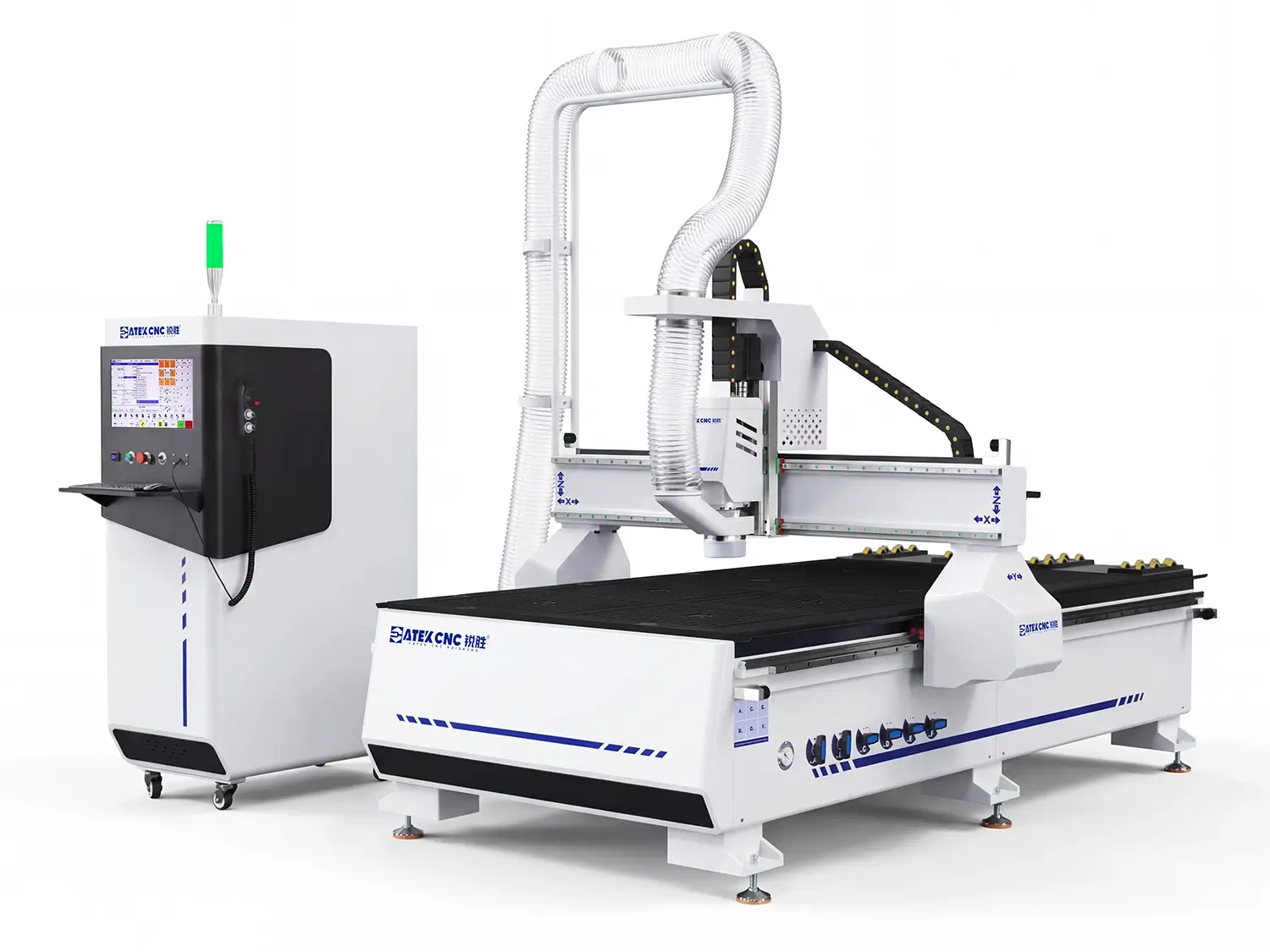
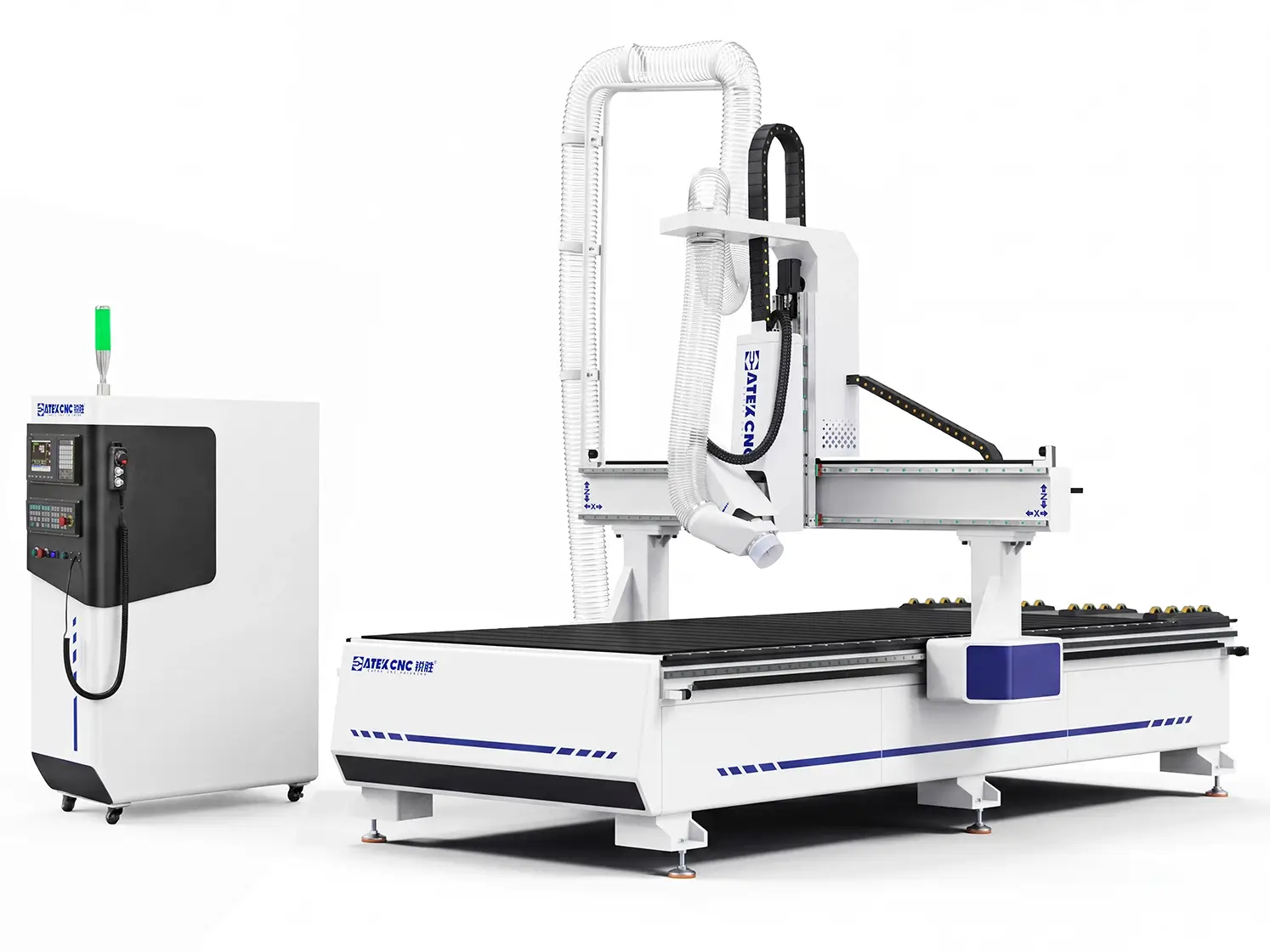
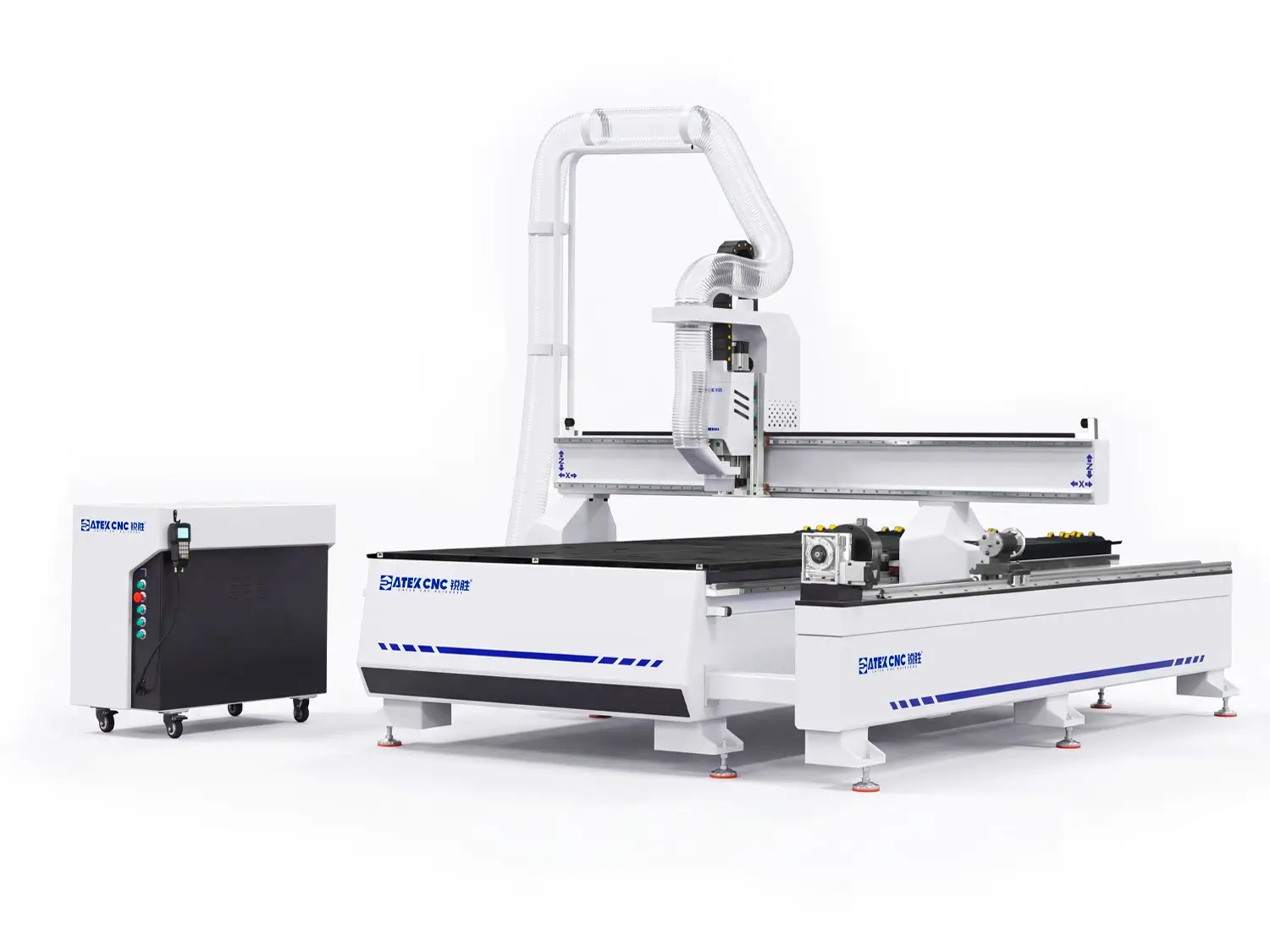
The Spire series is the high-end custom series of
CATEKCNC, featuring a completely redesigned exterior and mechanical
structure. It incorporates top-tier components from
first-tier suppliers and includes exclusive one-on-one
customer service.
Looks like you have not added anything to you cart. Goahead & explore top
categories.
{{goods.model}}
${{moneyFormat(goods.price * goods.num)}}
Total:
${{moneyFormat(total)}}
· Function Description ·
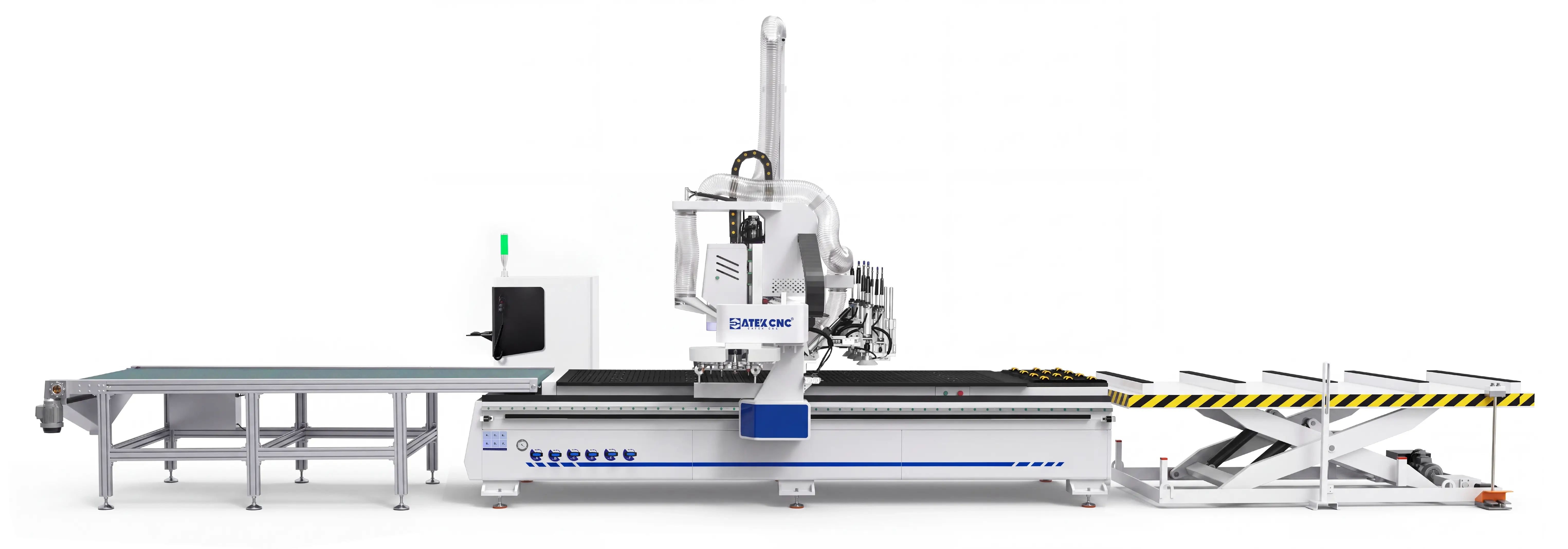
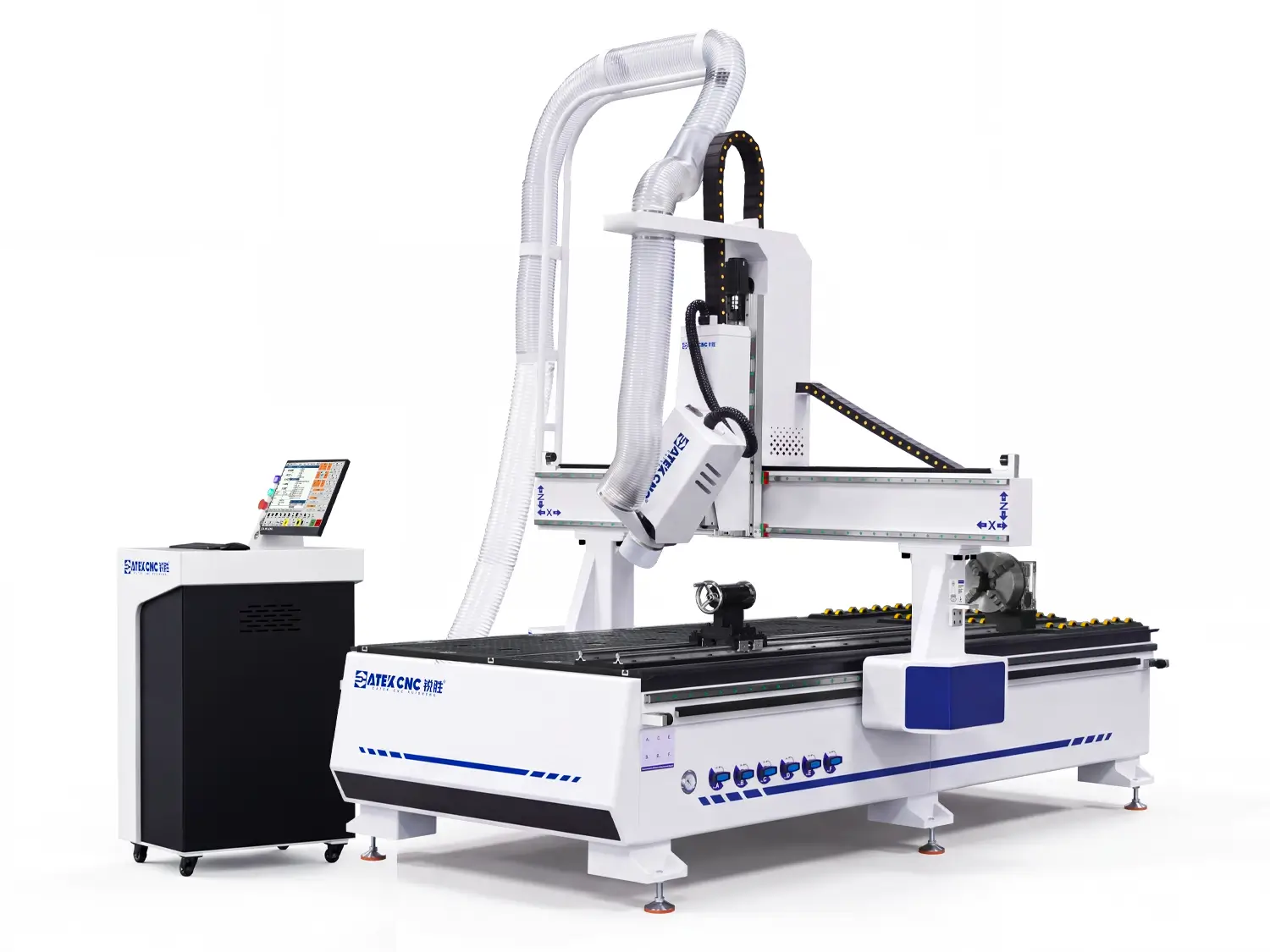
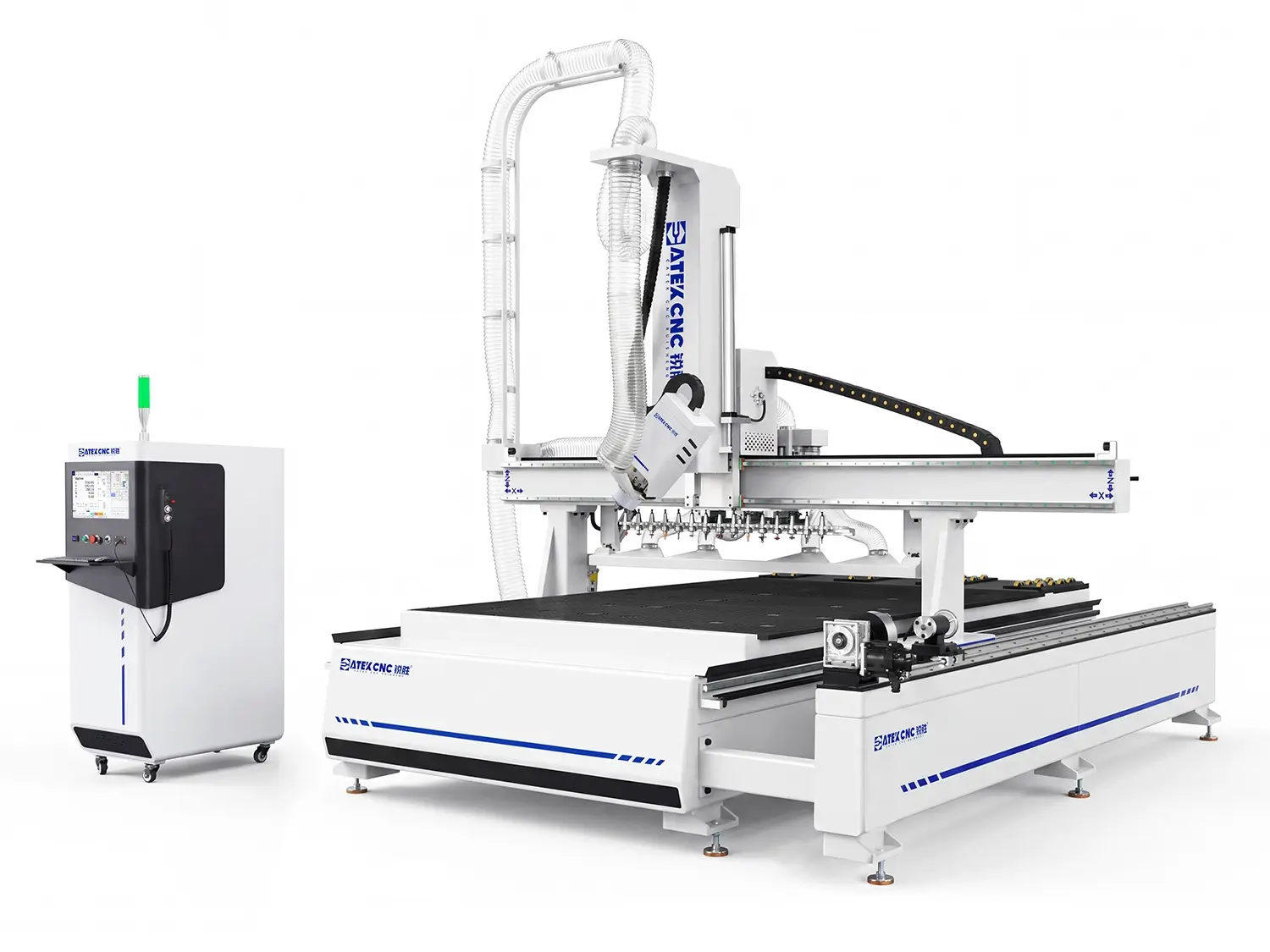
A New Member of the Spire Series! An ATC CNC Wood Router featuring a carousel-type tool changer, equipped with an automatic loading and unloading system and a drilling unit.
Integrating Multi-Process Machining and Automation for Seamless Workflow Coordination and
Enhanced Production Intelligence.
The CK-1531-RSP-AT-D is a
high-end Spire automatic CNC nesting machine designed for
modern panel furniture
manufacturing and whole-house customization. Integrating large-format panel machining,
multi-process capabilities, and automated production, it delivers greater manufacturing
efficiency and machining versatility. With a 1500 × 3100mm working area and a hybrid
worktable combining vacuum clamping and pneumatic pressure rollers, it accommodates panels
of various sizes and materials, including melamine-faced boards, MDF, and plywood. Equipped
with a 9kW automatic tool-changing spindle, a 16-position carousel tool magazine, and a 5+4
vertical drilling unit, the machine handles nesting, cutting, grooving, profiling,
engraving, and multi-position drilling in one setup. It efficiently processes wardrobe
doors, cabinet components, bookshelf panels, bathroom vanities, and other custom furniture
parts. Combined with a fully automatic loading and unloading system, it streamlines the
entire workflow from panel picking and loading to positioning, machining, and finished-panel
transfer, significantly reducing manual handling and repetitive operations while advancing
automated, continuous production.
From its core components to overall construction, the
CK-1531-RSP-AT-D is engineered for high efficiency,
operational stability, and long-term
production. Its reinforced heavy-duty structure, precision transmission system, and
high-quality industrial components help maintain consistent machining performance under
heavy loads and extended operation, ensuring smoother multi-process machining and more
reliable batch production. Beyond machining performance, the machine is backed by
comprehensive long-term support. As a premium Spire series
model, it includes a five-year
free warranty and dedicated one-on-one after-sales service, covering installation,
commissioning, operator training, maintenance guidance, and software upgrades. From initial
setup to ongoing production support, professional service helps minimize operational
concerns, improve productivity, and optimize manufacturing workflows for greater
competitiveness.
Core Advantages of Spire 1531
Automatic CNC Router: Four Dimensions to Reshape the Standards of
High-Efficiency Production
The CK-1531-RSP-AT-D combines vacuum clamping with
dual-rod independent pneumatic pressure rollers, providing a versatile
workholding solution across its 1500 × 3100mm working area. Operators can select
the appropriate clamping mode according to panel size, shape, and machining
requirements. Zoned vacuum clamping generates negative pressure through the
worktable to hold panels securely, while pneumatic pressure rollers apply
downward force to help prevent panels from lifting or shifting during machining.
Both systems can work together or independently, offering greater flexibility
for different applications. This setup accommodates a wide range of sheet
materials, including melamine-faced boards, MDF, and plywood, and is ideal for
machining wardrobe doors, cabinet side panels, furniture shelves, and other
custom panel furniture components.
02.
Automatic Tool Changing & 5+4
Drilling Unit, Coordinated Multi-Process Machining for Greater
Efficiency
Equipped with an HSD 9kW automatic tool-changing
spindle, a 16-position carousel tool magazine, and an HQD 5+4 vertical drilling
unit, the CK-1531-RSP-AT-D integrates multiple
machining operations into one machine. The ATC spindle automatically selects the
required tools according to the machining program to perform panel nesting,
cutting, grooving, profiling, contour engraving, and precision machining. The
5+4 drilling unit provides nine drilling positions for common operations such as
connector holes, shelf-pin holes, and positioning holes, without occupying the
main spindle. By allowing the spindle and drilling unit to handle their
respective tasks simultaneously and efficiently, the machine reduces process
changeover and waiting time, making it well suited for multi-process batch
production of panel furniture, including wardrobes, kitchen cabinets, bookcases,
bathroom vanities, and office furniture.
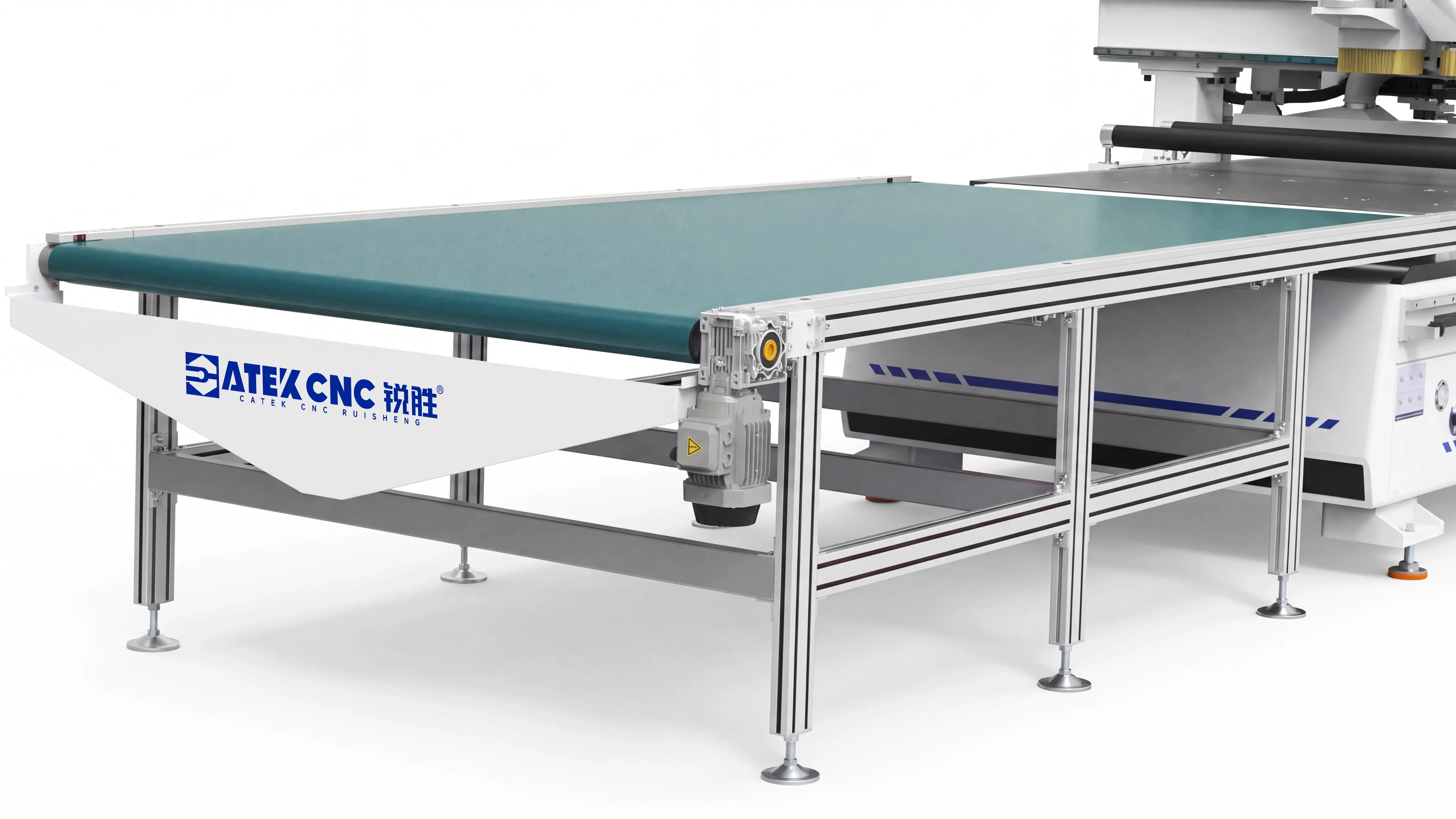
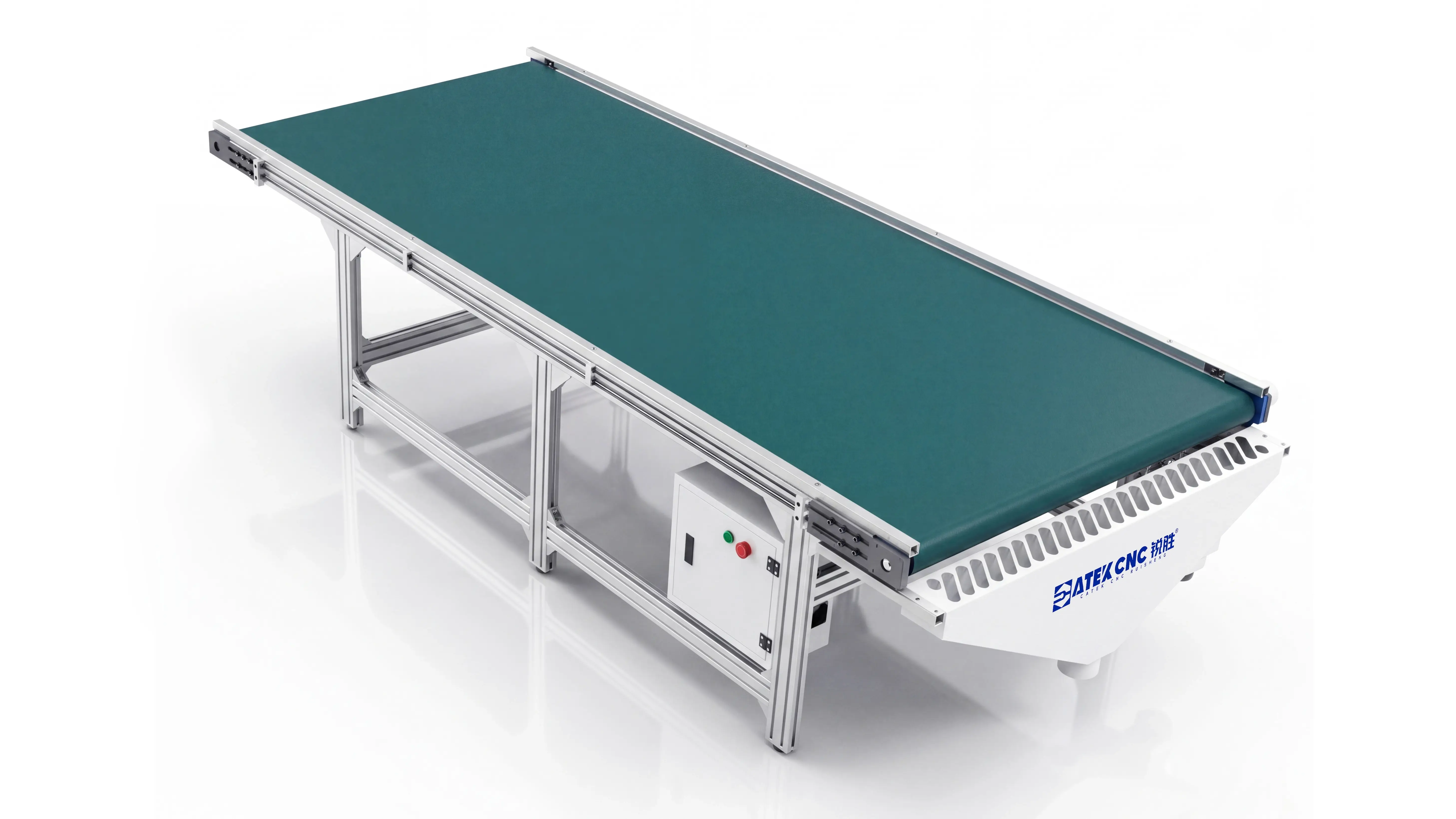
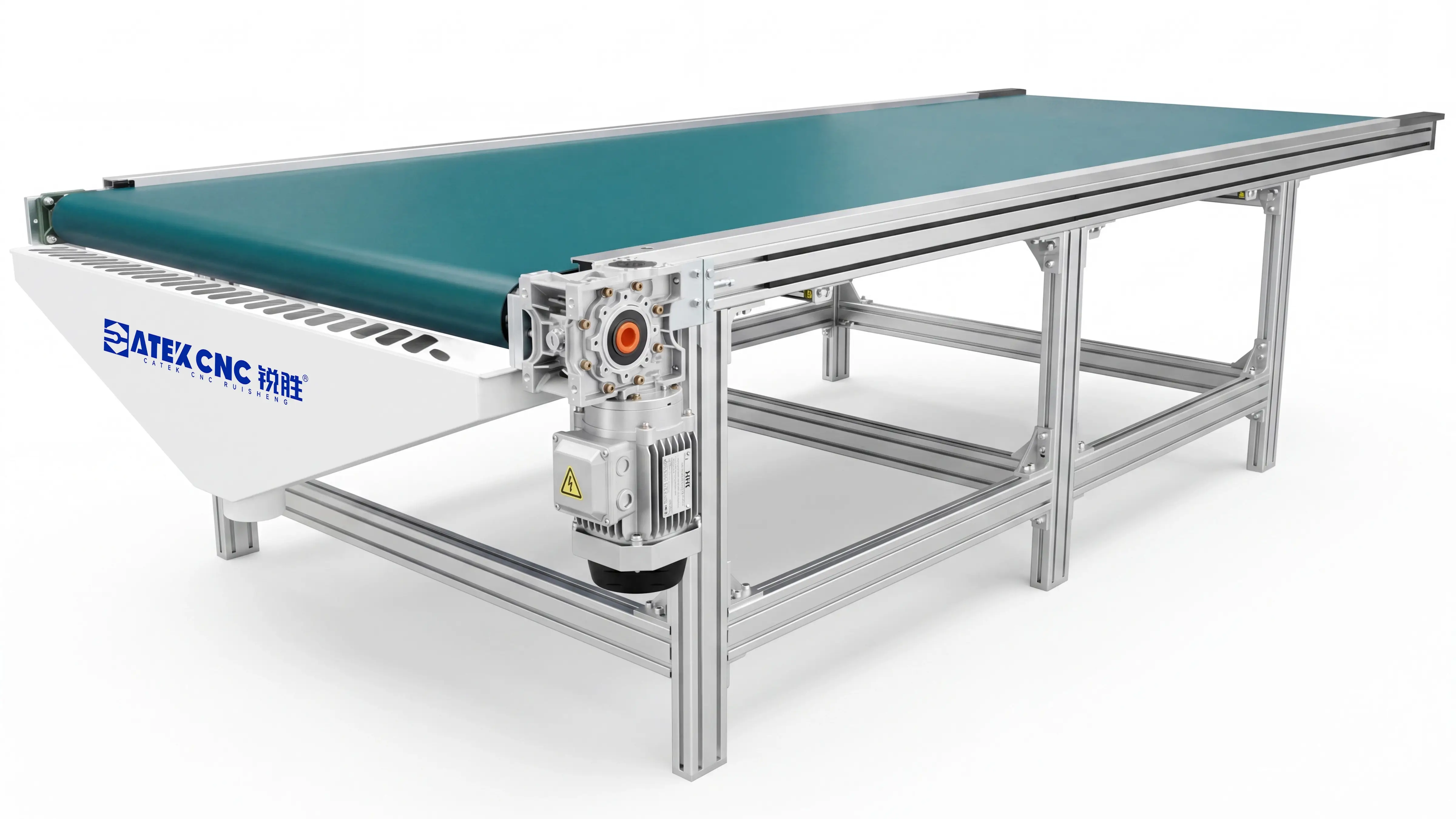
The machine integrates a hydraulic lifting loading
platform, vacuum suction cups, auxiliary conveyor rollers, and a belt-type
automatic unloading platform to enable continuous operation from panel pickup
and loading to positioning, machining, and finished-panel unloading. During
operation, the vacuum suction cups automatically pick up panels and transfer
them to the machining area. Once machining is complete, a rear-mounted pushing
mechanism moves the finished panels onto the conveyor platform, where the
conveyor belt automatically transfers them away while preparing for the next
panel to be loaded and processed. The entire workflow is coordinated by the CNC
control system, significantly reducing manual panel lifting, handling, and
loading/unloading operations. This lowers labor intensity and staffing
requirements, making the system particularly suitable for whole-house
customization, panel furniture factories, and high-volume production.
From the machine structure and core components to
auxiliary functional modules, the CK-1531-RSP-AT-D is equipped with high-quality
industrial-grade components and optimized for demanding, long-hour, and
high-volume production, balancing machining performance, operational stability,
and service life. The machine comes with a five-year free warranty, backed by a
professional technical support team providing installation and commissioning,
operator training, troubleshooting, maintenance guidance, and ongoing technical
assistance to help reduce equipment operation and maintenance costs.
Full-machine customization is also available, allowing the working dimensions,
functional modules, automation solutions, and equipment specifications to be
tailored to the customer's materials, product types, production volume, and
machining requirements, creating a machining solution that better fits actual
production needs.
Choosing the Spire 1531
Automatic CNC Router means
choosing
Wider Range of Applications
The 1500 × 3100mm working area accommodates various panel
sizes and materials, making the machine suitable for whole-house customization,
panel furniture manufacturing, and a wide range of custom wood products.
Greater Process Integration
The automatic tool-changing spindle, 16-position carousel
tool magazine, and 5+4 vertical drilling unit combine cutting, grooving,
profiling, engraving, and drilling in one machine, reducing the need for process
transfers between multiple machines.
More Efficient Production Workflow
Automated panel pickup and loading, followed by machining
and push-out unloading, creates a seamless production flow. This reduces manual
handling and repetitive operations while improving batch production efficiency.
Reliable Long-Term Operation
Built with high-quality industrial-grade components, the
machine supports full-configuration customization and comes with a five-year
free warranty and professional after-sales service to meet different factory
production plans and long-term operating requirements.
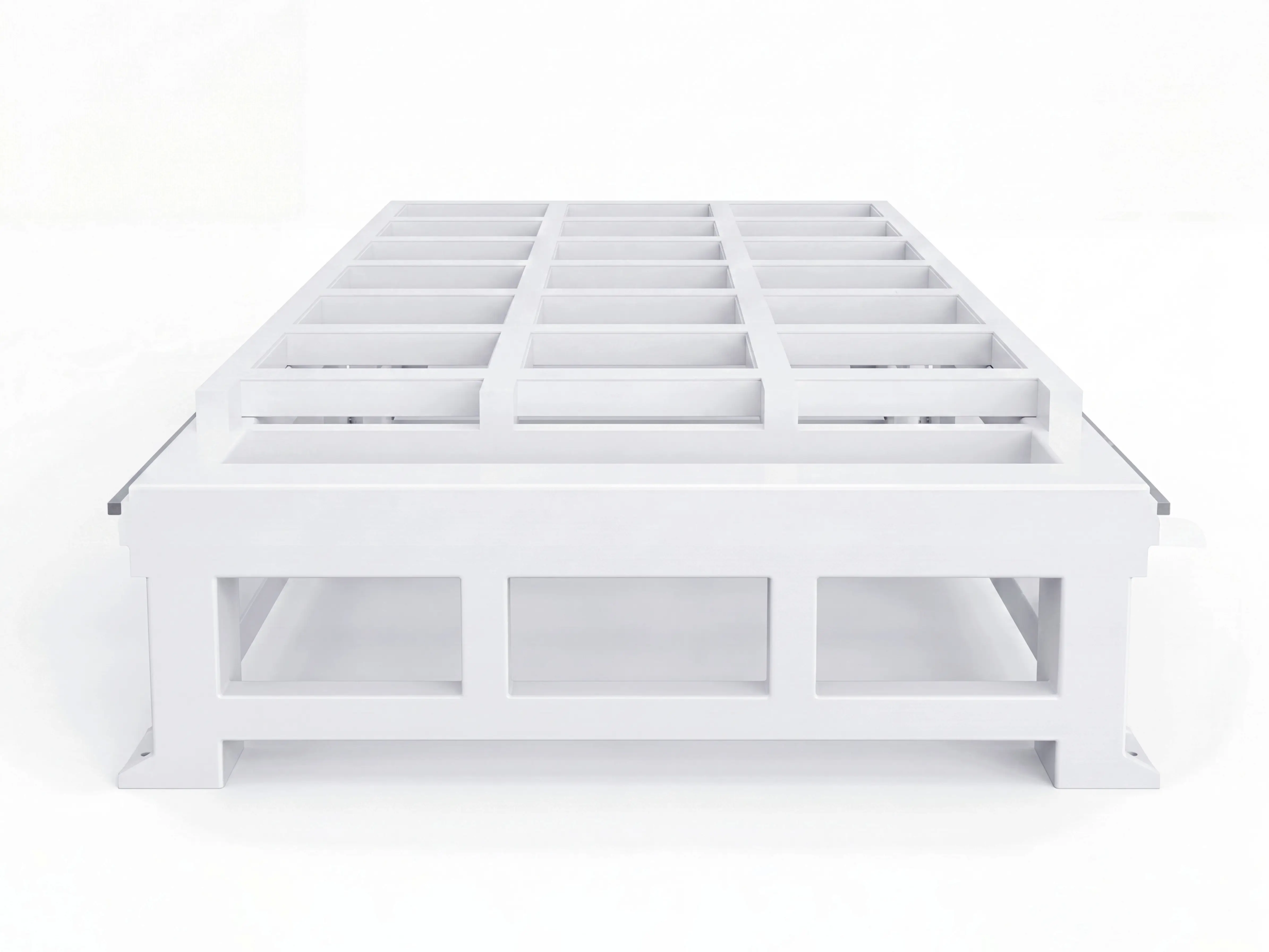
Heavy-Duty Bed Structure and Ultra-Rigid Gantry Ensure Stable Machining.
Spire
1531 Exclusive Heavy-Duty Custom Machine Bed Spire
The Spire 1531
Automatic CNC Router features an exclusive
heavy-duty machine bed, specially engineered for its 1500 ×
3100mm working area and automated production requirements.
The frame is constructed from thick-walled carbon steel
tubing with a reinforced welded structure. Combined with
Spire-specific
structural optimization and AI-based
simulation, the design optimizes load distribution, frame
layout, and critical support areas. Thickened steel strips
reinforce the guide rail and rack mounting positions, while
a continuous thick steel plate covers the bed surface,
further improving rigidity and resistance to deformation.
This robust construction effectively reduces vibration under
heavy machining loads, providing stable support for
large-panel machining and extended operation.
To ensure long-term structural stability and mounting
precision, the welded bed undergoes both vibration stress
relief and annealing to release residual welding stresses
and minimize deformation under continuous loads. A large
five-axis gantry milling machine is then used to precisely
machine critical mounting surfaces for the linear guides and
racks, ensuring flatness, straightness, and positional
accuracy. These processes help maintain precise component
installation and reduce the impact of structural errors on
overall machining accuracy.
The bed is supported by six heavy-duty legs, which
distribute loads evenly and enhance stability during
machining and automated loading and unloading. Whether
processing large panels or operating continuously with the
hydraulic loading platform and belt-type unloading conveyor,
the reinforced structure provides reliable load-bearing
support. The entire bed is finished with a durable powder
coating that offers excellent rust, wear, and scratch
resistance, helping protect the surface from dust, oil, and
other industrial contaminants while extending service life.
The Spire 1531
automatic CNC router features a heavy-duty
reinforced gantry, consisting of a thickened high-strength
beam and reinforced vertical uprights on both sides.
Specially engineered for its 3100mm machining travel and
demanding continuous operation, the beam features an
integrated reinforced structure made from thickened steel,
with additional steel strips welded along the guide rail and
rack mounting areas to strengthen critical load-bearing
sections and resist deformation. The uprights are
constructed from thick steel plates and heavy-duty square
tubing, with additional diagonal braces forming a stable
triangular support structure. This improves bending and
torsional resistance, enhances overall gantry rigidity, and
reduces vibration during high-speed movement and heavy-duty
machining.
To ensure precise assembly and long-term operational
stability, the beam-to-upright and gantry-to-bed interfaces,
along with other critical mounting positions, undergo
precision machining on a large gantry milling machine. The
mounting reference surfaces for the linear guides, racks,
and uprights are machined to maintain flatness,
straightness, and positional accuracy. This unified datum
machining process helps minimize cumulative machining errors
and assembly deviations, ensuring more precise connections
between the beam, uprights, and machine bed. Combined with
the high-strength welded structure, it provides consistent
structural alignment and rigidity for accurate, stable
operation.
The beam and uprights also receive an integrated powder
coating finish, forming a uniform, durable protective layer
with resistance to oil, water, static buildup, and rust.
This coating helps protect metal surfaces from wood dust,
machining contaminants, and moisture while improving wear
and scratch resistance. Combined with thickened steel
construction, diagonal reinforcement, and precision-machined
mounting surfaces, the gantry delivers high strength,
rigidity, and durability for large-format machining and
extended automated production.
The Spire 1531
automatic CNC router features an extra-thick,
heavy-duty Z-axis mounting plate manufactured from a single
piece of high-strength aerospace-grade aluminum alloy.
Precision-machined on a large milling machine, the plate
reaches an impressive thickness of 70mm, more than three
times that of conventional CNC router Z-axis plates. Its
one-piece construction eliminates potential gaps and weak
points associated with assembled structures, significantly
improving overall rigidity, bending resistance, and
dimensional stability. Specially reinforced to support the
9kW heavy-duty ATC spindle and automatic drilling unit, it
provides a solid mounting foundation while reducing
vibration under high-speed movement and machining loads.
Beyond structural strength, the Z-axis plate is designed to
balance rigidity with lightweight dynamic performance.
Aerospace aluminum alloy offers a high strength-to-weight
ratio, delivering the rigidity of a 70mm-thick structure
while weighing less than a comparable steel plate. This
helps reduce the overall moving mass and drive load of the
Z-axis. Combined with its rigid one-piece construction, it
enables smoother movement during rapid lifting, frequent
starts and stops, and automatic tool changes, while
minimizing the impact of inertia on positioning accuracy.
The precision-machined mounting surface also provides an
accurate reference for spindle installation, helping improve
Z-axis stability, positioning performance, and lifting
control.
To further enhance surface performance and service life, the
aluminum plate undergoes both sandblasting and anodizing.
Sandblasting creates a uniform, refined surface texture,
while anodizing forms a dense protective oxide layer that
improves surface hardness, wear resistance, and corrosion
resistance. These treatments help protect the plate from
dust, oil, and wear during long-term operation. Combining a
70mm one-piece structure with advanced surface finishing,
the Z-axis plate delivers high rigidity, lightweight
movement, and industrial-grade durability for demanding
continuous machining.
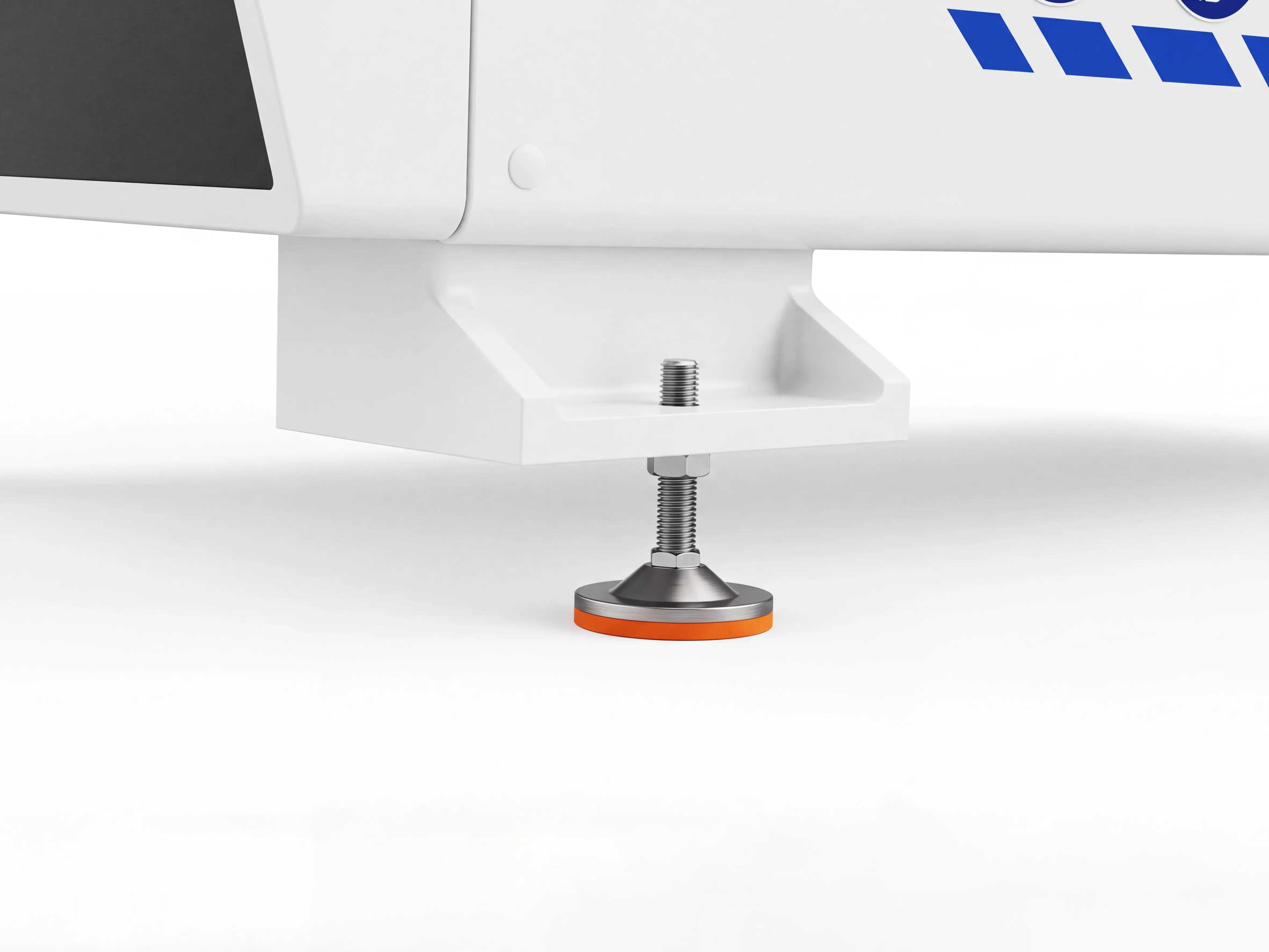
Heavy-Duty Adjustable Support Feet
The Spire 1531
automatic CNC router is equipped with six
high-strength, heavy-duty adjustable support feet, each
aligned with one of the six machine bed support legs to form
a stable multi-point load-bearing structure. Each foot
features a one-piece high-strensgth carbon steel threaded
rod, eliminating potential loosening associated with
segmented connections while providing excellent compression
resistance, wear resistance, and load capacity. With each
foot supporting over 1,000kg, the six evenly distributed
support points effectively spread the weight of the machine
and machining loads, reducing localized stress and ensuring
stable support for long-term operation.
The support feet are made from high-quality carbon steel,
with electroplated threaded rods for improved rust and
corrosion resistance. Standardized threads feature uniform
pitch and deep grooves, allowing smooth adjustment with even
force distribution while minimizing slipping or jamming.
Matching zinc-plated adjustment nuts provide additional
corrosion protection and durability, ensuring reliable
adjustment and secure connections under continuous loads.
Each support foot is fitted with a thickened TPU anti-slip
pad made from highly resilient, wear-resistant material. It
offers excellent grip, tear resistance, and fatigue
resistance, helping prevent cracking and premature aging.
The pads increase friction between the machine and the
floor, reducing movement during operation. All six feet can
be adjusted independently to compensate for uneven floors
and height differences, keeping the machine bed level and
preventing uneven loading or operational deviations. This
provides a stable foundation for large-format panel
machining and extended automated production.
Click the icon labels to view different
machine
parts
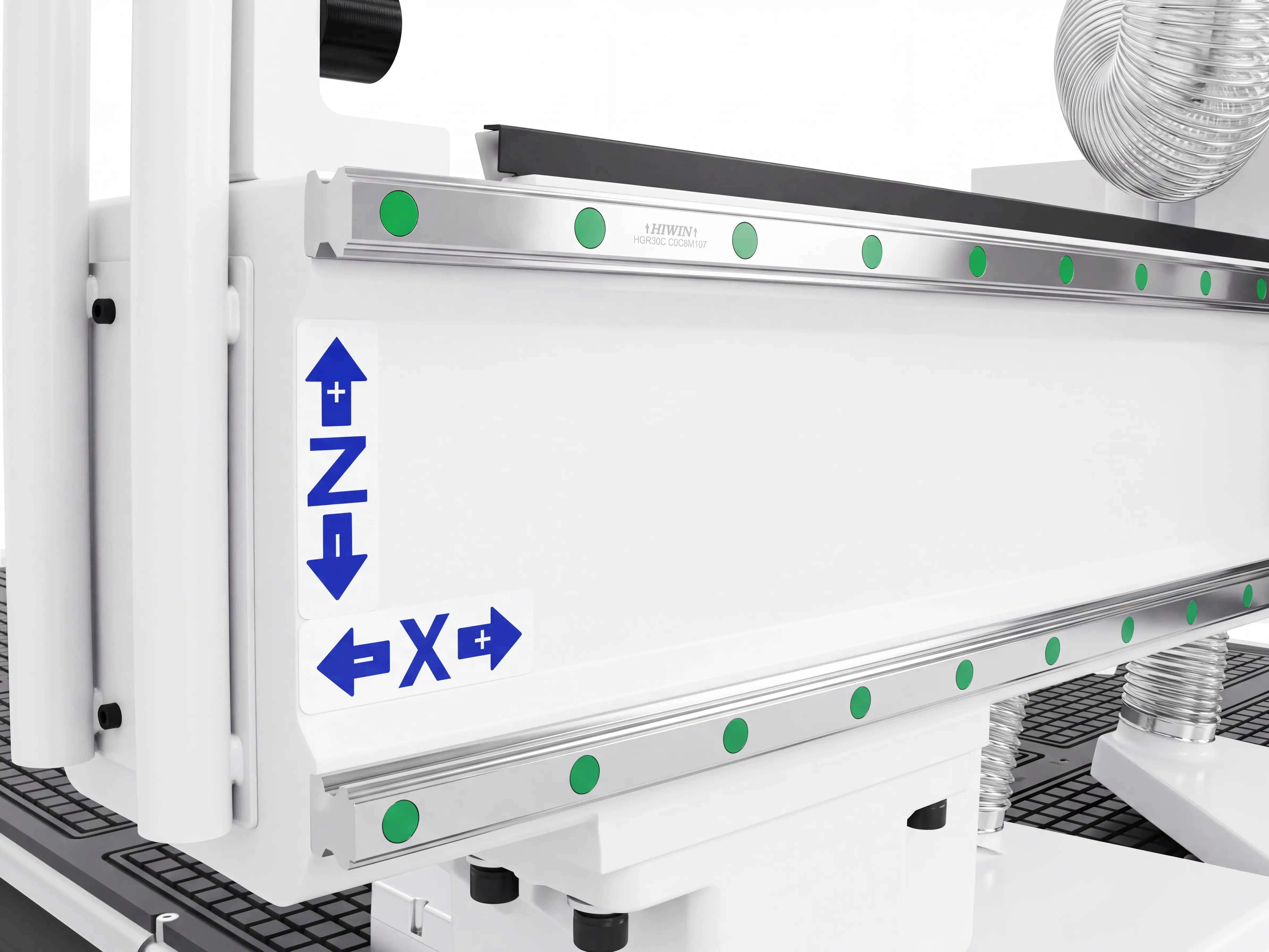
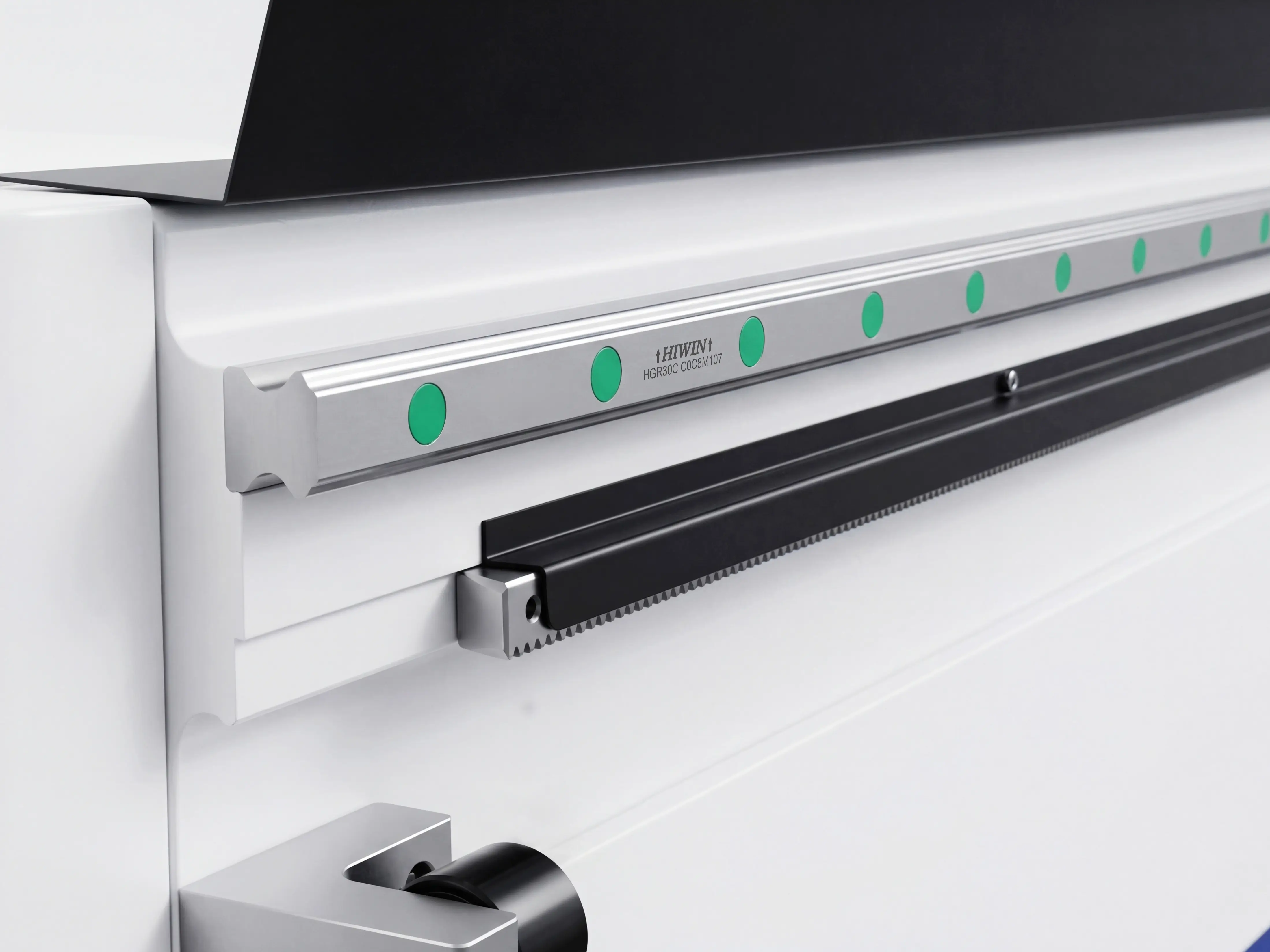
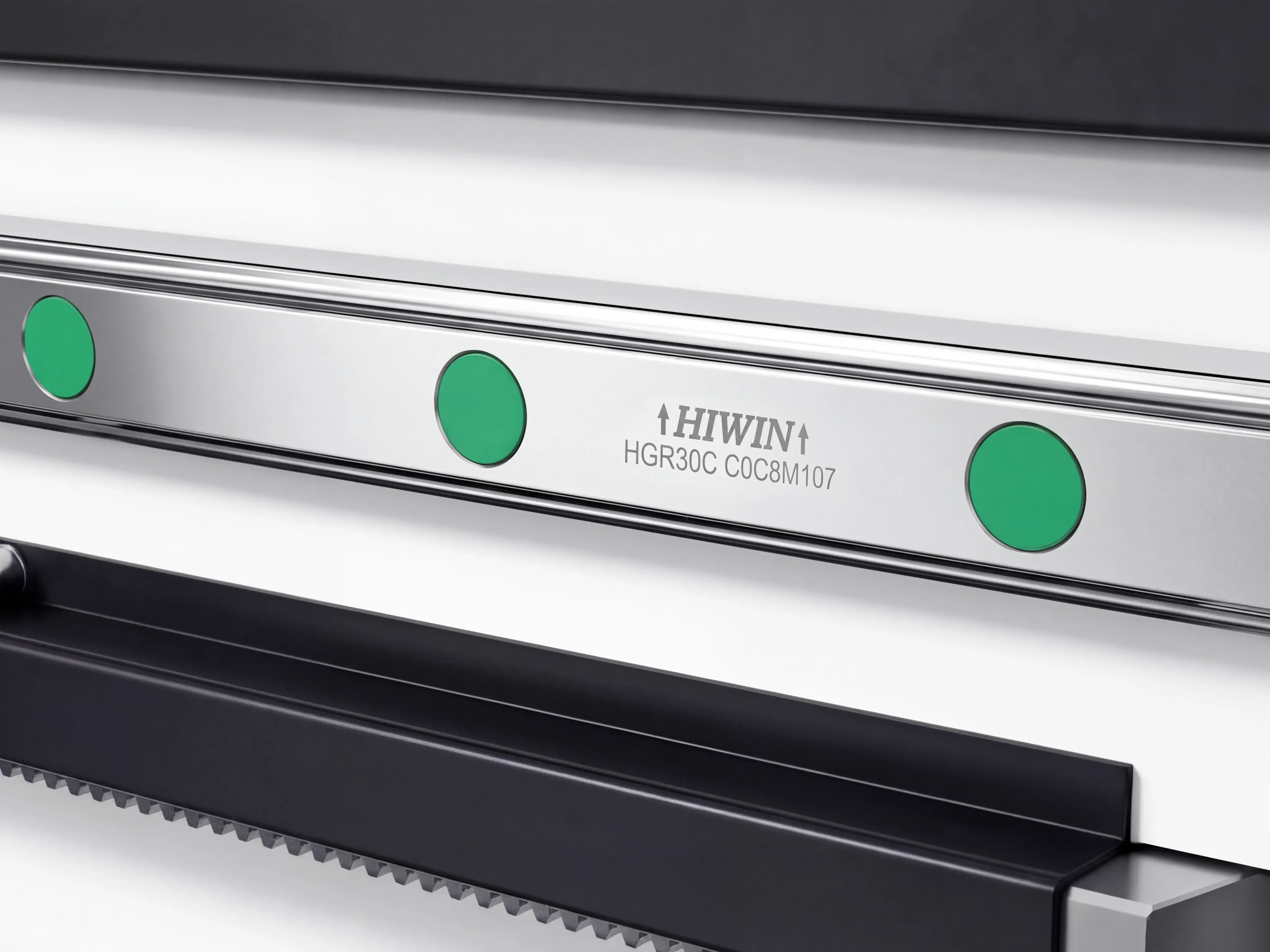
HIWIN Taiwan 30mm High-Rigidity
Linear Guides & Blocks
The Spire 1531
automatic CNC router features 30mm heavy-duty
HIWIN HG-series linear guides and matching blocks across all
three XYZ axes, designed for large-format machining, heavy
cutting loads, and continuous operation. The four-row
circular-arc groove design, combined with four rows of steel
balls and a 45° contact angle, provides equal load capacity
in four directions with high radial and lateral rigidity.
Made from imported bearing steel and precision-machined for
durability, the guides offer excellent wear resistance and
load capacity, providing reliable support for high-power
spindle operation and large-panel machining.
The HG-series guides feature automatic self-alignment,
allowing the steel balls inside the blocks to compensate for
minor mounting errors and reduce the impact of installation
deviations on motion accuracy. Their four-row rolling
contact structure maintains stable contact under loads from
different directions, minimizing uneven loading. This design
also reduces friction and motion fluctuations, ensuring
smooth, stable movement during high-speed travel, frequent
positioning, and extended machining.
For convenient maintenance, the HG-series blocks feature a
ball retainer that helps prevent steel balls from falling
out during installation, removal, and servicing. Their
standardized design also provides good interchangeability,
simplifying component replacement. Precision raceways and
high-quality bearing steel balls help minimize wear and
extend service life. With heavy-duty linear guides across
all three axes, the Spire 1531 CNC
router achieves a balance of load
capacity, motion accuracy, and maintenance convenience for
demanding industrial production.
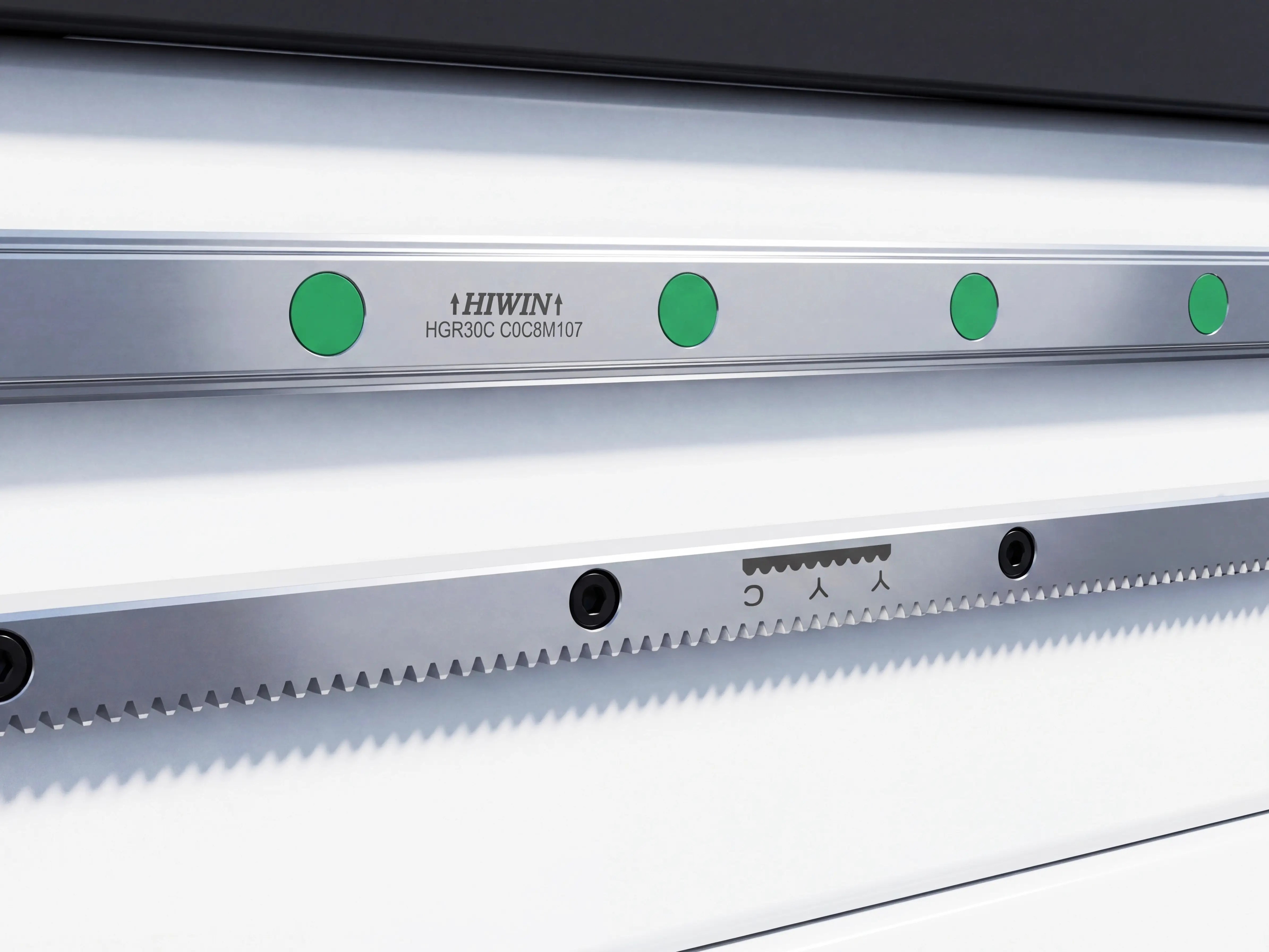
HIWIN Taiwan High-Precision Ground
Helical Racks
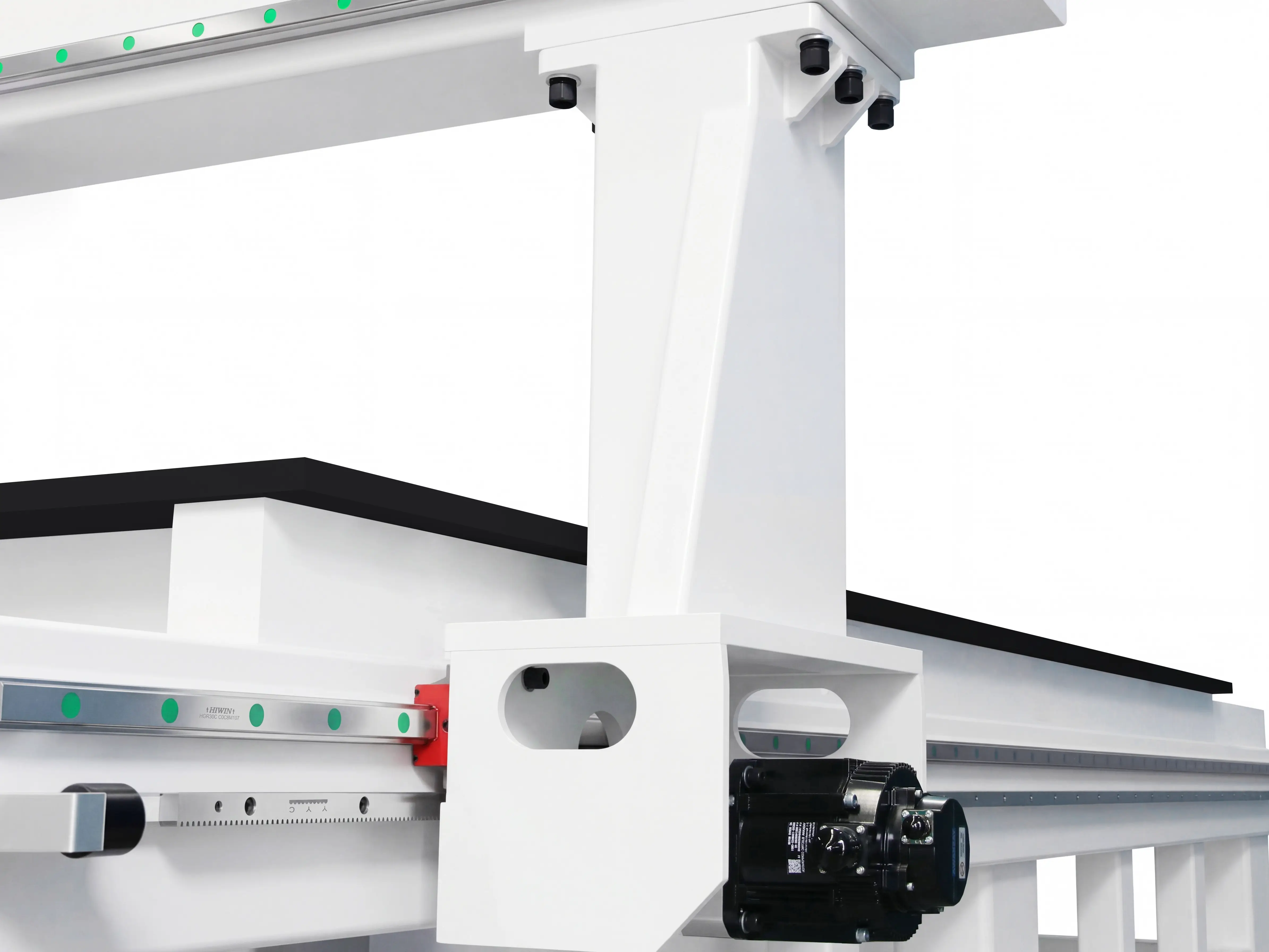
The Spire 1531
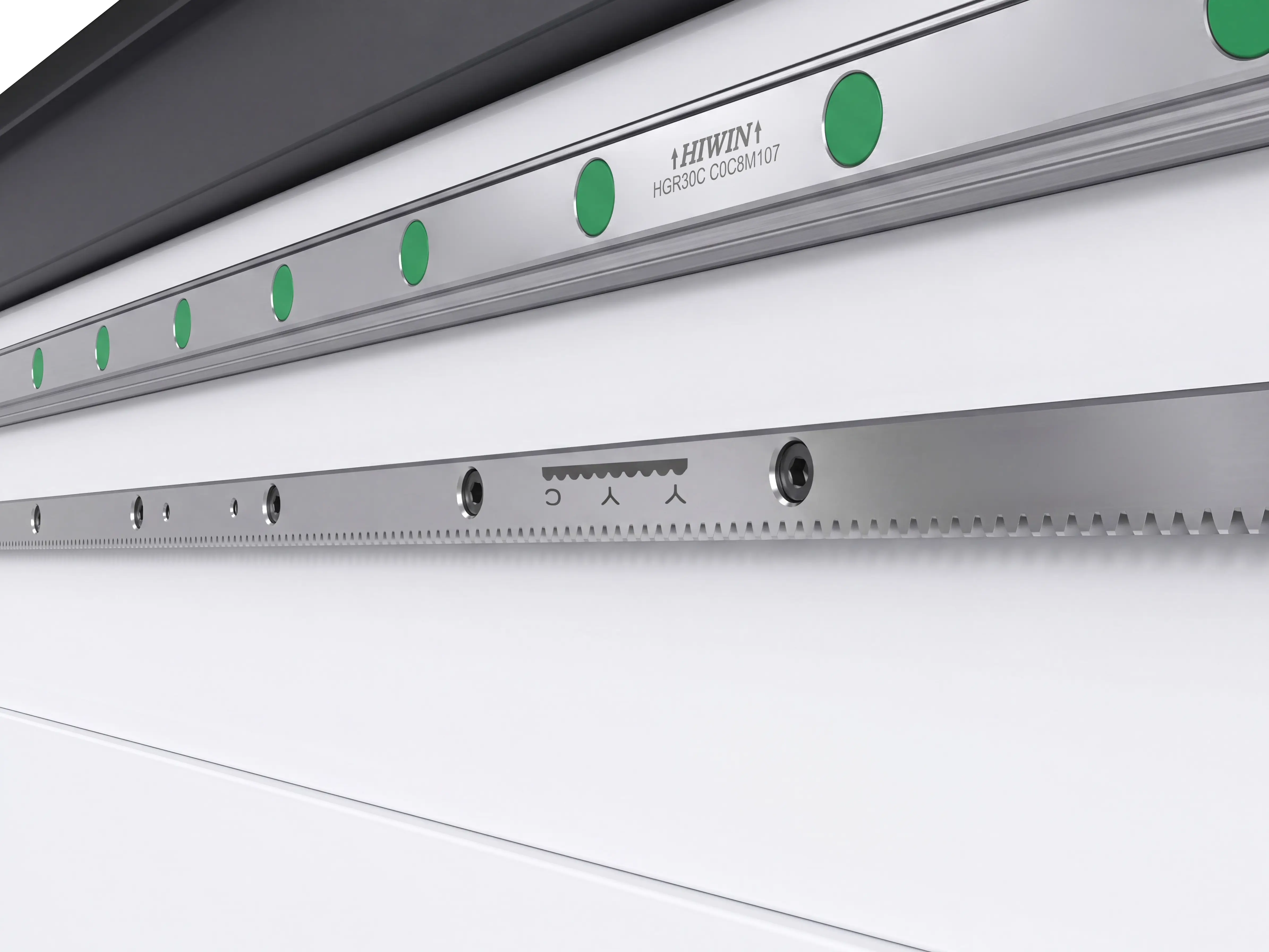
automatic CNC router uses CHTGH-DIN6
high-precision ground helical racks on the X and Y axes,
manufactured from S50C medium-carbon steel and
high-frequency hardened to achieve a tooth surface hardness
of HRC 50–55. This provides excellent strength, impact
resistance, and wear resistance. Featuring a 19°31′42″
right-hand helix angle and DIN-standard manufacturing, the
racks undergo heat treatment followed by precision grinding
on all four sides, ensuring dimensional accuracy and
consistent transmission performance for high-speed movement
and heavy-load machining.
Compared with straight racks, helical racks provide
smoother, more continuous gear engagement, reducing
transmission impact, vibration, and mechanical noise. Their
larger contact area improves load transmission capacity,
making them suitable for frequent acceleration,
deceleration, and high-torque operation. Precision-ground
tooth surfaces achieve Ra 0.8μm roughness, reducing friction
and improving transmission efficiency and service life.
The XY axes combine these high-precision racks with Japanese
SHIMPO precision reducers and 1.3kW Yaskawa absolute-encoder
bus servo motors. With a cumulative pitch error of Fp/1000 ≤
0.034mm per meter, the racks help maintain positioning
accuracy and repeatability. The coordinated drive system
delivers smooth, precise movement during rapid travel,
frequent direction changes, and continuous cutting,
supporting efficient, high-precision large-panel machining.
Taiwan TBI High-Precision Ground Ball
Screw
The Spire 1531
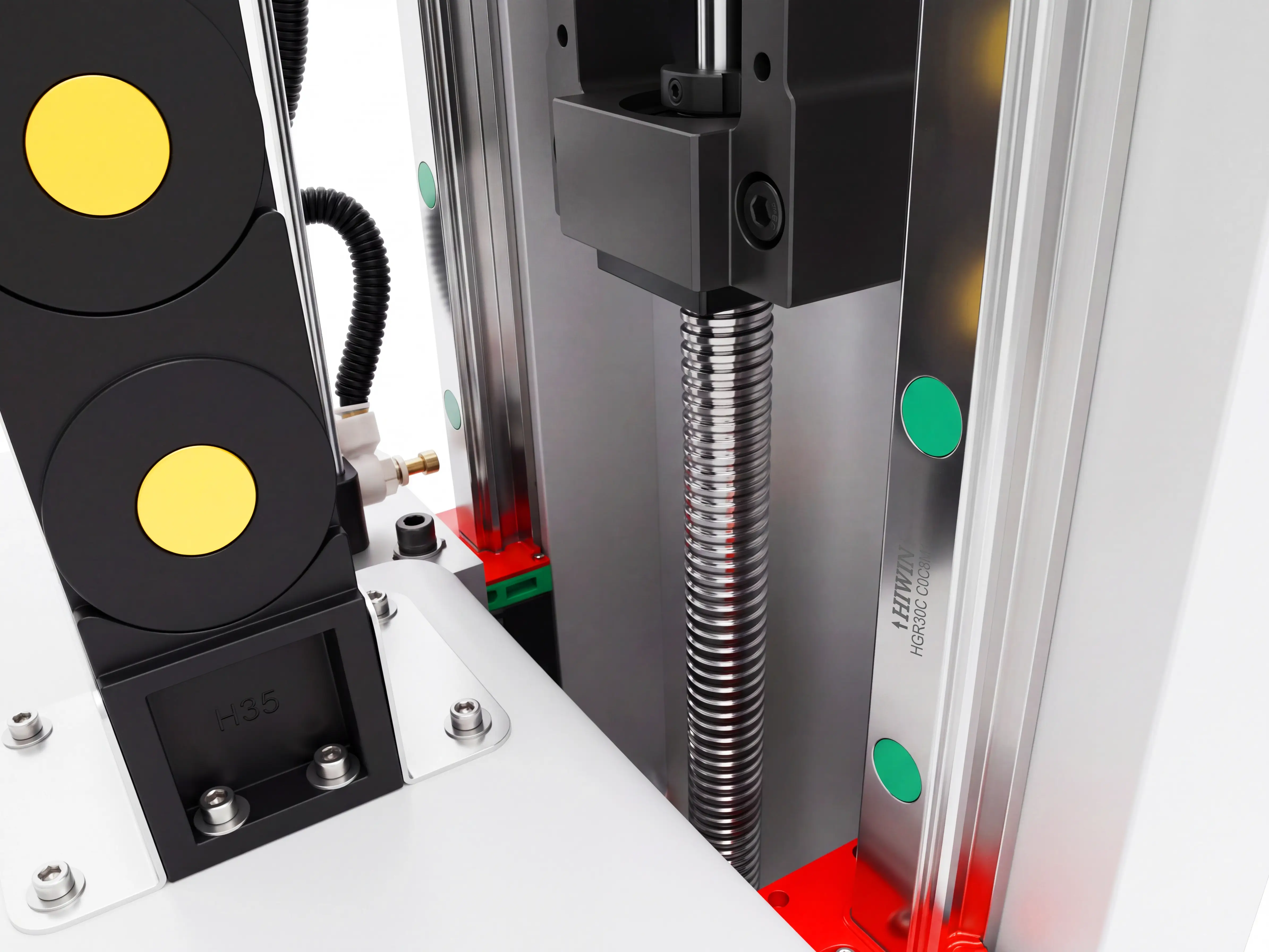
automatic CNC router uses a precision-ground TBI
ball screw on the Z-axis, featuring an internal ball
circulation design that integrates the return mechanism
inside the nut. This shortens the overall nut length, saves
installation space, and creates a more compact Z-axis
layout. Unlike conventional sliding lead screws, ball screws
transmit motion through rolling friction, requiring only
approximately one-third of the driving torque. This reduces
transmission resistance, drive load, and friction losses.
Combined with precision grinding, the screw delivers high
dimensional accuracy and consistent transmission for
frequent Z-axis movement, rapid positioning, and automatic
tool changes.
The high-precision rolling transmission structure supports
micro-feed movements and fine positioning adjustments, with
transmission accuracy reaching the 0.1μm level. Multiple
rolling contact points and a preloaded structure help
minimize backlash, improve axial rigidity, and enhance
motion response. Compared with sliding transmission, rolling
friction reduces energy loss and ensures smoother movement.
Even when supporting the 9kW ATC spindle and automatic
drilling unit, the Z-axis maintains stable and precise
lifting performance for high-accuracy panel machining and
continuous production.
To improve wear resistance and service life, the ball screw
uses G10-grade GCr15 bearing steel balls, offering high
dimensional precision, hardness, and wear resistance. The
screw nut is made from GCr53 high-carbon bearing steel and
undergoes high-frequency hardening to achieve a hardness of
HRC 58–62, enhancing raceway wear and fatigue resistance. A
metal deflector combined with the internal ball circulation
design enables continuous ball recirculation within the nut,
reducing circulation losses and supporting smooth,
consistent transmission.
High-Precision Aluminum Double-Diaphragm
Coupling
The Spire 1531
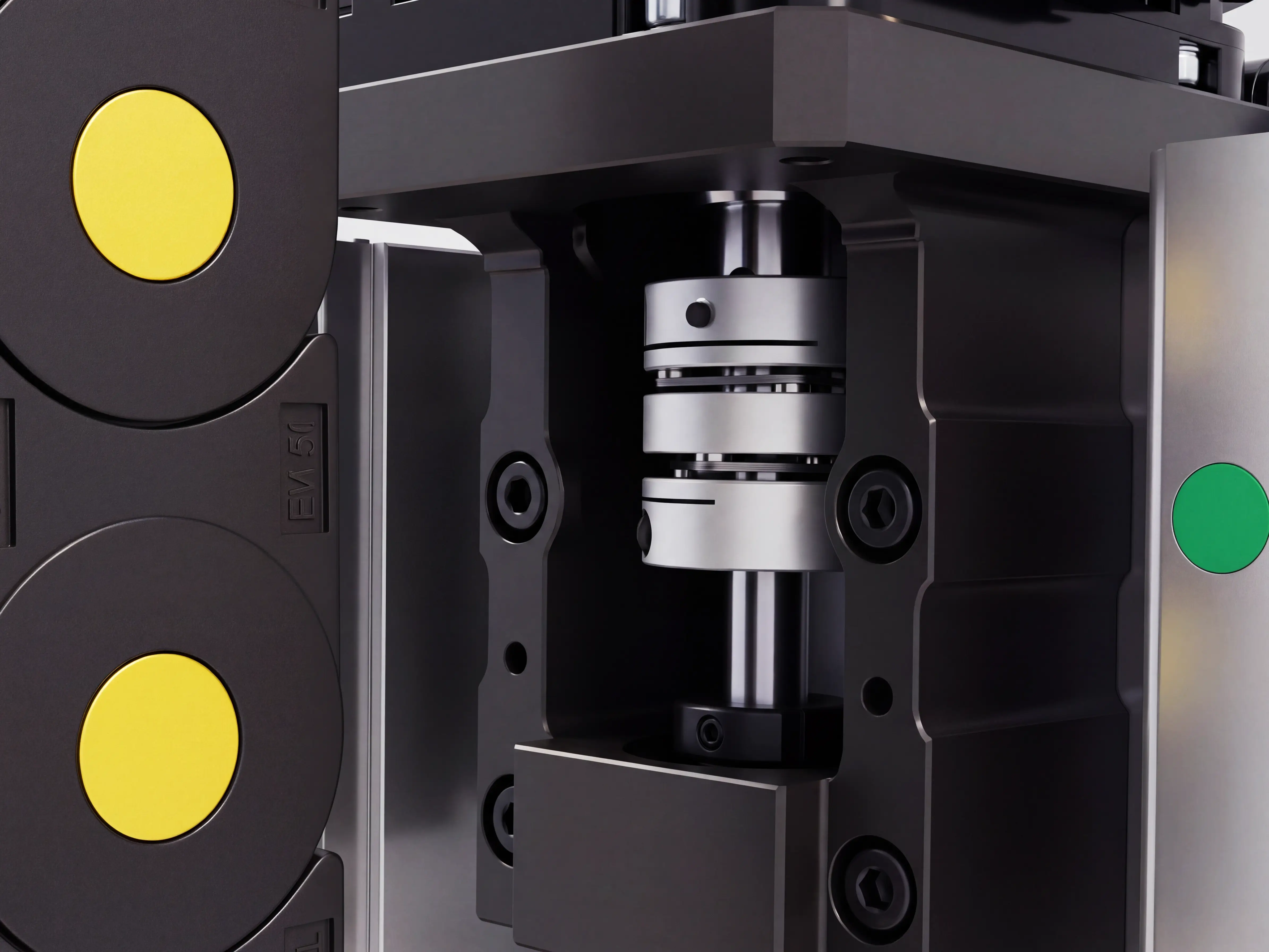
automatic CNC router Z-axis features a precision
double-diaphragm coupling that connects the ball screw to
the Japanese Yaskawa servo motor, ensuring accurate power
transmission. The coupling body is machined from a solid
block of 7075 aerospace-grade aluminum alloy, offering high
strength, hardness, and toughness while maintaining a
lightweight design. Its anodized surface provides enhanced
wear and corrosion resistance for long-term operation.
Two sets of 304 stainless steel flexible diaphragms
compensate for radial, angular, and axial misalignment
between the motor shaft and ball screw. The double-diaphragm
design combines high torsional rigidity with effective
misalignment compensation, making it suitable for precision
drive systems. Low reaction forces during radial
displacement help reduce additional loads on motor bearings
and screw supports. The metal diaphragms also offer
excellent fatigue resistance, require no lubrication, and
operate quietly without sliding friction or wear.
For reliable power transmission during high-speed operation
and frequent forward and reverse movements, the coupling
uses a dual locking system with clamping and set screws to
prevent loosening and slippage. Its symmetrical design
ensures consistent clockwise and counterclockwise
transmission, accurately transferring rotational movement
and speed. Compact, lightweight, and easy to install or
remove, it delivers high torsional rigidity, responsive
motion, and reliable long-term performance for the Z-axis
drive system.
Japanese SHIMPO High-Precision Planetary
Gear Reducers
The Spire 1531
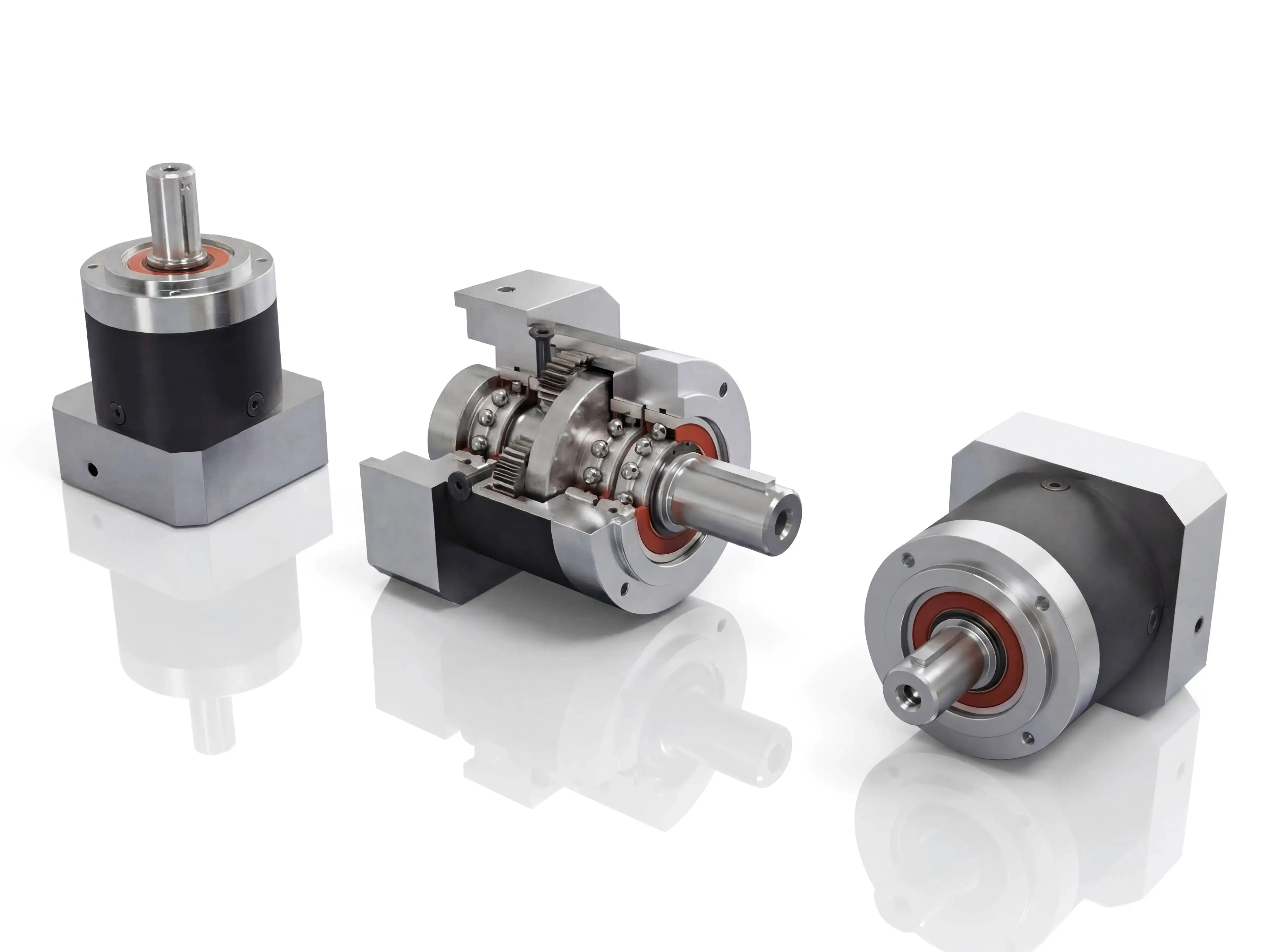
automatic CNC routeruses four Japanese SHIMPO
precision planetary gear reducers
across the XY axes and carousel automatic tool magazine,
designed for high-speed movement and heavy-load
transmission. Their precision helical gears are
professionally ground to ISO Grade 4 accuracy, while the low
backlash of just 0.05° (3 arcmin) minimizes transmission
errors and improves positioning accuracy. By optimizing
torque output and speed ratios, the reducers provide
responsive motion control for the XY axes and tool magazine,
supporting high-speed machining and efficient automatic tool
changes.
The gears are made from premium low-carbon alloy forged
steel and undergo carburizing and hardening to achieve a
tooth surface hardness of HRC 60, providing excellent wear
resistance and structural strength. A caged planetary
carrier is integrated with the output shaft to enhance
torsional rigidity and transmission stability. The planetary
gears use full-complement needle roller bearings without
cages, increasing load capacity and output torque. This
robust design maintains stable power transmission during
frequent starts, stops, acceleration, and reversing,
enabling faster positioning of the XY axes and quicker
carousel indexing to reduce machining downtime.
Featuring a sealed housing with IP65 protection, the
reducers effectively prevent dust and contaminants from
entering the transmission mechanism while minimizing
lubricant leakage. They are factory-filled with specialized
grease, providing up to 20,000 hours of maintenance-free
lubrication under specified operating conditions. With
operating noise of approximately 60dB, they deliver quiet
and smooth performance for extended industrial operation.
Precision gear grinding, advanced heat treatment, a rigid
planetary structure, and long-life lubrication combine to
provide low backlash, high load capacity, and reliable
long-term performance for the Spire
1531
automatic CNC router.
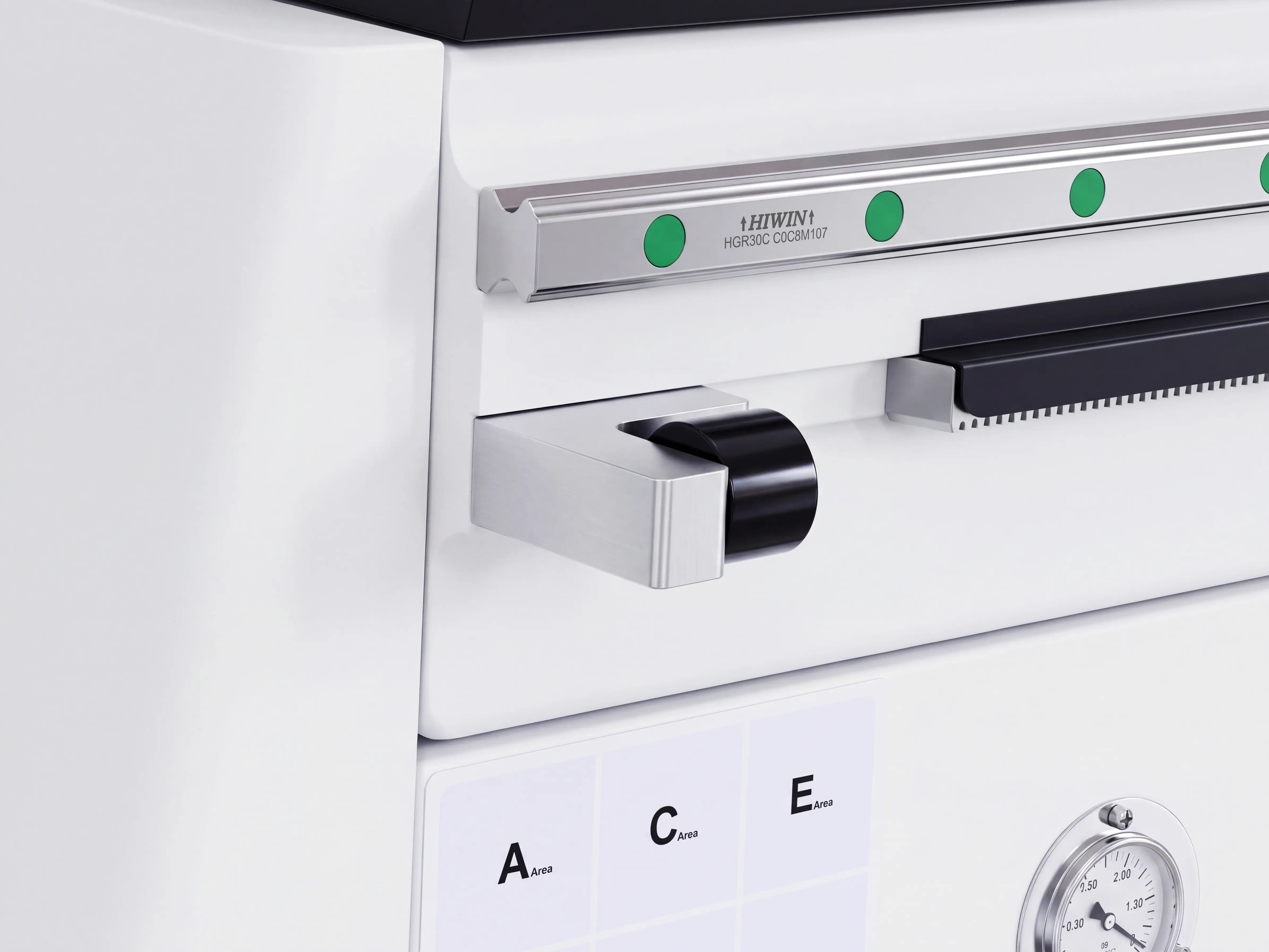
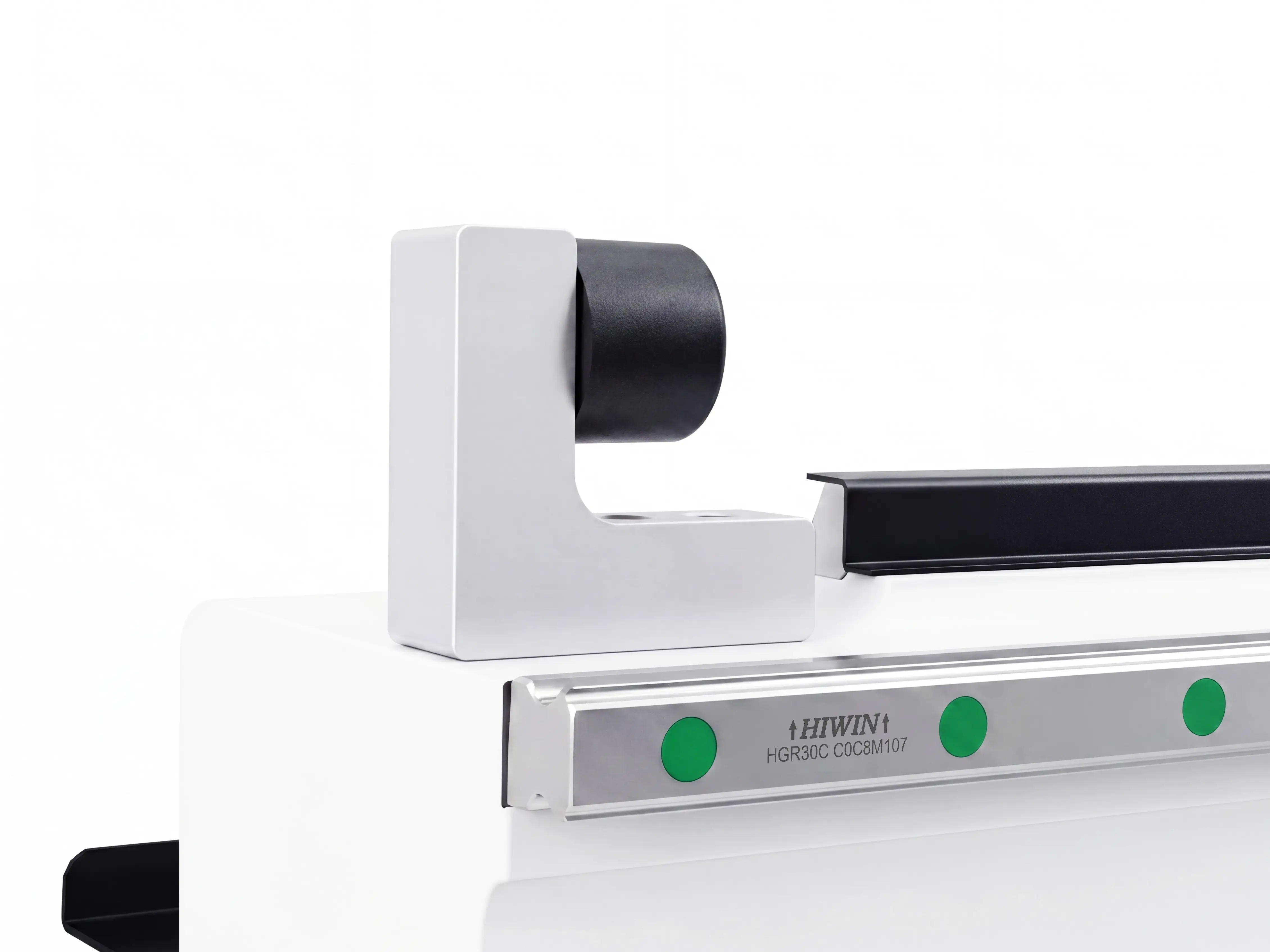
The X and Y axes are equipped with high-strength, one-piece
aluminum alloy collision stops featuring an L-shaped design.
Machined from solid aluminum alloy, the integrated structure
reduces connection points and provides greater rigidity and
impact resistance. Each stop is fitted with a highly elastic
TPU buffer pad that absorbs impact through elastic
deformation, helping protect the mechanical structure from
accidental collisions.
In addition to mechanical collision protection, all three
XYZ axes feature high-precision photoelectric limit sensors
for real-time position detection. When a moving component
approaches its preset travel limit, the sensors send
position signals to the control system to trigger the
corresponding limit protection and prevent movement beyond
the normal operating range. Their non-contact detection
method offers fast response, reliable sensing, and long
service life, making them suitable for high-speed movement
and frequent reciprocating operation.
The mechanical collision stops and photoelectric sensors
work together to provide dual travel protection through
electronic detection and mechanical buffering. The sensors
detect travel boundaries in advance and provide position
feedback, while the aluminum alloy stops offer additional
mechanical protection in abnormal situations. Combined with
the impact-absorbing TPU pads, this system helps reduce the
risk of damage to linear guides, blocks, and other critical
motion components, improving overall operating safety and
mechanical durability.
Click the icon labels to view different
machine
parts
HSD ATC Spindle + 5+4 Drilling Unit, Meeting Diverse
Machining Requirements.
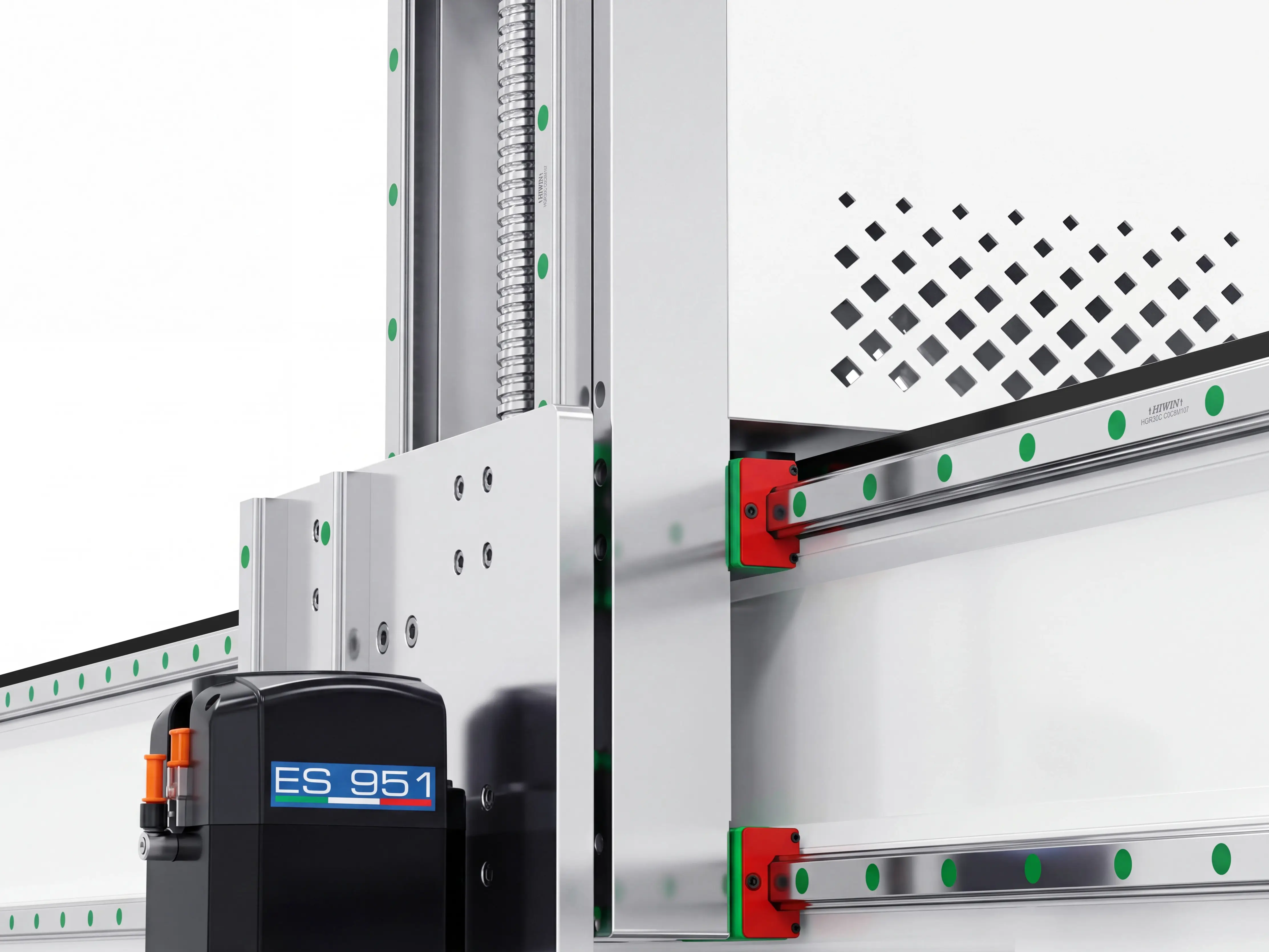
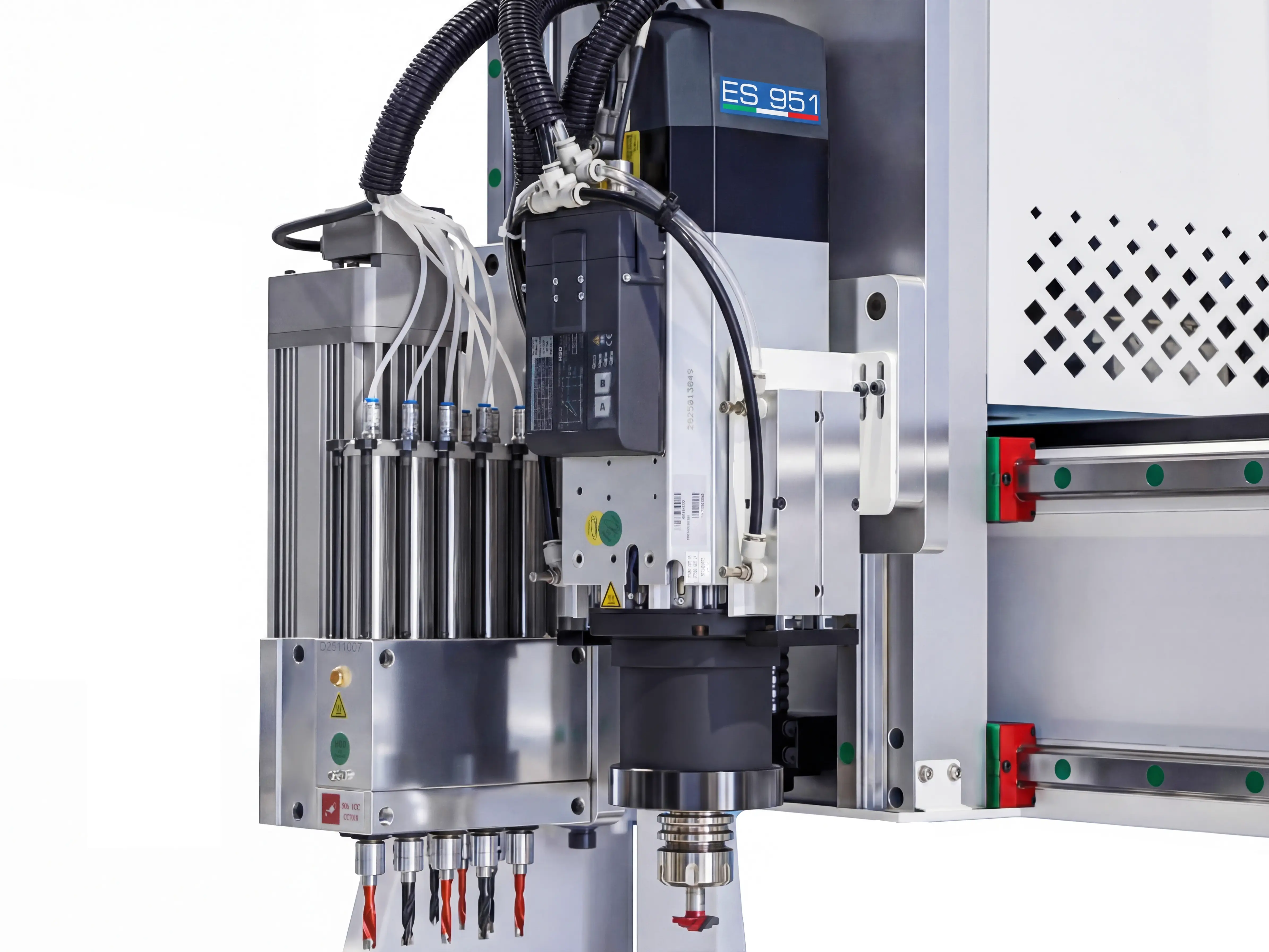
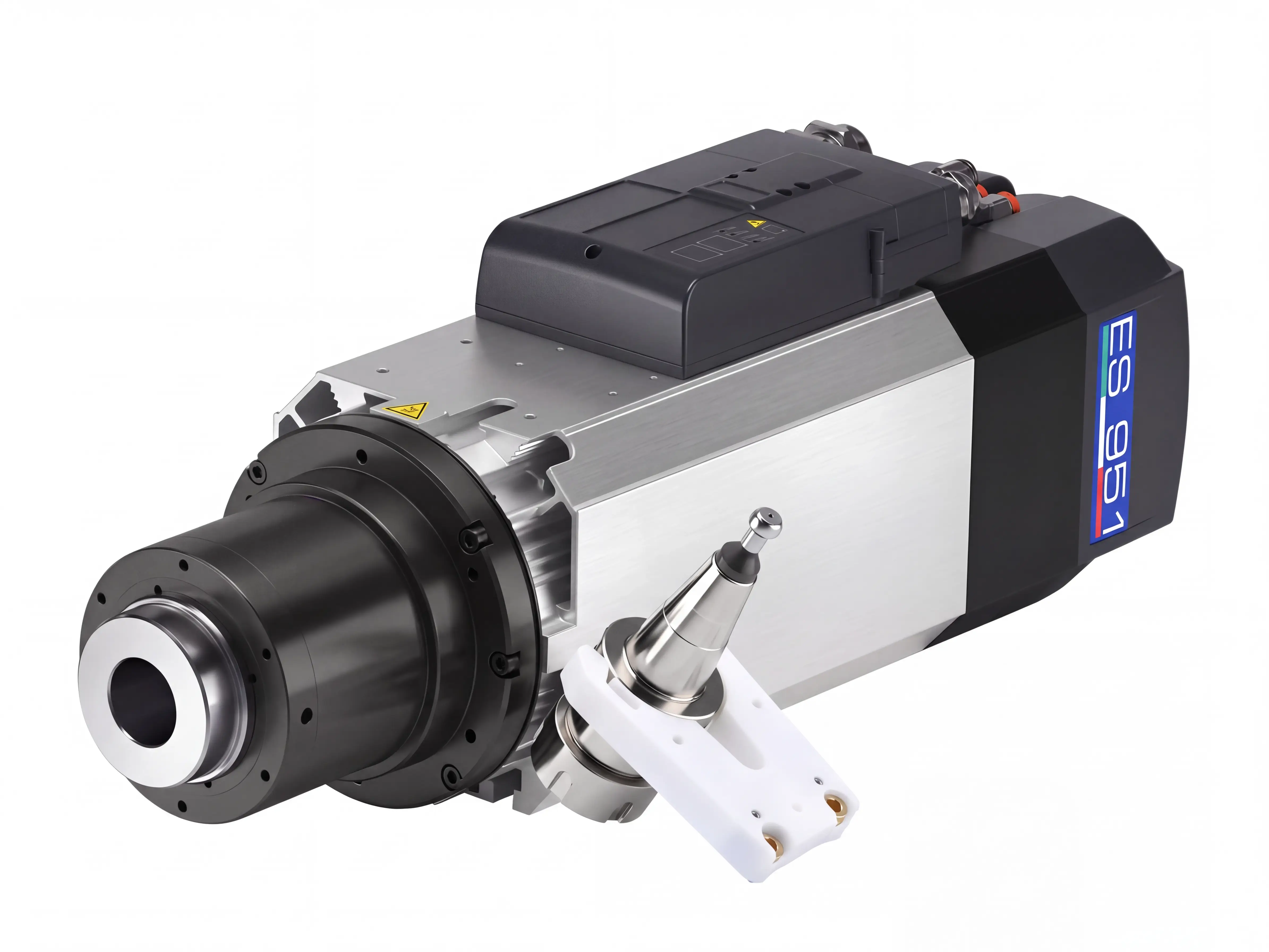
Italian HSD ES951 High-Speed
Air-Cooled Automatic Tool-Changing Spindle
Equipped with an Italian HSD ES951 9kW air-cooled ATC
spindle, the machine delivers speeds of up to 24,000 rpm
for powerful, high-speed machining. Its ISO30 tool
interface supports various tool holders and cutters,
accommodating tools up to 20mm in diameter. Tool
selection can be adjusted to suit different materials
and machining requirements, including solid wood, MDF,
plywood, plastics, PVC, and composite materials. It
handles cutting, milling, grooving, drilling, and
complex contour engraving with ease.
The spindle features a forced-air cooling system with an
integrated electric fan to dissipate heat during
operation. No external chiller, water circulation lines,
or coolant are required, reducing auxiliary equipment
costs and routine maintenance. Compared with
water-cooled spindles, this design eliminates the need
to check coolant levels or replace cooling fluid, while
removing the need for additional pumps and piping. Its
streamlined configuration simplifies installation and
operation, while the industrial-grade cooling design
supports sustained operation in demanding production
environments.
Built with a high-precision electric spindle structure,
the HSD ES951 delivers smooth operation and excellent
rotational accuracy, helping minimize vibration and
maintain workpiece surface quality at high speeds.
Combined with a 16-tool carousel magazine, it
automatically selects and changes tools according to the
machining program, enabling seamless transitions between
cutting, drilling, profiling, grooving, and detailed
engraving. This reduces manual tool changes and downtime
between processes, improving workflow continuity and
production efficiency when machining cabinet doors,
furniture components, irregularly shaped parts, and
complex contours.
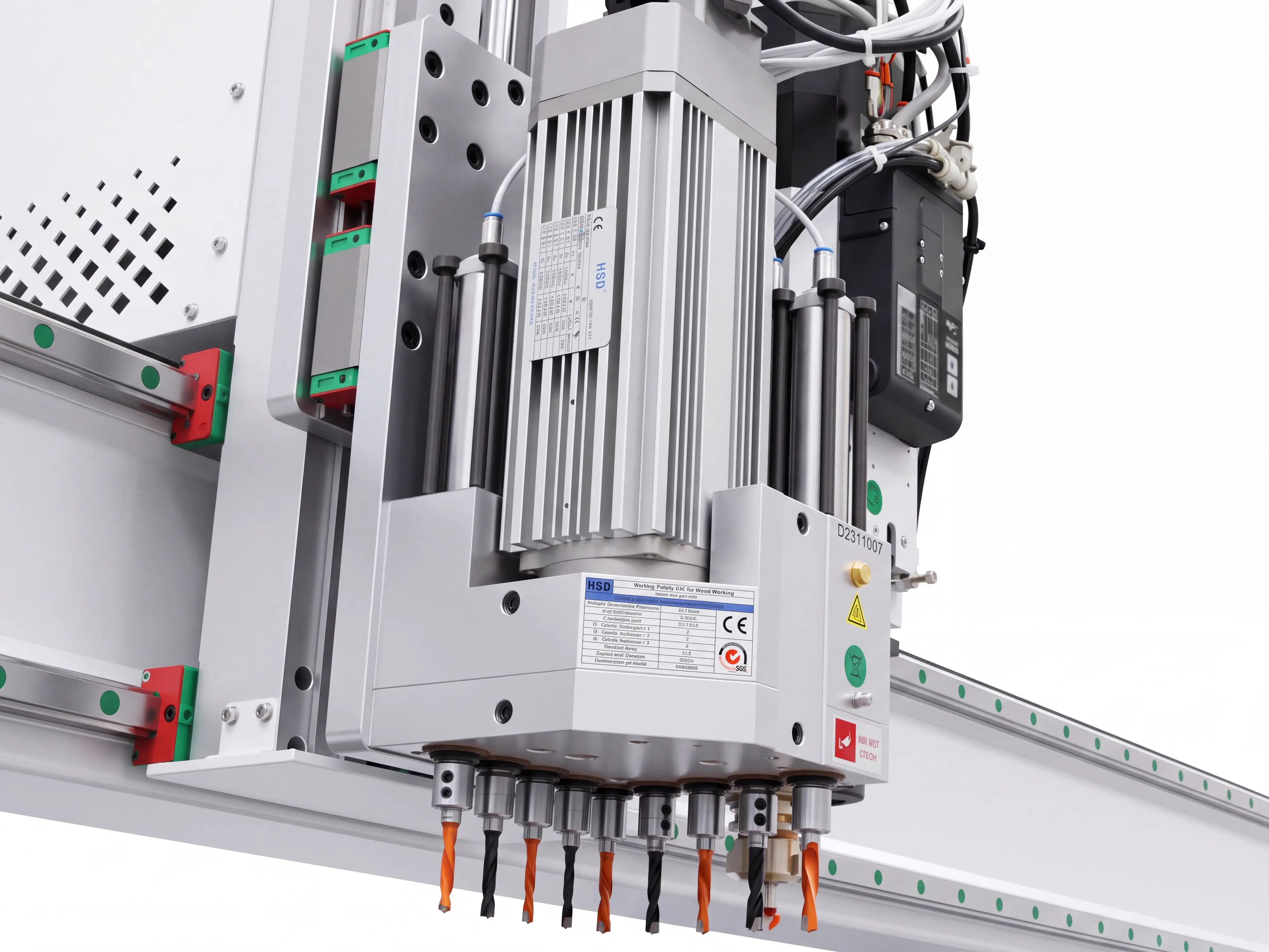
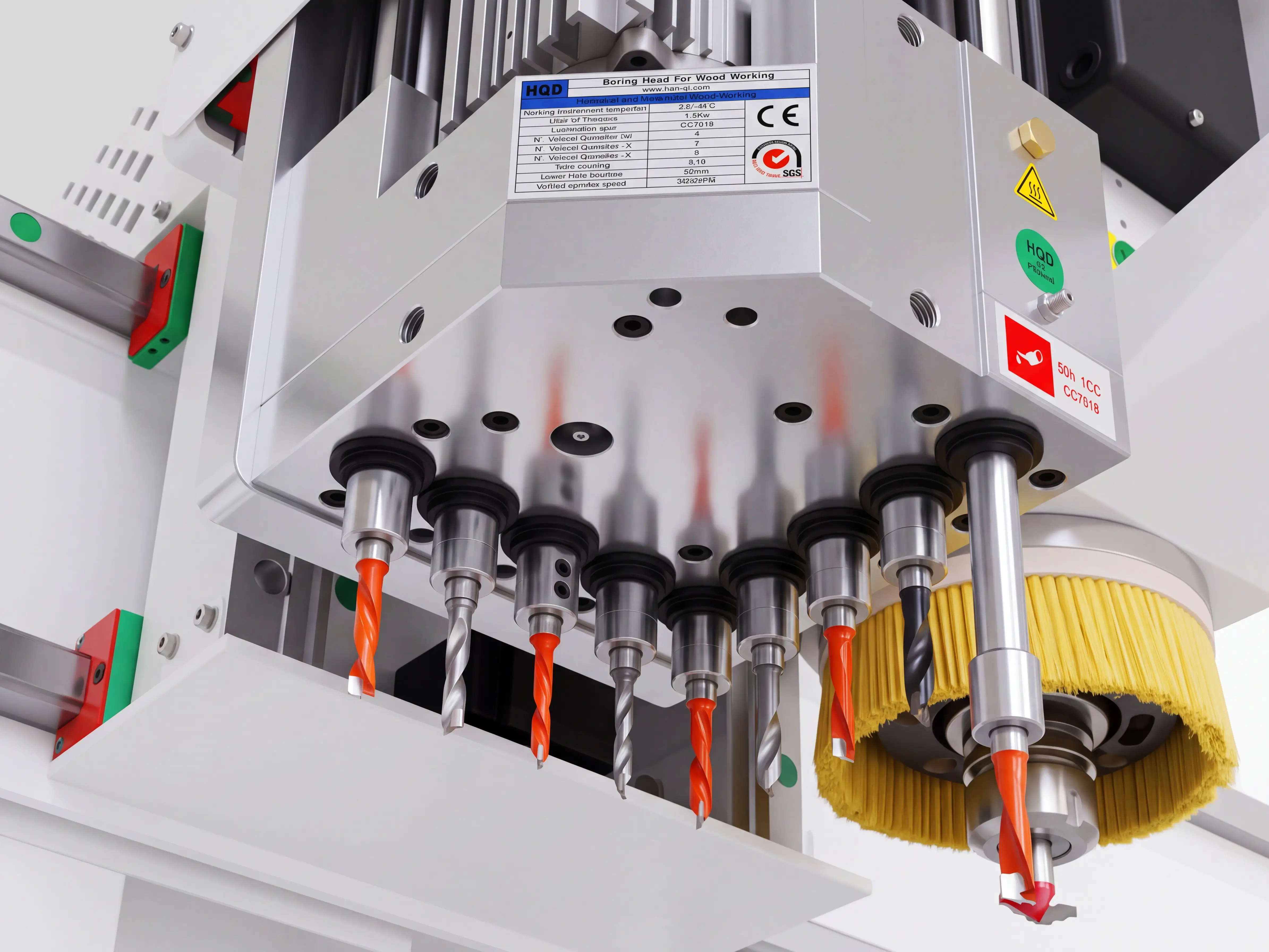
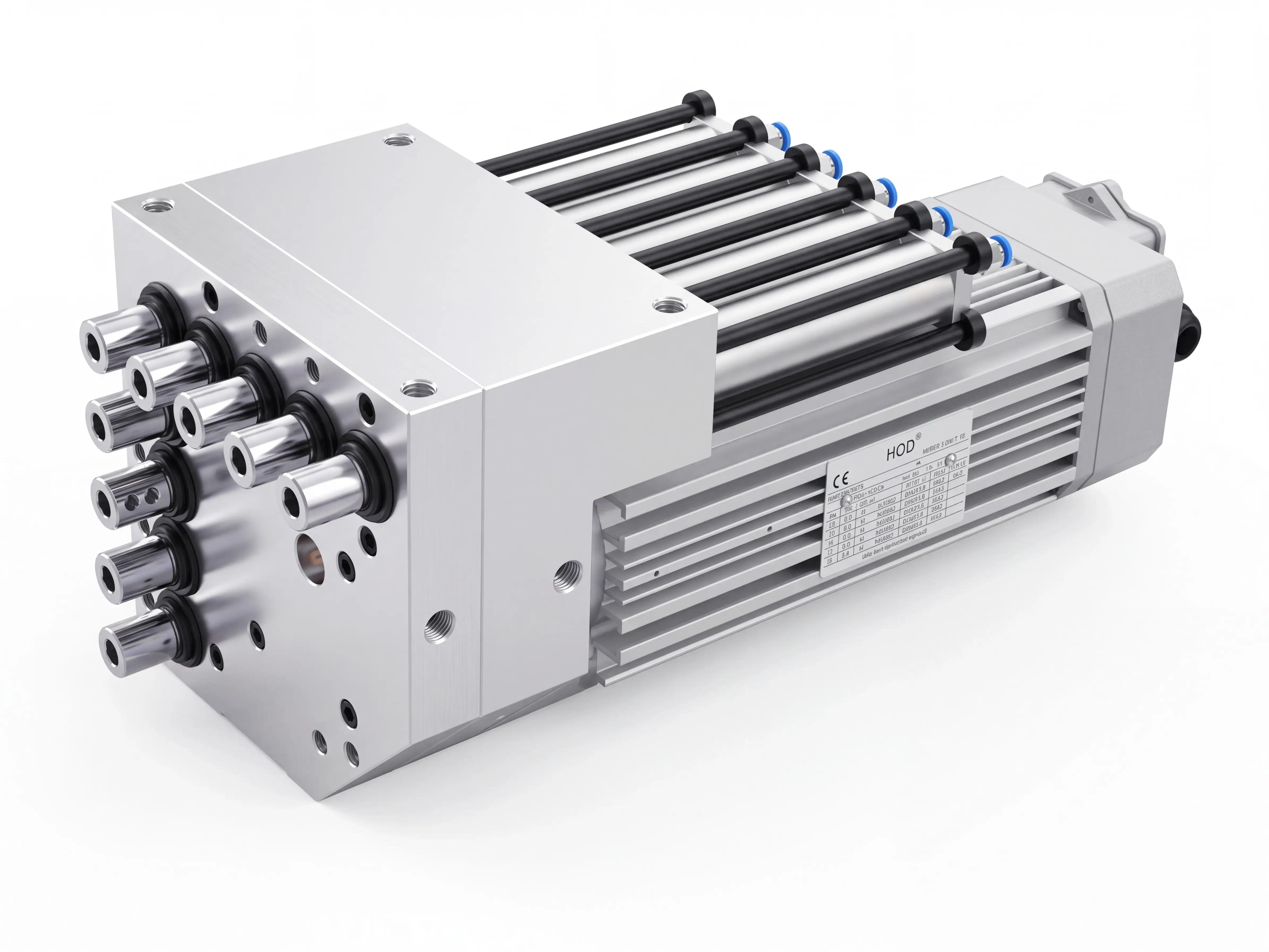
HQD 5+4 Pneumatic Vertical Drilling Unit
The Spire 1531 CNC nesting
machine is equipped with an HQD
5+4 pneumatic vertical drilling unit featuring nine drill
positions. It can hold up to nine different drill bits
simultaneously, accommodating various diameters and drilling
requirements for different panel machining processes. With a
drilling speed of up to 3,200 rpm, it efficiently handles
common furniture-making operations such as connector holes,
positioning holes, shelf-pin holes, and other vertical
drilling tasks. The multi-drill configuration reduces
frequent tool changes and is particularly suitable for panel
furniture production involving numerous holes, multiple
diameters, and repetitive drilling operations.
The drilling unit features independent pneumatic drive and
control, allowing the CNC program to activate the required
drill bits without occupying the main spindle or repeatedly
using the ATC system. Unlike conventional single-spindle
drilling, which requires frequent tool changes for different
hole specifications, the dedicated drilling unit keeps
multiple drill bits installed and switches quickly between
drilling requirements. This reduces tool-changing delays,
spindle start-stop cycles, and process transition time. With
drilling and milling handled independently, the main spindle
remains available for cutting, milling, grooving, profiling,
and complex engraving, improving overall machine
utilization.
The main spindle and HQD 5+4 drilling unit work together
through a specialized division of labor. The nine-drill unit
handles vertical holes in multiple specifications, while the
ATC spindle performs panel cutting, contour milling,
grooving, and complex shaping. For furniture production
involving numerous connector holes, positioning holes, and
panel contours, this coordinated configuration reduces
process interruptions and creates a more streamlined
workflow. It is ideal for manufacturing custom furniture,
kitchen cabinets, wardrobes, bathroom cabinets, office
furniture, and other panel-based products, particularly in
batch production involving multiple hole positions, drill
sizes, and machining operations.
Click the icon labels to view different
machine
parts
Top-tier Japanese Yaskawa Bus-Based Servo System Ensures Machining Precision.
Japanese Yaskawa M-III Absolute Encoder Servo
System
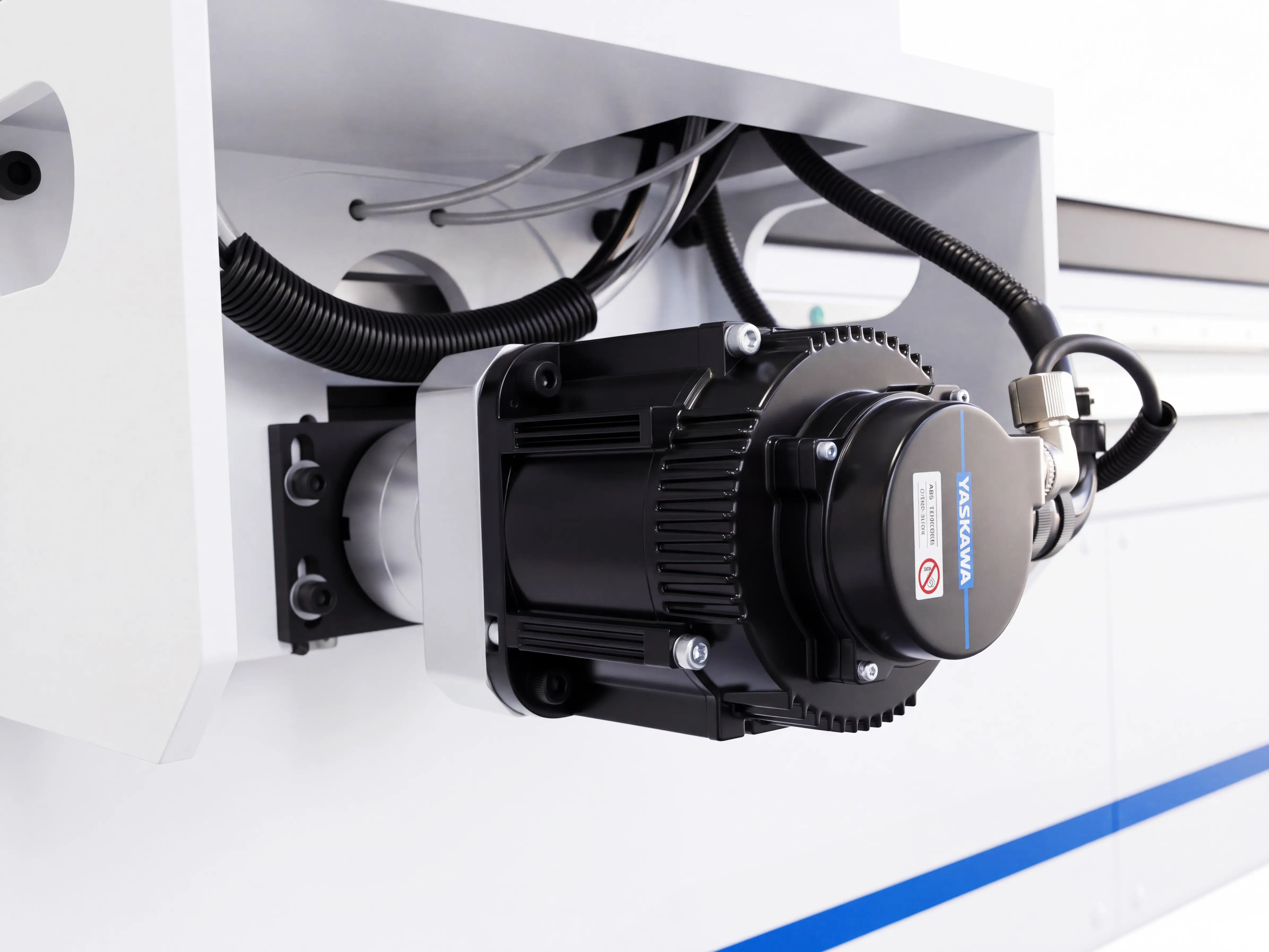
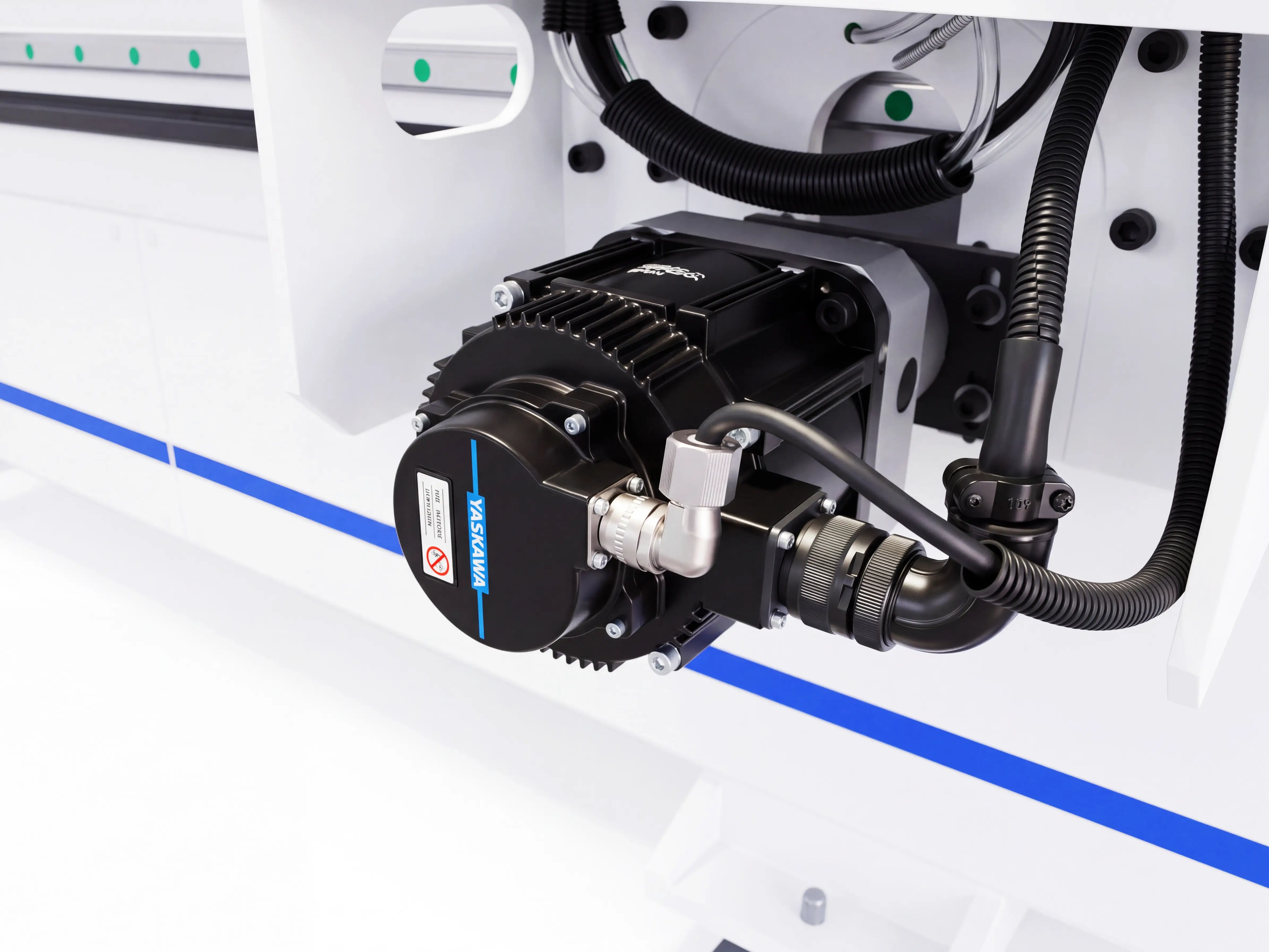
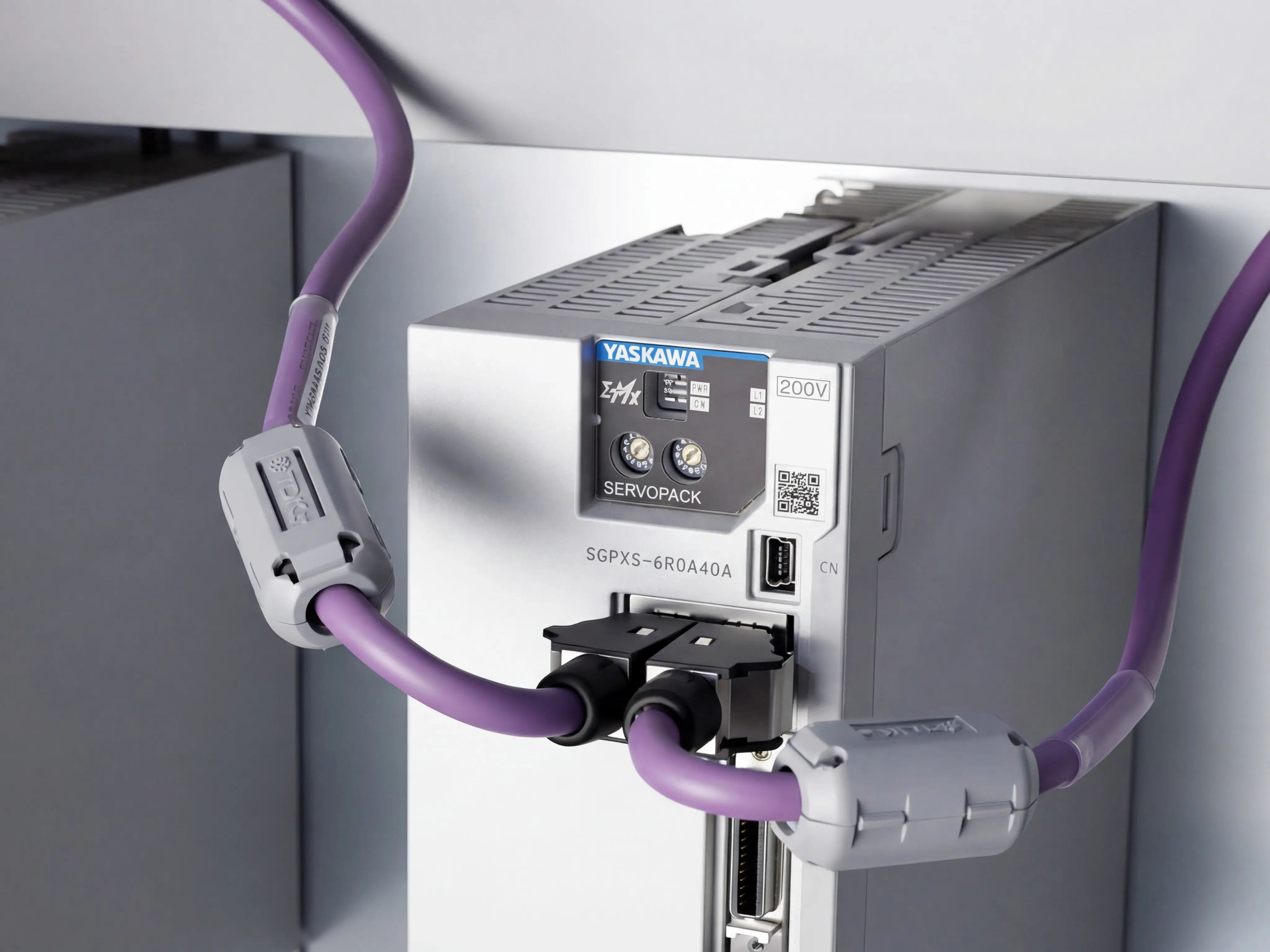
The X, Y, and Z axes use four 1,300W Japanese Yaskawa absolute
encoder servo motors, with dual-motor drive on the Y-axis for
greater driving force and synchronized gantry movement. The
carousel-type tool magazine has an independent 750W Yaskawa servo motor
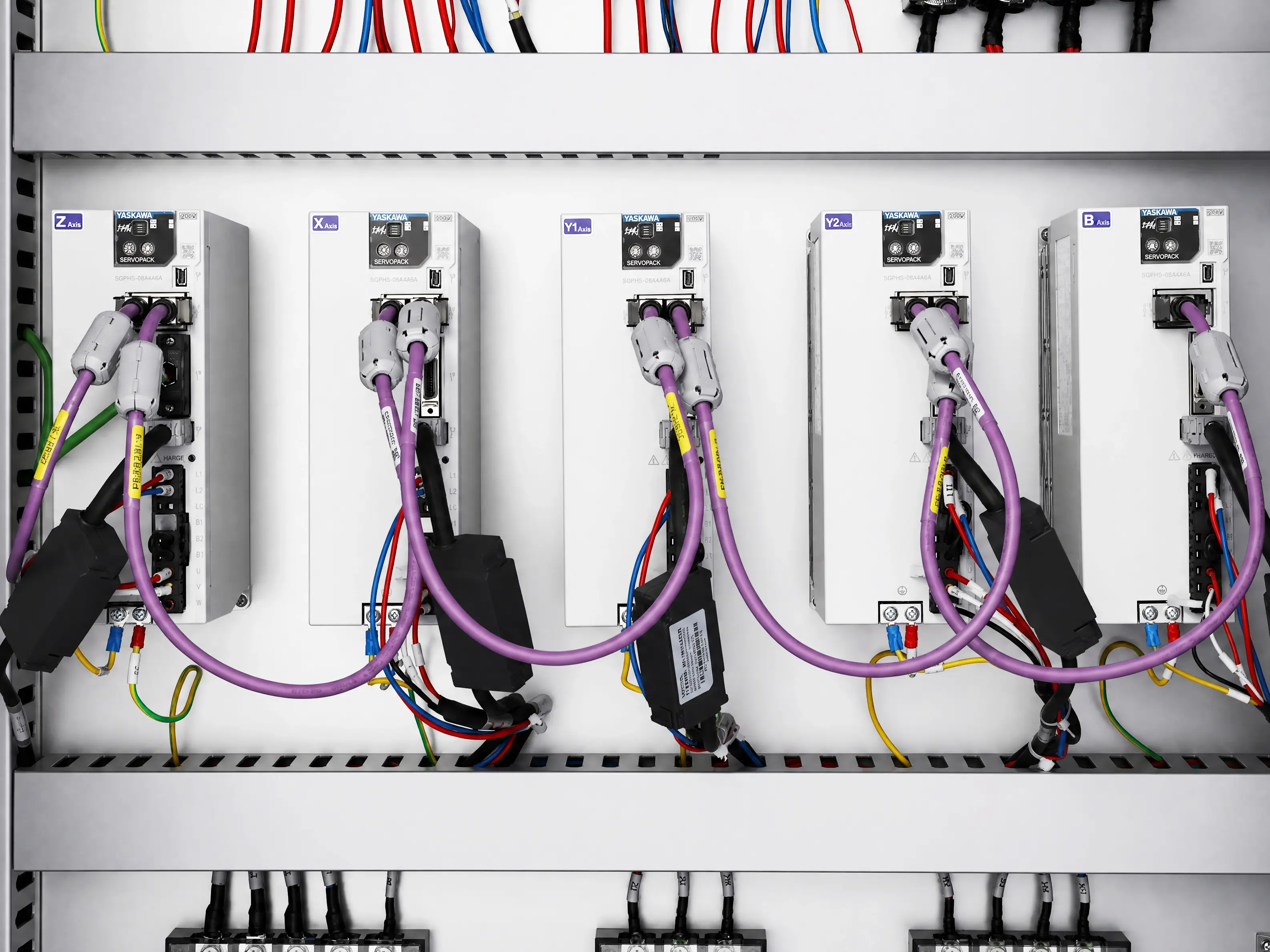
for precise positioning and tool changing. Using the
MECHATROLINK-III high-speed industrial bus protocol, the system
enables real-time communication and coordinated control between the
servo drives and Syntec CNC system. Compared with conventional pulse
control, bus communication reduces wiring complexity, improves
system integration, and enables efficient motion control and status
monitoring. The absolute encoder system also eliminates the need for
homing after startup.
Featuring a speed response frequency of up to 3.1kHz and a 24-bit
high-resolution absolute encoder, the system provides real-time
position feedback and precise speed control. Its rapid response
ensures smooth operation during acceleration, deceleration, and
frequent direction changes. Peak instantaneous torque reaches 350%
of rated torque, providing strong overload capacity to handle
varying cutting loads and support high-speed positioning, continuous
machining, and complex toolpaths.
Integrated with the Syntec CNC system, the Yaskawa servo drives
allow parameters to be read and adjusted directly through the CNC
interface, simplifying commissioning and maintenance without
separate tuning software. Automatic tuning adapts to changes in load
inertia, while vibration suppression technology helps reduce
mechanical resonance and operational vibration. These features
minimize repeated adjustments under different machining conditions
and improve multi-axis coordination and long-term operating
stability.
Taiwan Syntec 60CA Control System: Intuitive Operation and Professional-Grade Performance.
Taiwan Syntec 60CA CNC Control System
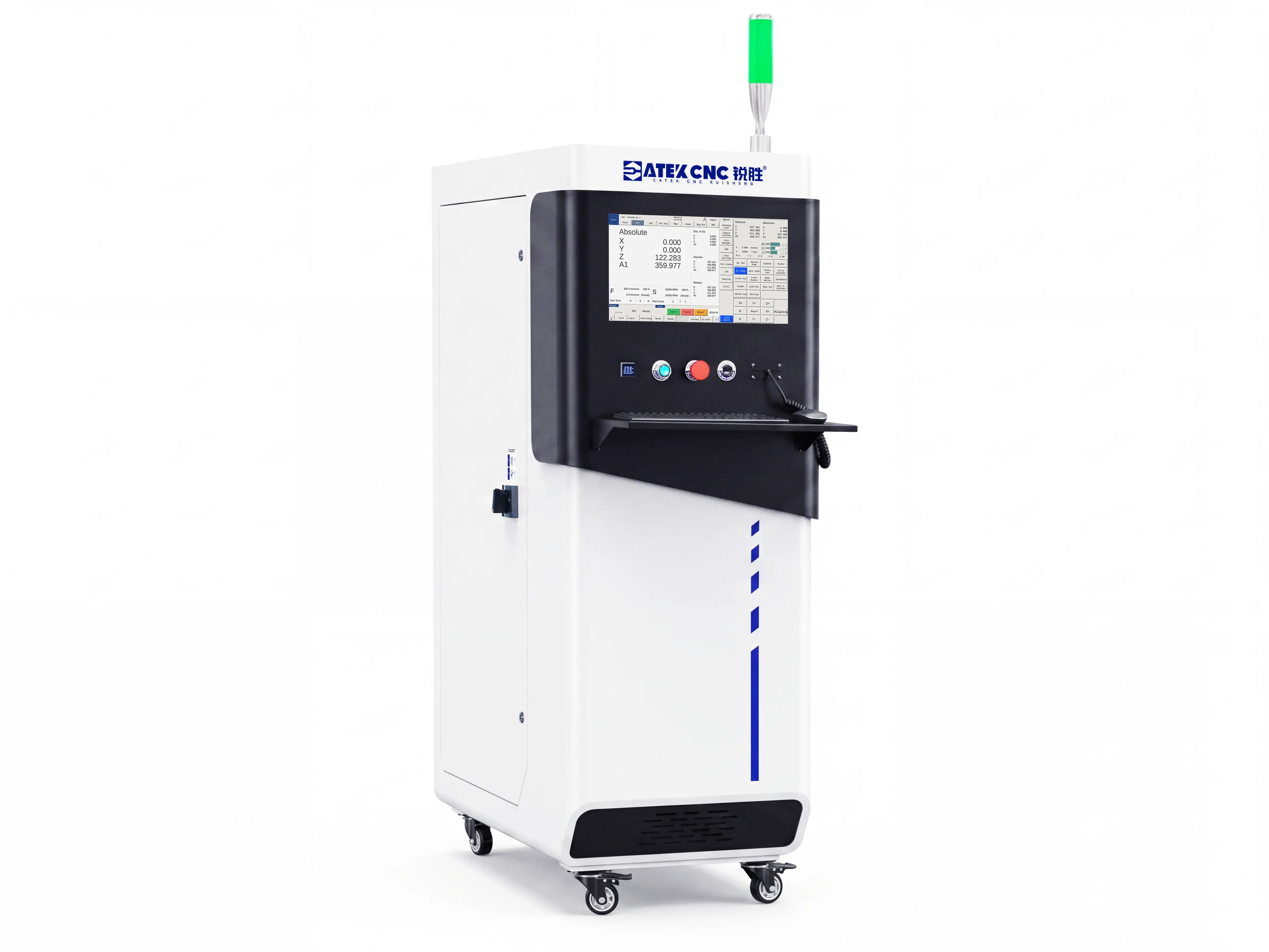
Equipped with the Taiwan Syntec 60CA CNC control system, the
machine integrates control of the carousel-type ATC magazine,
HQD 5+4 vertical drilling unit, and automatic loading and
unloading platforms. It coordinates the spindle, tool
magazine, drilling unit, servo drives, and material handling
systems throughout the entire workflow, from panel
positioning and automatic tool changing to multi-process
machining and finished-part unloading. The system supports
machining files generated by various CAD/CAM software and is
compatible with multiple G-code formats, making it easy to
adapt to different design tools and production requirements.
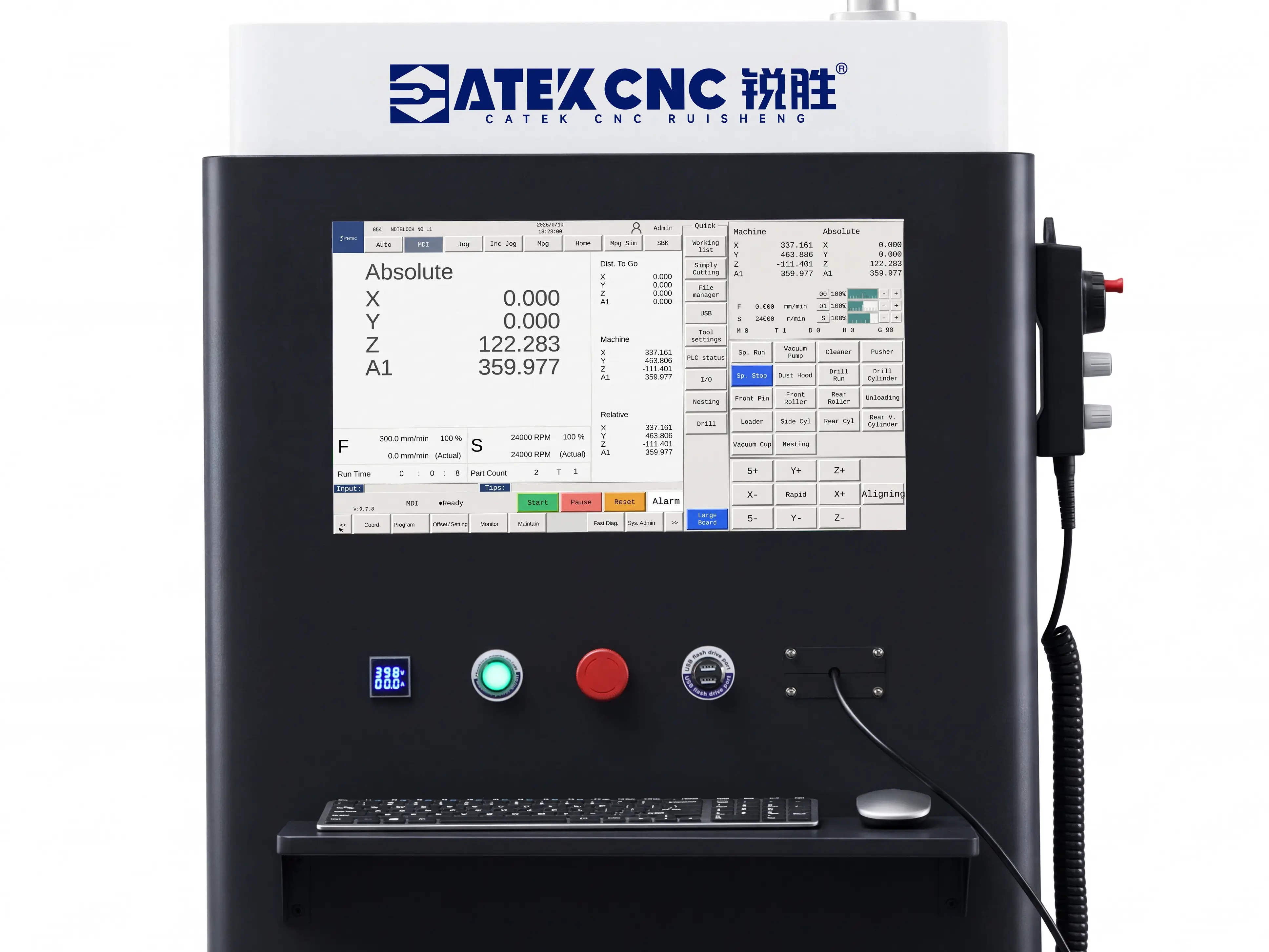
The control system features a 19-inch high-definition LCD
display with an intuitive interface. Machining parameters,
machine status, and function commands are clearly organized
for easy viewing and adjustment. Multiple interface
languages are available to accommodate operators in
different regions and reduce the learning curve. Daily
operations, including program selection, file management,
parameter settings, and command execution, are handled
through a keyboard and mouse, making the system
straightforward to learn and operate.
For file management and manual control, the system supports
machining program import via USB flash drive, simplifying
file transfer and preparation for different workpieces. It
also includes an independent electronic pulse handwheel for
precise manual movement and positioning of the X, Y, and Z
axes. This is useful for workpiece positioning, tool
setting, machining origin calibration, and machine setup.
Combined with keyboard and mouse operation, the handwheel
provides flexible manual control alongside automated
machining.
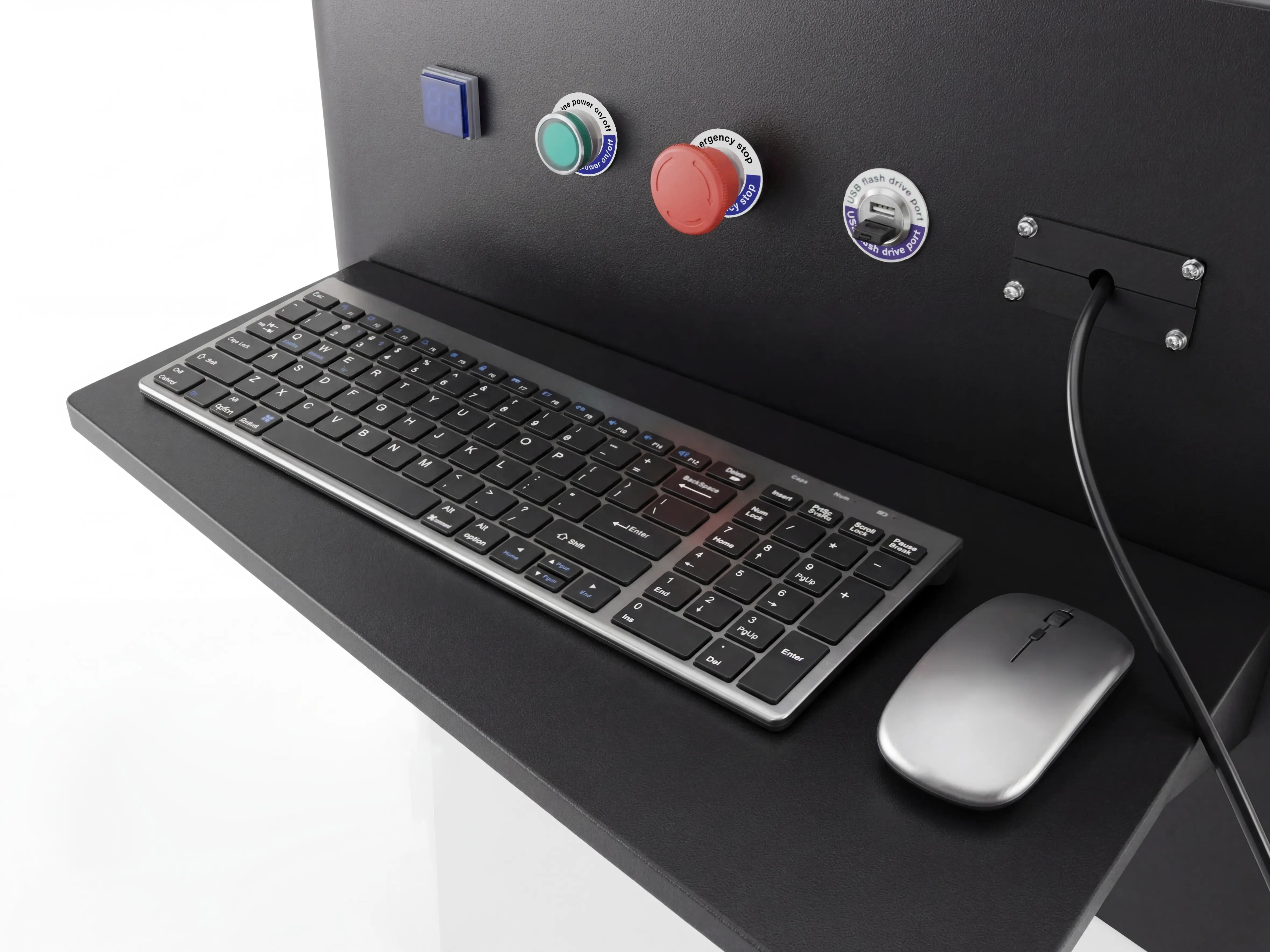
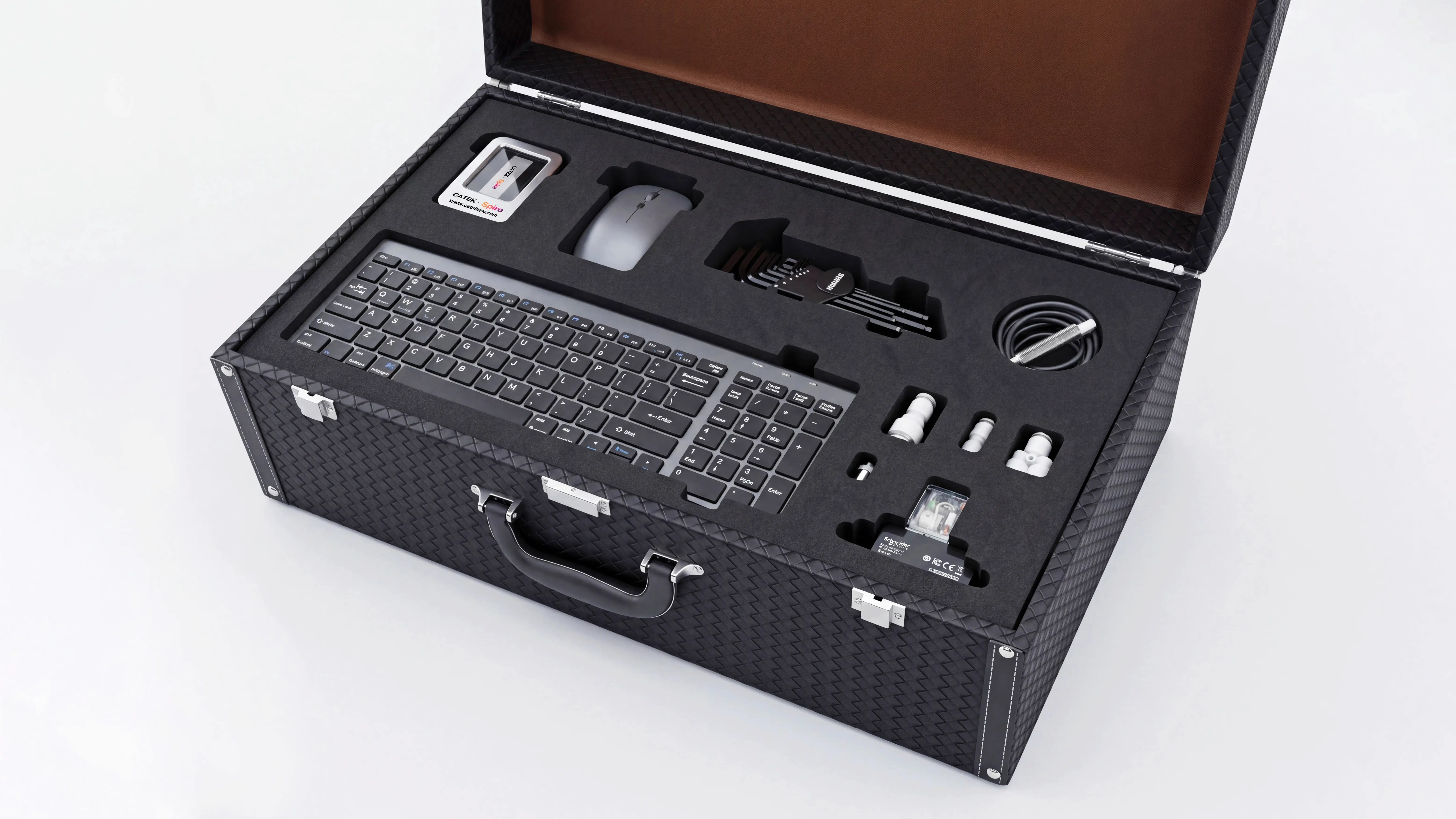
2.4GHz Wireless Keyboard & Mouse
Equipped with a 2.4GHz wireless keyboard and mouse connected
to the CNC control system via a wireless receiver,
eliminating the need for traditional wired connections.
Operators can freely adjust their working position around
the machine when selecting programs, setting machining
parameters, managing files, and accessing system functions.
The wireless design reduces cable clutter and prevents
tangling, pulling, or accidental tripping, keeping the
operating area neat and organized. It is especially
convenient for frequent machine adjustments, program
changes, and production management.
Using 2.4GHz wireless transmission technology, the keyboard
and mouse provide stable connectivity and good interference
resistance, helping minimize delays and connection
interruptions in industrial environments. When paired with
the Syntec 60CA CNC system, they offer familiar
computer-style operation for program selection, file import,
parameter adjustment, and system settings. The intuitive
controls reduce the learning curve for new operators and
improve daily operating efficiency.
The wireless keyboard features an integrated housing and
sealed design that minimizes external gaps, helping prevent
wood chips and dust from entering the interior. This makes
it well suited to the working environment of CNC routers.
Its built-in rechargeable battery provides over 30 days of
use per charge, reducing charging frequency and supporting
extended daily operation.
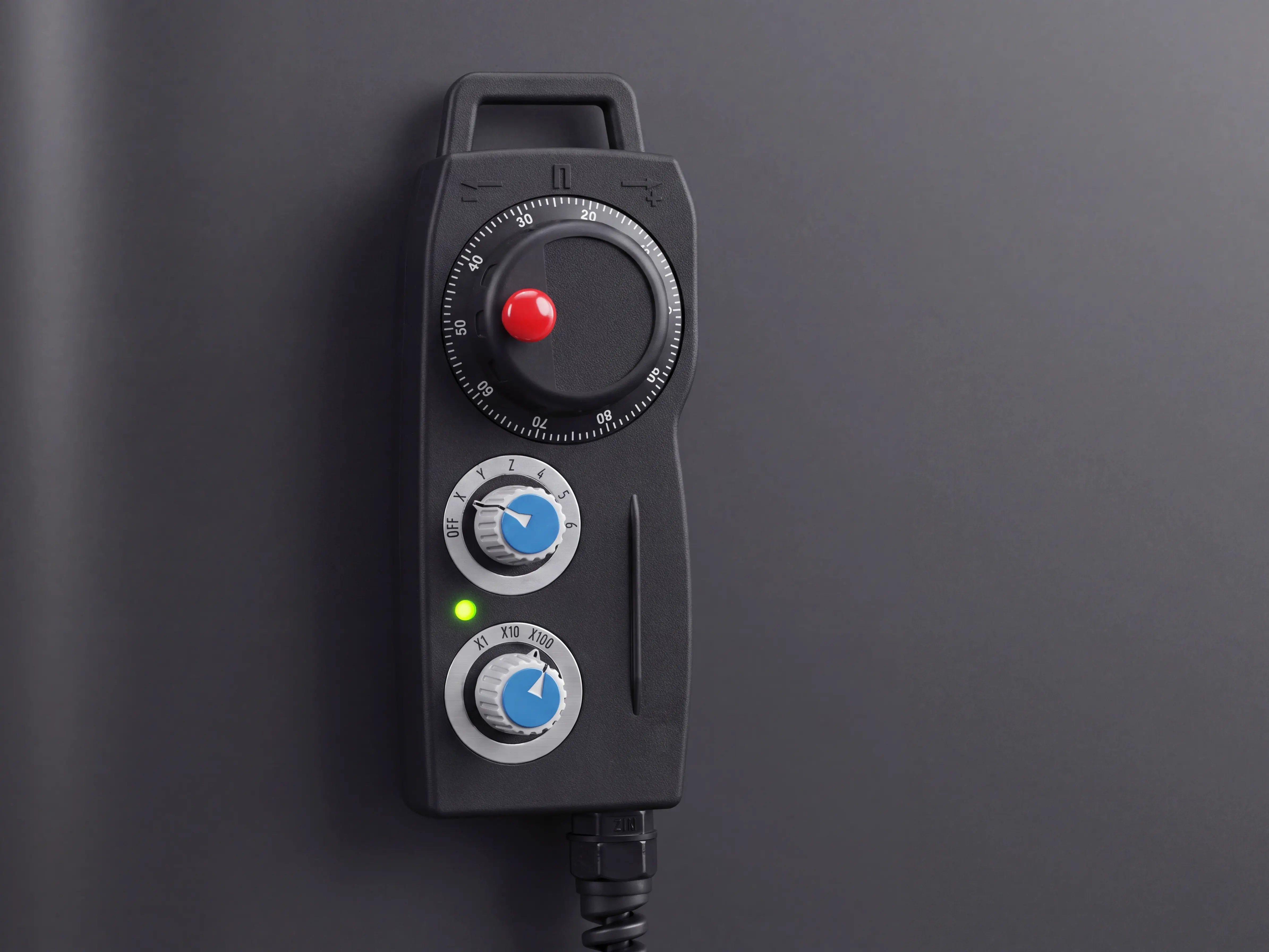
High-Precision Pulse Electronic Handwheel
Equipped with an independent pulse electronic handwheel
featuring an axis selector and feed-rate adjustment dial.
Operators can quickly select the X, Y, or Z axis and switch
between different movement increments, enabling flexible
control from rapid positioning to fine adjustment. Rotating
the handwheel directly controls the selected axis's
direction and travel distance, making it convenient for
workpiece positioning, tool setting, machining origin
calibration, and machine setup. Compared with entering
movement commands via the keyboard, handwheel operation is
more intuitive and allows precise manual positioning.
The back of the handwheel features a strong magnetic
mounting system, allowing it to attach securely to suitable
metal surfaces on the machine for convenient access. Its
wired signal transmission ensures stable command delivery
while avoiding wireless interference. A flexible
spring-loaded retractable cable extends to the required
operating distance and automatically retracts when released,
reducing cable tangling, floor contact, and workspace
clutter.
The electronic handwheel can also work with the Syntec CNC
system's handwheel simulation function to verify machining
programs and check toolpaths before production. Operators
can manually move each axis to inspect tool trajectories,
machining positions, and program execution, helping identify
potential path deviations, coordinate errors, and other
programming issues in advance. Combining precise manual
control with pre-machining program verification helps reduce
operating errors and collision risks while improving program
testing efficiency for batch production.
Click the icon labels to view different
machine
parts
Top-Tier Electrical Components Ensure The Machine
Operates in a Stable, Reliable, and Safe Manner.
Delta
High-Performance Vector Inverter
Control
cabinet interlock protection switch
High-Quality
Power Switches
Schneider
Electrical Components
Air
Source Connection Sliding Valve
High-Reliability
Aviation Plugs
Three-color
status indicator light:
Fully
Enclosed High-Strength Cable Carrier
High-Quality
Terminal Blocks
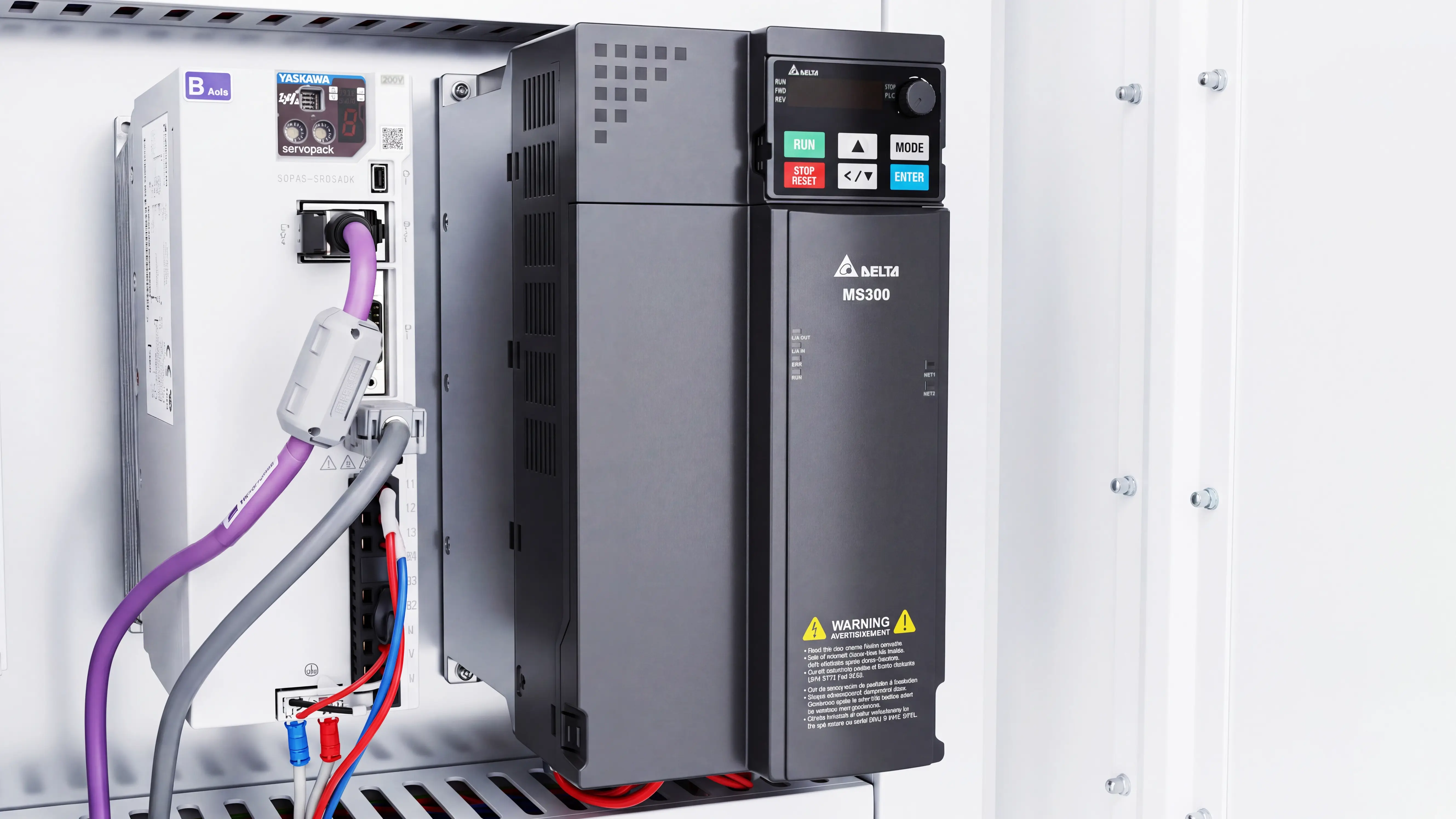
Delta MS300 High-Performance
Vector Frequency Inverter
Equipped with a Delta MS300 Series 11kW high-performance vector
inverter, paired with the 9kW high-speed ATC spindle. Its
advanced vector control technology precisely manages spindle
startup, stopping, acceleration, deceleration, and operating
speed, delivering stable driving power. Spindle speed can be
adjusted to suit different tool sizes, material properties, and
machining requirements, supporting high-speed milling, grooving,
drilling, and cutting operations.
The MS300 inverter provides precise speed regulation and
responsive dynamic control, ensuring smooth transitions during
startup, acceleration, deceleration, and stopping. It adjusts
output according to changes in spindle load, helping minimize
speed fluctuations and maintain consistent cutting performance.
Paired with the 9kW ATC spindle, it supports flexible speed
changes between machining processes, improving operational
stability and workpiece surface quality.
For operational safety, the inverter incorporates multiple
protection functions, including overvoltage, overcurrent, and
overload protection. It monitors electrical parameters and load
conditions, issuing alarms or activating protective measures
when abnormalities occur. The combination of precise vector
control and comprehensive protection helps maintain stable
spindle operation during high-speed and extended machining while
reducing the risk of damage to the inverter and spindle drive
system.
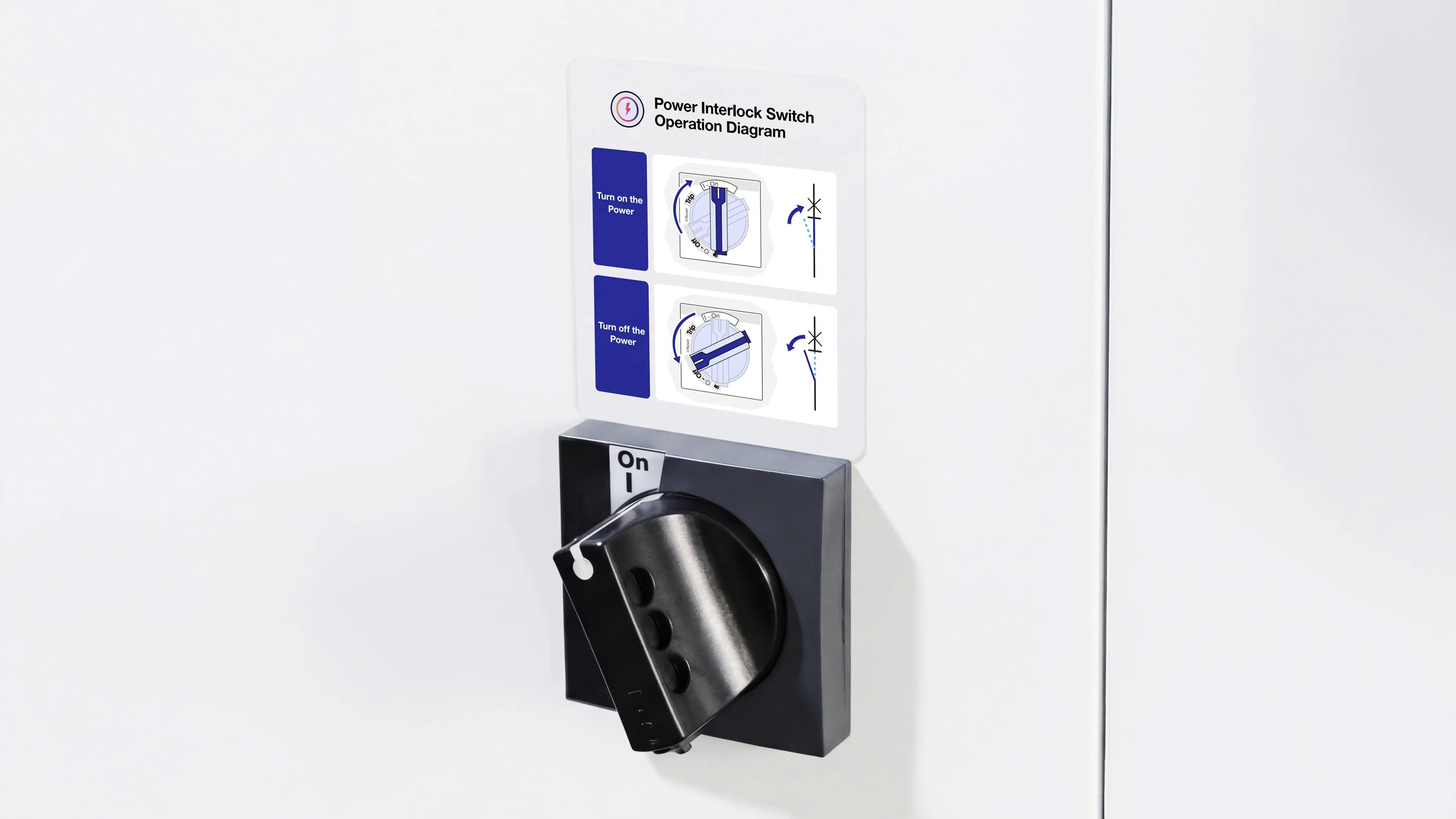
Dual Interlocking Safety
Protection Switch
The electrical cabinet of the Spire series CNC router features a
dual safety design combining a keyed door lock and a power
interlock switch. During normal operation, the cabinet remains
locked to prevent unauthorized access. For electrical
inspections, wiring adjustments, or component maintenance,
operators must first unlock the door with the key and then
operate the interlock switch. Activating the switch immediately
disconnects the machine's power supply, ensuring that power is
cut off before the cabinet can be opened and reducing the risk
of contact with live electrical components.
Closing the electrical cabinet door does not automatically
restore power. Operators must manually reset the interlock
switch before the machine can be powered on again. This prevents
unexpected startup after maintenance and reminds operators to
check internal wiring, electrical components, and tools before
resuming operation. The machine can return to normal operation
only after the cabinet door is closed and the interlock is
reset.
The interlock switch also incorporates overload and
short-circuit protection. When abnormal current exceeds the
preset protection range, the protective mechanism disconnects
the circuit to help prevent further damage to wiring and
electrical components. Combined with the cabinet door interlock,
these functions provide multiple layers of protection during
both machine operation and electrical maintenance.
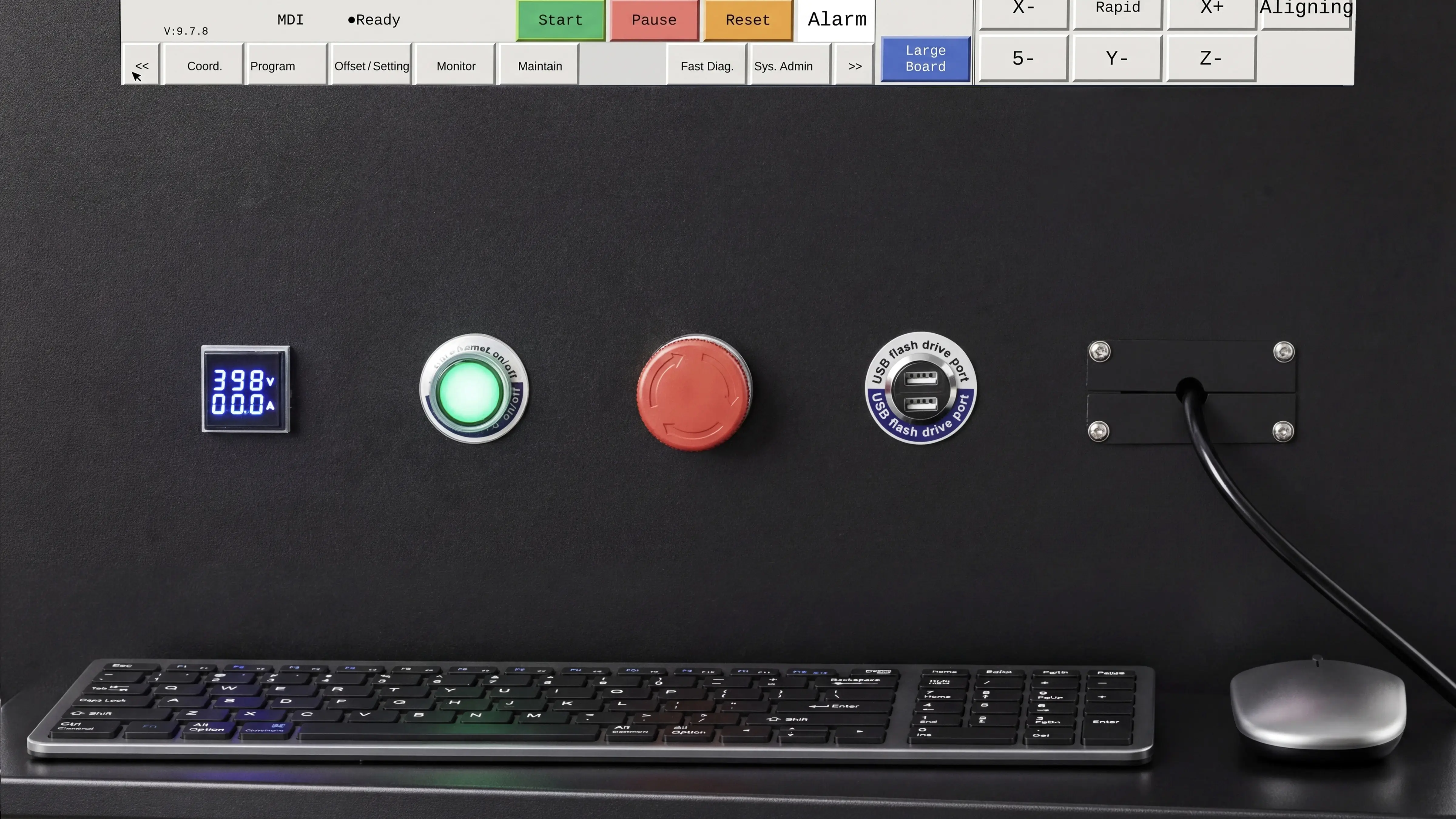
Schneider Electric Push-Button
Switches
The Spire CNC Router features a
centralized control panel that integrates machine monitoring,
operation controls, and data interfaces in one convenient
location. Arranged beneath the display are an ammeter,
voltmeter, start button, emergency stop button, and two USB
ports. Each function is clearly positioned for easy access and
identification. The ammeter and voltmeter provide real-time
visibility of operating current and voltage, helping operators
monitor the power supply and identify potential electrical
abnormalities.
The panel is equipped with Schneider Electric start and
emergency stop buttons, designed for reliable operation and long
service life in industrial environments. The green start button
and red emergency stop button are easily distinguishable. The
emergency stop features a push-to-lock, turn-to-release
mechanism, requiring manual rotation to reset after activation.
This helps prevent accidental release and keeps the machine
stopped until the issue has been checked and it is safe to
resume operation.
Two USB ports on the right side of the panel provide convenient
connections for external devices and data transfer. Operators
can connect a keyboard, mouse, 2.4GHz wireless receiver, or USB
flash drive for file import, data access, and peripheral
operation. Firmware updates and maintenance can also be
performed where supported by the system. With frequently used
interfaces integrated directly into the control panel, daily
file management, machine operation, and technical maintenance
become more convenient.
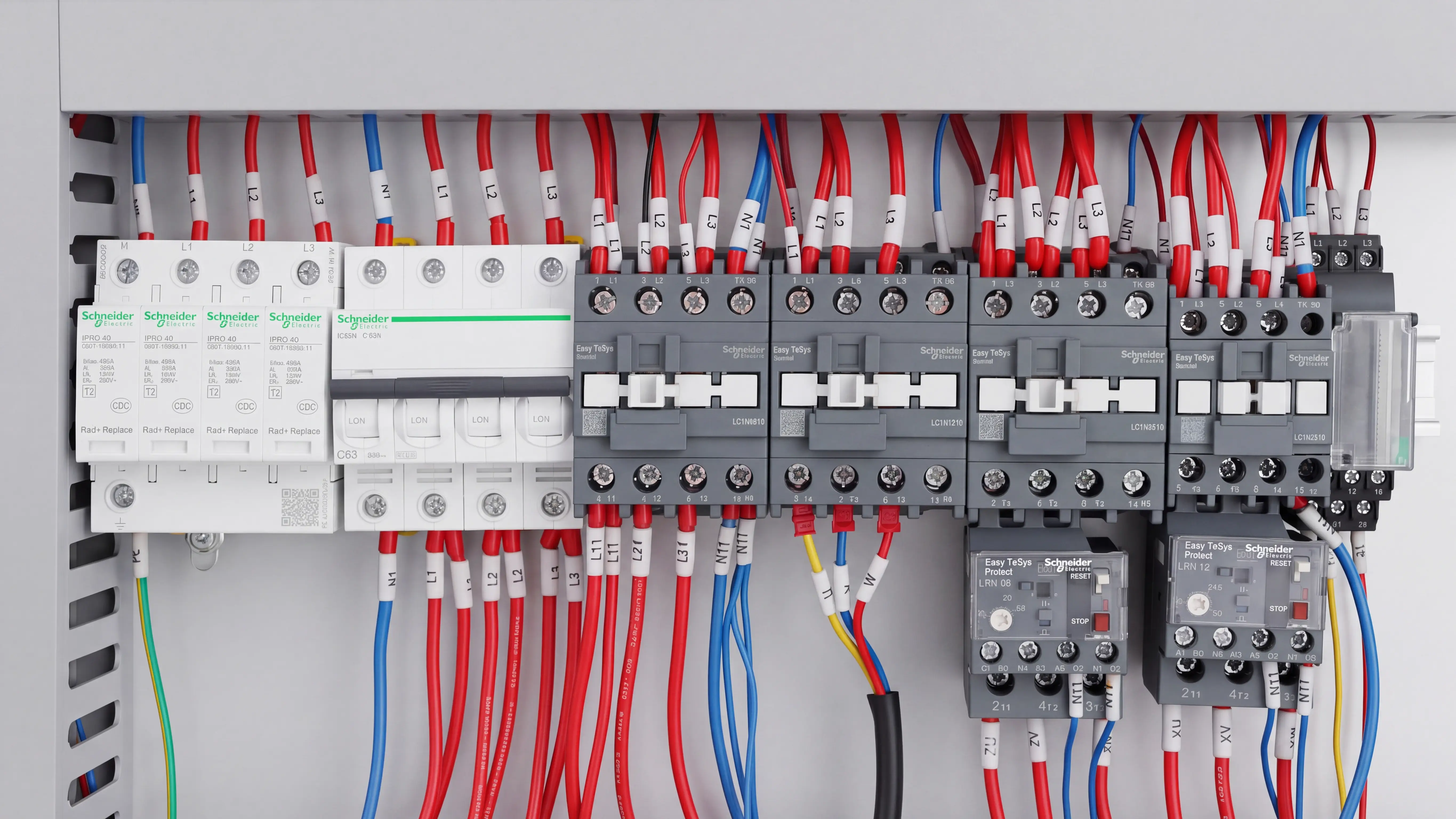
Schneider Electric
Industrial-Grade Electrical Control & Protection System
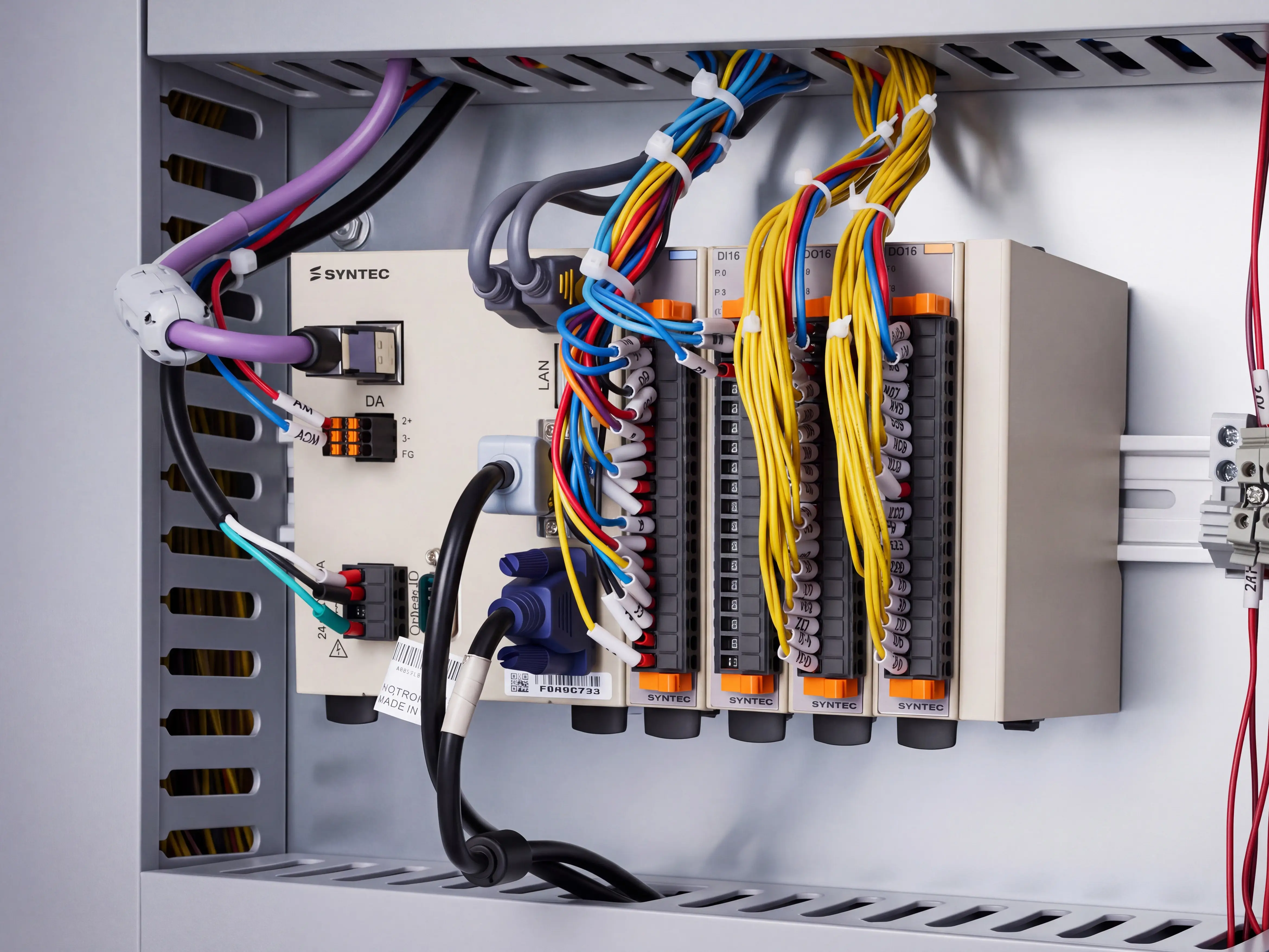
The electrical cabinet serves as the core of machine power
distribution and automation control. The Spire 1531 CNC router uses
Schneider Electric industrial components to manage power
distribution and control circuits throughout the machine. Key
components include circuit breakers, AC contactors, a 24V
switching power supply, relay groups, thermal overload relays,
phase sequence protection relays, and surge protectors. Each
performs a specific role in power distribution, signal control,
and electrical protection. Organized by circuit function, these
components create a well-structured control cabinet and provide
a stable electrical environment for the CNC system, spindle, and
auxiliary equipment.
During operation, each electrical component performs its
designated function. Circuit breakers control power connections
and provide short-circuit and overcurrent protection. AC
contactors automatically switch main circuits and manage the
operation of equipment such as dust collectors and vacuum pumps.
The 24V switching power supply provides DC power to the CNC
system, sensors, and low-voltage control components, while relay
groups handle signal conversion and transmission for coordinated
control of machine actuators. This organized configuration
separates power and control circuits, supporting automated
operation while simplifying inspection and maintenance.
Designed for extended machine operation, the electrical system
incorporates dedicated protection against common electrical
faults. Thermal overload relays monitor motor loads, including
dust collectors and vacuum pumps, helping prevent damage caused
by prolonged overloading. Phase sequence protection monitors the
three-phase power supply and detects phase loss or incorrect
phase sequence. Surge protectors help suppress transient voltage
spikes and reduce their impact on the CNC system and electrical
components. Together, these functions provide comprehensive
electrical protection and support stable, continuous machine
operation.
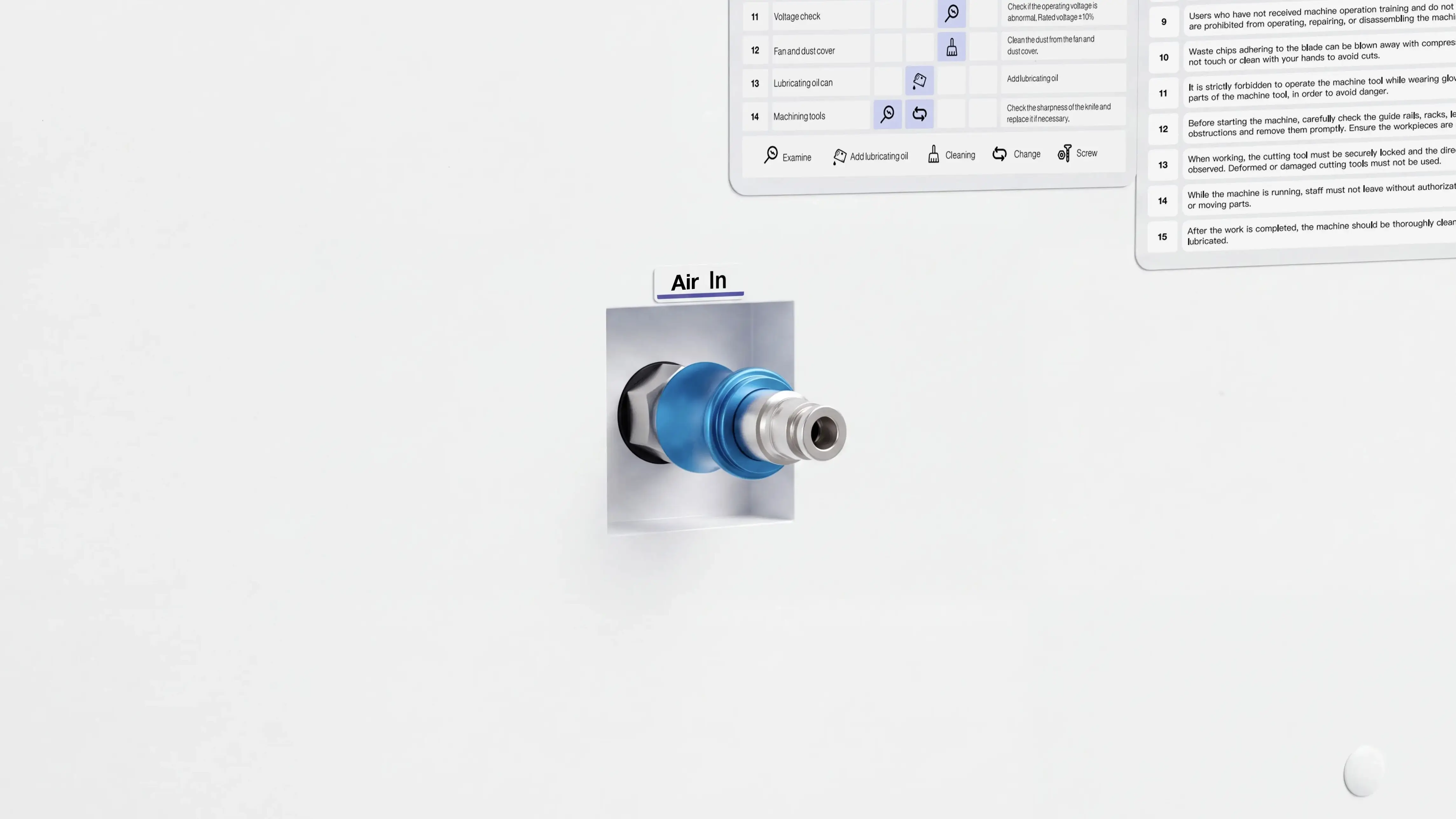
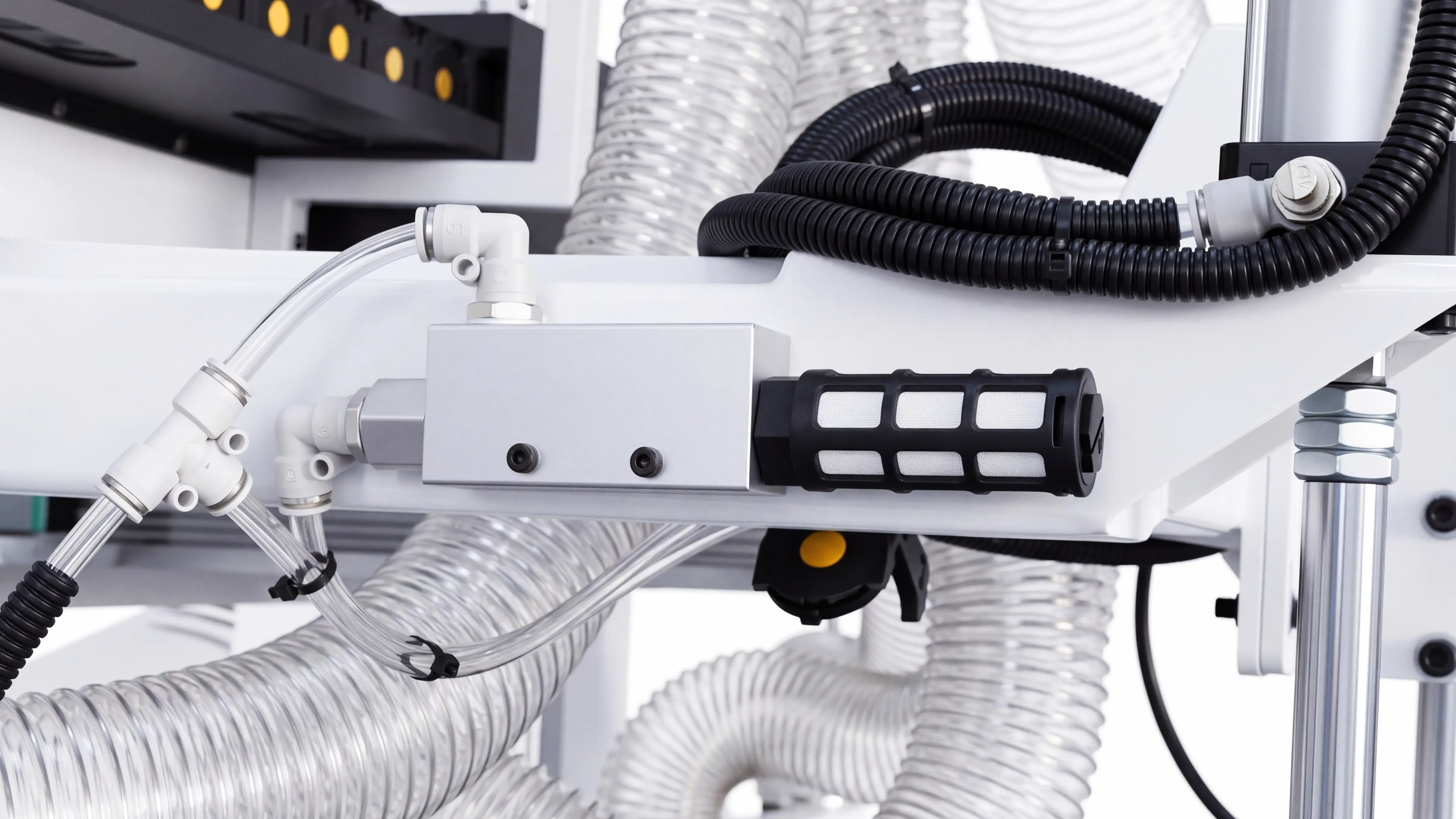
High-Performance Pneumatic
Sliding Valve
Equipped with a pneumatic sliding valve at the rear of the
machine, manufactured from high-strength aluminum alloy for
excellent wear resistance, corrosion resistance, and pressure
resistance. The optimized valve body design combines lightweight
construction with high structural strength, reducing operating
load while ensuring long service life. Compared with
conventional valve designs, the pneumatic sliding valve provides
easier operation, more stable opening and closing control, and
improves the overall efficiency of the vacuum and pneumatic
systems.
The valve adopts a dual sealing ring structure with multiple
sealing protection, effectively reducing air leakage caused by
wear or aging during long-term operation. The sealing
performance reaches up to 99.98%, ensuring stable pressure
control during pneumatic switching operations. The
high-precision sealing structure combined with the
corrosion-resistant aluminum alloy body enables reliable
performance even in demanding environments with dust and
humidity.
Compared with standard valves, the pneumatic sliding valve
offers approximately 30% higher pressure resistance and is
capable of continuous operation under higher-pressure
conditions. With stable sealing performance and extended service
life, it provides reliable support for the machine’s pneumatic
and vacuum control systems.
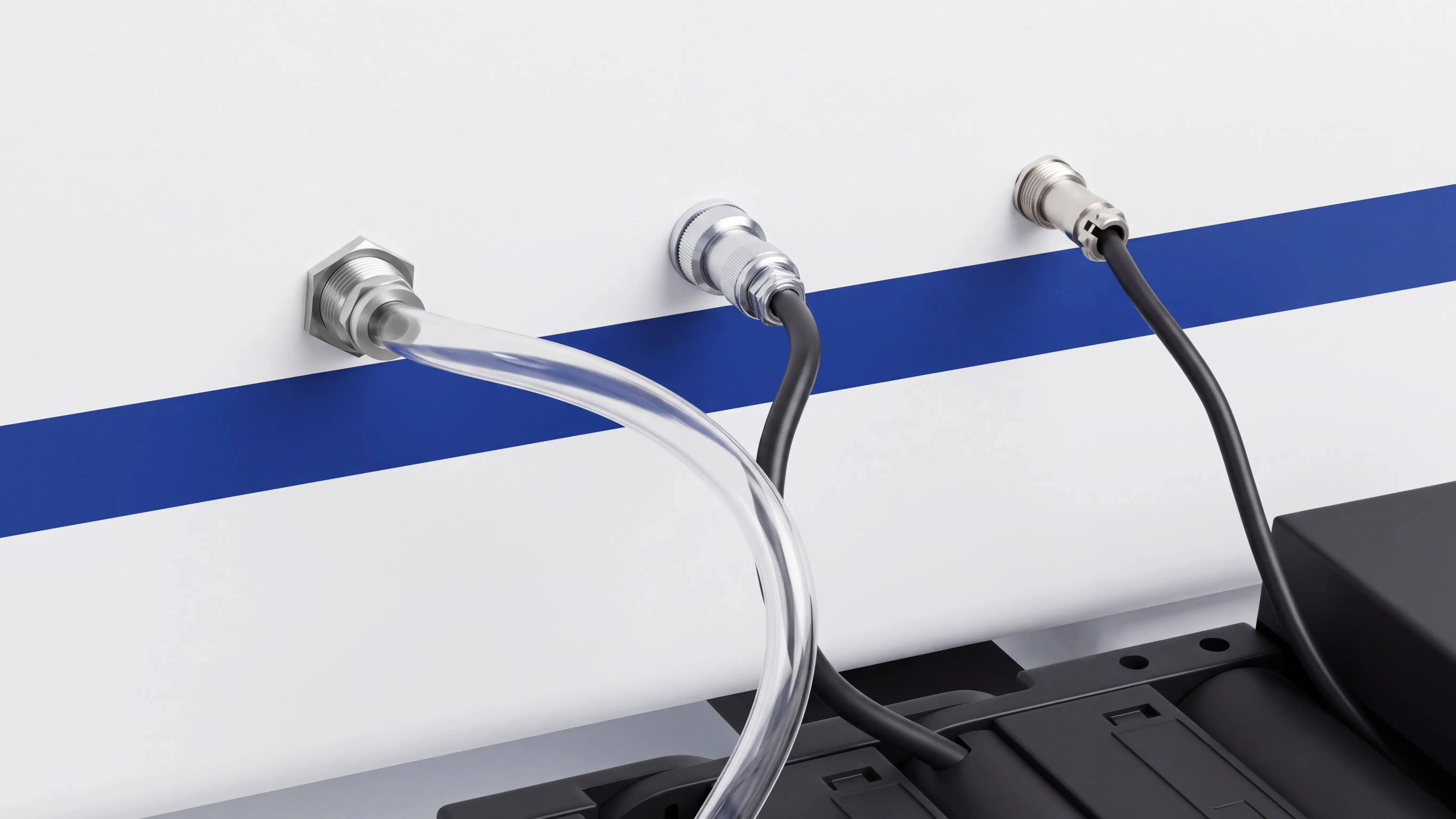
High-Reliability Aviation
Plugs
The machine body connects to the control cabinet via industrial
aviation connectors. Boasting an IP65 protection rating, these
connectors ensure that the interior of the control cabinet
remains perfectly clean and dry even in harsh shop floor
environments, effectively eliminating the risk of short circuits
or signal interference caused by environmental exposure.
Engineered to withstand the continuous vibration and repetitive
impacts of CNC machining, the connectors feature a rugged
housing and a precision-engineered contact design. This
guarantees exceptional electrical conductivity and stable data
transmission under high-intensity operating conditions,
completely preventing loose pins or intermittent connectivity
issues caused by long-term structural vibration.
The convenient "quick-connect & disconnect" design significantly
accelerates installation, commissioning, and teardown
efficiency. It greatly simplifies the operator's workflow during
machine relocation, shop reconfiguration, or routine preventive
maintenance.
Three-Color Audible & Visual
Status Warning System
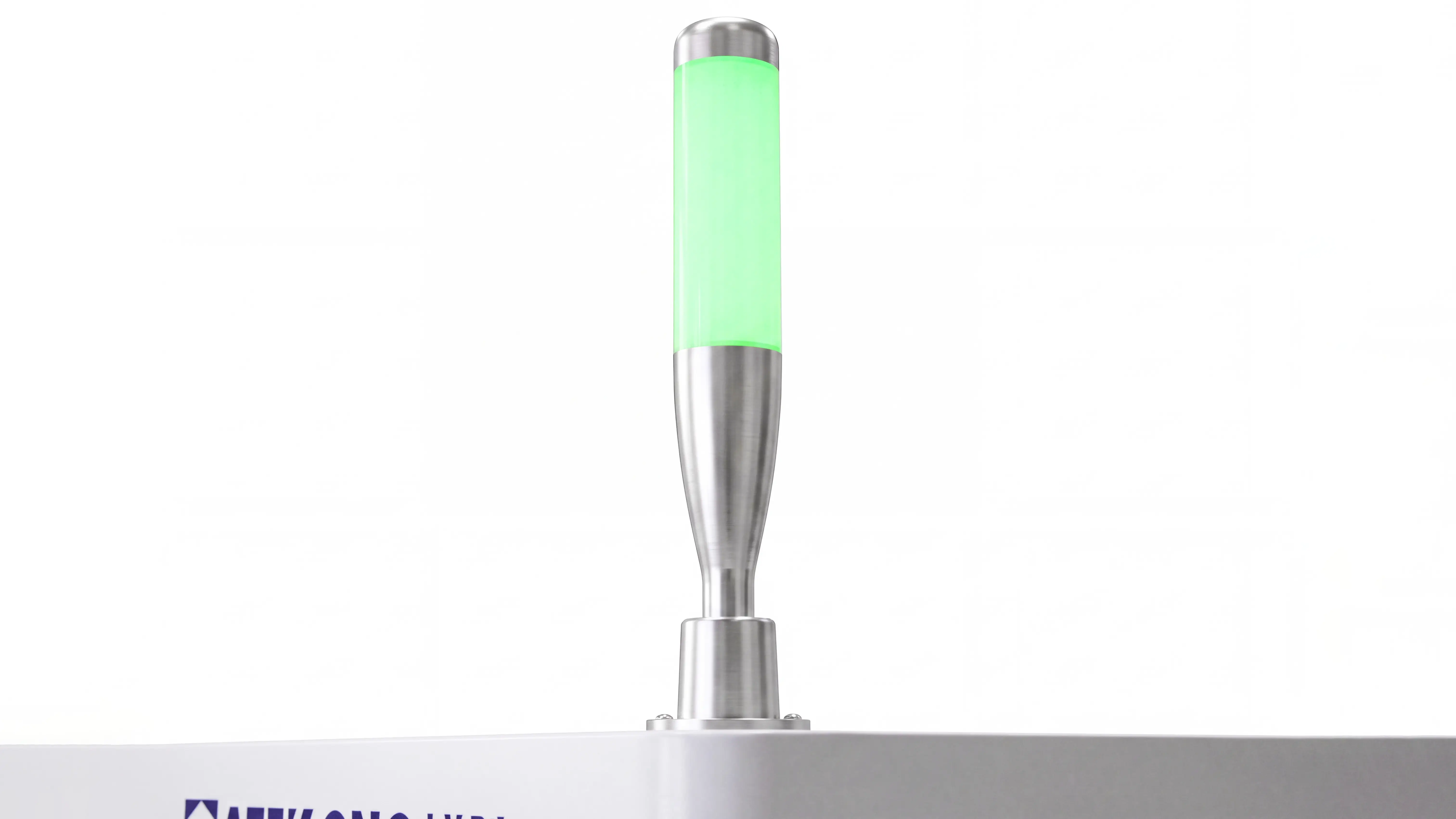
To help operators monitor machine operation, a three-color
signal tower is installed on top of the electrical cabinet,
providing clear visual status indications. Green indicates
normal operation, yellow indicates a stopped or standby state,
and red signals a detected fault or abnormal condition. These
distinct colors allow operators to quickly identify the
machine's current status from different working positions
without constantly monitoring the CNC control interface.
When the system detects an abnormal condition, the red warning
light activates and the built-in buzzer sounds simultaneously,
alerting nearby personnel through both visual and audible
signals. In woodworking environments, where spindle, vacuum
pump, and dust collection noise can make alarms difficult to
hear, the flashing light provides an additional warning channel.
Operators can then check the alarm information on the CNC
system, identify the cause, and take appropriate action
promptly.
The signal tower is mounted at the top of the cabinet for
improved visibility from different operating positions. By
integrating status indicators and fault alerts in one prominent
location, it reduces the need for operators to repeatedly check
the control interface. Working alongside the CNC system's status
monitoring and electrical protection functions, the warning
system makes daily operation, production monitoring, and fault
response more convenient.
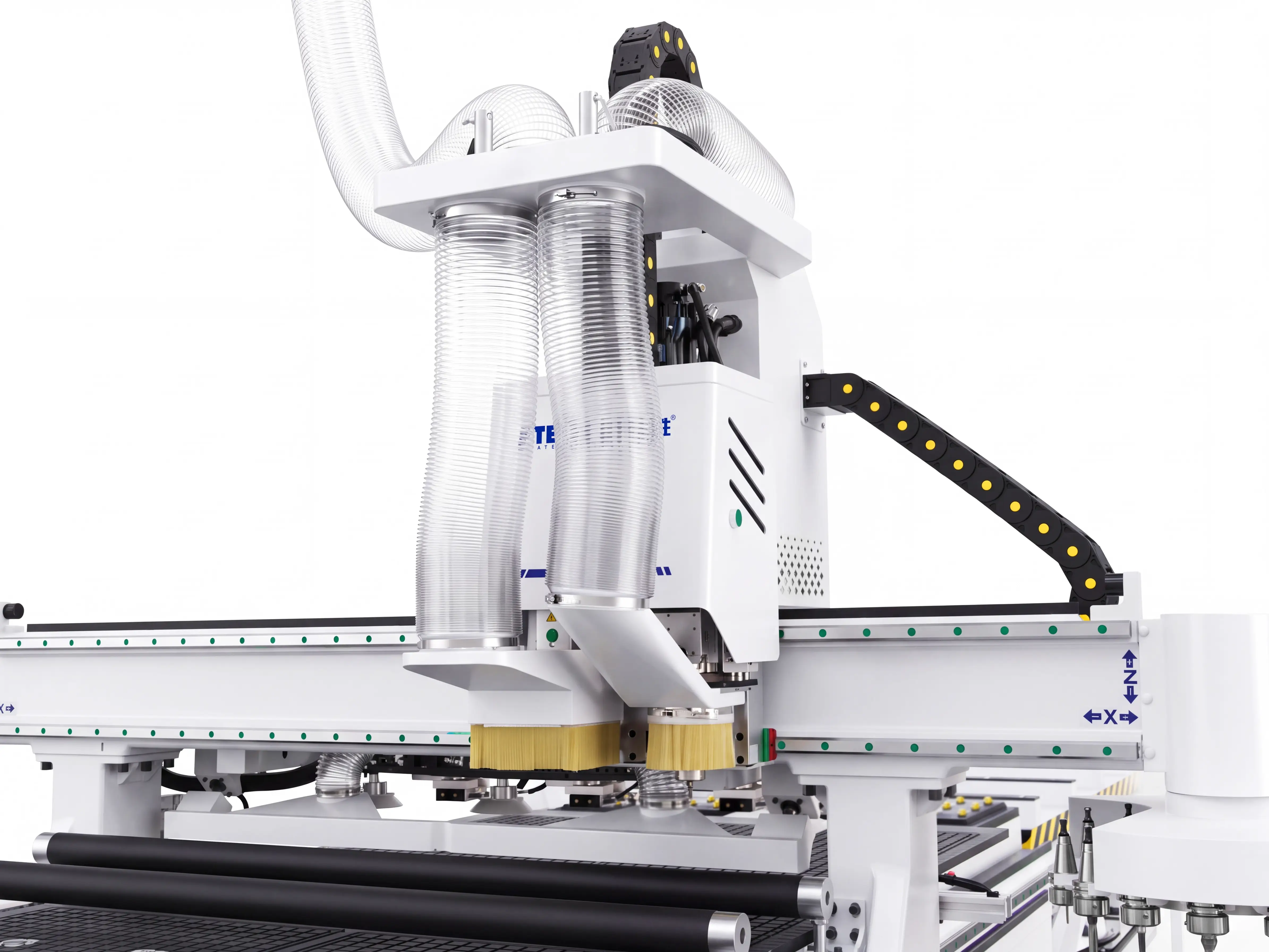
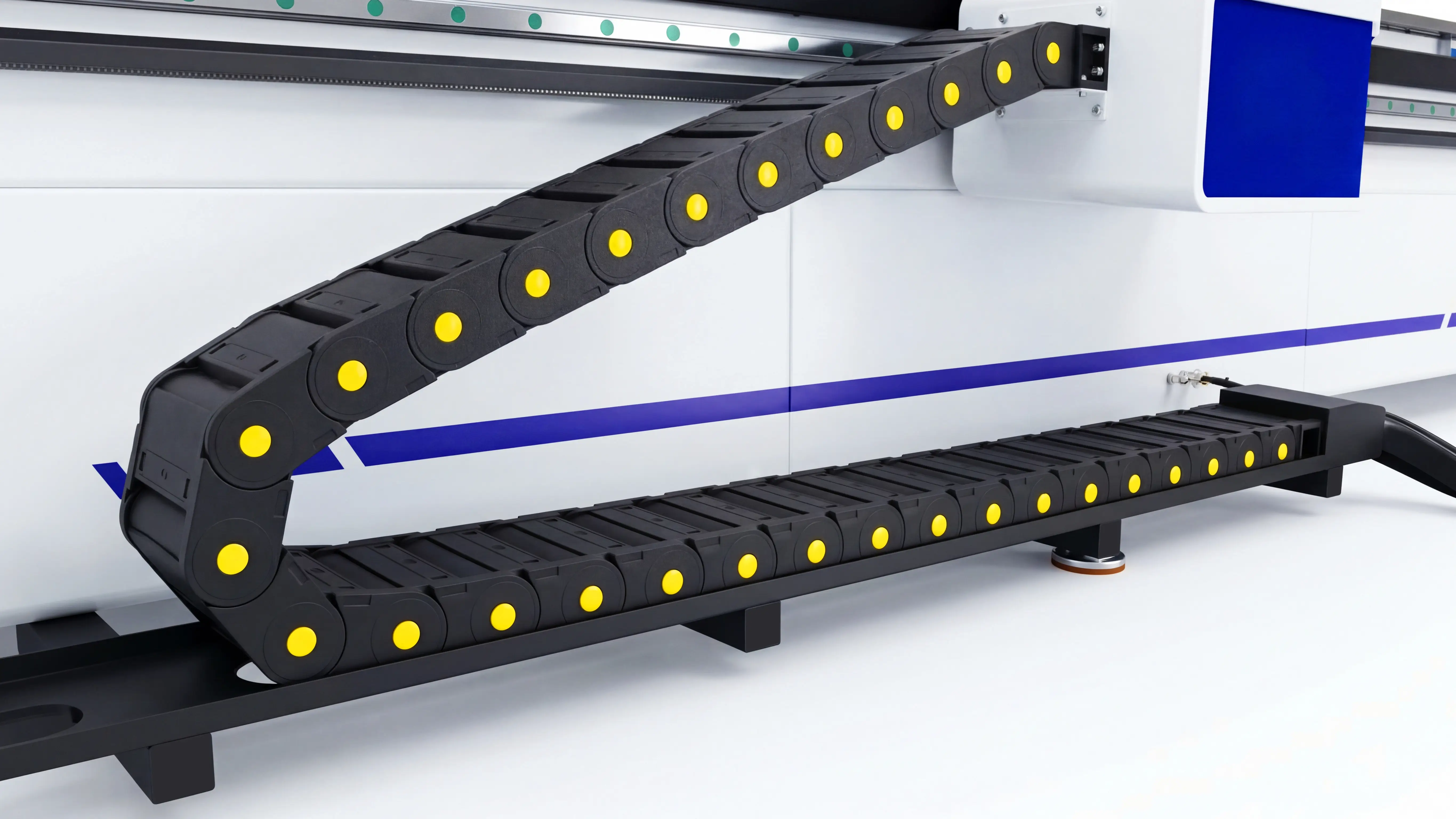
Designed for the dusty conditions of woodworking environments,
the Spire series uses fully enclosed nylon drag chains on all
three XYZ axes. Servo cables, power lines, and air hoses are
neatly housed inside the chains, while the enclosed covers help
block flying wood chips and dust. This reduces direct exposure
to debris and minimizes the risk of cable wear or operational
issues caused by dust accumulation and foreign objects. Compared
with conventional open drag chains, this design is better suited
to long-term operation in dusty CNC machining environments.
As the gantry and axes move back and forth at high speeds, the
drag chains follow their movement paths, providing continuous
support and controlled bending for internal cables and hoses.
This prevents excessive swinging and friction against the
machine structure while reducing cable crossing, tangling, and
over-bending. Made from high-strength nylon, the chains offer
good flexibility and wear resistance, withstanding repeated
bending and the mechanical demands of long-term operation.
The drag chains also provide organized cable routing, keeping
XYZ-axis cables and air hoses along designated paths and away
from the machining area. This reduces the possibility of contact
with moving components and machining debris while keeping the
internal layout neat and organized. The standardized routing
also simplifies future inspection, maintenance, and cable
replacement. By combining cable protection, motion guidance, and
cable management, the fully enclosed drag chains support
reliable long-term machine operation.
Independent Three-Group Power
Wiring System
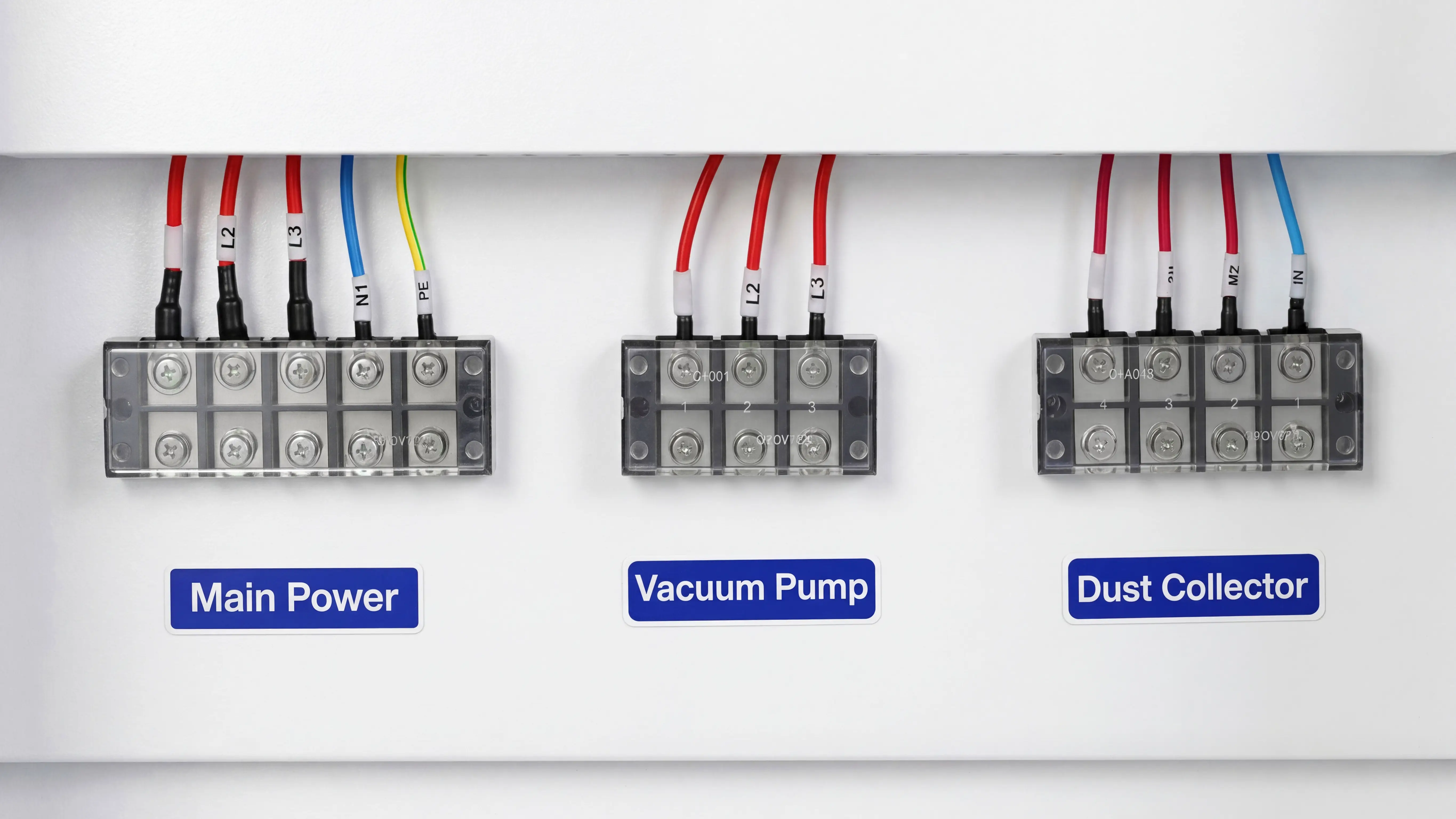
To accommodate the power requirements of different machine
components, the Spire series CNC router features three
independent power terminal groups inside the electrical cabinet.
Each group serves a dedicated power connection circuit. By
organizing power wiring according to function, the system
prevents multiple power cables from becoming tangled or crossing
unnecessarily, keeping the cabinet wiring neat and organized.
Clearly designated terminal areas also help electricians quickly
identify individual circuits during installation, inspection,
and maintenance.
The three terminal groups are assigned to the machine's main
power supply, vacuum pump, and dust collector. External power is
connected through the main power terminals and distributed
according to the machine's electrical design, while the vacuum
pump and dust collector each have dedicated power connections.
Separate wiring paths prevent circuit mixing and allow
independent inspection and maintenance of the vacuum clamping
system, dust collection system, and main power supply.
This function-based terminal layout supports both standardized
factory wiring and long-term maintenance. In the event of a
power supply issue or electrical component replacement,
technicians can quickly locate the corresponding circuit without
tracing through complex cable bundles. Clear circuit separation
also helps reduce the risk of loose connections, crossed wiring,
and maintenance errors, making the electrical cabinet easier to
manage and supporting reliable machine operation.
Automatic Tool Changing and Calibration for Greater
Efficiency.
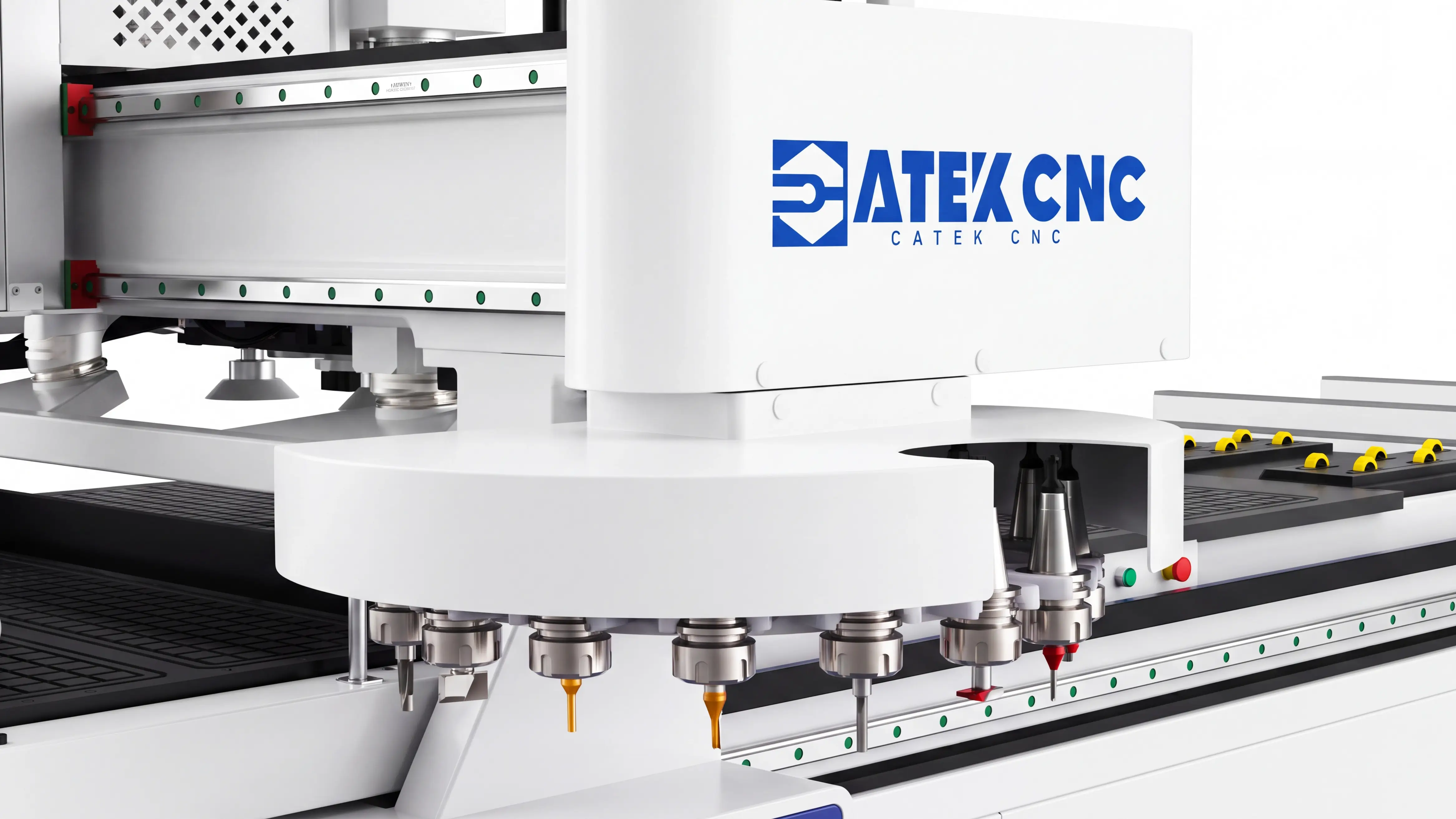
16-Tool Carousel-Type Automatic Tool Changer
Equipped with a 16-tool carousel-type magazine mounted on the right side
of the machine gantry, it accommodates 16 different ISO30 tool
holders at once. Operators can configure cutting tools, milling
cutters, engraving tools, and other tooling according to material
and machining requirements. Its large capacity reduces frequent tool
changes and supports continuous multi-process machining. Unlike
linear tool magazines mounted beneath the gantry, the side-mounted
design does not occupy valuable working space or interfere with
workpiece clamping and machine movement, preserving a more flexible
machining area.
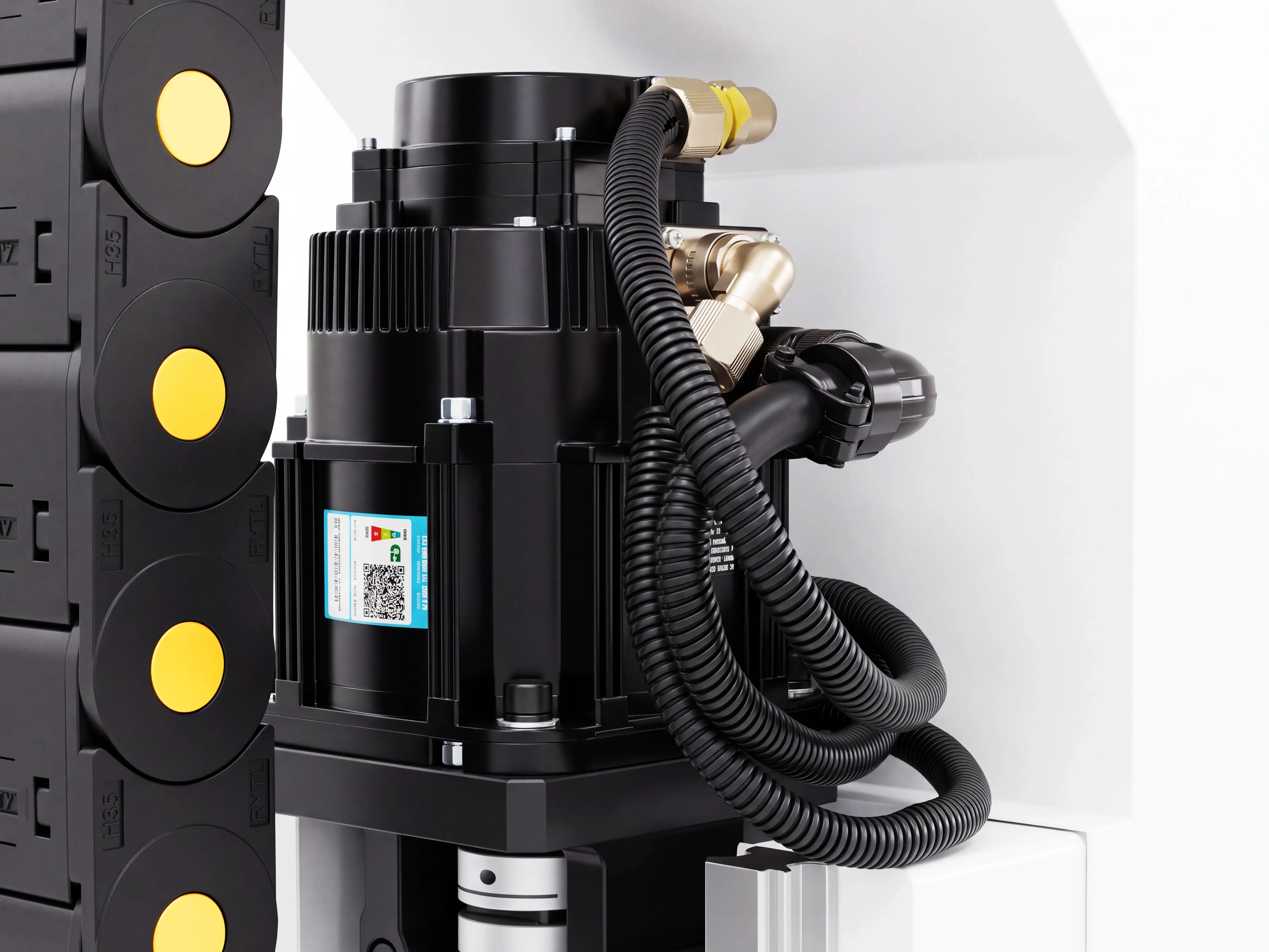
The tool magazine is driven by a Japanese Yaskawa 750W bus absolute
encoder servo motor paired with a Japanese SHIMPO precision
planetary reducer. This combination provides responsive rotation,
accurate tool-position recognition, and reliable positioning. The
servo motor enables fast response, while the reducer increases
torque and ensures smooth, precise transmission. Together, they
allow rapid and stable movement between tool positions, reducing
positioning delays during frequent tool changes.
When a machining operation is complete, the CNC system automatically
moves the X-axis to the tool-changing area on the right side of the
gantry. The magazine rotates to the designated position, returns the
current tool, and positions the required replacement tool before the
automatic tool-changing mechanism completes the exchange. The entire
process is coordinated by the CNC system without manual tool
handling. Combined with the 9kW ATC spindle, it enables seamless
transitions between cutting, milling, grooving, drilling, and
complex contour machining, reducing downtime and improving
production efficiency.
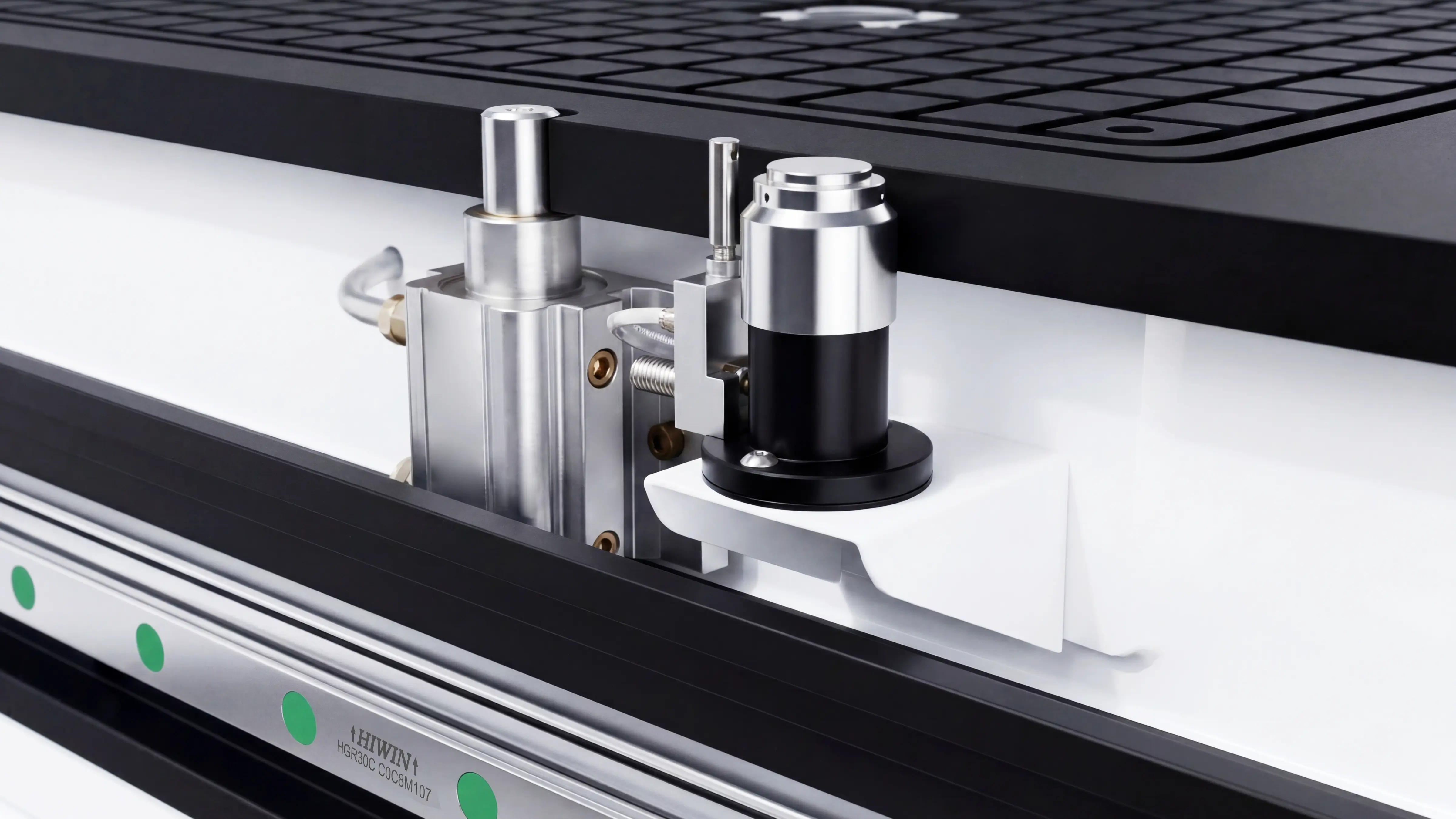
High-Precision Automatic Tool Setter
Equipped with a high-precision automatic tool setter featuring a
20mm-diameter contact surface made of high-hardness tungsten
carbide. Precision grinding and 4S mirror finishing achieve a
surface hardness of over 92 HRA, providing excellent wear resistance
and stable contact. Its precision-ground tungsten carbide core
maintains dimensional stability during repeated measurements, with
repeatability of up to 0.001mm and a contact service life of up to 5
million cycles. It accurately detects tool length differences and
provides reliable compensation data to the CNC system, helping
minimize machining depth deviations.
The tool setter features a blackened stainless steel housing for
improved corrosion resistance and a sealed internal structure rated
IP68 for protection against water, oil, and dust. It is well suited
to CNC machining environments containing wood chips, dust, and oil.
An integrated automatic air-blowing function cleans the contact
surface before measurement, removing debris and contaminants that
could interfere with contact and affect tool length accuracy.
During operation, tool length measurement and calibration are
completed automatically through the CNC system, eliminating
traditional manual measurement. Whether using different tools from
the 16-tool disc magazine or replacing tools due to wear, the system
automatically measures tool lengths and applies the corresponding
compensation values. This reduces manual measurement and
recalibration time, minimizes human error, and improves machining
consistency and efficiency during continuous multi-tool production.
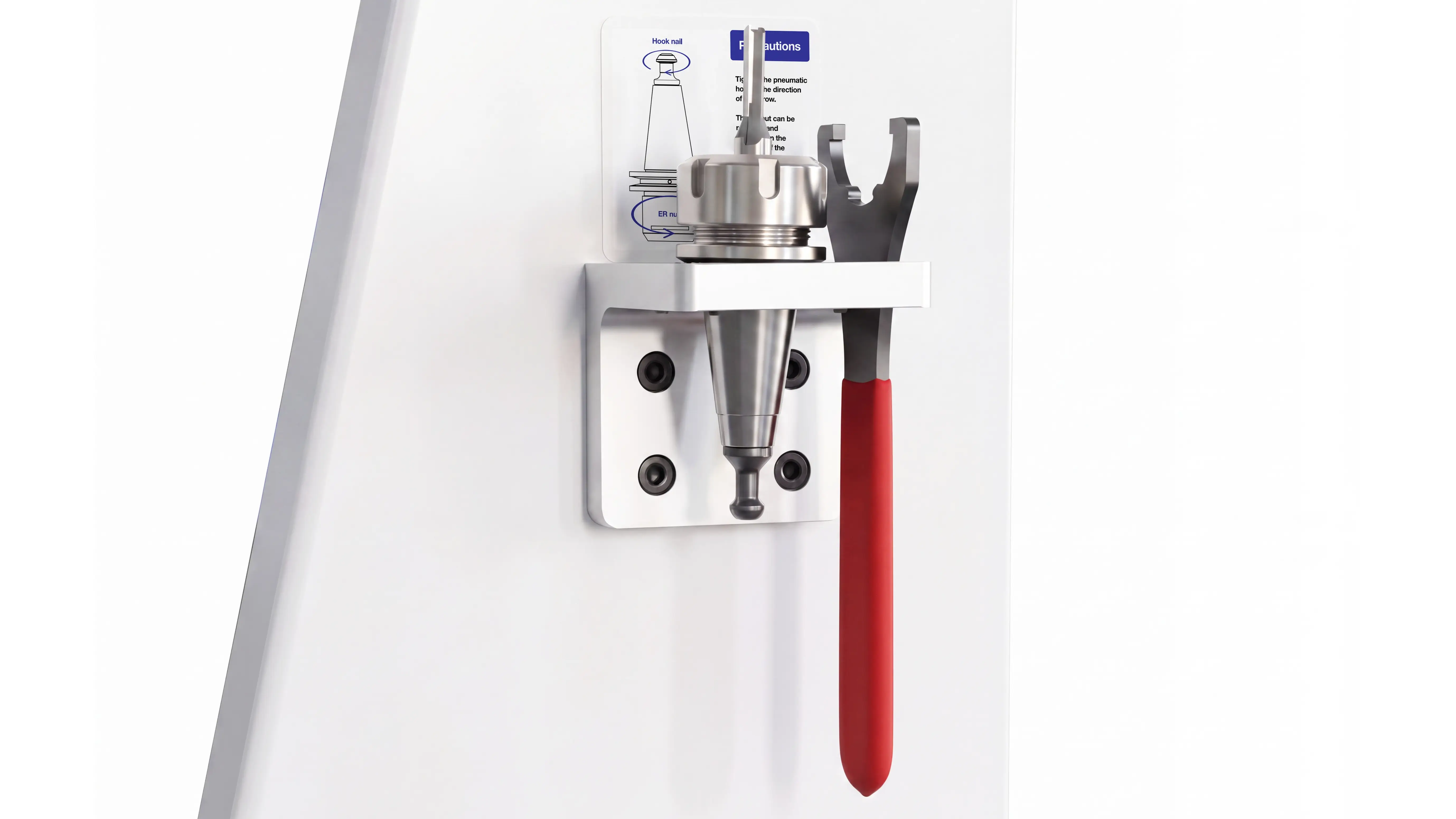
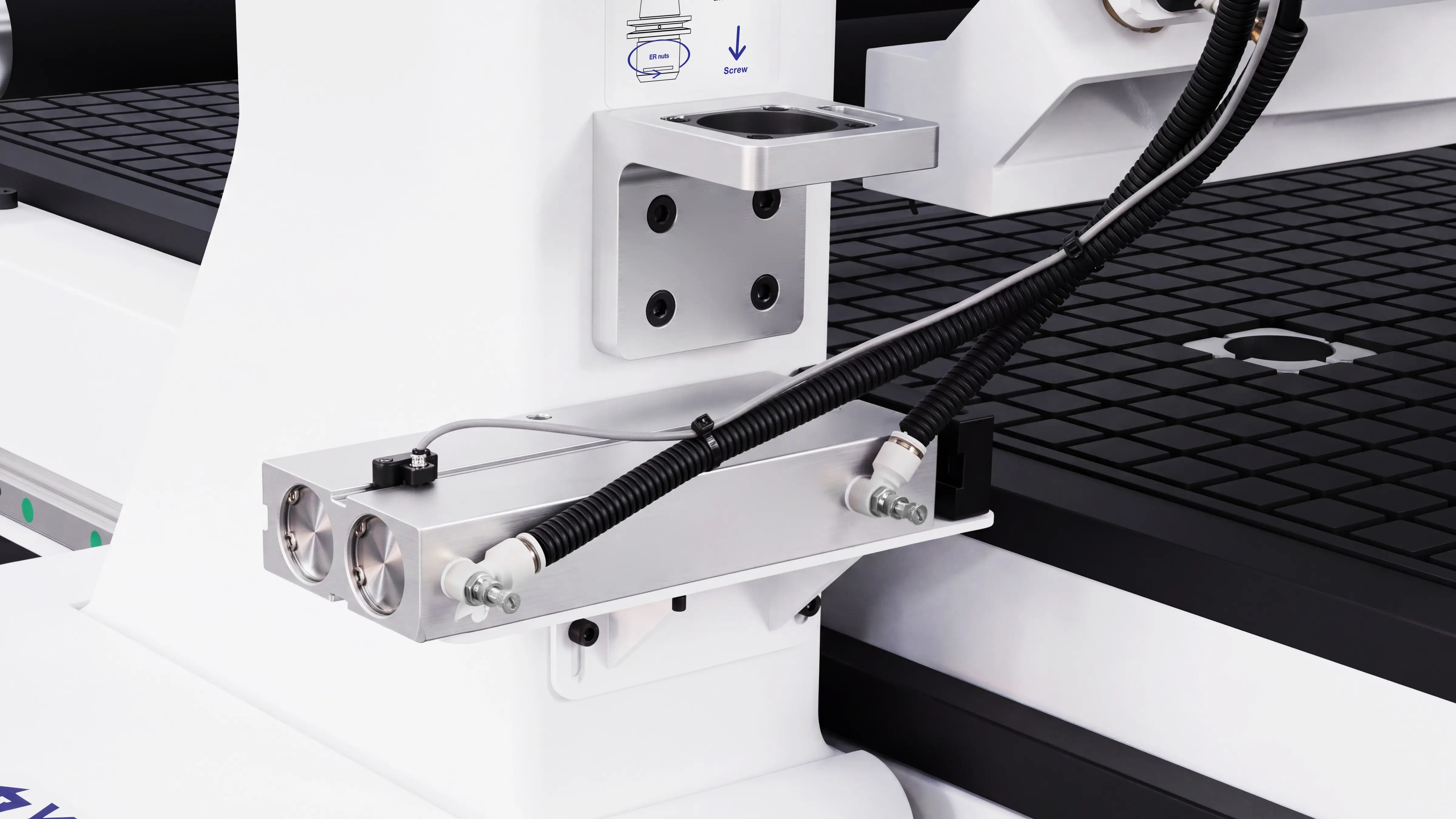
ISO Tool Holder Quick-Release Fixture
For convenient tool changes and routine maintenance, an ISO tool
holder quick-release fixture is mounted on the right side of the
vertical upright. Its main body features a one-piece machined
aluminum alloy structure, combining lightweight construction with
reliable mounting strength. The reinforced steel locating slot
provides additional strength and wear resistance. Simply place the
ISO tool holder into the designated slot, where it is securely
supported and positioned for easier tool removal and installation.
Designed for ER32 tool holders, the fixture works with a dedicated
ER32 wrench to loosen and tighten the tool holder's locking nut.
Once the holder is secured in the locating slot, operators can use
the wrench to remove or replace the cutting tool. The stable support
prevents the holder from slipping or rotating during operation,
eliminating the inconvenience of holding the tool holder by hand
while using the wrench and helping prevent damage caused by improper
handling.
Since tool changes are a frequent maintenance task, the fixture is
conveniently mounted on the side of the vertical upright, close to
the working area. Operators can perform tool replacement, cleaning,
maintenance, and adjustment without searching for additional
fixtures or occupying the vacuum clamping table. The combination of
an aluminum alloy body and reinforced steel locating slot provides
durable support while keeping tool changes and routine maintenance
simple and convenient.
The Intelligent Dual-Mode Workbench and Positioning
System Save Time and Labor Costs.
6 Zones Vacuum Worktable
Vacuum Zone Control Switches
4+2 Positioning Cylinders
Pneumatic Pressure Roller
Side-Positioning Telescopic Cylinder
Auxiliary Loading Rollers
Rear Control Switches
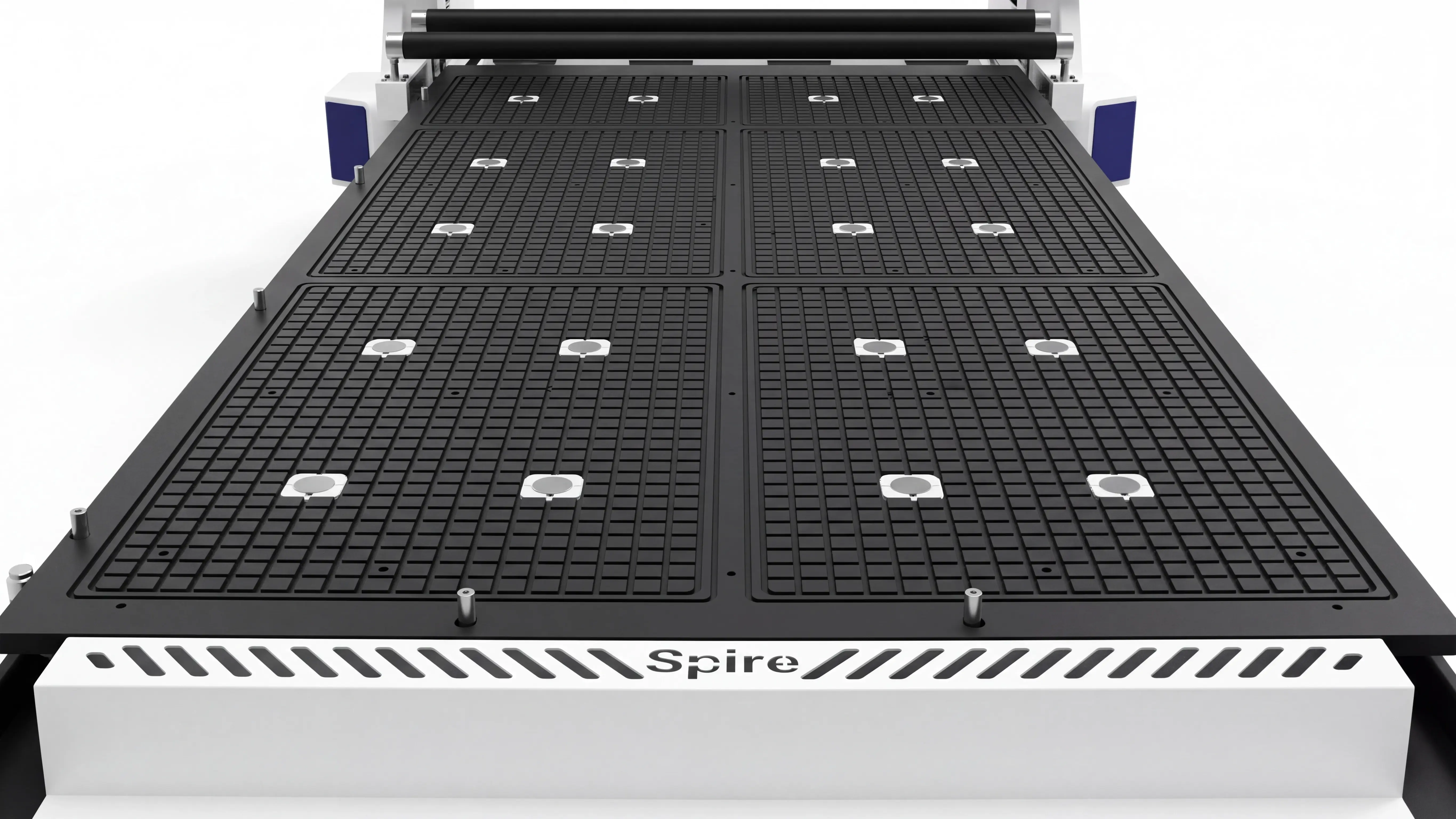
Equipped with a large 1500 × 3100mm vacuum clamping table, the
machine accommodates a wide range of panel sizes up to 5 × 10 ft,
meeting the large-format machining needs of furniture manufacturing,
cabinet production, and panel processing. Using vacuum negative
pressure generated by the vacuum pump, the table securely holds
workpieces against its surface, reducing the need for traditional
mechanical clamps that occupy valuable machining space. It provides
stable, evenly distributed clamping for cutting, grooving,
profiling, and complex contour machining, helping prevent panel
movement during operation while simplifying loading and positioning.
The vacuum table features six independently controlled zones with 20
vacuum ports. Each zone can be switched on or off according to the
workpiece size and placement. Operators can activate only the areas
covered by the panel, avoiding unnecessary vacuum loss in uncovered
sections and improving system efficiency. Compared with full-table
vacuum clamping, this zoned design offers greater flexibility for
both large panels and smaller workpieces of different sizes.
The vacuum clamping table supports a wide range of materials,
including solid wood, MDF, plywood, acrylic, PVC, and melamine-faced
boards. From furniture panel nesting and cabinet door profiling to
acrylic and PVC cutting and engraving, operators can select the
appropriate vacuum zones for secure and efficient workpiece holding.
Combined with six-zone independent control and 20 vacuum ports, the
system adapts to different panel sizes, machining positions, and
production requirements, making it suitable for custom furniture,
panel furniture, and diversified material processing.
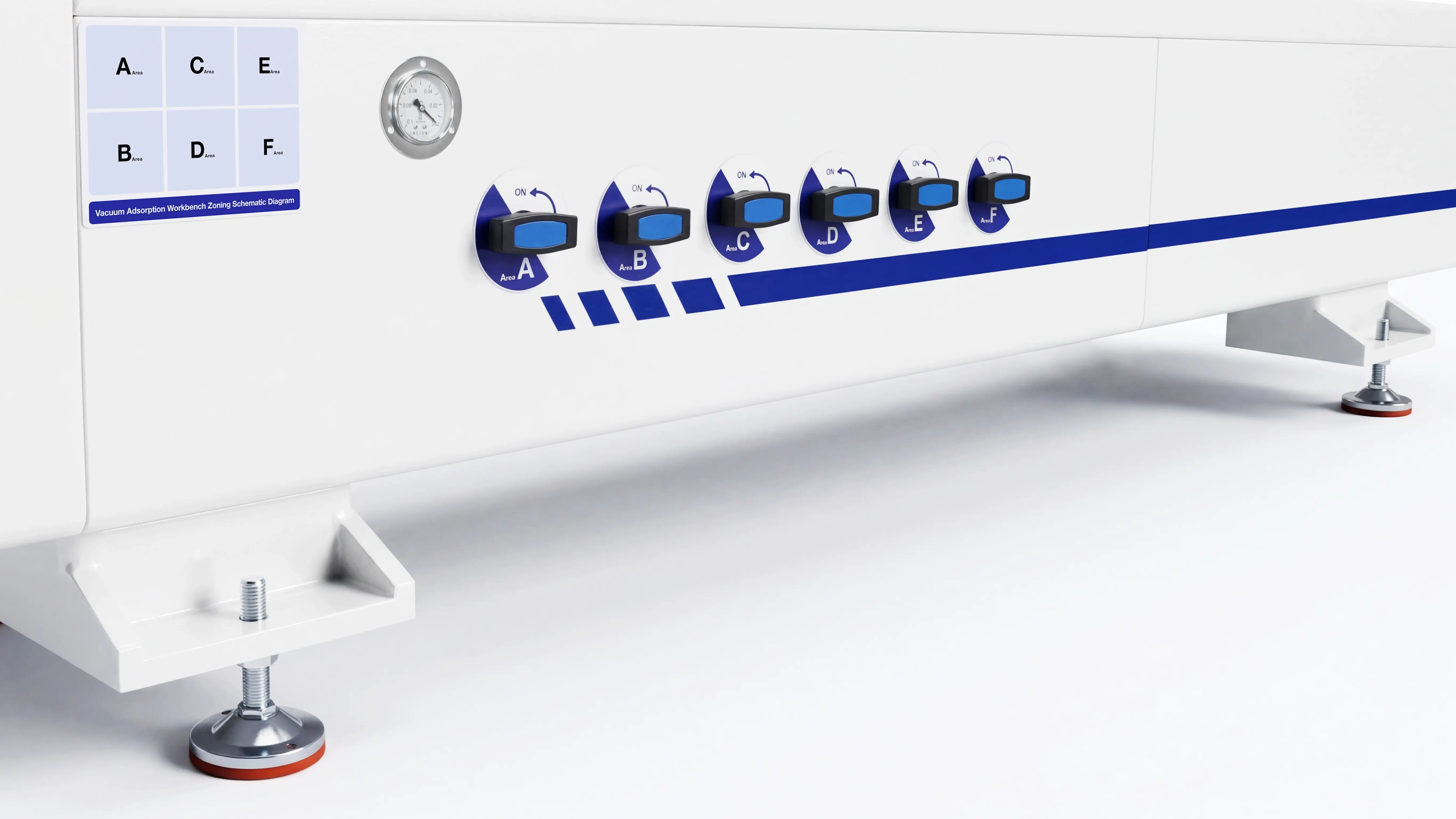
The vacuum clamping table is equipped with six independently
controlled zones, each of which can be switched on or off
individually. Operators can select the required vacuum zones
according to the panel dimensions, positioning, and machining area.
When processing full-size panels, multiple zones can be activated to
expand the effective clamping area. For smaller panels or localized
workpieces, only the corresponding zones need to be enabled,
preventing unnecessary vacuum draw in uncovered areas and reducing
wasted energy. This independent zone control allows the vacuum
system to adapt flexibly to different workpiece sizes and clamping
requirements.
Each zone features a full-copper vacuum ball valve for quick and
reliable control of vacuum airflow. The copper valve body offers
good corrosion resistance and durability, making it suitable for
long-term operation within the vacuum system. Its straightforward
design provides clear open and closed positions, allowing operators
to switch vacuum zones quickly without complicated system settings,
even during frequent changes in daily production.
The control panel also features a vacuum pressure gauge for
real-time monitoring of negative pressure, helping operators assess
the current clamping status and determine whether the vacuum level
is sufficient to secure the workpiece. A vacuum zone layout diagram
is mounted on the side of the control panel, clearly identifying
each zone and its corresponding valve. This makes the control
arrangement easier to understand and helps reduce operating errors.
By combining pressure monitoring, a zone layout diagram, and
independent ball valve controls, the system provides more intuitive
operation and simplifies routine inspection and maintenance.
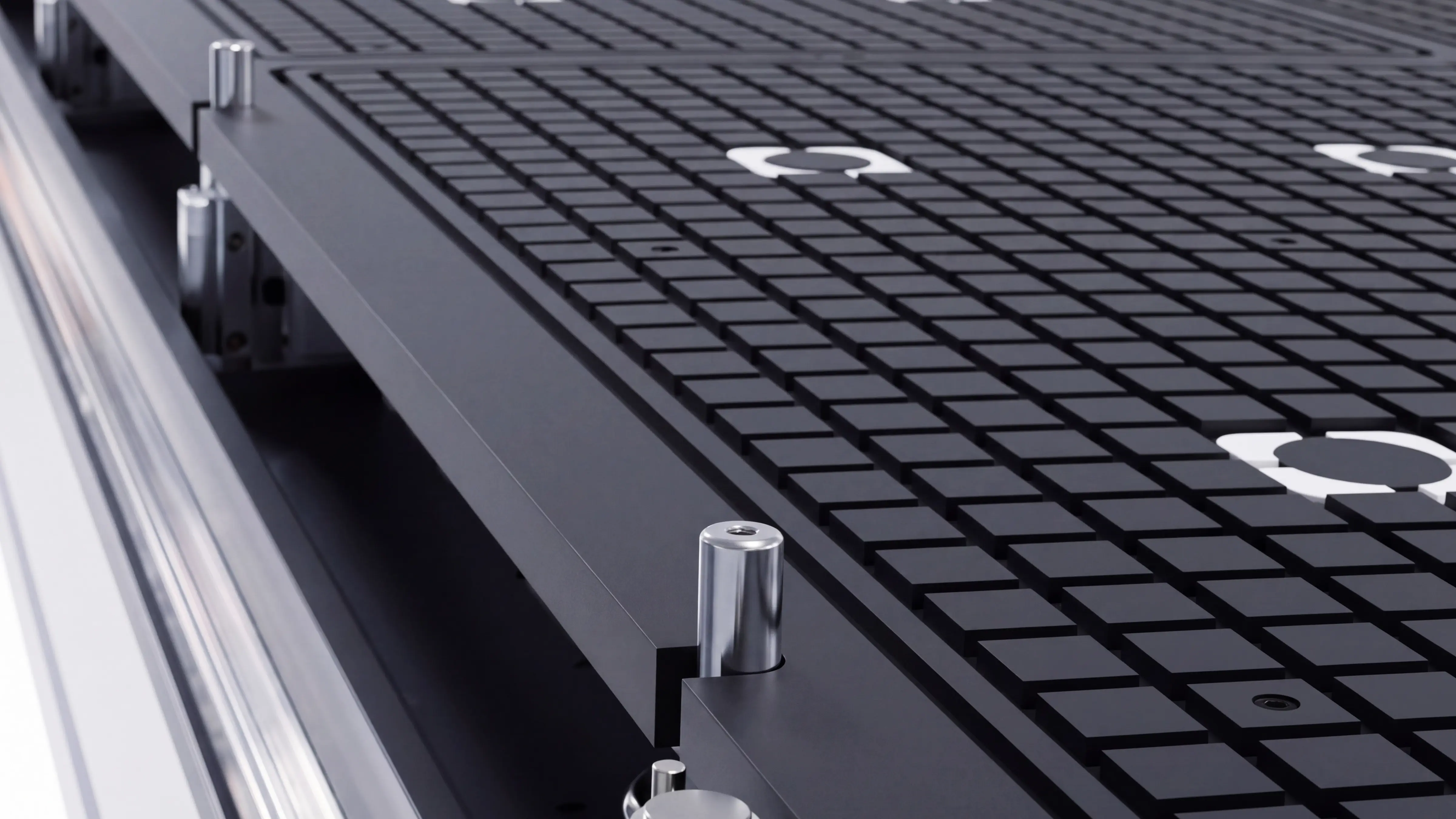
The worktable is equipped with six pneumatic automatic positioning
cylinders arranged in an L-shaped layout. Four cylinders are
installed along the left side of the Y-axis, while two are
positioned at the front of the X-axis. These two perpendicular
positioning groups form a precise right-angle reference. After
automatic loading, the cylinders rise to establish the X- and Y-axis
positioning references. The panel is simply pushed against both
reference edges to achieve quick and accurate alignment. Compared
with repeated manual measuring and adjustment, pneumatic positioning
simplifies the loading process, reduces operator intervention, and
improves positioning consistency and batch production efficiency.
Controlled by the CNC system, the positioning cylinders extend and
retract automatically according to the machining sequence. During
loading, they rise to provide reliable edge references. Once
positioning is complete, they can retract as required by the
machining program to prevent interference with subsequent
operations. The L-shaped arrangement constrains the panel along two
perpendicular directions, helping prevent misalignment and
inconsistent positioning. This is particularly useful for automated
loading and continuous machining of large panels, improving
positioning repeatability between workpieces.
The 4+2 positioning system also simplifies realignment during
two-sided machining. After completing drilling, grooving, or other
operations on one side, the panel can be flipped and pushed against
the same L-shaped positioning references to quickly re-establish its
original alignment. This eliminates the need for repeated manual
measurements and complex coordinate adjustments. For furniture
panels, cabinet doors, and irregularly shaped workpieces requiring
machining on both sides, the system reduces repositioning time and
manual alignment errors while helping maintain consistent machining
references between the two faces.
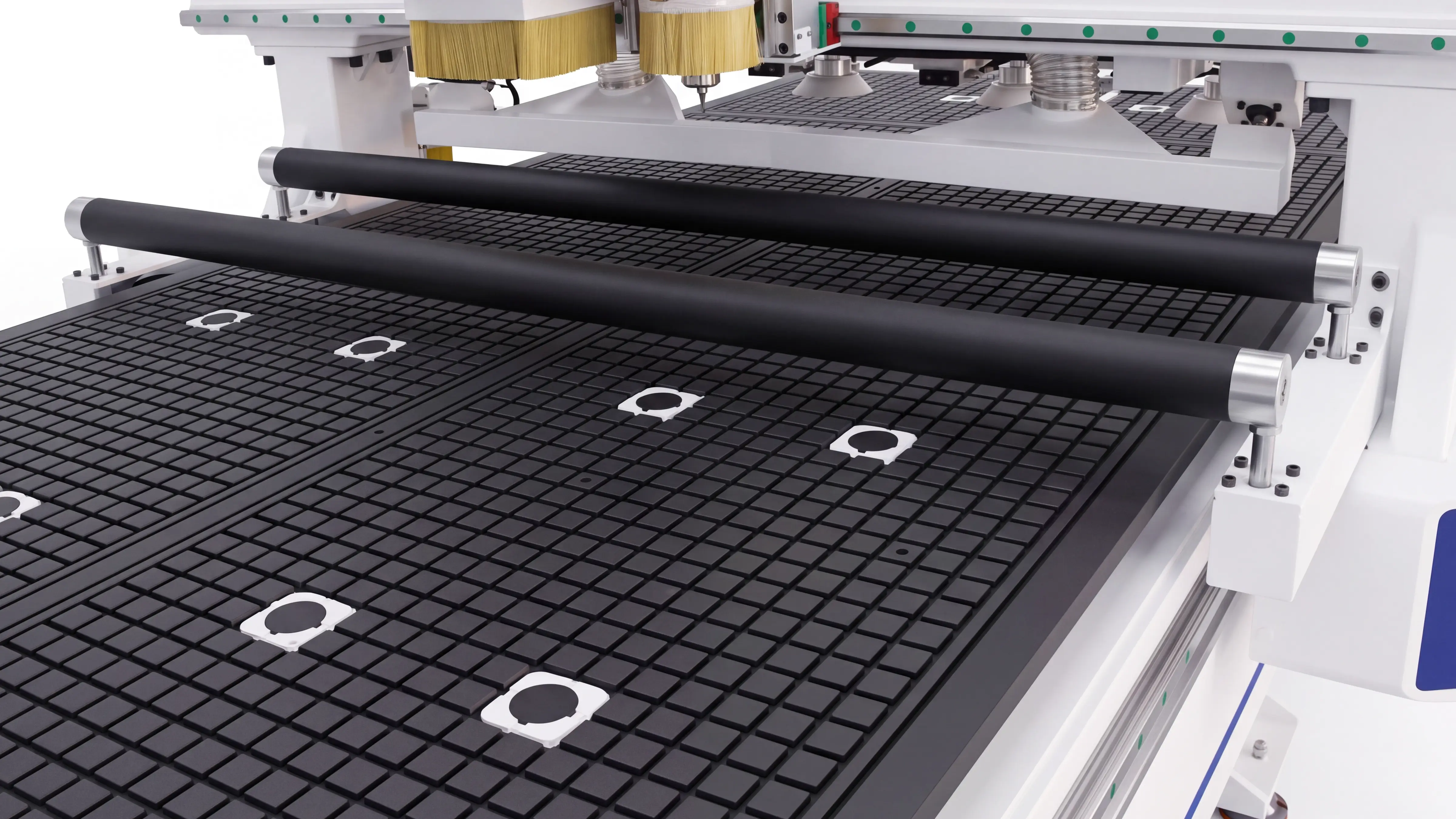
The machine is equipped with dual-rod pneumatic pressure rollers,
with each roller featuring two independently controlled lifting
cylinders. The pressing position can be adjusted to suit different
panel thicknesses and machining requirements. As the gantry moves,
the rollers travel synchronously with it, continuously applying
downward pressure during cutting. This improves contact between the
panel and worktable, helping prevent lifting, vibration, and
displacement caused by cutting forces. The dual-rod design provides
stable auxiliary clamping across the machining area, making it
particularly suitable for large panels, high-speed cutting, and
continuous production.
Each roller features a fully rubber-coated exterior, providing
flexible contact with the panel surface. Compared with direct
contact from rigid metal clamping components, the elastic rubber
coating distributes and cushions the applied pressure, helping
reduce dents, scratches, and damage to decorative finishes. This is
especially beneficial when processing melamine-faced boards,
PVC-faced panels, and other furniture materials with high
surface-finish requirements. It maintains stable clamping while
helping protect the panel's appearance and improve finished surface
quality.
The dual-rod pneumatic pressure rollers can work alongside the
vacuum clamping system or operate independently. When a workpiece
can be securely held by the pressure rollers alone, the vacuum
system can be switched off, reducing vacuum pump operating time and
energy consumption. For large panels or high-speed cutting
applications requiring greater holding force, both systems can be
activated to provide combined downward pressure and vacuum clamping.
For standard panels, operators can choose either method according to
the actual requirements. These flexible clamping options allow the
Spire 1531 CNC router to accommodate different materials, workpiece sizes, and
machining processes while balancing machining stability, production
efficiency, and energy consumption.
The machine is equipped with auxiliary side-positioning cylinders on
the right side of the gantry and at the rear of the worktable.
Working together with the 4+2 automatic positioning cylinders, they
form a multi-directional positioning system. By applying pushing
force from the rear and right sides, the auxiliary cylinders correct
the panel's alignment and guide it toward the preset positioning
references. Compared with single-direction positioning, this
coordinated arrangement better accommodates panel position
variations during automatic loading, reducing misalignment and
making the positioning process smoother and more consistent.
Once a panel is transferred from the automatic loading platform onto
the machining table, the auxiliary positioning cylinders extend
automatically and push the panel from its rear and right edges
toward the reference points established by the 4+2 positioning
cylinders. This ensures that the panel edges fit securely against
the positioning stops. The entire process is completed
automatically, eliminating repeated manual measurements and
adjustments while simplifying post-loading alignment and reducing
setup time.
Working in coordination with the 4+2 positioning cylinders, the
auxiliary side-positioning system helps align every automatically
loaded panel to a consistent reference position. For batch
processing of wardrobe doors, cabinet side panels, furniture
shelves, and other panel components, it reduces machining deviations
caused by inconsistent placement and improves positioning
repeatability across successive workpieces. Integrated with the CNC
system's automated workflow, this coordinated positioning
arrangement standardizes panel alignment during continuous
production and helps maintain machining accuracy and finished-part
dimensional consistency.
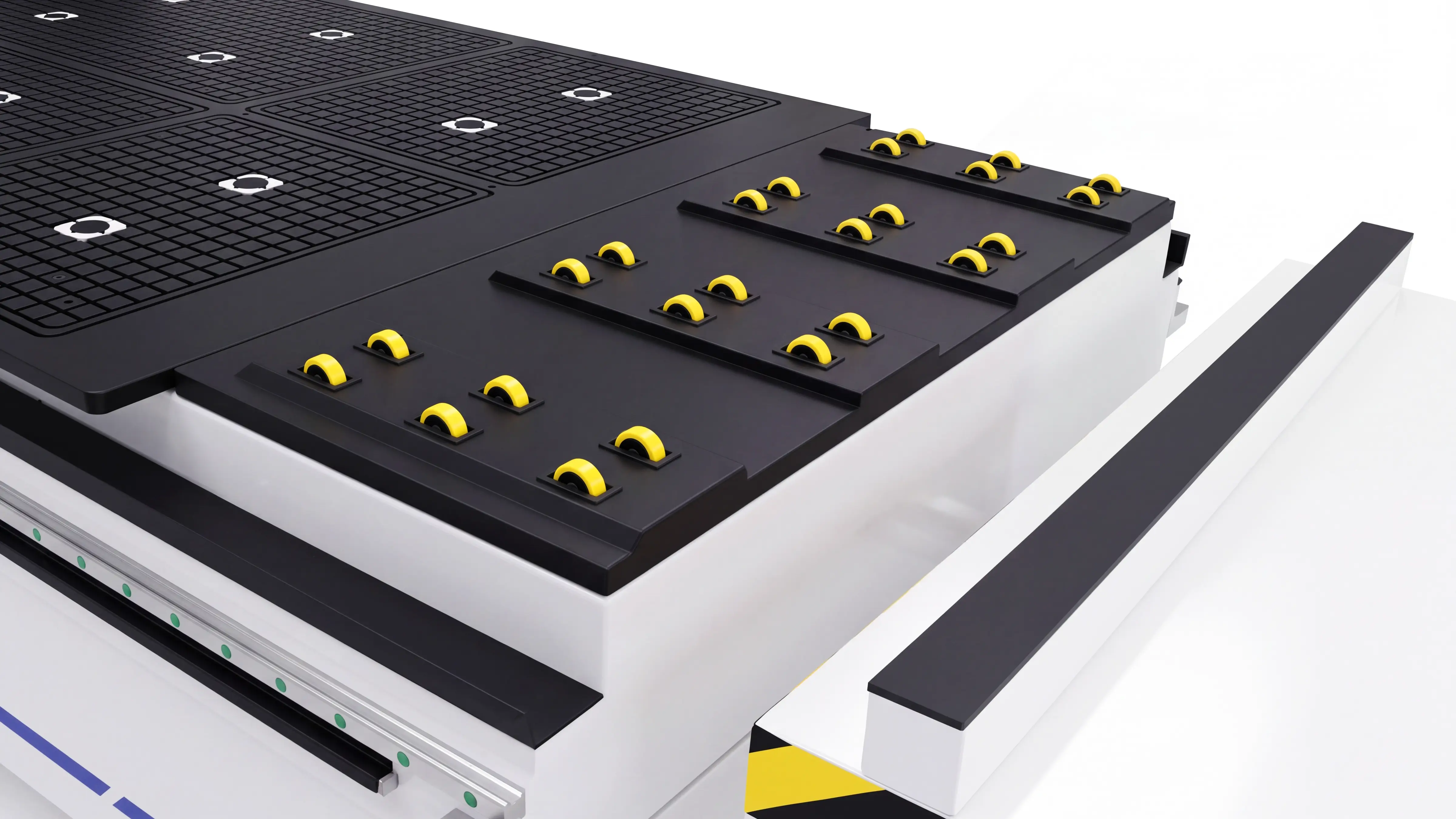
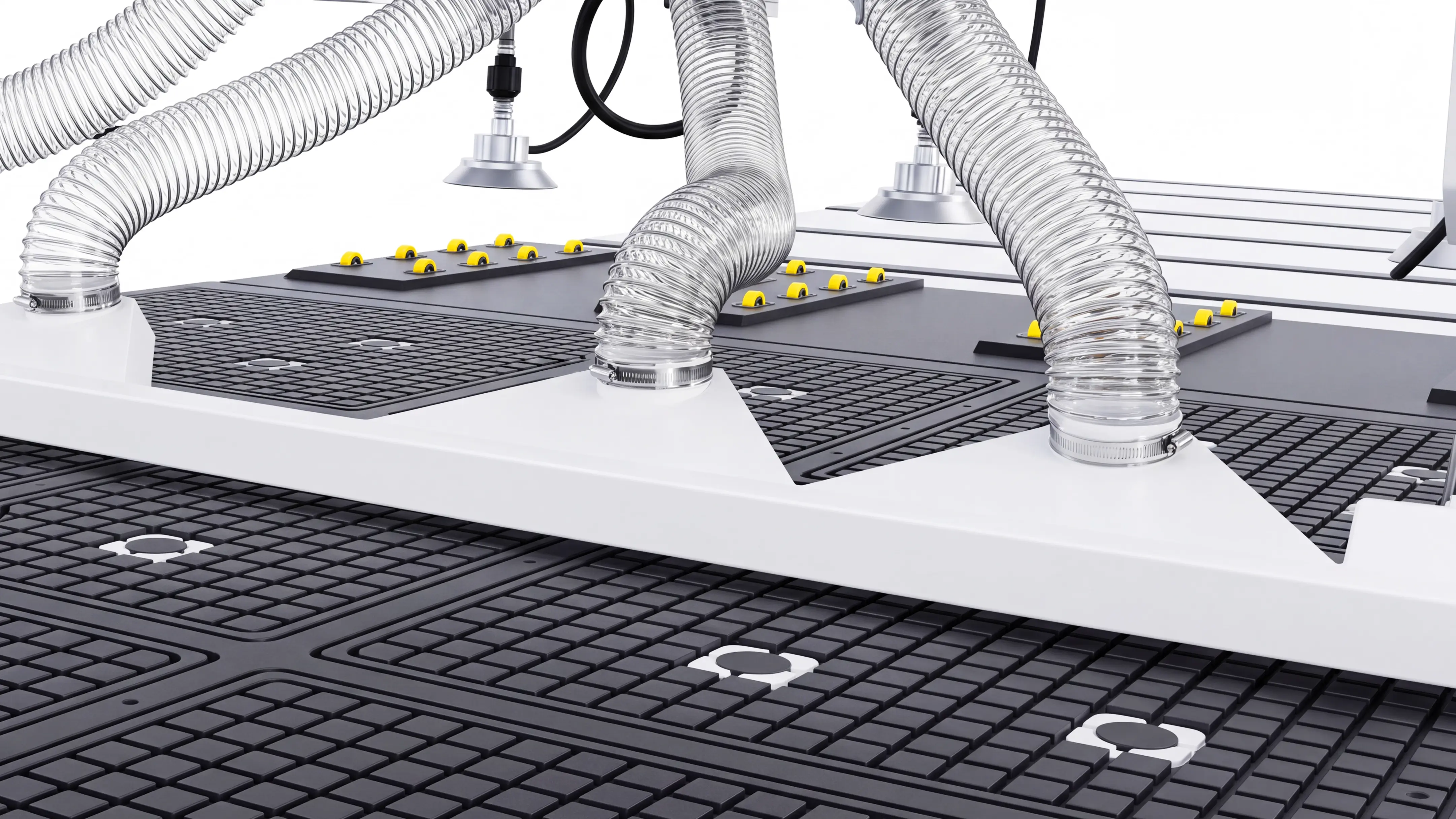
The rear loading area is equipped with 24 auxiliary rollers, evenly
distributed and positioned to connect with the hydraulic lifting
loading platform. Designed for high load capacity, wear resistance,
and low-noise operation, these precision rollers provide continuous,
evenly distributed support for panels of different sizes and
weights. Their smooth surfaces offer low rolling resistance,
allowing panels to move freely while reducing friction against fixed
support surfaces and minimizing the risk of scratches or surface
wear. Whether handling standard thin panels, large-format sheets, or
long and heavy workpieces, the multi-point roller support helps
ensure smooth feeding while reducing tilting, jamming, and uneven
movement.
In manual loading mode, the 24 rollers provide ample rolling
support, allowing operators to push large or long panels smoothly
onto the worktable without requiring multiple people to lift and
carry them. Compared with dragging panels directly across a fixed
table surface, roller-assisted feeding significantly reduces
friction and manual effort while helping prevent edge collisions and
surface scratches during handling. This makes manual loading more
convenient and efficient for flexible production involving small
batches, multiple product types, and frequent order changes.
In automatic loading mode, the 24 auxiliary rollers work in
coordination with the hydraulic lifting platform and three groups of
vacuum suction cups. Once the suction cups grip the panel, the
Y-axis servo drive moves it smoothly across the roller-supported
area and accurately positions it above the vacuum clamping table.
The pneumatic positioning system then completes automatic placement
and alignment. The rollers provide support and assist feeding, the
vacuum cups grip and pull the panel, and the servo system controls
its movement. Together, these mechanisms reduce friction and
resistance during material transfer, ensuring smoother automatic
loading. Combined with automatic positioning, vacuum clamping, and
subsequent machining operations, the system supports a continuous
workflow from material storage and pickup to feeding, positioning,
and machining, helping enable unattended batch production.
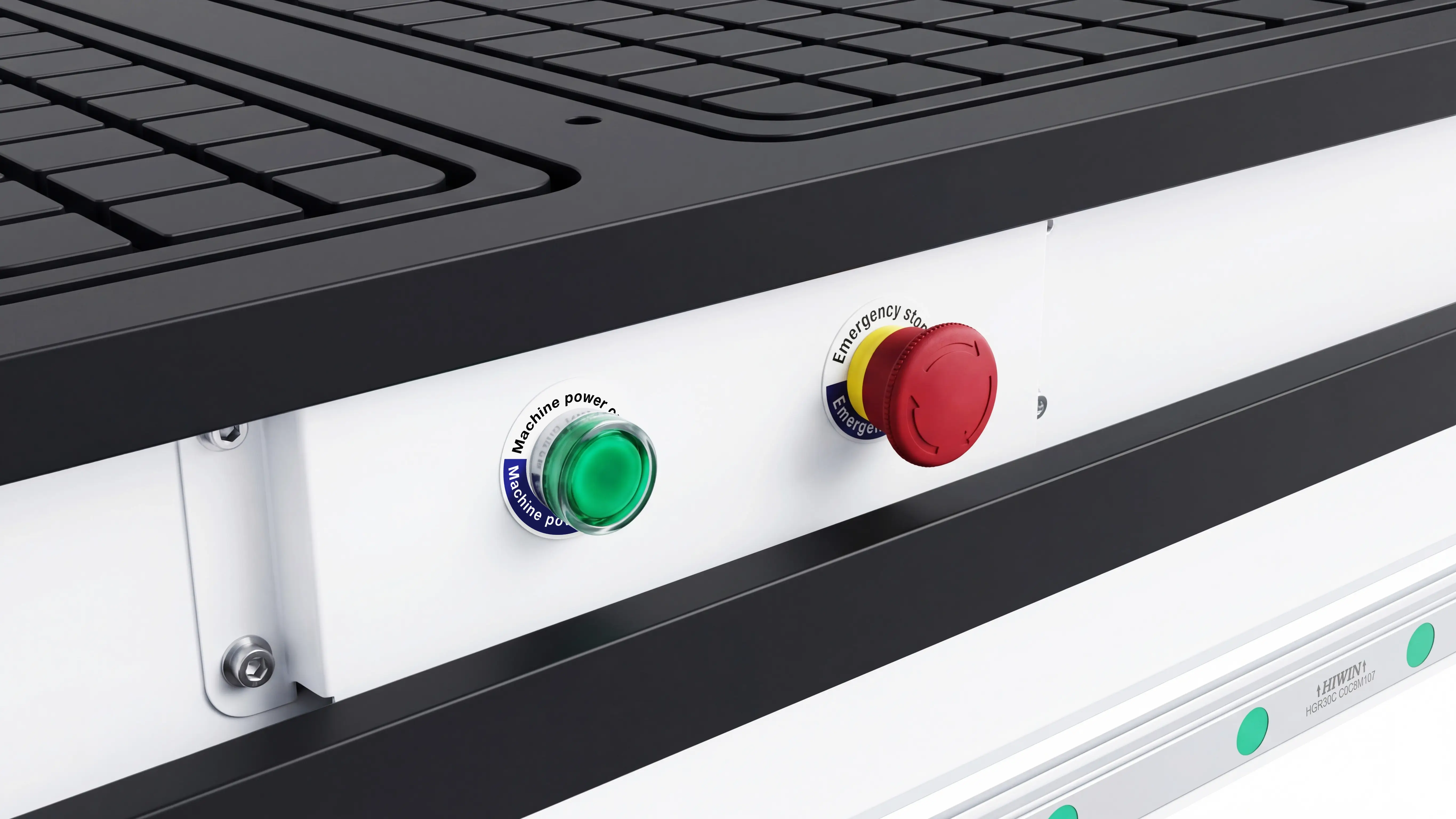
The rear of the worktable is equipped with dual-control operation
switches featuring Schneider Electric push buttons. The cycle start
and emergency stop functions are conveniently located near the
machining area, allowing operators to control the machine without
repeatedly walking back to the electrical cabinet. This makes it
easier to start automatic machining cycles and perform shutdown
operations during daily production.
The cycle start button quickly initiates the machine's automatic
machining cycle once panel loading, positioning, and preparation are
complete, simplifying the operating process. The emergency stop
button allows operators to stop the machine promptly in the event of
an abnormal situation. It is integrated with the emergency stop
circuit on the electrical cabinet, enabling shutdown from either
operating position and reducing response time during emergencies.
The rear switches work in coordination with the machine's main
control system, allowing cycle start and emergency stop functions to
be operated from different positions. This is particularly
convenient during automatic loading, unloading, and continuous
production, as operators can perform routine operations without
returning to the electrical cabinet. In the event of an emergency,
the nearby stop button also provides quick access to shutdown,
improving both operational convenience and machine safety.
Auto Loading & Unloading, Achieving Complete Process Automation
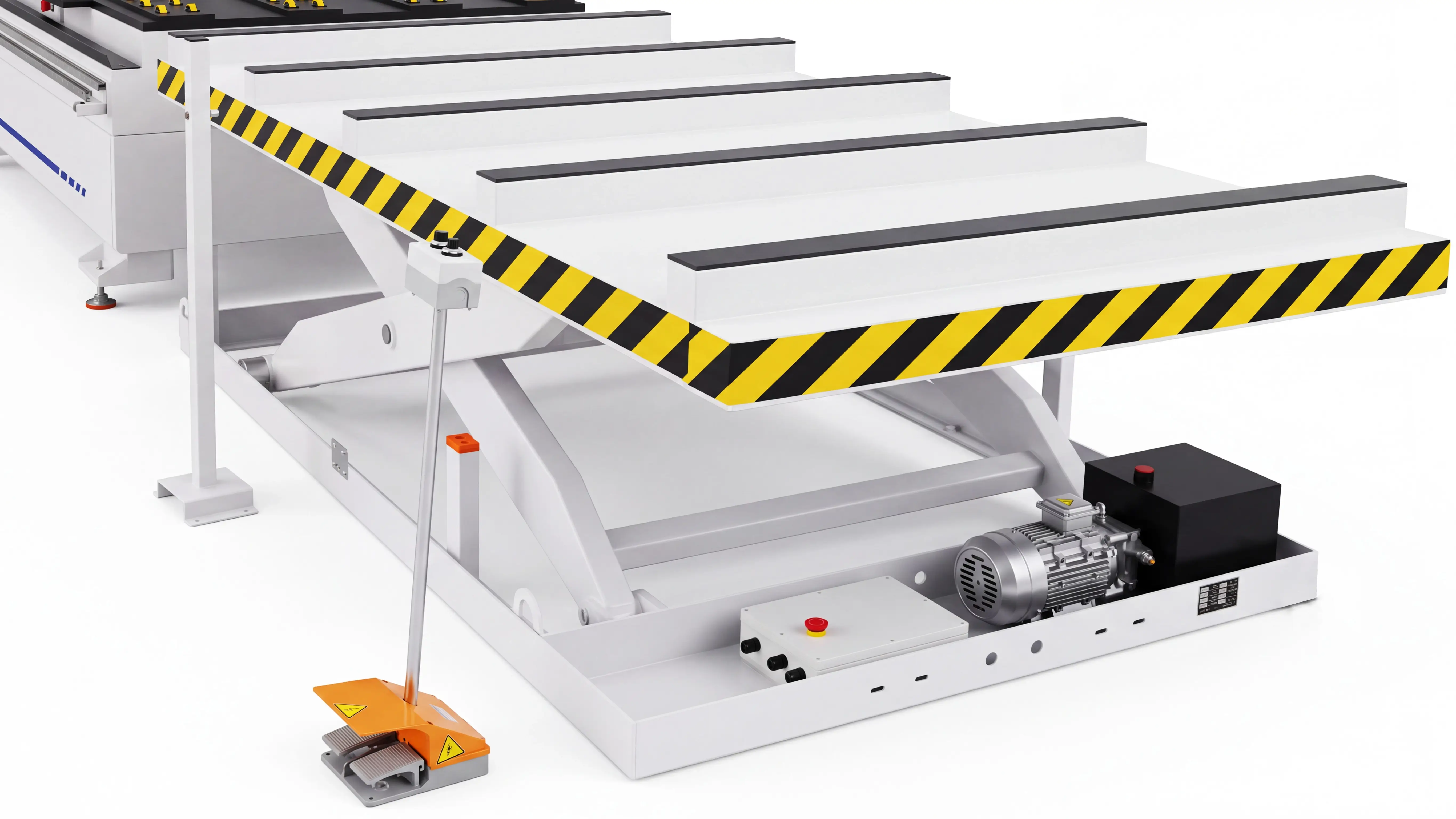
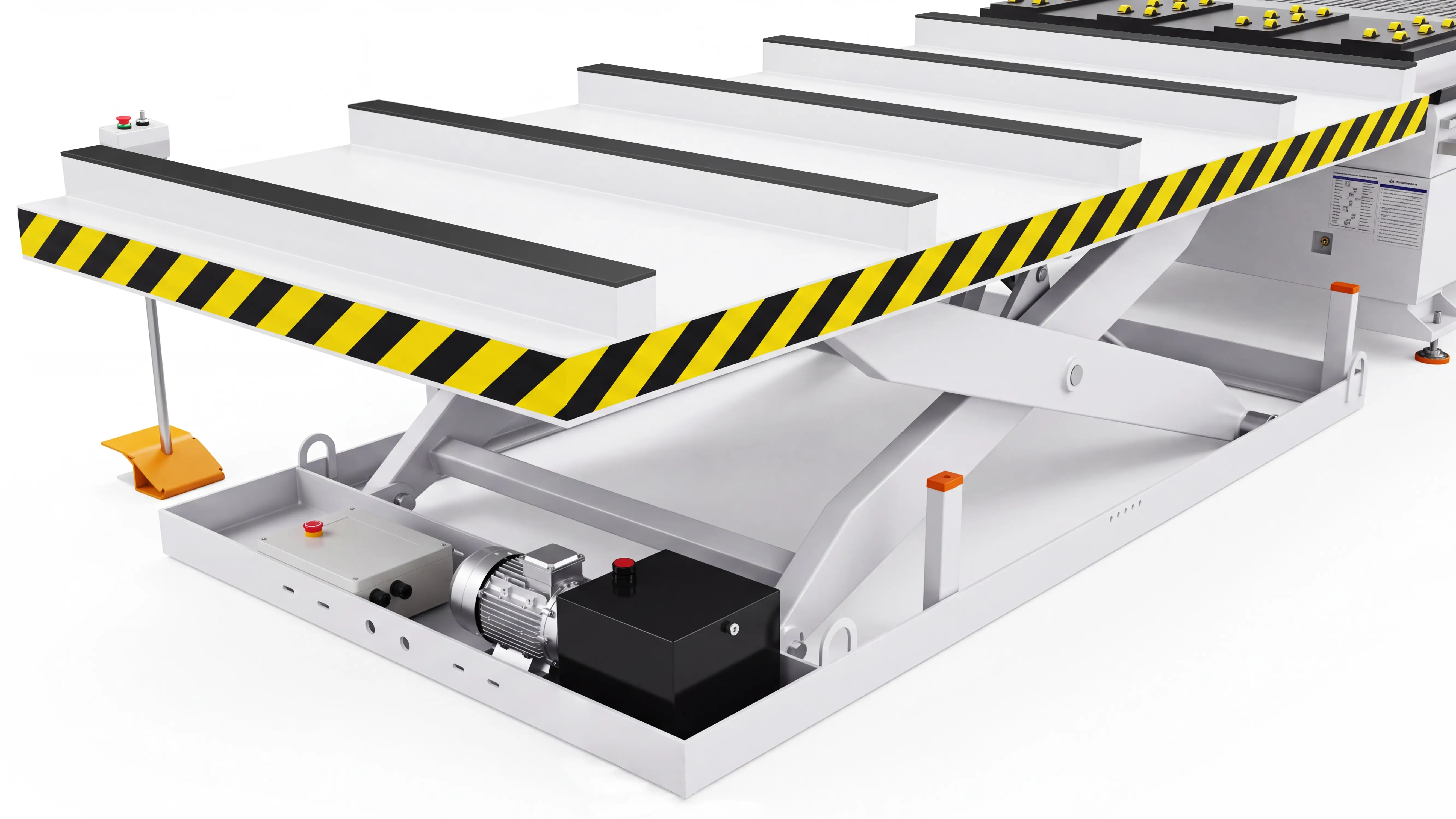
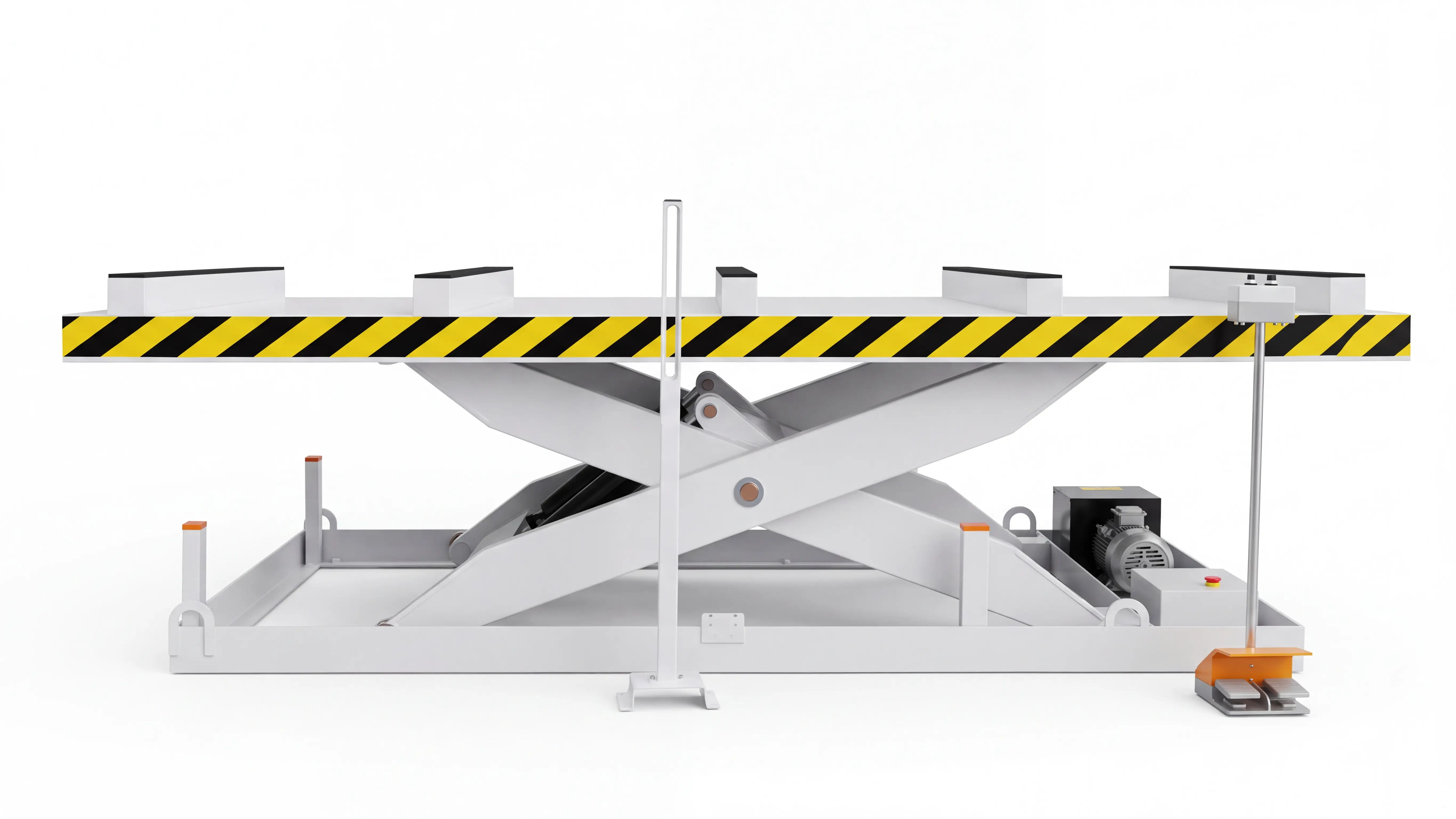
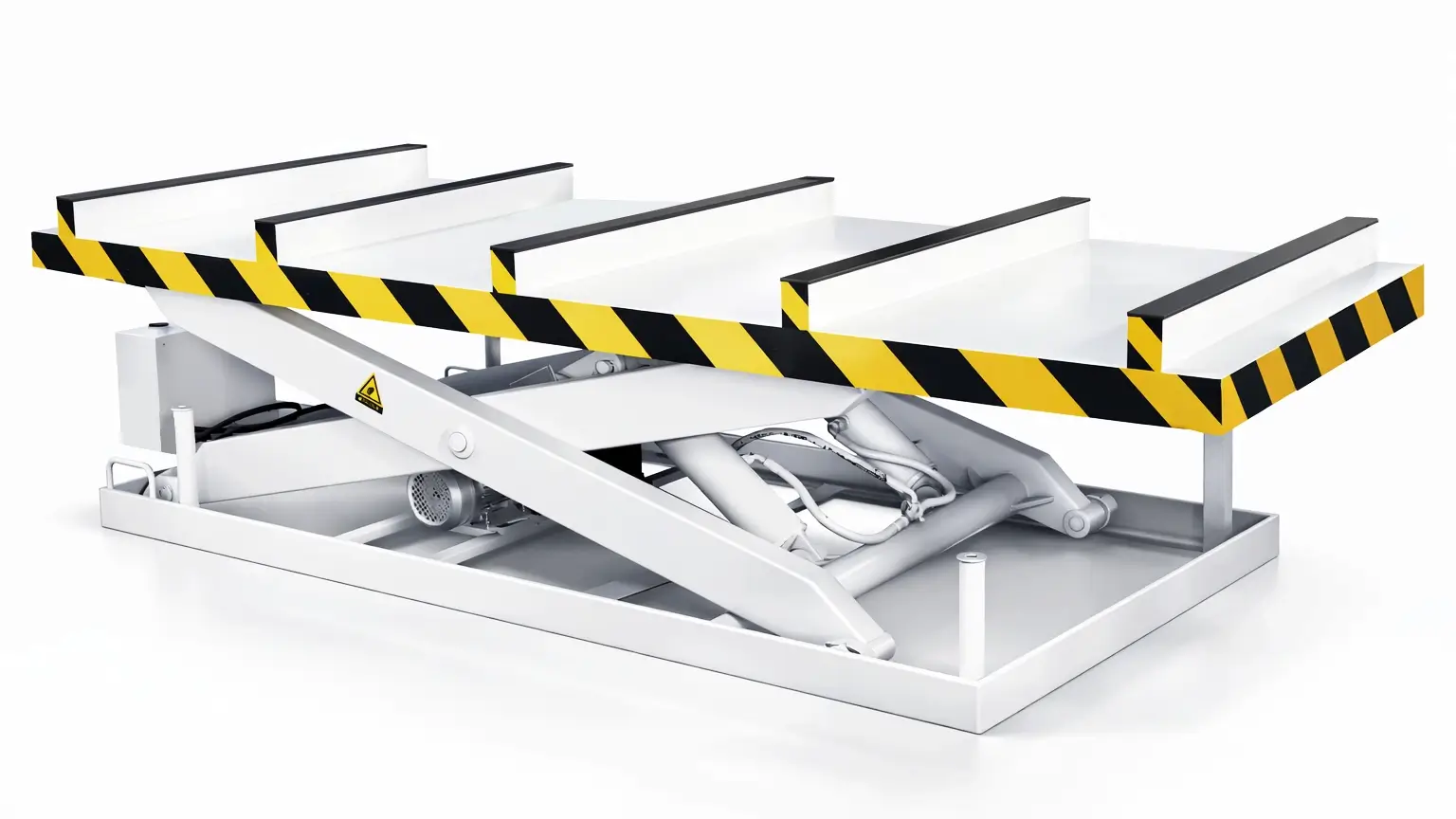
Heavy-Duty Hydraulic Automatic Loading Table
The rear of the machine features a heavy-duty hydraulic lifting platform
with a maximum load capacity of over 3,000kg. It accommodates various
panel materials up to 1500 × 3100mm, supporting centralized loading of
large-format sheets and standard furniture panels. Operators can
pre-stack multiple panels on the platform, allowing automatic pickup and
feeding while reducing manual handling, labor intensity, and frequent
material replenishment. Its high load capacity also provides sufficient
material supply for continuous production.
A sensor-based limit system monitors the platform height and panel stack
position in real time. When the top panel reaches the preset pickup
height, the platform automatically stops lifting, ensuring an optimal
position for vacuum suction. As each panel is picked up, the platform
adjusts its height according to sensor feedback, keeping subsequent
panels ready for pickup without manual measurement or adjustment.
The loading system works in coordination with the Y-axis servo drive,
three groups of vacuum suction cups, and auxiliary rollers. Once
machining is complete, the Y-axis moves to the rear loading position,
where the suction cups grip the top panel and transfer it smoothly
across the rollers onto the vacuum clamping table. This automated
process integrates height adjustment, vacuum pickup, servo-driven
feeding, and panel placement, enabling continuous loading of
large-format panels while reducing manual handling and improving
production efficiency.
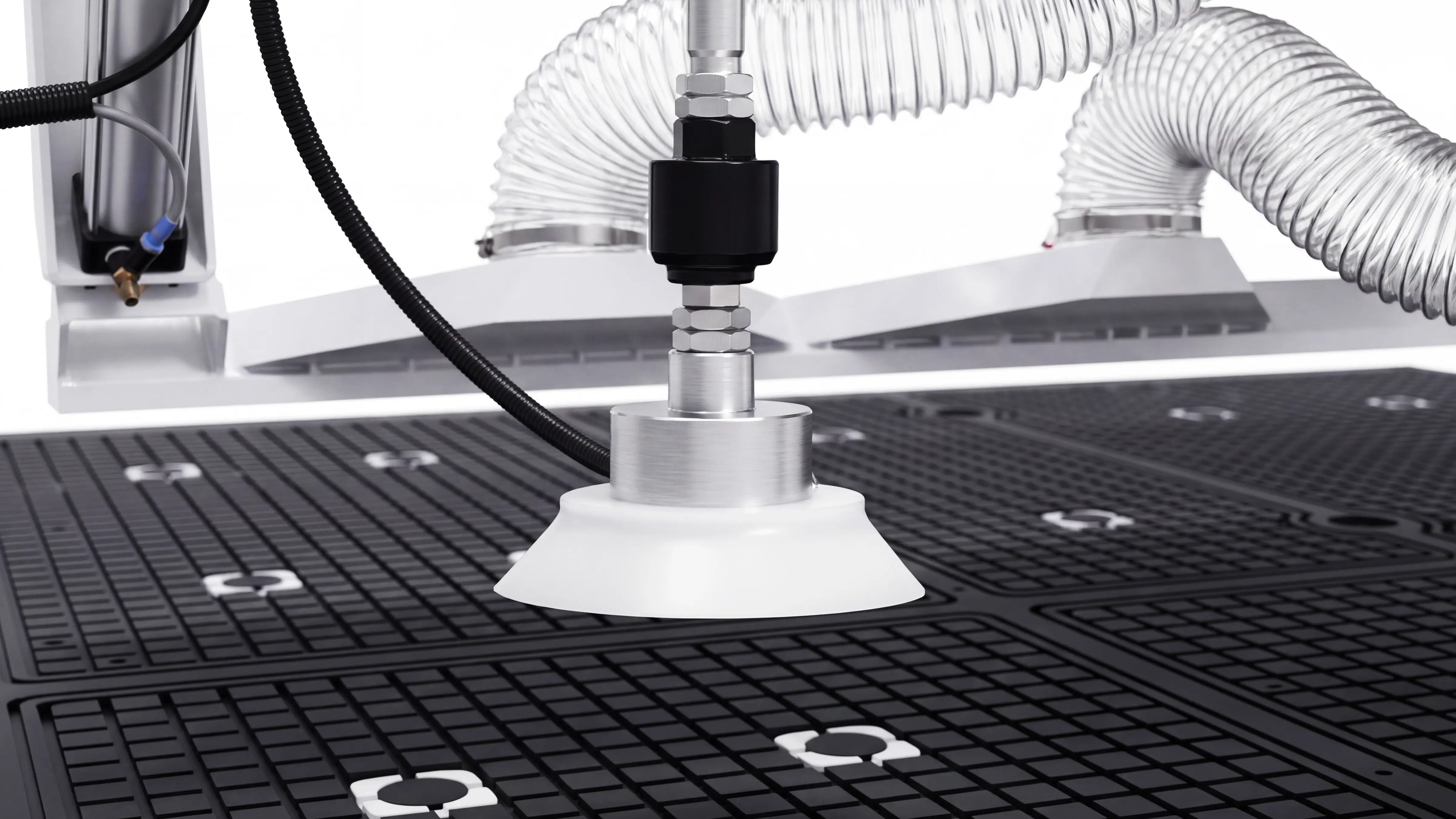
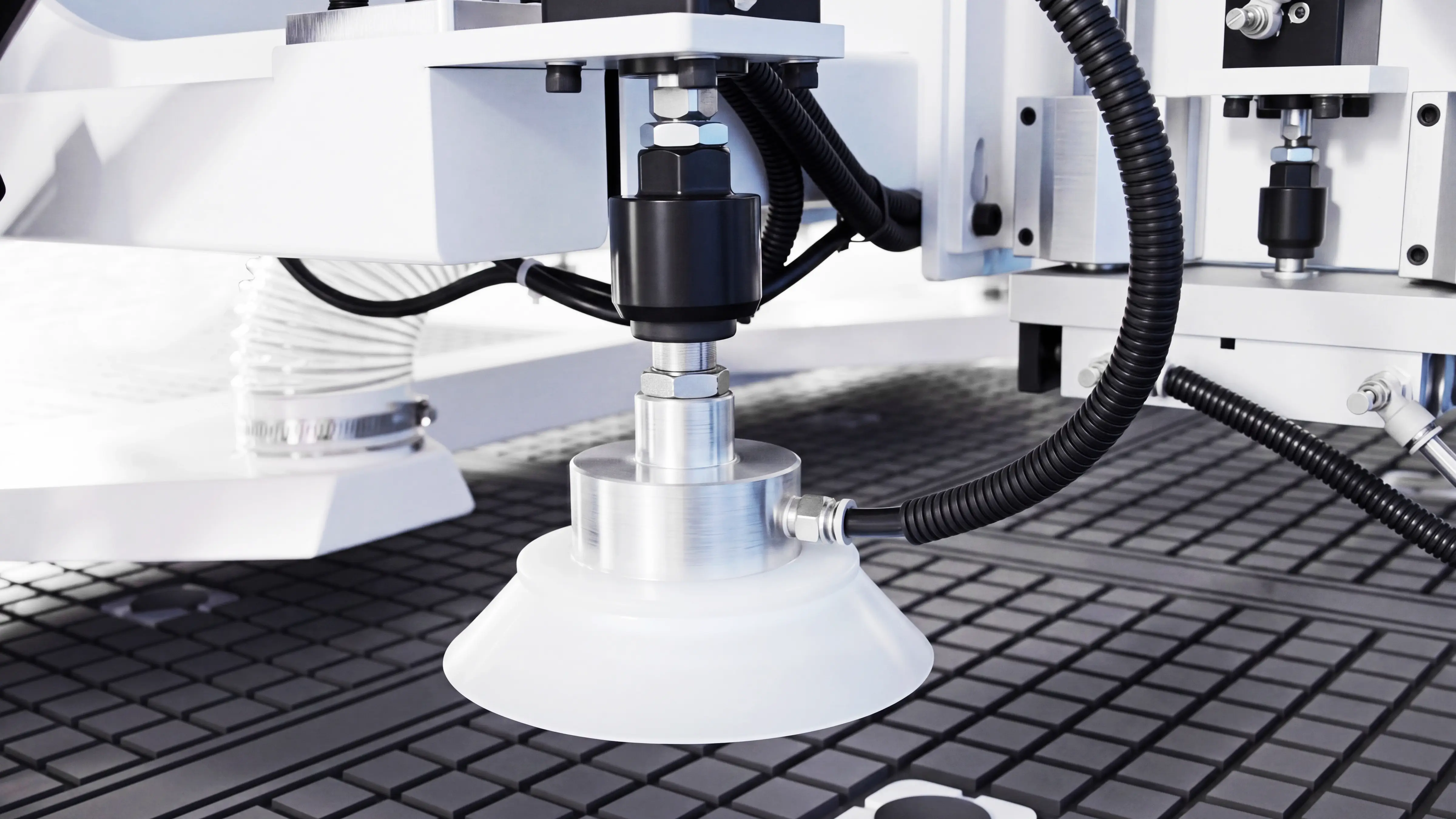
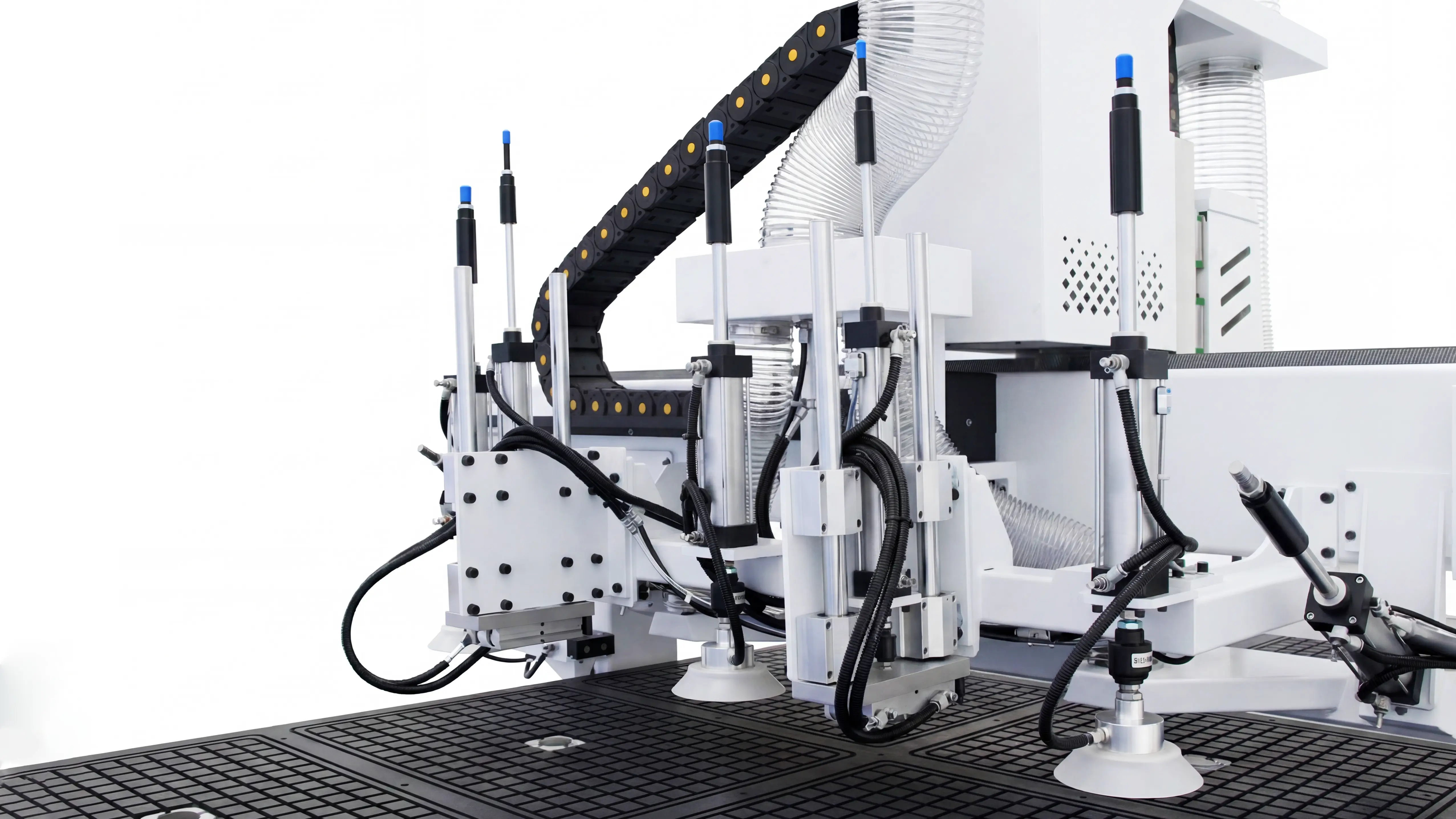
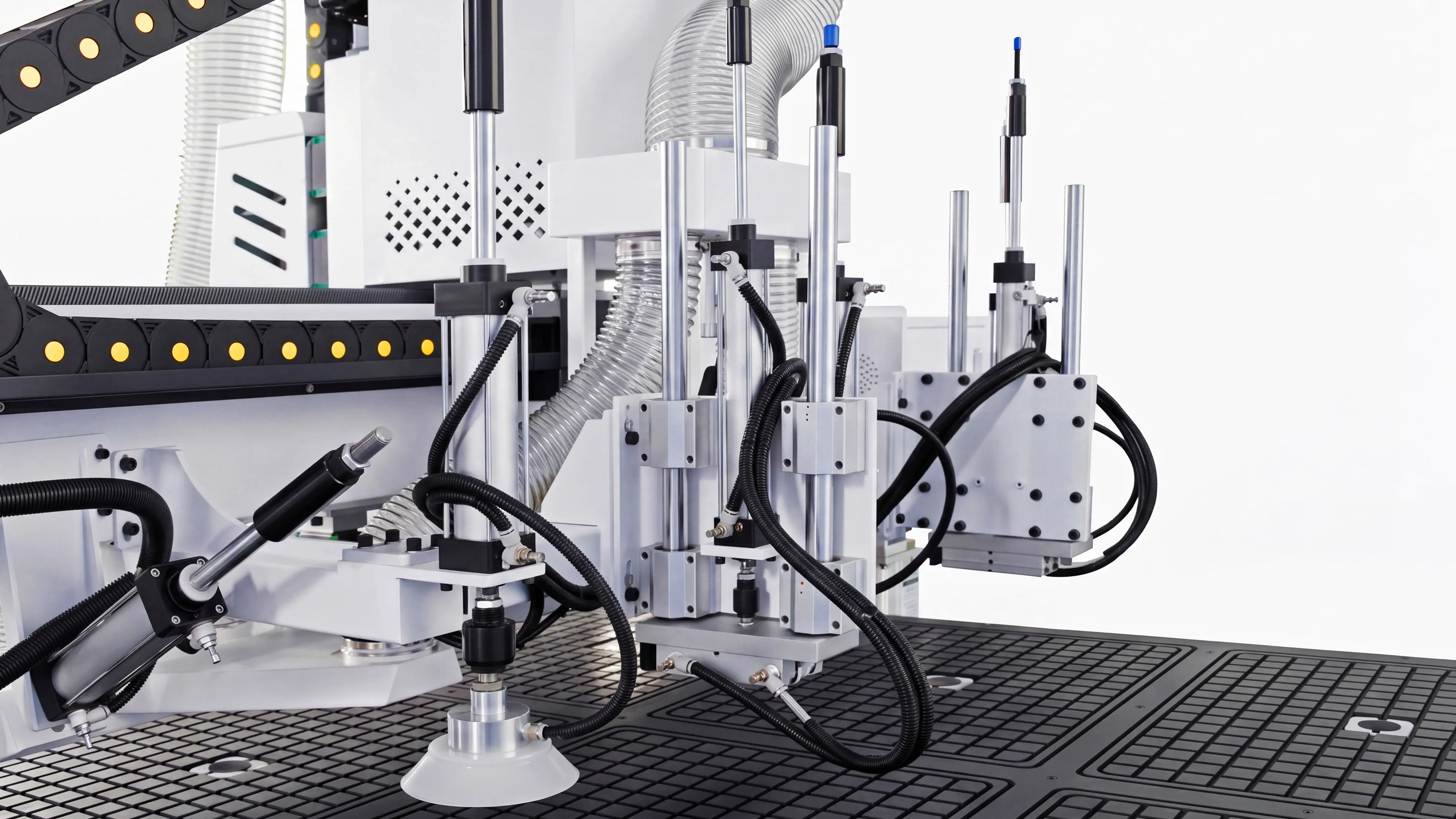
Three Groups of Vacuum Loading Suction Cups
Three groups of vacuum loading suction cups are installed behind the
gantry and driven by adjustable pneumatic cylinders. Their spacing and
mounting height can be adjusted to accommodate different panel sizes,
thicknesses, and loading positions. Using negative-pressure suction, the
cups provide stable contact and evenly distribute the gripping force to
keep panels steady during lifting and transfer. Their flexible contact
surfaces also help protect decorative finishes, including melamine-faced
and PVC-faced panels, from damage caused by rigid mechanical clamping.
The three suction cup groups work in coordination with the hydraulic
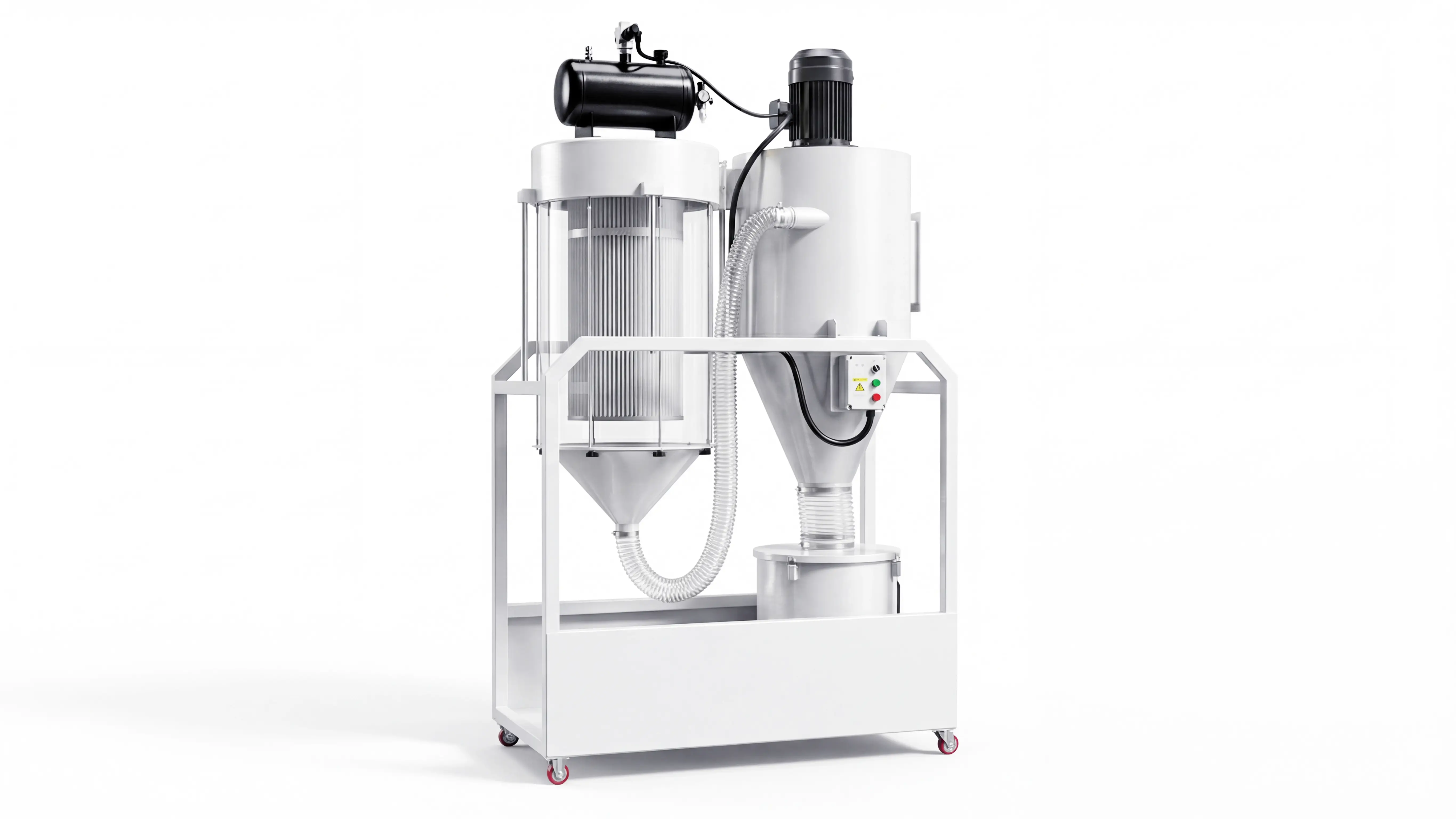
loading platform to automate panel pickup and feeding. During loading,
the cups descend and grip the top panel, then lift it smoothly. The
Y-axis servo drive moves the gantry to transfer the panel accurately
above the vacuum clamping table for automatic placement. This eliminates
manual lifting and handling, reduces labor requirements, and helps
prevent collisions, scratches, and handling-related safety risks.
After transfer, the rear and right-side auxiliary positioning cylinders
work together with the worktable's 4+2 pneumatic positioning system to
align the panel against the preset right-angle references. Vacuum
pickup, servo-driven feeding, automatic placement, and pneumatic
positioning are coordinated by the CNC system to create a continuous
loading process. Combined with vacuum clamping, automatic tool changing,
and programmed machining, the system supports efficient batch processing
and unattended production of large-format panels.
Automatic Unloading Pusher and Multi-Stage Dust Collection System
An automatic unloading pusher is installed behind the gantry. Once all
machining operations are complete, the gantry moves to the rear of the
finished panel, and the pusher automatically lowers to move the panel
forward onto the conveyor-type unloading platform. Controlled by the CNC
system, it automatically completes the lowering, pushing, and resetting
sequence without manual handling. The finished panel is quickly cleared
from the work area, making room for the next workpiece and reducing
downtime between machining cycles.
A dust collection port is integrated into the bottom of the pusher.
During automatic unloading, the dust collection system operates
simultaneously to perform secondary cleaning of the vacuum clamping
table, removing residual wood chips, dust, and small waste particles. It
cleans areas such as vacuum grooves, suction ports, and panel edges
where debris tends to accumulate. This helps prevent residue from
affecting the contact between the next panel and the worktable,
maintaining reliable vacuum clamping performance.
An additional dust collection funnel is installed at the front of the
worktable, forming a multi-stage cleaning system with the collection
port beneath the pusher. As the finished panel moves forward, remaining
wood chips, offcuts, and other debris are swept toward the front funnel
for centralized collection. By combining automatic unloading, secondary
dust extraction, and front-end debris collection, the system unloads
finished panels while cleaning the worktable, reducing debris buildup
and preparing the surface for the next machining cycle. This is
particularly beneficial for long-term, continuous batch production.
Conveyor-Type Automatic Unloading Table
The machine features a conveyor-type automatic unloading platform driven
by a motor and worm gear reducer, ensuring smooth and continuous
material transfer with controlled operating speed. Once machining is
complete, the Y-axis moves behind the finished panel, and the pneumatic
pusher pushes it accurately onto the unloading platform. The conveyor
then starts automatically and transfers the panel to the designated
position. This eliminates manual lifting and handling, reduces labor
requirements, and helps prevent scratches, edge impacts, and surface
damage during unloading.
Two high-precision sensor-based limit switches monitor panel position
and control the conveyor's automatic start and stop. When the pusher
transfers a finished panel to the first sensing position, the conveyor
starts automatically. Once the panel reaches the second position, the
system stops the conveyor, positioning the finished workpiece at the
preset location. A dust collection port is also installed at the front
of the platform to collect residual wood chips, dust, and small debris
from the panel surface during transfer, helping keep finished panels and
the unloading area cleaner.
The unloading platform is integrated with the CNC control system,
automatic pusher, and hydraulic loading platform to create a coordinated
loading and unloading cycle. After machining, the machine automatically
pushes out the finished panel, conveys it to the unloading position, and
then proceeds with pickup and loading of the next panel. By combining
finished-panel discharge and raw-material feeding into one automated
workflow, the system reduces auxiliary downtime and manual handling,
making it suitable for continuous batch production in furniture,
cabinetry, and custom furniture manufacturing.
Top-Of-The-Line Dust Removal and Vacuum Systems – Enabling Dust-Free Processing and Stable
Vacuum.
The machine is equipped with a 7.5kW industrial pulse cyclone dust
collector to handle wood chips, dust, and cutting debris generated
during large-format panel machining. Powered by a 2,900rpm fan, it
delivers an airflow capacity of up to 9,000m³/h and air pressure of
2,500Pa. The dust hood captures debris during cutting, milling,
drilling, and grooving, conveying it to the collector for centralized
disposal and reducing dust accumulation around the machine.
The system combines cyclone separation with pulse-jet filter cleaning
and features a large 260L collection bin. Cyclone separation removes
larger wood chips and particles before they reach the filters, while
high-pressure pulse cleaning removes accumulated fine dust to help
maintain airflow. The large-capacity bin extends cleaning intervals and
reduces maintenance downtime, making the system suitable for demanding,
continuous machining operations.
A multi-point dust collection network connects the spindle dust hood,
rear gantry pusher, and unloading platform to the central collector. It
captures debris directly during machining, cleans residual chips from
the vacuum clamping table during automatic unloading, and collects
remaining dust during panel transfer. This integrated design reduces
manual cleaning and helps maintain a cleaner working environment for
continuous production.
To meet the vacuum clamping requirements of the 1500 × 3100mm worktable,
the machine features two German BECKER 5.5kW oil-free rotary vane vacuum
pumps connected in series. Each pump operates independently, delivering
300m³/h airflow and a vacuum level of up to 200mbar. When both pumps run
simultaneously, total airflow reaches 600m³/h, providing strong and
continuous vacuum clamping for large panels during cutting, milling,
drilling, and grooving while helping prevent workpiece movement.
The dual-pump system supports flexible operation according to panel size
and clamping requirements. A single pump can handle smaller workpieces
or limited clamping areas, reducing unnecessary power consumption, while
both pumps can operate together for large panels requiring greater
airflow. Combined with the six-zone independent vacuum control system,
operators can activate only the zones covered by the workpiece,
optimizing vacuum performance and energy efficiency.
Both pumps feature an oil-free rotary vane design, eliminating the need
for lubricating oil during vacuum generation. This helps prevent oil
contamination in vacuum lines and on panel surfaces while reducing
maintenance requirements. The dual-pump configuration balances
energy-efficient operation for smaller workpieces with increased vacuum
capacity for large-format panel machining.
Variable Frequency
-70KPa
600m³/h
Automatic Lubrication for the Entire Machine—Saves
Time, Effort, and Worry.
1.5L Large-Capacity Automatic Lubrication System
To meet the lubrication requirements of transmission components
during extended operation, the Spire series features a 1.5L
centralized automatic lubrication system that manages oil supply to
critical moving parts, including linear guides and ball screws.
Operators can set lubrication intervals and oil delivery times
through the CNC system, allowing the system to automatically supply
lubricant to designated points according to preset parameters.
Compared with manual lubrication, centralized oil delivery
simplifies maintenance, reduces manual intervention, and ensures
more consistent lubrication management.
The system also features low-oil alarms and pressure monitoring. A
float sensor inside the oil reservoir detects the remaining
lubricant level and triggers an alert when it drops below the preset
limit, reminding operators to refill the reservoir. An external
pressure gauge displays lubrication line pressure, providing a
convenient way to monitor oil delivery and check system operation.
Proper lubrication helps reduce friction and wear on linear guides
and ball screws during continuous axis movement. The 1.5L reservoir
provides sufficient lubricant storage, while scheduled automatic
delivery ensures consistent lubrication at designated points.
Automatic oil supply, low-level alarms, and pressure monitoring work
together to simplify routine maintenance and support reliable
long-term machine operation.
Behind Every Spire, There Lies Our Unwavering Support.
Spire Series Exclusive Nameplate &
Comprehensive Service Support
Every Spire series machine features a
dedicated rear nameplate with a unique serial number for accurate
identification and traceability. Customers can provide this number when
contacting the after-sales team to quickly confirm the machine model,
configuration, and technical information, ensuring more efficient support
for troubleshooting, spare parts, and machining inquiries.
All Spire machines come with a
five-year free warranty and dedicated one-on-one after-sales support,
covering installation, commissioning, operation, and maintenance. Additional
services include lifetime free maintenance guidance, software upgrades, and
programming assistance to help customers address practical production and
technical challenges.
Clear operating instructions and maintenance guidelines are also provided on
the rear of the machine, covering safety precautions, routine inspections,
and standard maintenance procedures. Combined with serial number management,
warranty coverage, and ongoing technical support, these services help
customers maintain reliable machine operation over the long term.
Spire Series Complete Standardized
Documentation Package
Each Spire series machine comes with a
complete set of original factory documents, including a Certificate of
Conformity, Warranty Card, Warranty Information, Quick Start Guide, and Full
User Manual. These documents cover equipment delivery, warranty terms,
operation, and maintenance, helping customers understand the machine and
providing essential references for daily management and after-sales support.
The Quick Start Guide focuses on initial installation and basic operation,
covering accessory checks, electrical connections, vacuum pump and dust
collector piping, startup procedures, and common troubleshooting methods.
Step-by-step illustrated instructions help operators complete initial setup,
learn essential operating procedures, and get the machine into production
more efficiently.
The Full User Manual provides more detailed information on machine
structure, component functions, accessory installation, machining
procedures, routine maintenance, and troubleshooting. It also includes the
complete electrical schematic and machine startup diagrams, providing
technical personnel with useful references for wiring inspections, component
maintenance, and fault diagnosis. Together, these documents support both
everyday operation and professional machine servicing.
A Complete Set of Tools, Ensuring It’s Ready for Use the Moment You Receive It.
Spire Series Dedicated Accessory & Tool Kit
Each Spire machine comes with a dedicated
tool kit containing essential operating, maintenance, and tool-installation
accessories. It includes a complete set of heavy-duty hex keys, an ER32
spindle wrench, a wireless keyboard and mouse, spare relays, limit switches,
air fittings, 16 ISO30 tool holders, and 18 ER32 collets. These accessories
cover routine tasks such as bolt tightening, tool changes, and component
replacement, reducing the need for additional purchases.
A 35-piece CNC router bit set is also included, featuring various tools for
cutting, engraving, milling, and drilling. Users can select suitable bits
according to the workpiece material, panel thickness, and machining
requirements. This versatile set covers common panel machining and detailed
engraving applications, providing a ready-to-use starter tool selection.
Each machine also comes with a dedicated USB drive containing the user
manual, instructional videos, test files, and system backup files. These
resources support initial operation, machine testing, troubleshooting, and
subsequent maintenance, providing essential technical support throughout the
machine's service life.
Toolbox First LayerToolbox Second
LayerMachining Tool Collet
SetMachining Tool Set
Applicable Industries
Whether it’s furniture such as wardrobes, cabinets, and doors, or items like advertising
lettering, wooden crafts, and carved ornaments, The Spire
can handle them all with ease.
Easily explore helpful answers to the questions our users ask
most,so
you can understand the Spire better
and get support instantly.
Contact Us Now!
+86 135 8313 8886
1. What Is the Difference Between a Carousel-Type and a Linear Automatic Tool Changer on a CNC Router, and How Should You Choose?
The main differences between crousel-type and linear automatic tool changers lie in their magazine structure, installation position, and tool-changing method. A crousel-type tool changer uses a rotating circular magazine with multiple tool stations. The crousel rotates to select the required tool, which is then picked up by the spindle. Its compact design keeps tools organized in one place and is typically mounted beside the gantry or near the column, leaving the main machining area unobstructed. It is well suited to complex machining tasks that require frequent tool changes.
A linear tool changer arranges tools in a straight row of fixed positions. The spindle moves to the designated tool-changing position to complete each tool change. Its structure is relatively straightforward, and it is usually installed beneath the gantry or at the rear of the machine.
The choice depends on tool capacity, machine layout, tool-changing efficiency, and production requirements. The CK-1531--RSP-AT-D features a crousel-type automatic tool changer that selects tools automatically according to the machining program, reducing manual tool changes and downtime. It is particularly suitable for continuous multi-process machining of wardrobes, cabinets, and panel furniture, including cutting, profiling, grooving, and engraving.
2. What Production Requirements Make This CNC Nesting Machine with a 5+4 Vertical Drilling Unit and Automatic Loading & Unloading System the Right Choice?
If your factory specializes in wardrobes, cabinets, bathroom vanities, or custom panel furniture, with frequent batch orders involving multiple machining processes, this machine is designed to meet those production needs. It integrates a 9kW automatic tool-changing spindle, a 16-tool crousel-type magazine, a 5+4 vertical drilling unit, and an automatic loading and unloading system. These features enable panel cutting, profiling, grooving, engraving, and vertical drilling on a single machine, reducing workpiece transfers and repeated setups.
The advantages are especially clear when production involves large volumes of connector holes, shelf holes, and positioning holes, while also requiring less manual handling and more continuous operation. The automatic loading and unloading system handles panel feeding and finished-part transfer, the drilling unit performs multi-position vertical drilling, and the ATC spindle handles various milling operations. Working together, these systems reduce process transition time and manual intervention while improving overall production efficiency. This machine is particularly suitable for furniture manufacturers upgrading from manual handling and separate machining processes to integrated automated production.
3. What Is the Purpose of a 5+4 Vertical Drilling Unit on a CNC Router, and What Advantages Does It Offer Over Spindle Drilling?
The 5+4 vertical drilling unit consists of two groups of vertically arranged drill bits, with five and four positions respectively, providing a total of nine drilling positions. The CNC program selects the appropriate drill bits to quickly perform multi-position vertical drilling on panels. Typical applications include drilling connector holes, shelf holes, and positioning holes for wardrobes, cabinets, and other panel furniture.
Compared with using the spindle to drill holes one at a time, a dedicated drilling unit reduces repeated tool changes and individual drilling operations, improving efficiency when machining multiple holes. In this configuration, the automatic tool-changing spindle handles panel cutting, profiling, grooving, and engraving, while the 5+4 drilling unit is dedicated to frequent vertical drilling tasks. This division of labor reduces waiting time between machining processes and improves overall panel furniture production efficiency.
4. What Are the Functions and Advantages of an Automatic Loading & Unloading System on a CNC Router?
An automatic loading and unloading system connects panel handling, feeding, positioning, machining, and finished-part unloading into a streamlined automated process, reducing the need for repetitive manual handling. For large and heavy panels, mechanisms such as vacuum suction cups, lifting platforms, and auxiliary rollers handle panel pickup and transfer, reducing operator workload and minimizing the risk of bumps or surface damage during handling.
During continuous production, the system automatically feeds panels into the machine and transfers finished workpieces to the designated unloading area, reducing downtime caused by manual loading and unloading. This improves machine utilization and overall production efficiency. For batch production of wardrobes, cabinets, and custom panel furniture, automatic loading and unloading can reduce labor requirements, streamline workflows, and support a more efficient, continuous production process.
5. What Are the Functions and Features of Independent Pneumatic Lifting Pressure Rollers on a CNC Router?
Independent pneumatic lifting pressure rollers help secure panels during machining. Driven by pneumatic cylinders, the rollers move up and down to apply consistent downward pressure, reducing panel shifting or lifting caused by cutting forces and machine movement during cutting, milling, and engraving. Unlike fixed clamps, the independent pneumatic design allows each roller to be controlled separately, offering greater flexibility when working with panels of different thicknesses and sizes.
The CK-1531-RSP-AT-D features dual-rod independent pneumatic pressure rollers, with each roller group controlled by its own cylinder. Rubber-coated roller surfaces provide secure pressure while helping minimize the risk of scratching the panel. The rollers can work alongside the vacuum clamping system or operate independently without vacuum clamping, providing flexible workholding for different materials and machining conditions while improving panel stability.
6. What Are the Advantages of Bus-Type Absolute Encoder Servo Motors Over Conventional Pulse-Type Servo Motors on a CNC Router?
The servo system directly affects axis response speed, positioning performance, and multi-axis coordination. Conventional pulse-type servo motors receive commands through pulse and direction signals, while bus-type servo motors use a communication protocol to enable high-speed data exchange between the CNC controller and multiple servo drives. This allows position, speed, and operating status information to be transmitted more efficiently while reducing signal wiring and improving coordination between machine axes.
Absolute encoders also retain the motor's absolute position data, even after a power failure. When the machine restarts, it can typically recover its position without repeating the homing procedure. For large-format CNC routers, combining bus communication with absolute position feedback improves multi-axis response, motion synchronization, and operating stability, making it well suited to high-speed movement, continuous machining, and complex contour engraving.
Last Updated:
2026-11-04 20:51:32
Technical Parameters
Series
CATEK ·Spire
Model
CK-1531-RSP-AT-D
XYZ Working Travel
1500*3100*200mm
Bed
Spire-specific machining center processed reinforced bed base, independent anti-interference
control cabinet
We use cookies to personalise content and ads, to provide social media features and to analyse our
traffic. We also share information about your use of our site with our social media, advertising and
analytics partners who may combine it with other information that you’ve provided to them or that
they’ve collected from your use of their services.
You may modify your privacy preferences at any time by accessing the "Your Privacy Choices" link
located at the bottom of the page.