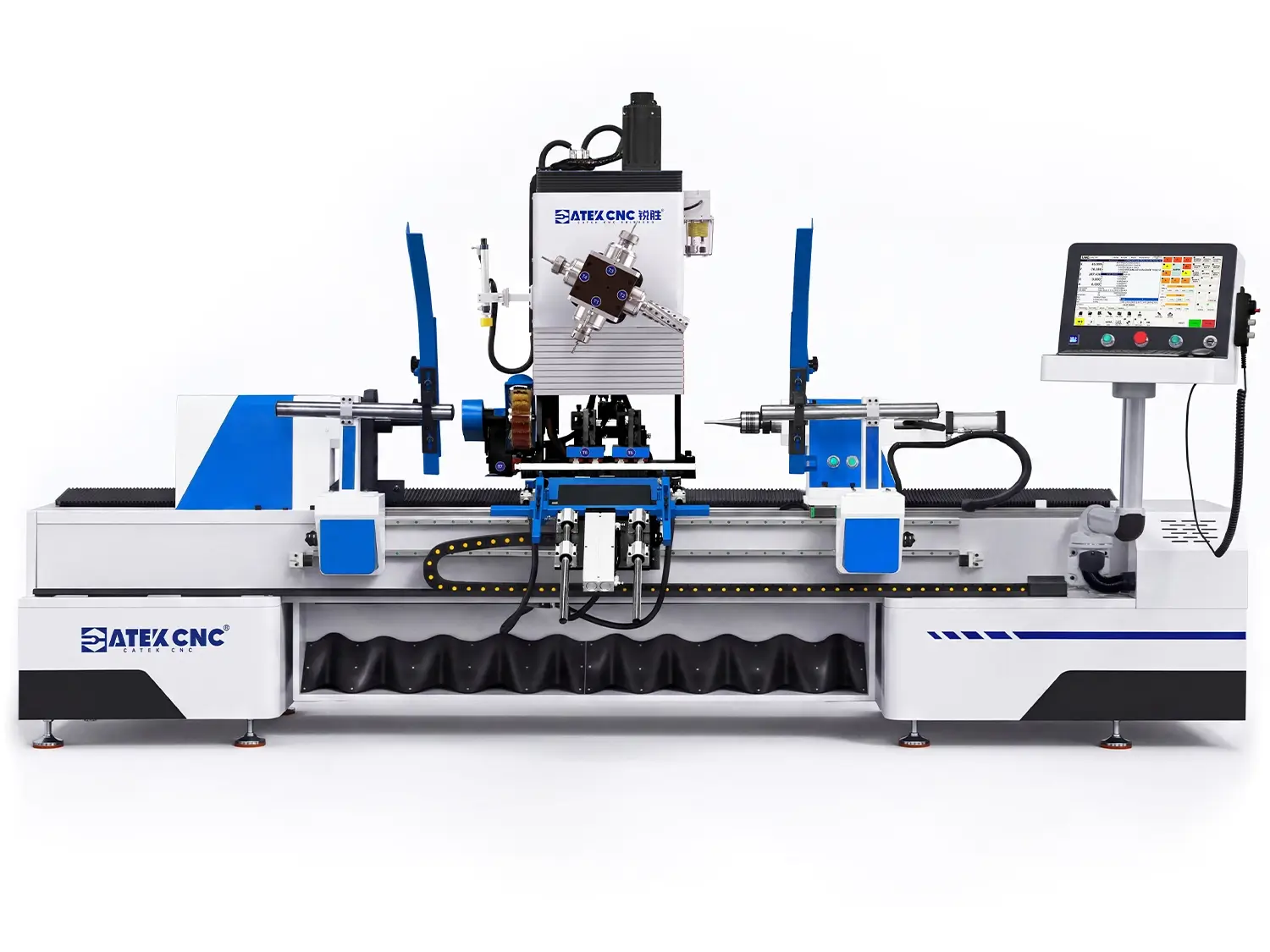
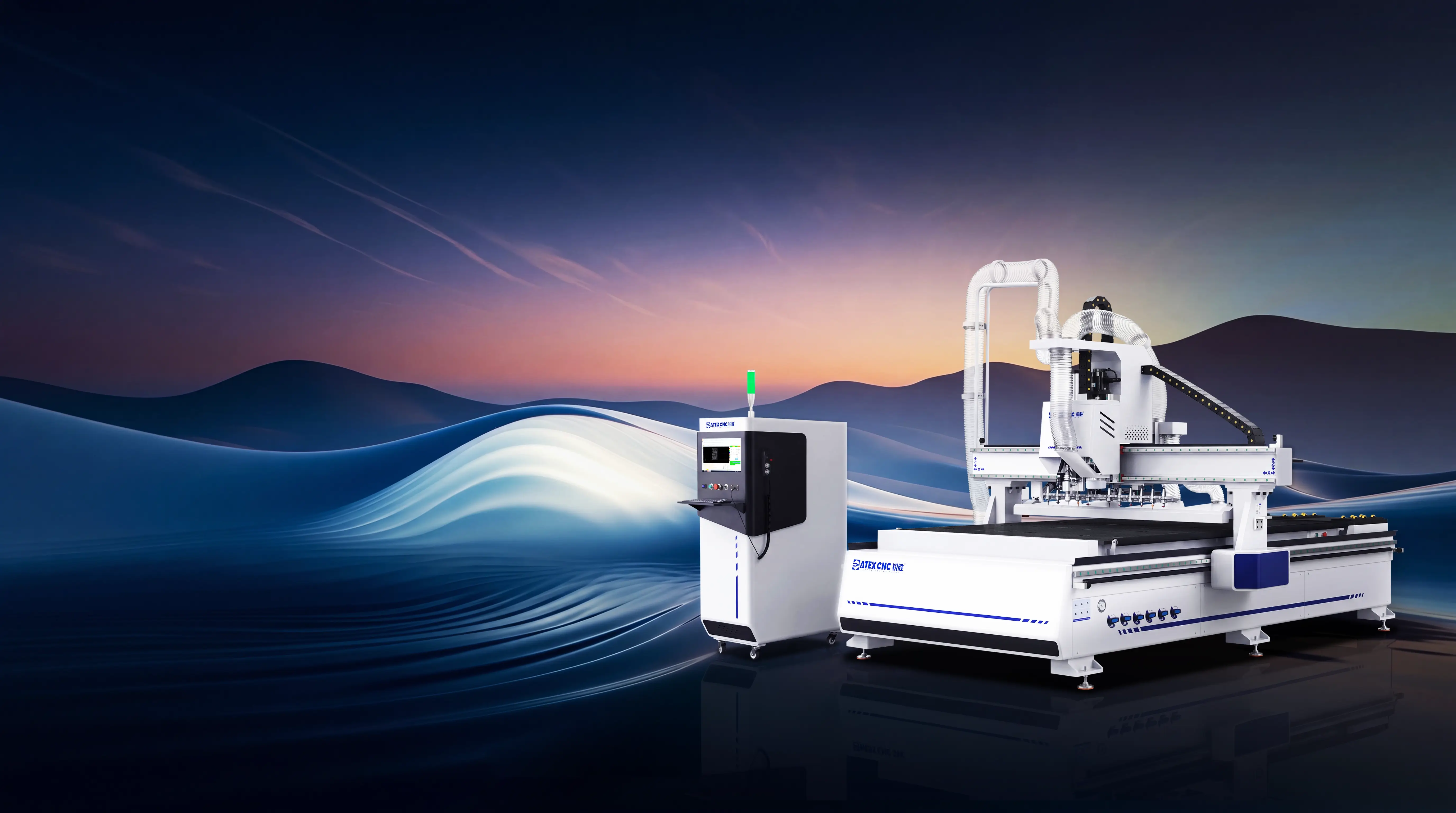
The Spire series is the high-end custom series of
CATEKCNC, featuring a completely redesigned exterior and mechanical
structure. It incorporates top-tier components from
first-tier suppliers and includes exclusive one-on-one
customer service.
Looks like you have not added anything to you cart. Goahead & explore top
categories.
{{goods.model}}
${{moneyFormat(goods.price * goods.num)}}
Total:
${{moneyFormat(total)}}
· Function Description ·
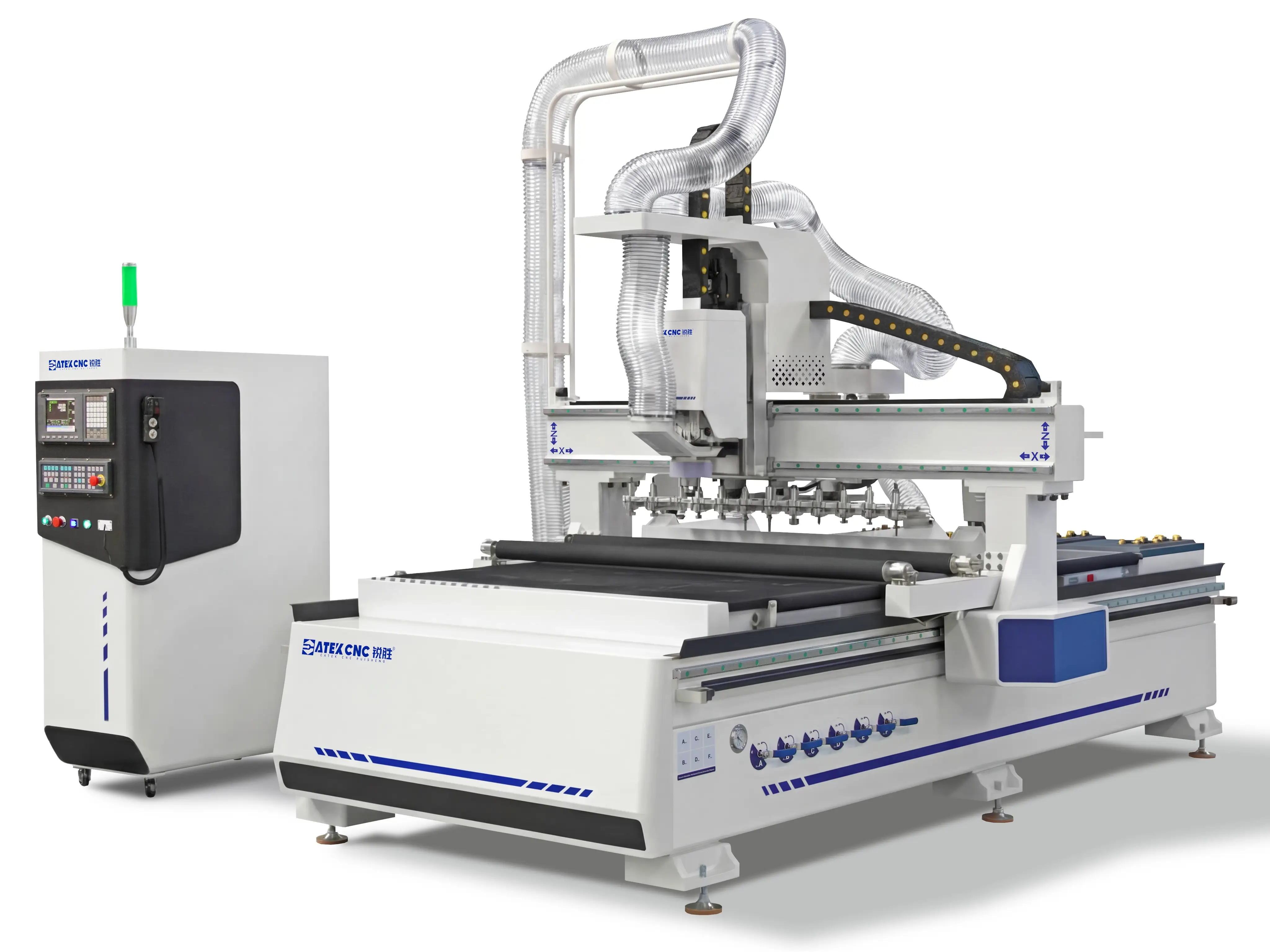
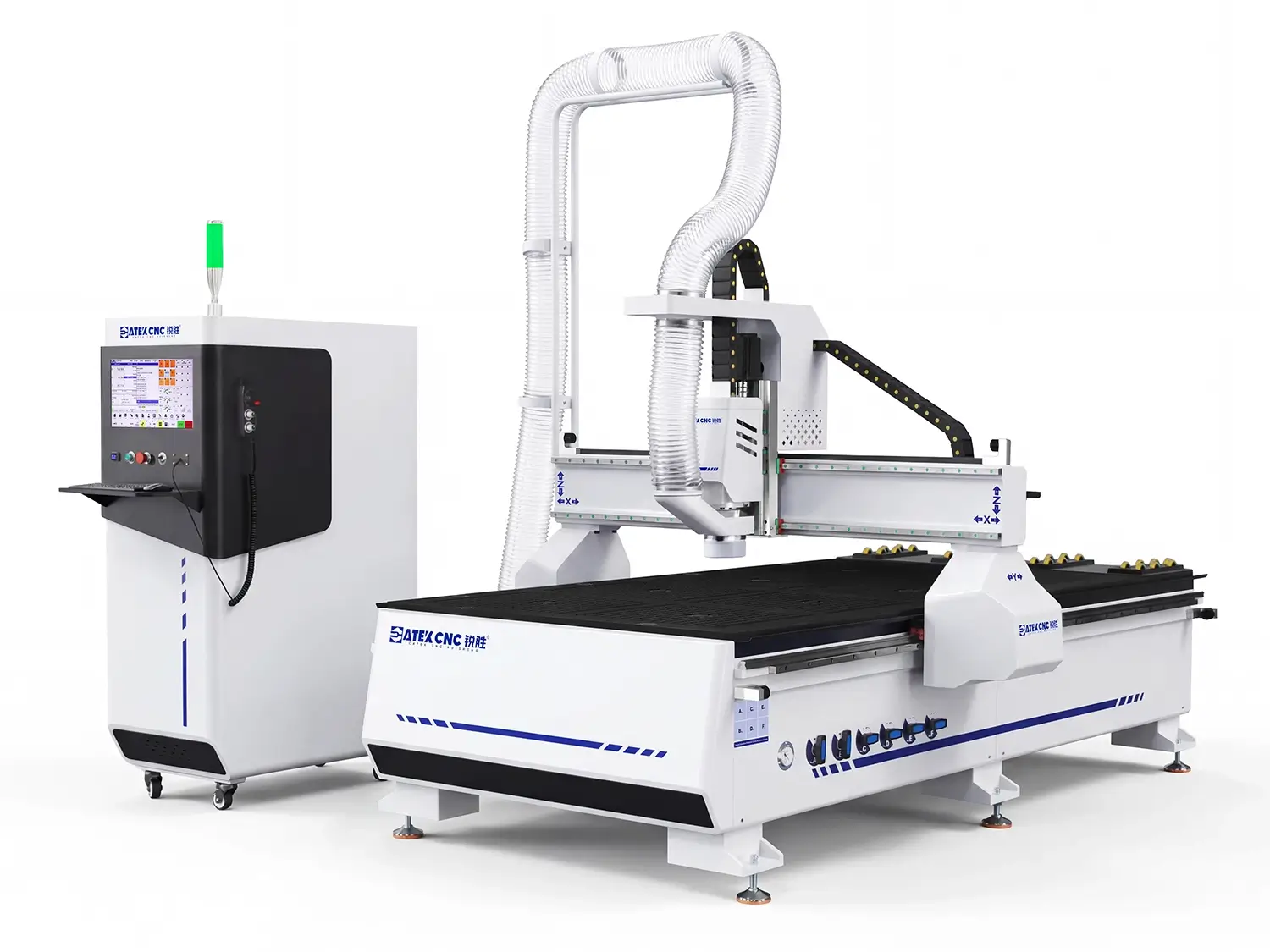
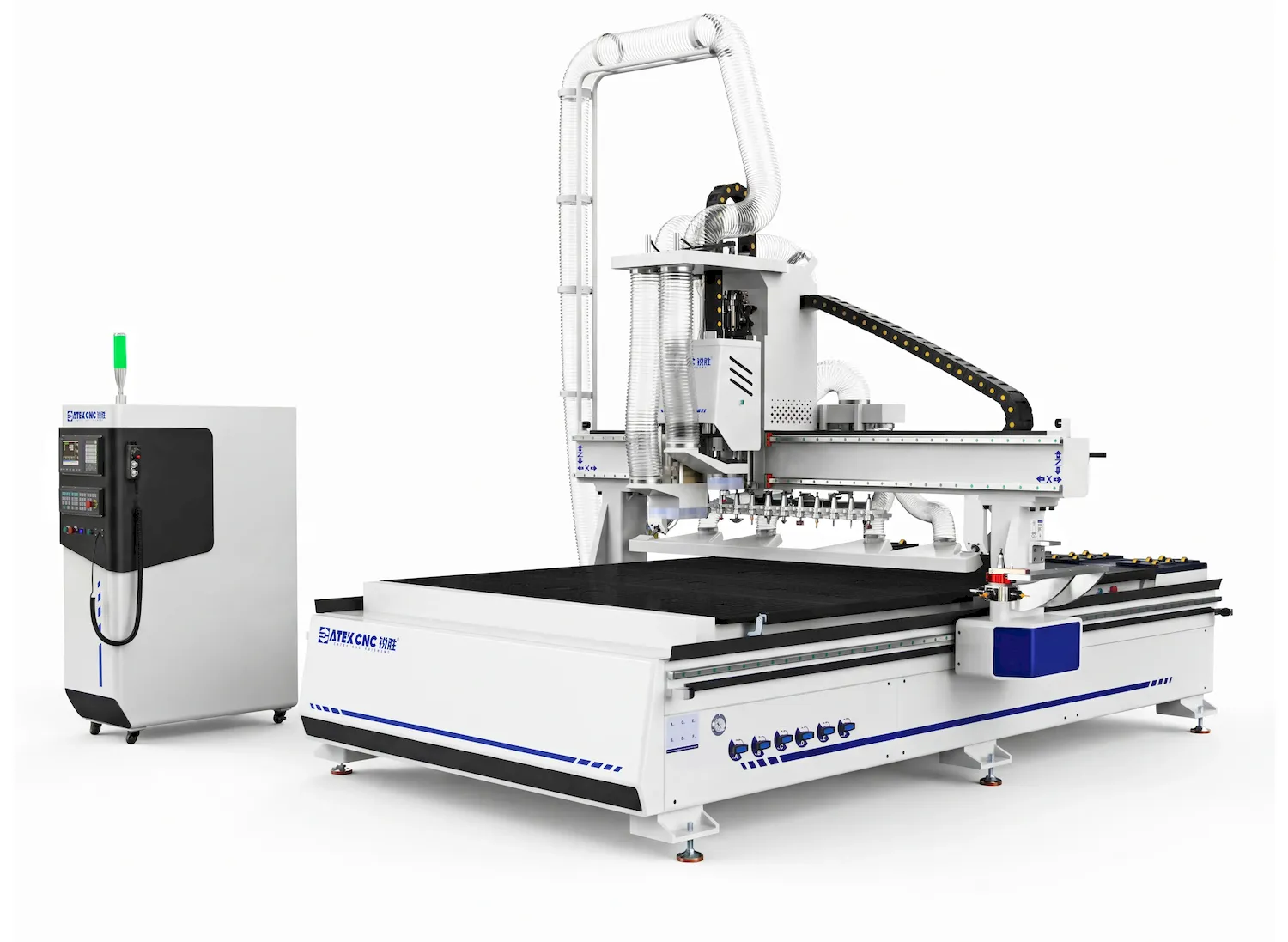
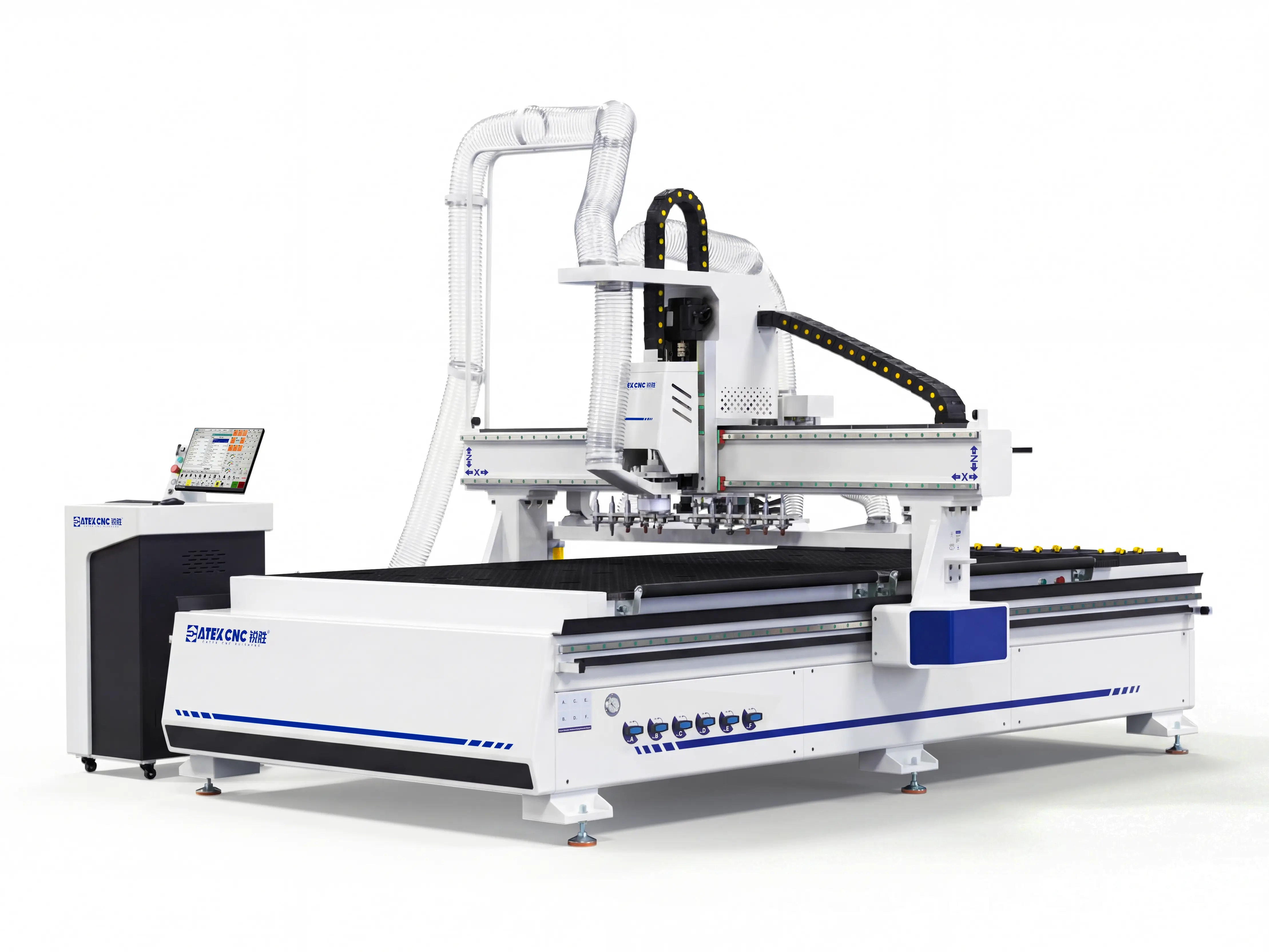
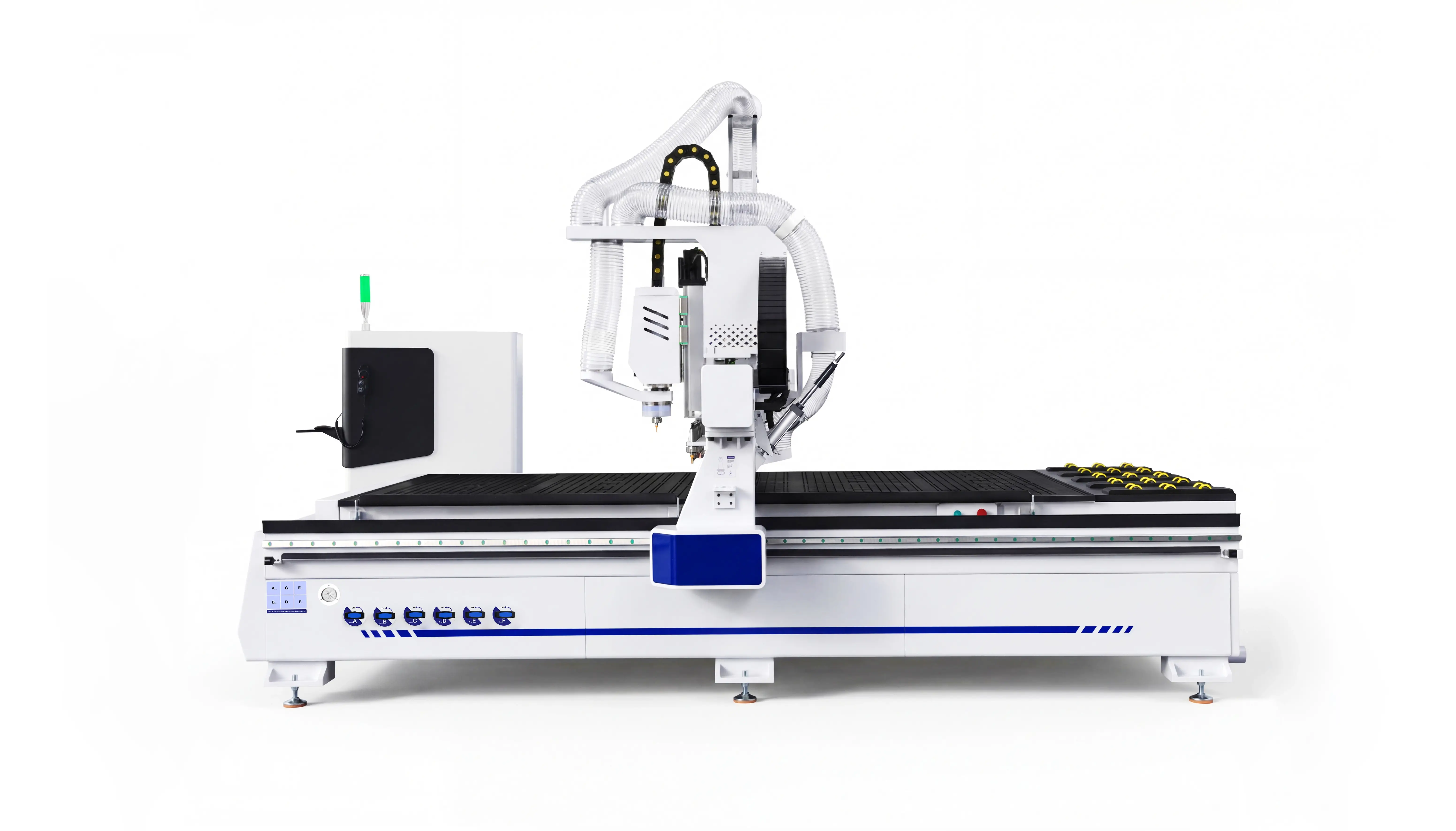
This is a Spire Series multi-functional CNC router with a 2000 × 3000 mm working area. Its key feature is the integration of a pneumatic oscillating cutter and a CCD vision system, enabling efficient cutting of both rigid and flexible materials.
Tags:Spire Series,ATC,Oscillating Cutter,Vision System
Share:
Description
Parameters
Reviews
CATEK · Spire
Maximizing Efficiency and Application Scope with Multi-Material Machining
The CK-2030-RSP-TK is a Spire Series CNC nesting machine designed for multi-material processing applications, with a maximum working area of 2000 × 3000mm. This model integrates a 9kW automatic tool-changing air-cooled spindle, a 9-zone 25-hole vacuum table, a high-frequency oscillating tool system, and a CCD vision system. Based on diverse material processing requirements, the machine adopts a dual-system configuration combining a spindle and an oscillating tool. The spindle is primarily used for rigid materials and is suitable for processing wood, MDF, PVC boards, aluminum composite panels, melamine boards, carbon fiber, and HDPE. When switched to the oscillating tool system, it efficiently processes flexible materials such as EPE foam, acoustic panels, leather, corrugated cardboard, and composite foam core materials.
To further improve machining accuracy and production efficiency, the CK-2030-RSP-TK is equipped with multiple auxiliary systems. The vacuum adsorption system enables fast and stable workpiece fixation. The automatic tool changer supports continuous multi-process machining, reducing downtime. The CCD vision system enables automatic edge detection and precise cutting of flexible materials. The automatic lubrication system ensures long-term stable operation of the equipment. Together, these features form an efficient solution for complex machining scenarios.
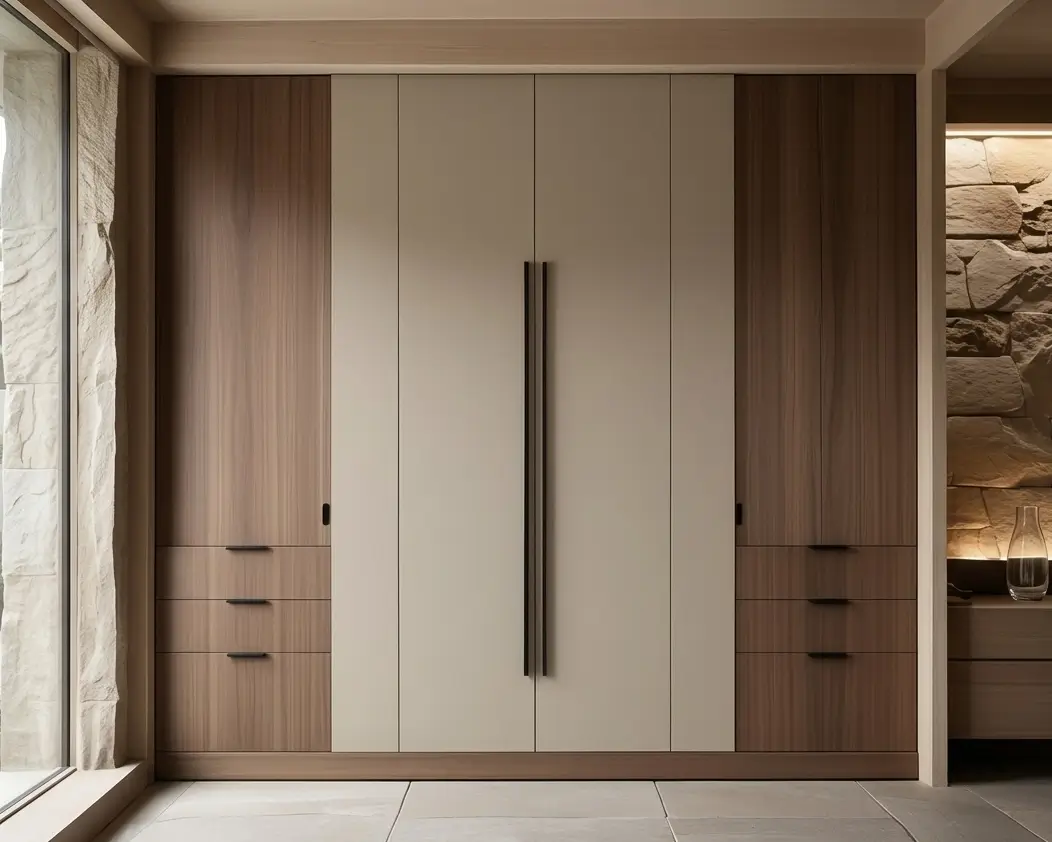
With its strong multi-material adaptability and stable machining performance, this model is widely used in furniture manufacturing, advertising signage production, precision craft processing, and functional product fabrication. In the furniture industry, it is used for processing wardrobes, cabinets, wooden doors, display racks, and decorative wall panels. In advertising applications, it is suitable for illuminated letters, signage logos, display boards, and exhibition stands. In precision manufacturing, it can be used for musical instrument components (such as guitars and violins), wooden molds, and artistic relief carving. Additionally, it performs well in the processing of packaging structures, foam inserts, and acoustic insulation materials.
Core Advantages of Spire 2030 CNC
Router with Oscillating Cutter: Four Dimensions to Reshape the Standards of
High-Efficiency Production
The CK-2030-RSP-TK CNC nesting machine is equipped with a 9 kW ATC air-cooled spindle, a pneumatic oscillating cutter, and a CCD vision system, enabling integrated machining of both rigid and flexible materials. This machine is widely used for cutting and milling rigid materials such as wooden doors, cabinets, display racks, illuminated signs, corrugated panels, musical instrument components, furniture accessories, and wooden molds. It is also highly effective for processing flexible materials, including automotive floor mats, sofa leather, carpets, cardboard boxes, and acoustic foam. The CCD vision system can automatically recognize graphic contours, enabling automatic edge-following cutting and path tracking. This significantly improves adaptability and precision when processing complex patterns and irregular materials. As a result, the machine delivers integrated production capabilities across multiple industries, materials, and processes.
The CK-2030-RSP-TK CNC router features an oversized 2000 × 3000mm working area. Combined with a 9-zone, 25-hole vacuum table, it can securely hold rigid sheet materials up to 7 × 9 feet, such as wood, acrylic, PVC, and aluminum composite panels. When replaced with a felt vacuum surface, the table is also suitable for processing flexible materials such as EPE foam, foam sheets, leather, acoustic panels, and cardboard. The zone-controlled vacuum design allows operators to activate or deactivate specific suction zones according to workpiece size, significantly improving vacuum efficiency and holding stability.This flexible configuration enables energy-efficient, high-precision, and highly stable machining across a wide range of sheet sizes and material types, meeting diverse production requirements in multi-scenario manufacturing environments.
03.
Highly Customizable, Meet Any Machining Needs.
To meet the diverse requirements of users in terms of production capacity, machining accuracy, and process complexity, the Spire Series offers fully customized solutions. Machine dimensions, control systems, functional configurations, and key component selections can all be extensively tailored to specific application needs. By strategically integrating functional modules and process units, the machine can be configured to achieve a more precise match between equipment performance and actual production requirements. This customized approach not only improves machining efficiency and operational stability but also helps optimize production workflows and reduce overall operating costs, enabling manufacturers to build more efficient, intelligent, and application-specific machining solutions.
The CK-2030-RSP-TK CNC router is designed with stability and ease of use at its core. Its control system integrates a wide range of machining process control functions and features an intuitive human-machine interface (HMI), simplifying operation and enabling users to quickly learn, set up, and commission the machine. This significantly shortens the time required to bring the equipment into production. In terms of hardware, the machine's frame structure, electrical system, and control system are all built to industrial-grade standards, ensuring reliable performance in long-duration, high-intensity production environments. In addition, the optimized system architecture and carefully selected proven components help minimize equipment failures and reduce maintenance requirements, lowering overall operating and ownership costs.
Choosing the Spire 2030 CNC Router with Oscillating Cutter means
choosing
Higher overall machine utilization
The integrated multi-process system is designed to meet the machining requirements of both rigid and flexible materials, eliminating the need to invest in multiple single-purpose machines. By enabling one machine to perform a wide range of production tasks, it significantly improves equipment utilization and maximizes return on investment.
Superior industrial-grade reliability
Built with a heavy-duty machine structure and equipped with premium electrical components sourced from leading global manufacturers, the machine delivers consistent accuracy and dependable performance even during prolonged high-speed operation and demanding heavy-load machining applications.
Greater production flexibility
The machine can quickly adapt to changing order requirements and processing demands by switching between different machining modes and processes. It supports a wide variety of applications, ranging from wardrobes, cabinets, musical instrument components, and advertising signage to automotive floor mats, foam packaging, and cardboard products, enabling efficient multi-material production on a single platform.
More reassuring full-process guarantee
Backed by a service system that goes beyond industry standards, the machine is supported by comprehensive technical consultation and after-sales assistance. Throughout the entire lifecycle of the equipment, users can rely on professional support to minimize concerns related to machine performance, maintenance, or product quality, ensuring a worry-free ownership experience.
Industrial-Grade Base, Building a Stable Foundation for Long Life Operation
Heavy-Duty Bed Base Dedicated to Spire
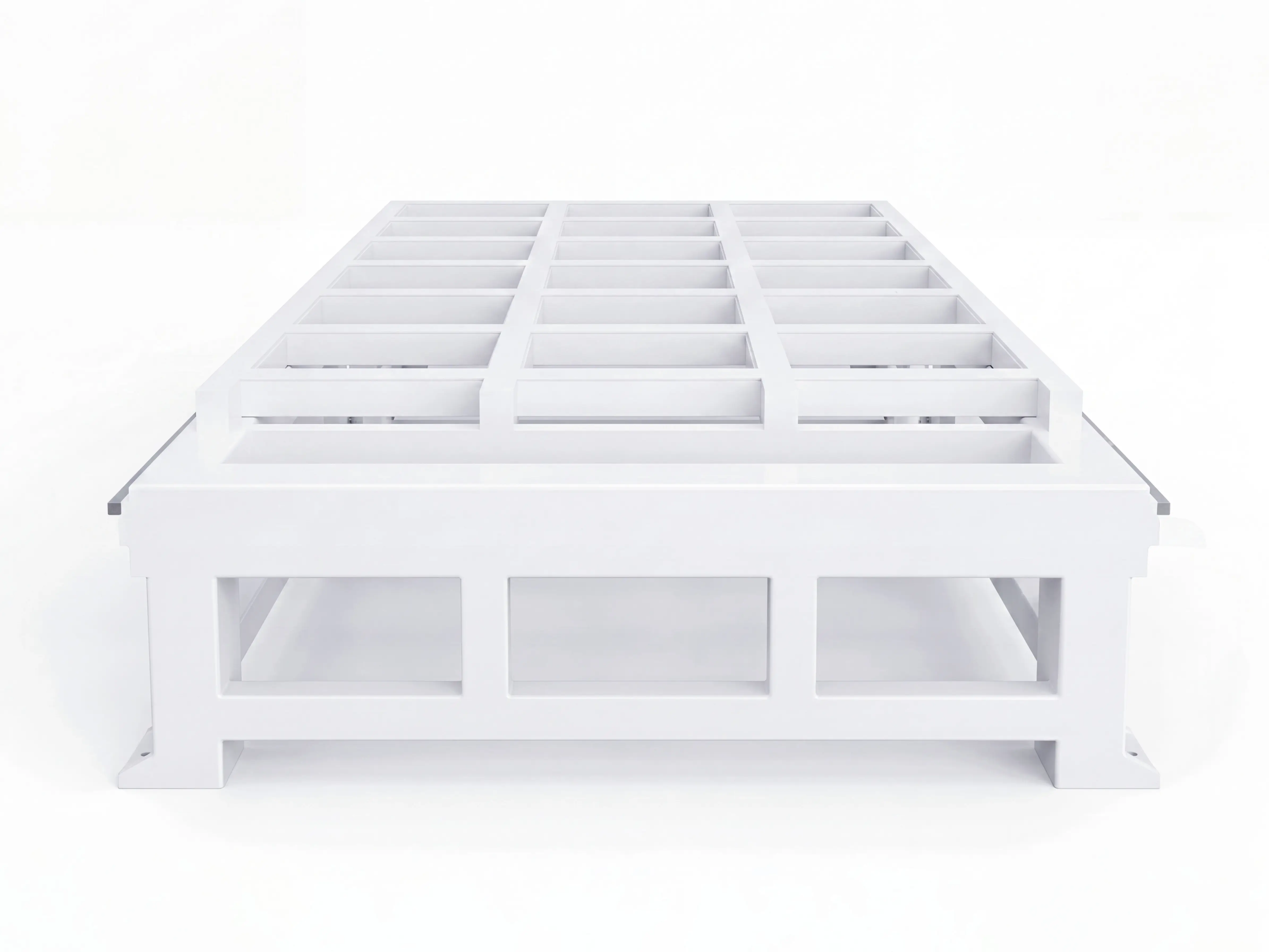
The bed and base of the CK-2030-RSP-TK are constructed using a heavy-duty welded steel tube structure, combined with a topology-optimized mechanical model developed exclusively for the Spire Series. By redefining the overall load-bearing paths and key support point distribution, the design effectively eliminates stress concentration areas commonly found in conventional welded structures. As a result, the machine frame maintains high rigidity and minimal deformation even under long-term high-speed operation.
The vacuum table base is built from thickened high-strength steel plates, with reinforced structural support applied to the linear guide and rack mounting areas. This significantly enhances load-bearing capacity and impact resistance at critical stress points. When processing materials such as wood, acrylic, PVC, and aluminum composite panels, the structure effectively reduces vibration transmission, ensuring improved stability and consistent machining accuracy during extended continuous operation.
Before delivery, the machine bed undergoes a dual stress-relief treatment combining vibratory stress relief and annealing. The vibratory process rapidly homogenizes surface stress distribution, while annealing further stabilizes the internal metallic structure, effectively preventing long-term deformation and positional deviation during operation. In addition, the entire machine is precision-machined on a five-axis gantry machining center, ensuring integrated accuracy of the guide rail mounting surfaces and transmission reference planes, as well as overall structural consistency.
Heavy-Duty Reinforced Gantry
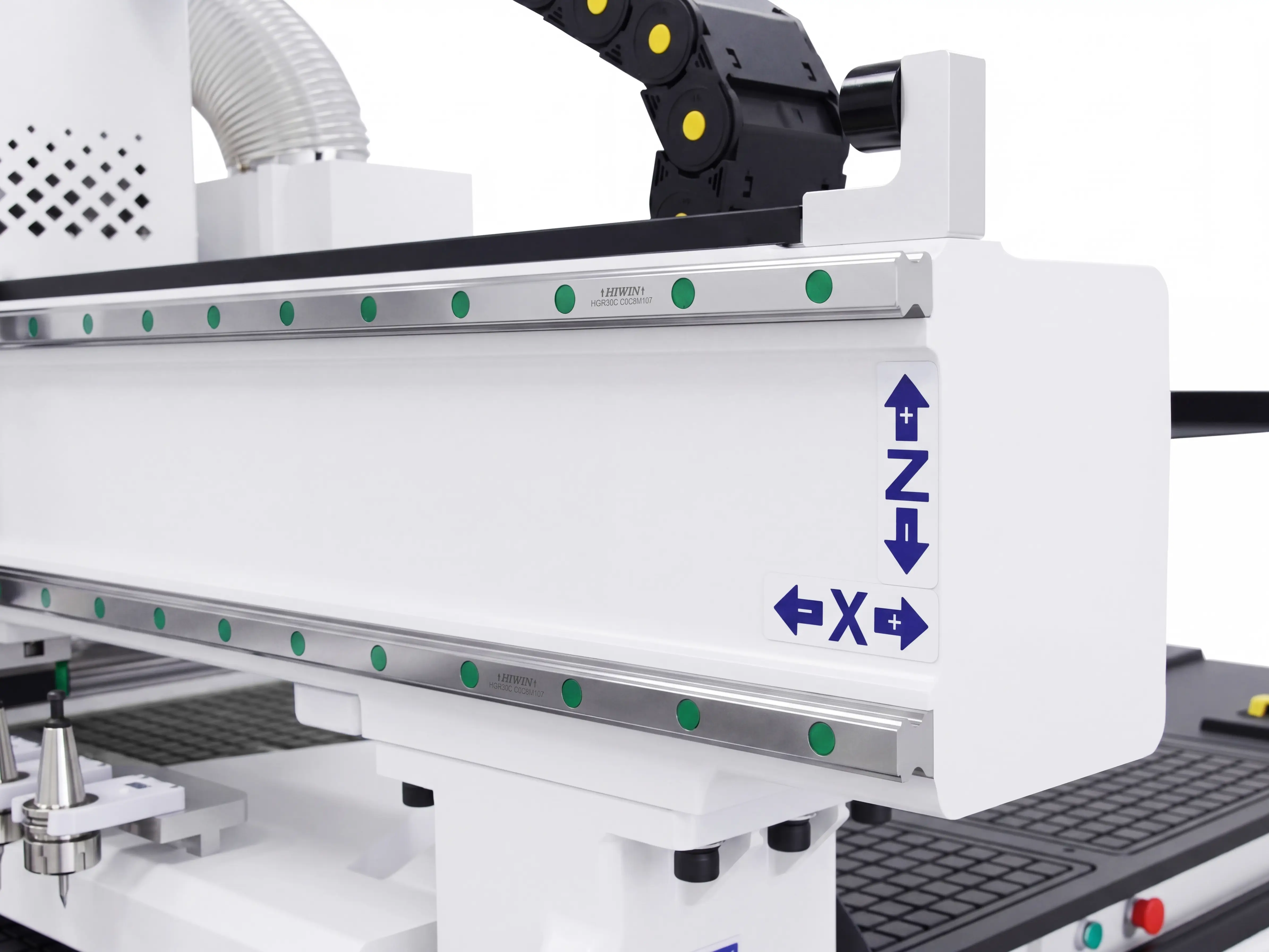
The machine adopts a heavy-duty gantry beam structure that has been specifically optimized for heavy-load cutting and high-speed operation. This design significantly enhances overall machine rigidity and torsional resistance. Even under demanding machining conditions, the machine maintains stable performance, providing a solid foundation for high-precision machining and continuous production.
The mounting bases for both the linear guides and rack-and-pinion system are fabricated from thickened steel sections through welded construction. By increasing structural thickness and expanding the contact area at critical mounting points, the design further improves the load-bearing capacity and structural stability of the drive system. During high-speed and high-acceleration operation, vibration effects on the transmission system are effectively minimized, ensuring smooth motion, precise positioning, and reliable performance throughout extended production cycles.
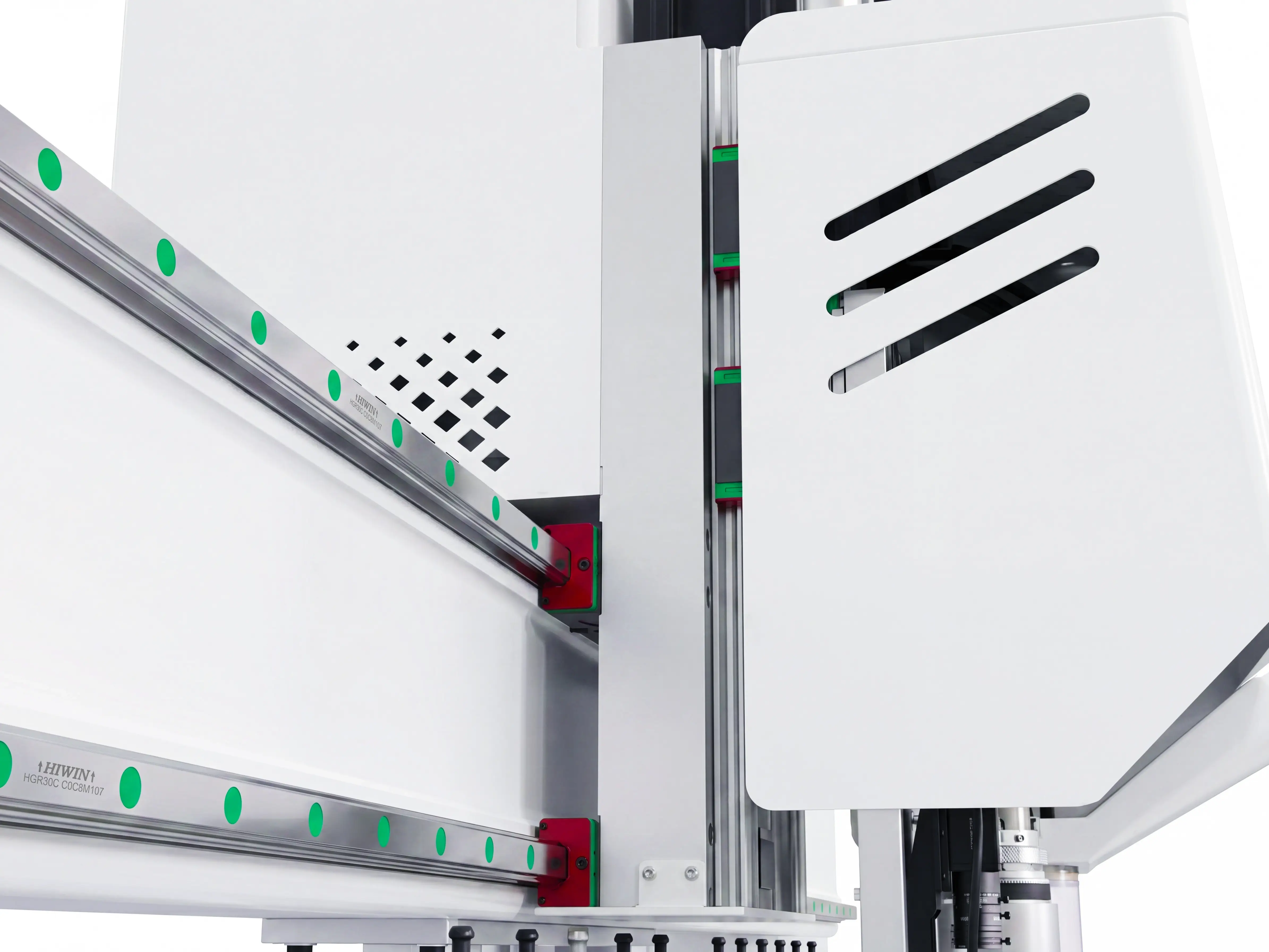
The connection interfaces between the gantry beam and gantry columns are precision-machined using a large-scale gantry machining center. Through strict control of machining tolerances on critical structural components, the machine achieves excellent geometric accuracy and operational stability after assembly, providing a reliable foundation for long-term precision performance.
The Z-axis mounting plate is machined from a solid 70mm-thick high-strength aluminum alloy using a high-precision machining center and finished with a hard anodized surface treatment. This process provides excellent corrosion resistance, oxidation resistance, and wear resistance while achieving a lightweight design without compromising structural strength, thereby enhancing overall machine stability and extending service life.
The 70mm ultra-thick structure significantly improves the mounting plate’s resistance to bending and torsional deformation. As a result, the spindle can maintain accurate spatial positioning even under substantial cutting loads, minimizing machining errors caused by structural deflection. Whether performing high-speed cutting or heavy-duty machining, the system ensures consistent motion accuracy and machining quality.
While maintaining high rigidity, the lightweight aluminum alloy construction effectively reduces the overall mass of the Z-axis moving assembly. This decreases the load on the servo system and improves dynamic response performance, enabling faster acceleration and deceleration, smoother motion control, and higher machining efficiency. The result is outstanding precision and enhanced productivity across a wide range of machining applications.
High-Strength Leveling Feet
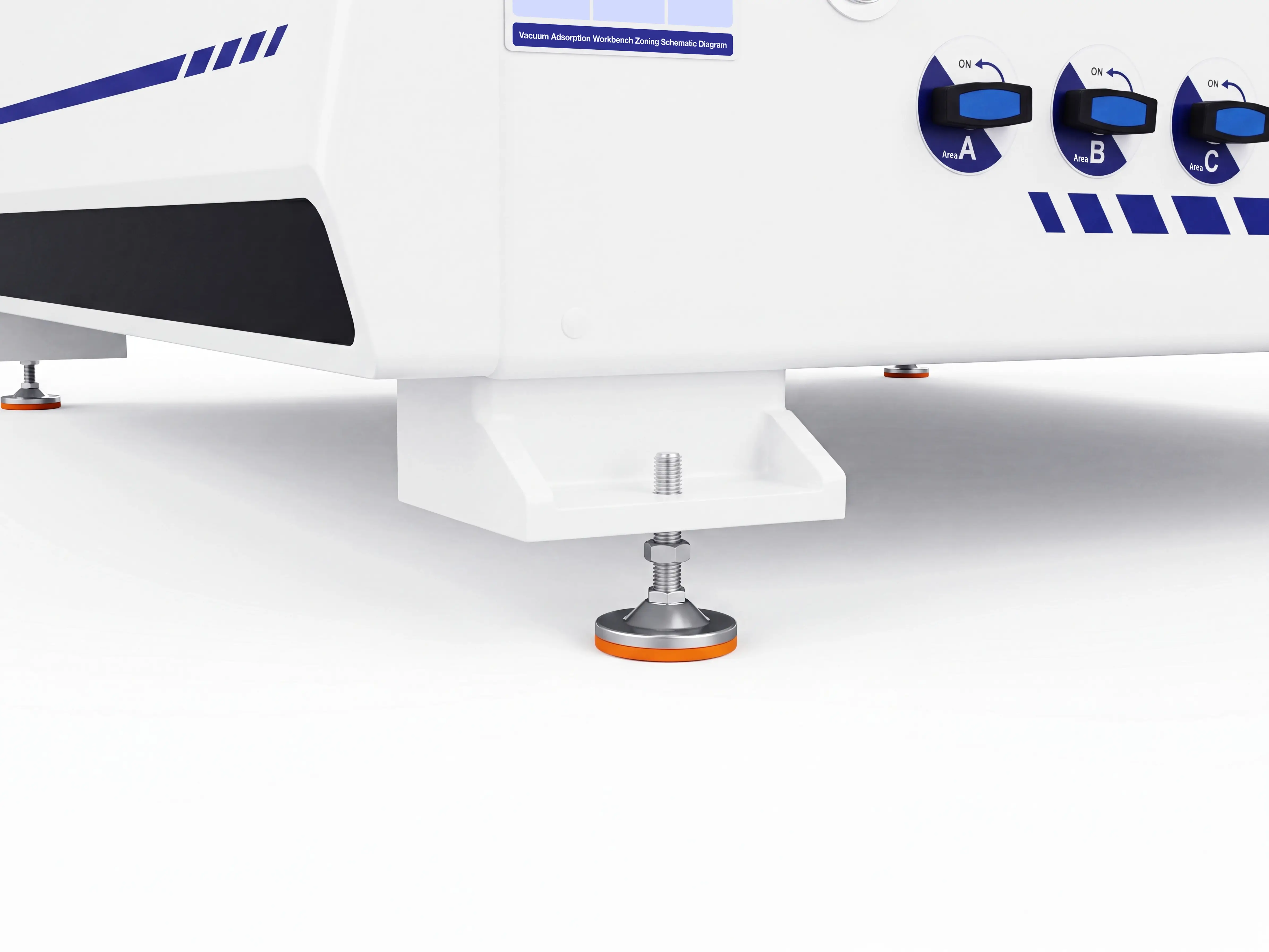
The CK-2030-RSP-TK CNC router is equipped with an adjustable leveling foot system. Six support points are positioned across the machine bed’s key load-bearing areas to effectively distribute the machine's weight and optimize load transfer paths. This design helps prevent bed deformation and stress concentration caused by uneven loading over time, ensuring long-term operational stability and consistent machining accuracy.
Each leveling foot features an integrated screw-type adjustment mechanism, allowing precise leveling based on the flatness of the workshop floor. This enables the machine to maintain a perfectly level installation and adapt easily to various facility conditions, simplifying installation and improving environmental adaptability.
The base of each leveling foot is fitted with a vibration-damping rubber pad that effectively absorbs vibrations generated during machine operation while preventing machine movement caused by vibration. This further enhances operational stability and machining quality, providing reliable support for high-precision manufacturing applications.
Click the icon labels to view different machine
parts
Reliable Transmission, Keeping Every Movement Smooth and Consistent
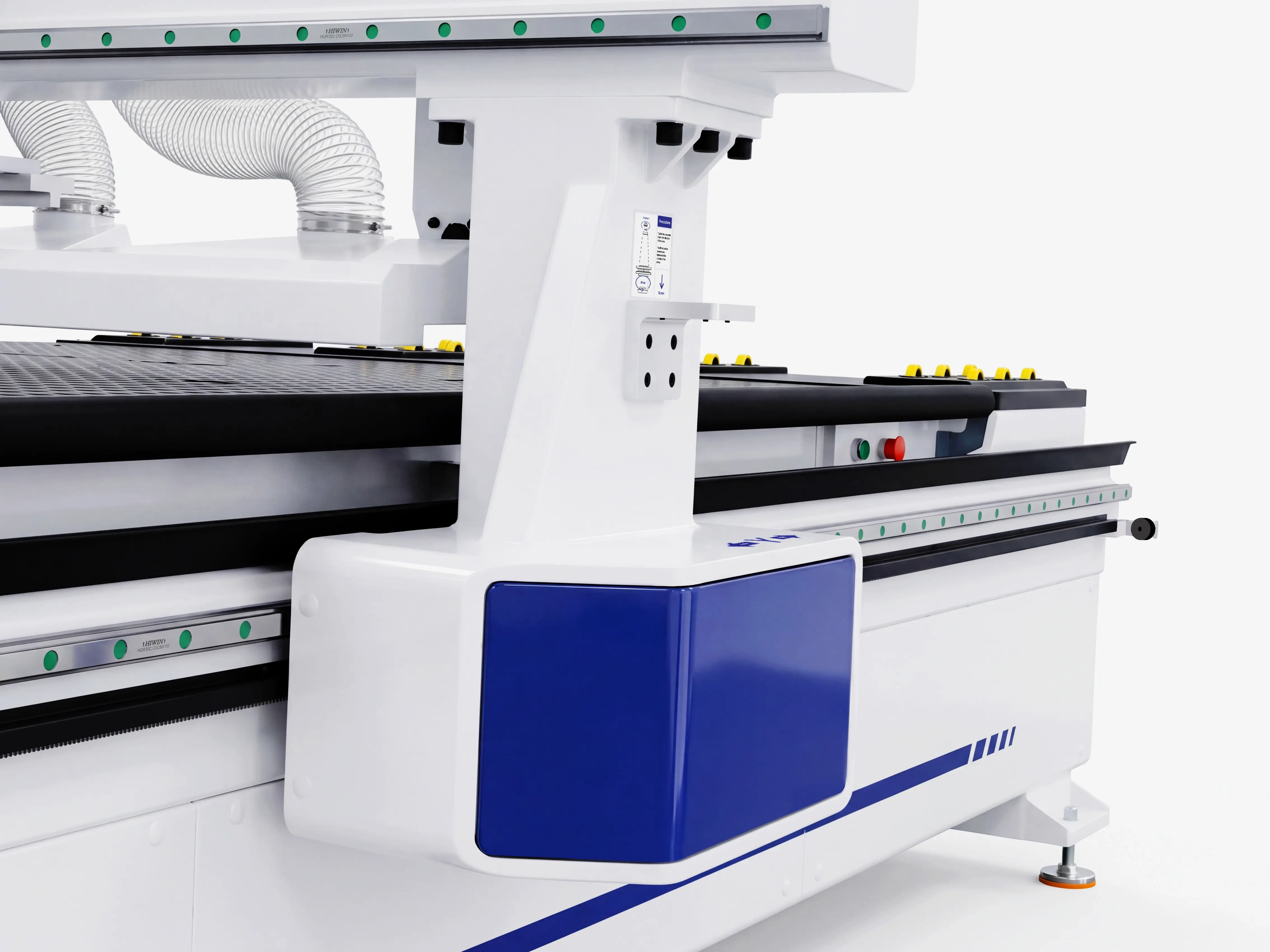
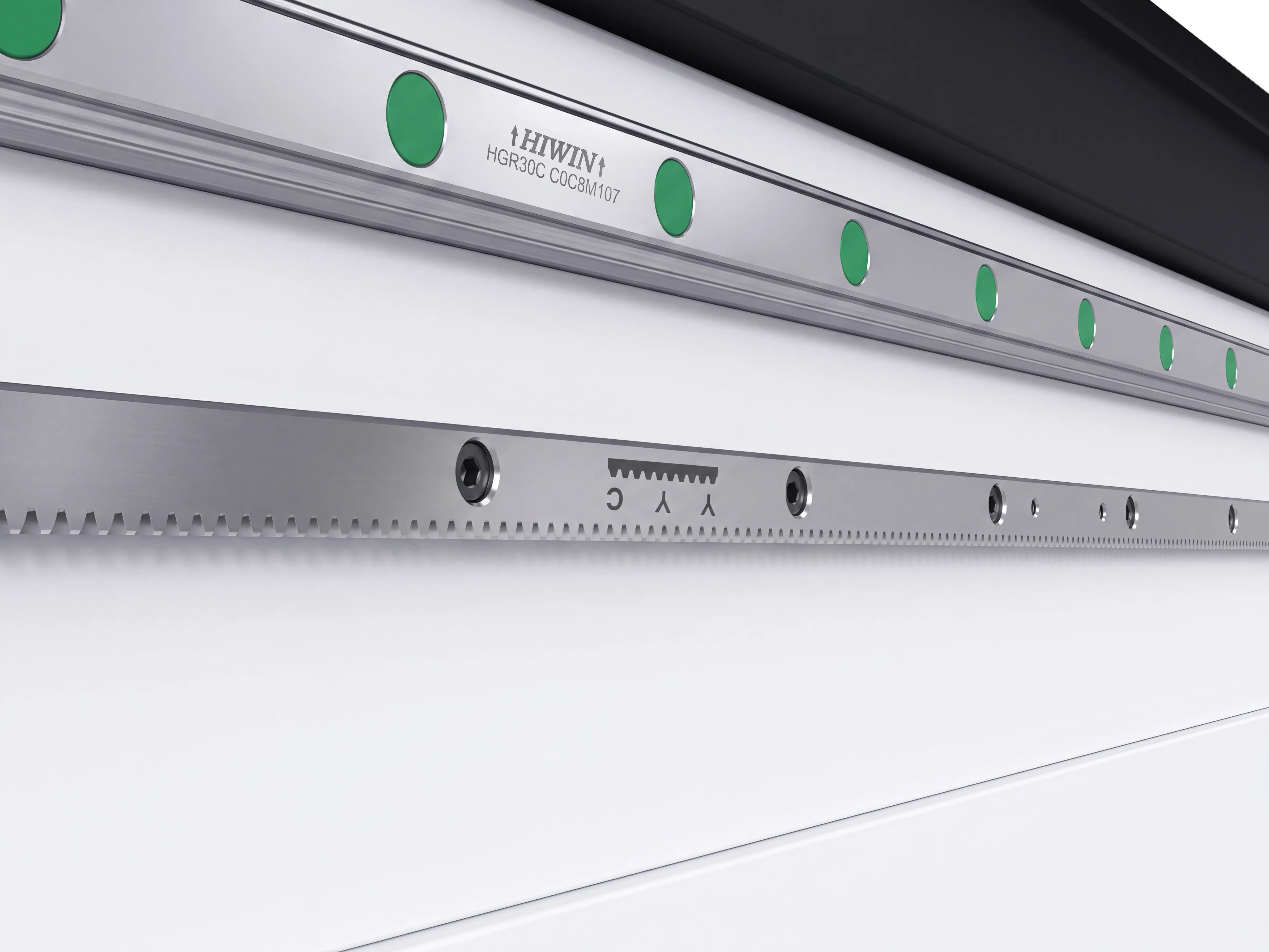
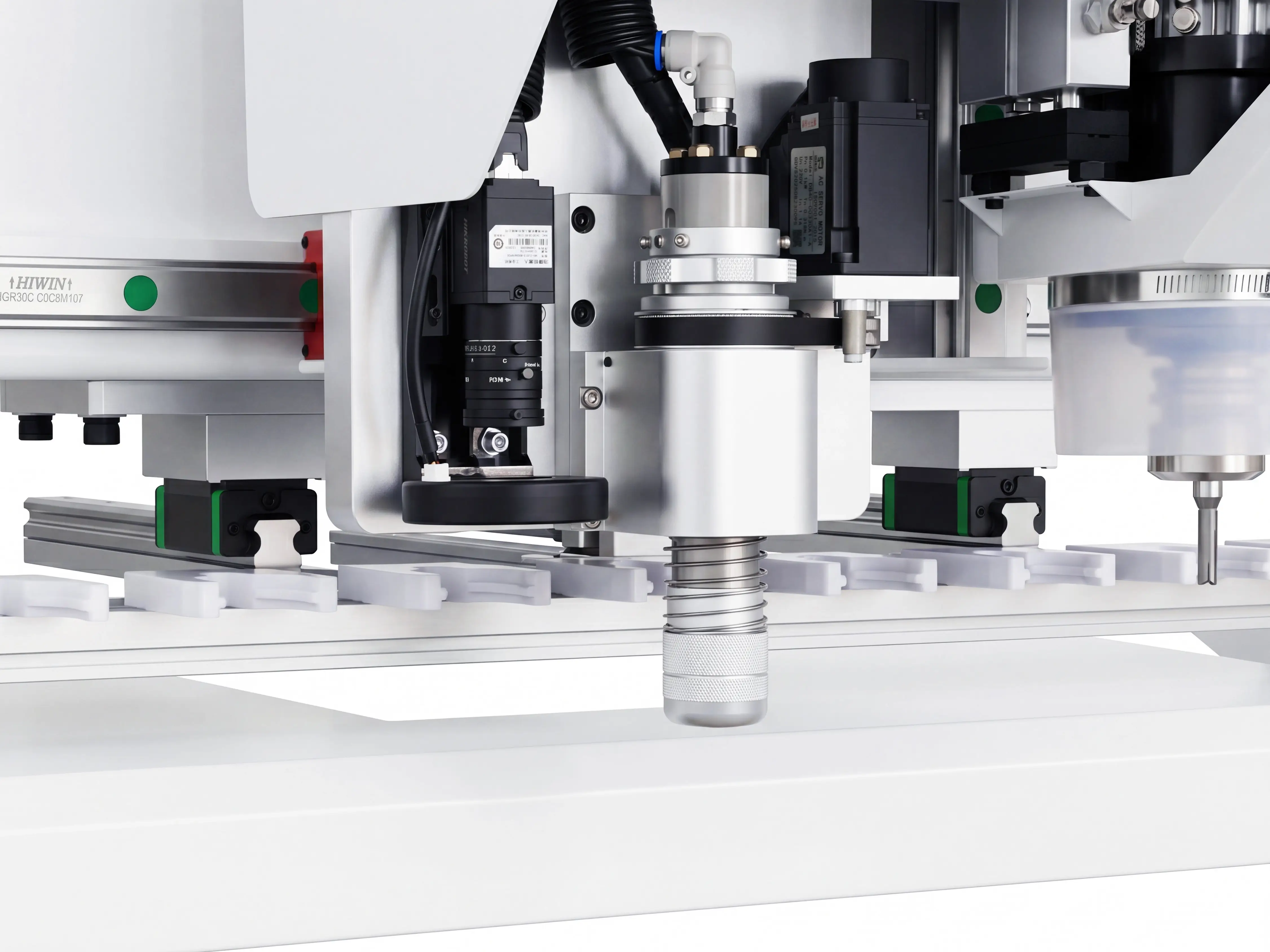
HIWIN (Taiwan) P-Level 30mm Linear
Guideways
The X, Y, and Z axes are equipped with Taiwan HIWIN P-level 30 mm heavy-duty linear guide rails and carriage systems, offering high rigidity, high precision, and strong load-bearing capacity. Even under high-speed cutting and long-duration continuous machining conditions, the system provides stable and reliable guidance support, fully meeting the demands of industrial mass production and high-precision machining applications.
The guide rails are manufactured using a P-level precision preloading process. Combined with an optimized internal carriage structure, this design enhances overall rigidity while reducing running friction resistance. As a result, the transmission system achieves improved positioning accuracy and smoother motion performance, ensuring stable operation in demanding applications such as fine engraving, advertising cutting, and panel nesting.
These linear guide systems also feature excellent durability and extended service life. The linear bearing steel achieves a hardness of HRC58 or higher, while the rolling friction coefficient is as low as 0.004. This effectively reduces wear and energy consumption during operation, further improving long-term stability and extending maintenance intervals.
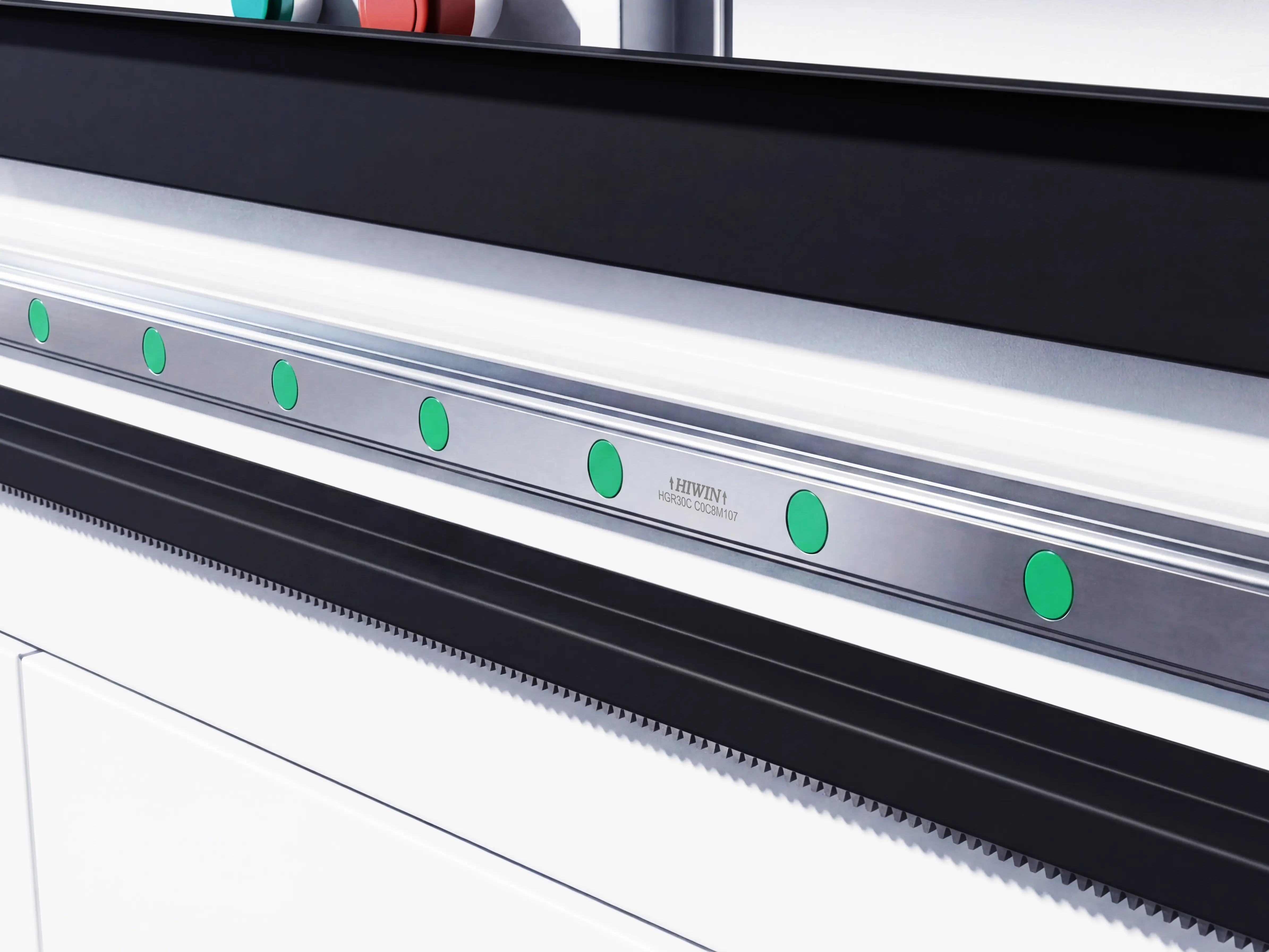
The X and Y axes adopt Taiwan YYC high-precision ground rack systems for long-stroke, high-speed transmission. Through multiple processing stages, including tooth surface grinding and four-side precision machining, the cumulative pitch error is controlled within 0.028mm per meter, providing a stable and reliable linear motion foundation for large-format 2000 × 3000mm machining applications.
The helical rack design increases the tooth contact engagement area, enabling smoother gear meshing during transmission. This significantly reduces impact during engagement as well as operational noise. In addition, the structure helps minimize wear and backlash variation over long-term operation, ensuring consistent repeat positioning accuracy and machining stability.
The YYC high-precision rack system significantly enhances overall transmission rigidity and dynamic response of the X and Y axes. Even under high-speed movement and heavy-duty cutting conditions, the machine maintains stable trajectory control performance, thereby improving overall machining efficiency and motion accuracy.
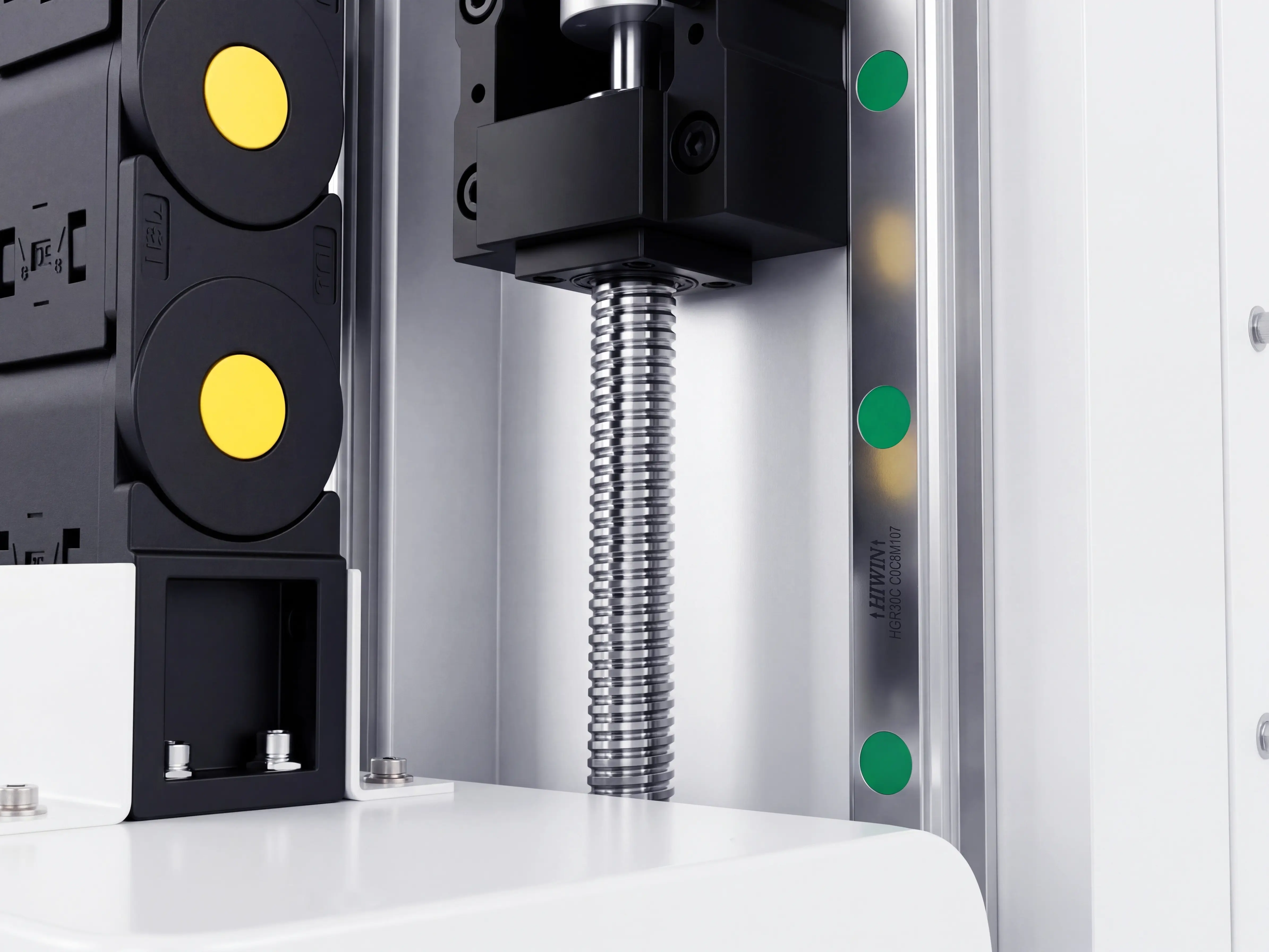
TBI (Taiwan) High-Precision Ground Ball Screw
The Z-axis adopts a Taiwan TBI high-precision ground ball screw system, manufactured through precision grinding processes. It features extremely low backlash and excellent repeat positioning accuracy. Compared with traditional sliding lead screws, its rolling transmission structure offers lower friction and higher transmission efficiency, significantly reducing heat generation and energy loss during operation. As a result, the Z-axis maintains stable, smooth motion and high-precision positioning even under high-speed movement and frequent start-stop conditions.
The TBI ground ball screw utilizes an internal circulation ball return design, with a driving torque approximately one-third that of an ACME trapezoidal lead screw. This effectively reduces the load on the servo motor, enabling more responsive Z-axis movement and smoother acceleration and deceleration performance. It enhances detail reproduction and overall machining consistency in complex tool paths. In applications such as mass production of cabinets and wardrobes, furniture carving, and cutting of fabrics and flexible materials, it consistently delivers stable and high-precision machining results.
The TBI ball screw is manufactured from high-strength materials combined with strict heat treatment and precision engineering processes. The screw shaft, nut, and steel balls are made of high-carbon steel or chromium-molybdenum alloy steel, achieving an overall hardness of HRC58–64. This provides excellent wear resistance and structural stability, effectively extending service life and ensuring long-term consistency in machining accuracy.
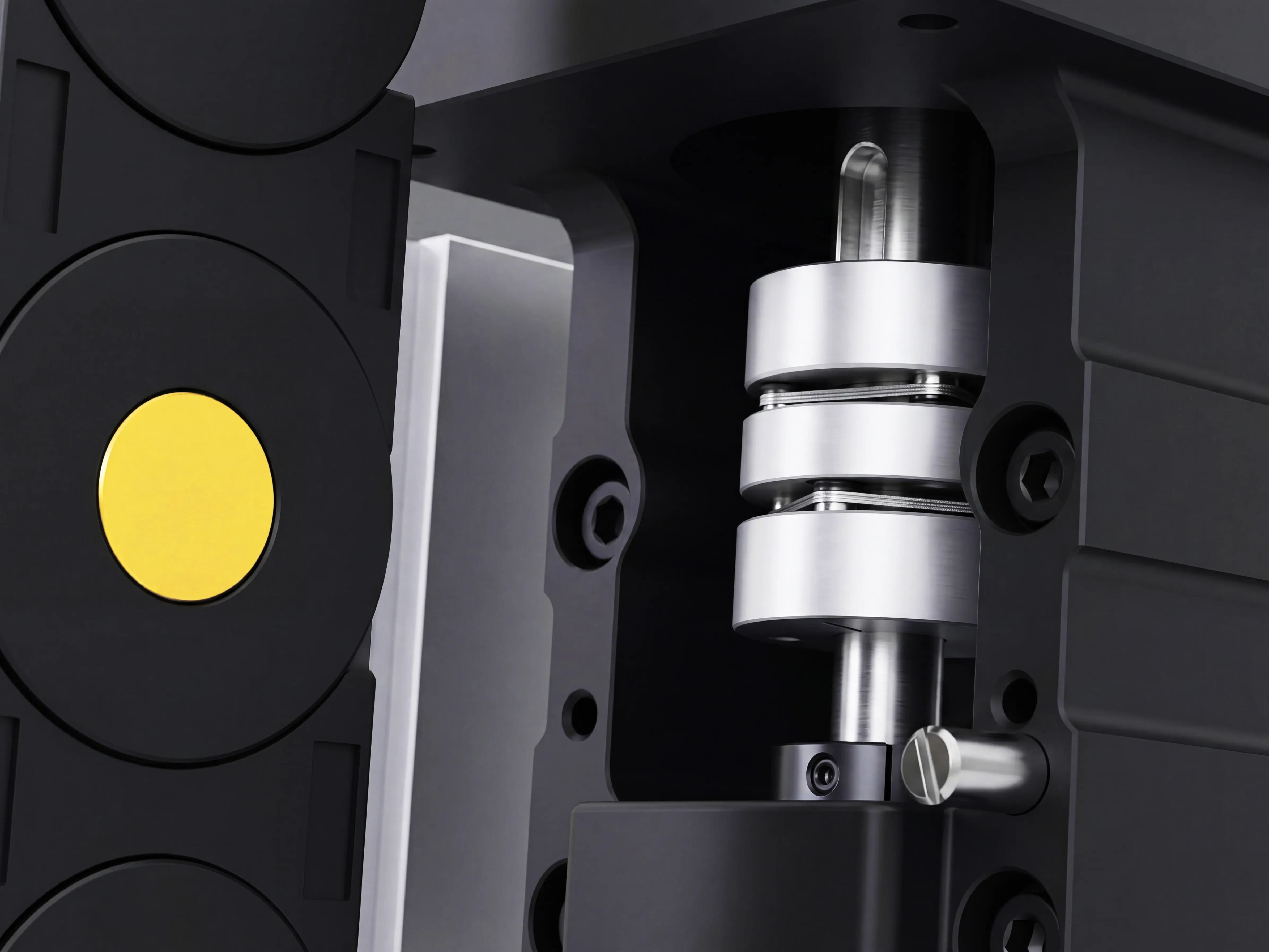
Diaphragm Coupling
The Z-axis servo motor is connected to the ball screw via a double-diaphragm coupling. This coupling features an integrated aluminum alloy structure combined with high-strength stainless steel flexible diaphragms, effectively absorbing installation errors and ensuring stable and precise power transmission between the servo motor and the screw.
The double-disc coupling offers zero-backlash transmission characteristics along with excellent axial, radial, and angular misalignment compensation capabilities. It effectively reduces additional stress caused by assembly tolerances or operational deviations, minimizing wear on both the ball screw and motor bearings. This extends the service life of core transmission components while improving overall stability and reliability during long-term continuous machining.
The aluminum alloy body combines lightweight design with high structural strength, while the stainless steel diaphragms provide outstanding fatigue resistance and anti-aging performance. Compared with traditional jaw couplings, it offers superior adaptability under high-temperature, low-temperature, and high-speed operating conditions, reliably supporting rotational speeds of tens of thousands of revolutions per minute.
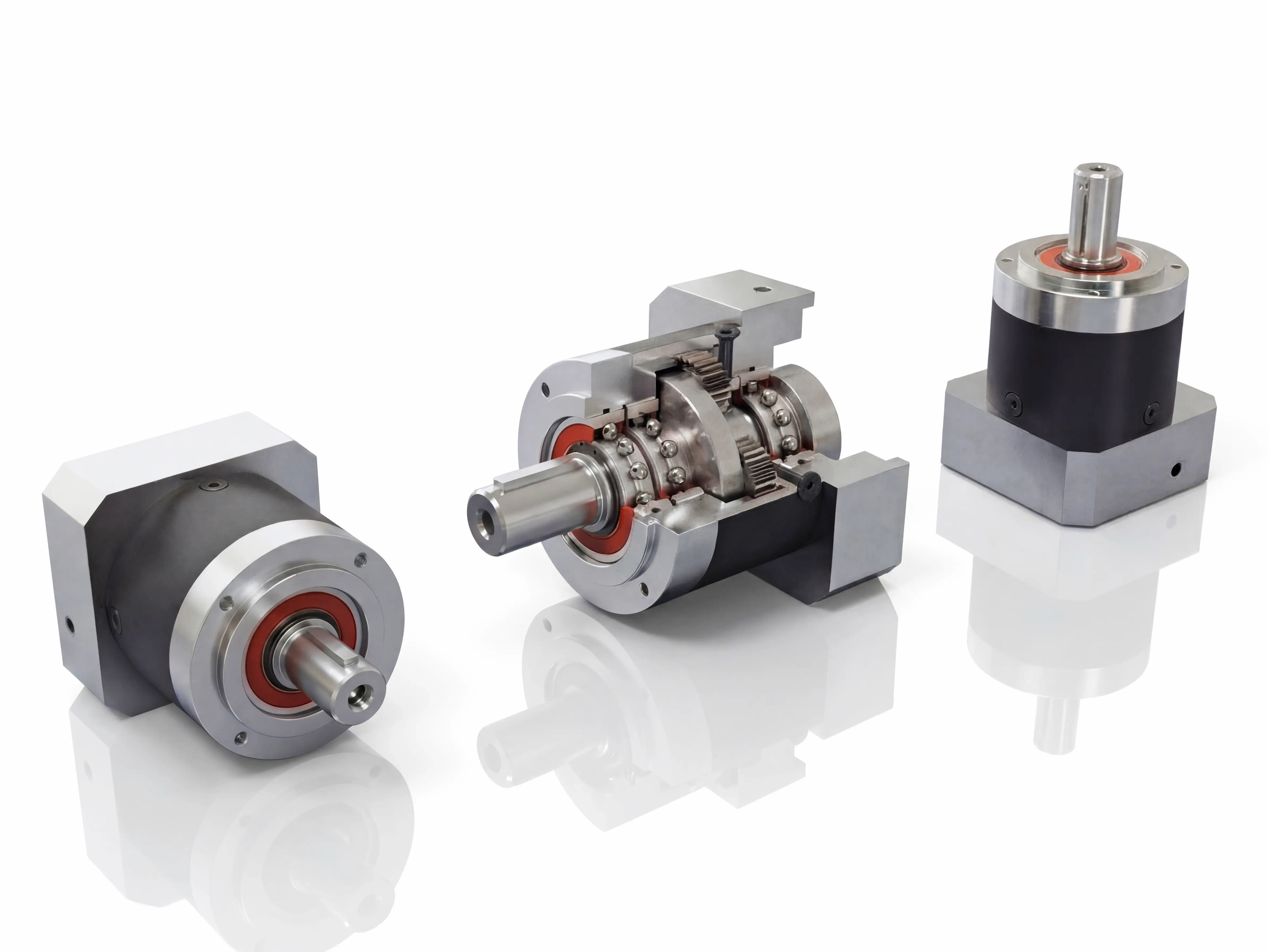
SHIMPO (Japan) Planetary Gear Reducers
The X and Y axes are equipped with a Japan SHIMPO high-precision planetary gear reducer paired with servo motors. The internal gears are manufactured through high-precision machining and heat treatment processes, providing excellent wear resistance and long-term operational stability. The gearbox is filled with high-performance lubricant and designed with a sealed structure, enabling long-life lubrication that requires virtually no replacement during normal service life.
This planetary reducer features extremely low backlash characteristics (<0.05°), effectively eliminating transmission clearance and ensuring highly consistent and accurate positioning for every indexing and motion cycle. This significantly improves the positioning accuracy and repeatability of the X and Y axes.
In addition, the SHIMPO planetary reducer offers advantages such as low noise, low vibration, and high transmission efficiency during operation. It effectively reduces system energy consumption and mechanical wear, further extending the service life of both the servo motors and the entire transmission system, ensuring stable and reliable performance even under high-speed and high-load working conditions.
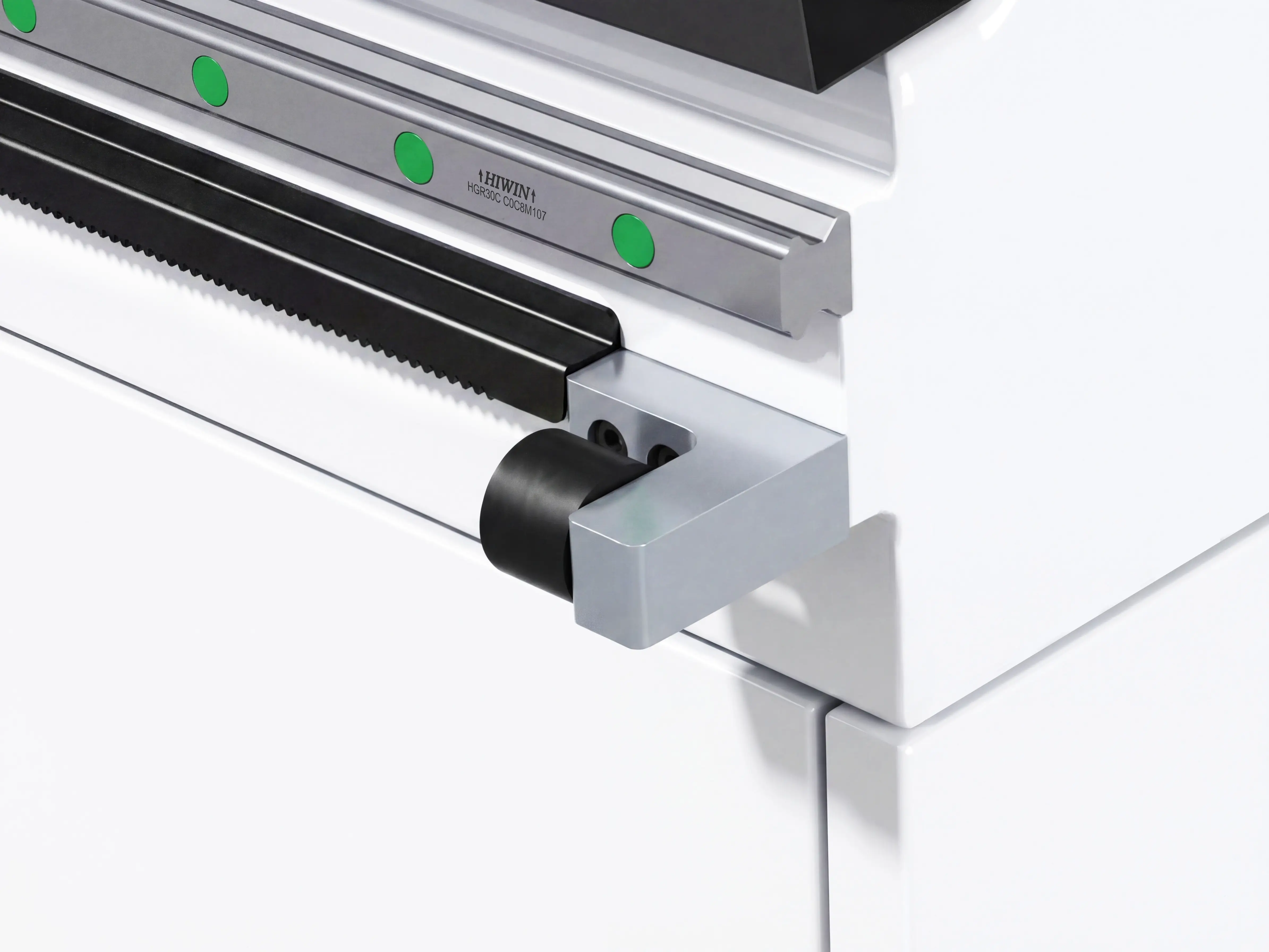
High-Strength Aluminum Alloy Limit Bumpers
The end positions of both the X and Y axes are equipped with limit bumpers that serve as hard limit protection structures. In the event of abnormal or failed photoelectric soft-limit signals, these mechanical stops provide final-stage safety protection, effectively preventing over-travel collisions and enhancing the overall operational safety and reliability of the machine.
The base of the limit bumper is manufactured using an integrated aluminum alloy structure, offering high structural strength and strong impact resistance. It is capable of withstanding instantaneous impact loads under high-speed operating conditions, providing a stable and reliable hard limit support at the end of travel.
The end face of the limit bumper is fitted with industrial-grade damping rubber material. Upon contact, it effectively absorbs impact energy and disperses instantaneous forces, reducing the effect of rigid collisions on the machine frame and transmission components, thereby further protecting critical parts from damage.
Click the icon labels to view different machine
parts
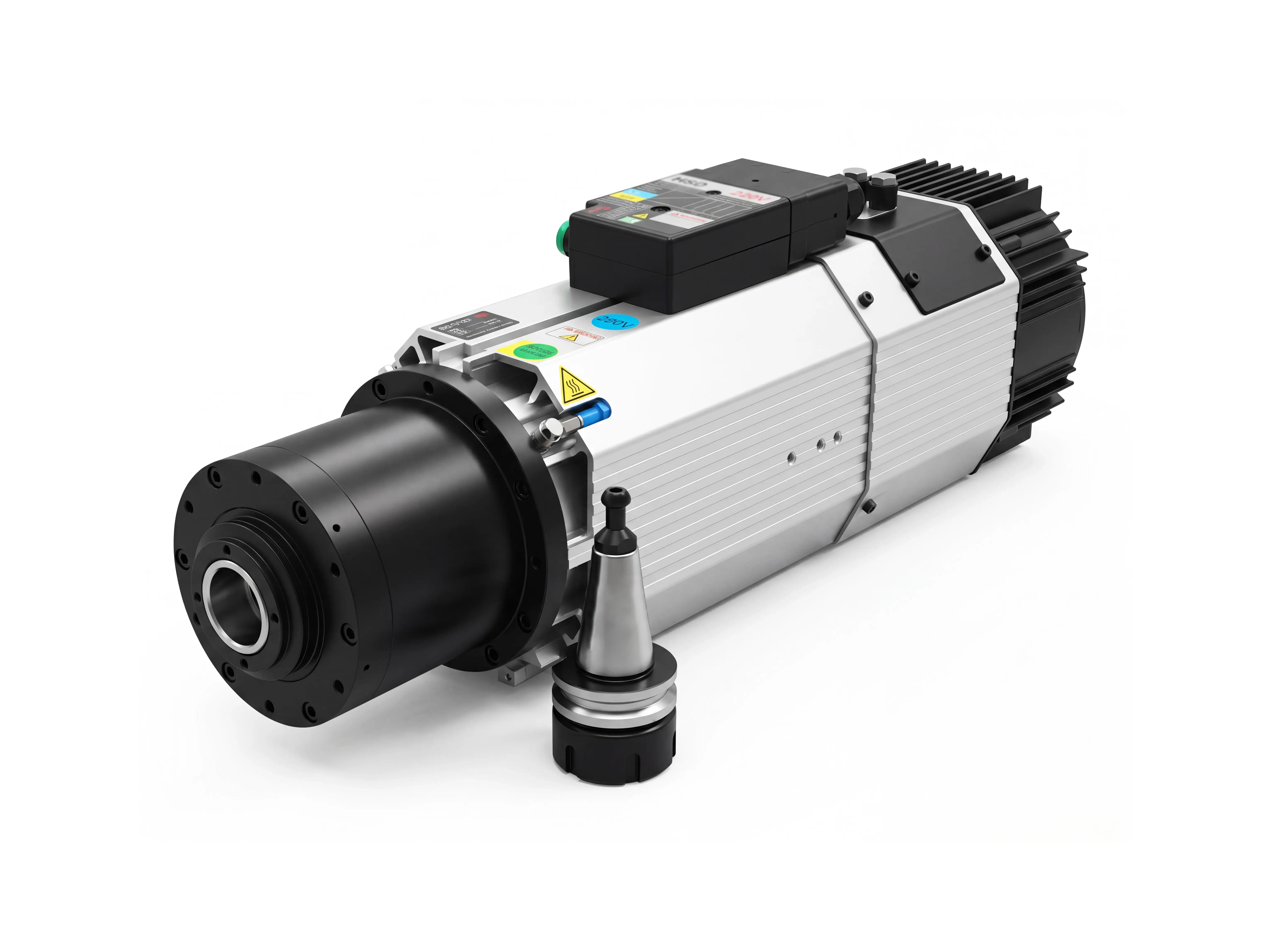
The HQD 9 kW high-power ATC air-cooled spindle delivers a maximum rotational speed of up to 24,000rpm. It is engineered with industrial-grade dynamic balance precision calibration and reinforced bearing structure design, ensuring stable and reliable performance even under high-speed operating conditions. The spindle provides excellent torque output capability, achieving a balanced performance between heavy-duty cutting and high-speed finishing, thereby optimizing both machining efficiency and surface quality.
The spindle supports both ISO30 tool holders and ER32 collet systems, allowing stable clamping of tools with shank diameters up to ≤20 mm. It is seamlessly integrated with the automatic tool changer system, enabling fully automated tool replacement. This significantly improves machining continuity across multiple processes and enhances overall production efficiency.
The spindle adopts an efficient air-cooling heat dissipation structure, eliminating the need for a complex water-cooling system. While ensuring reliable cooling performance, it significantly reduces system complexity, thereby lowering failure rates and improving daily maintenance convenience.
High-Frequency Pneumatic Oscillating Cutter and CCD Vision System
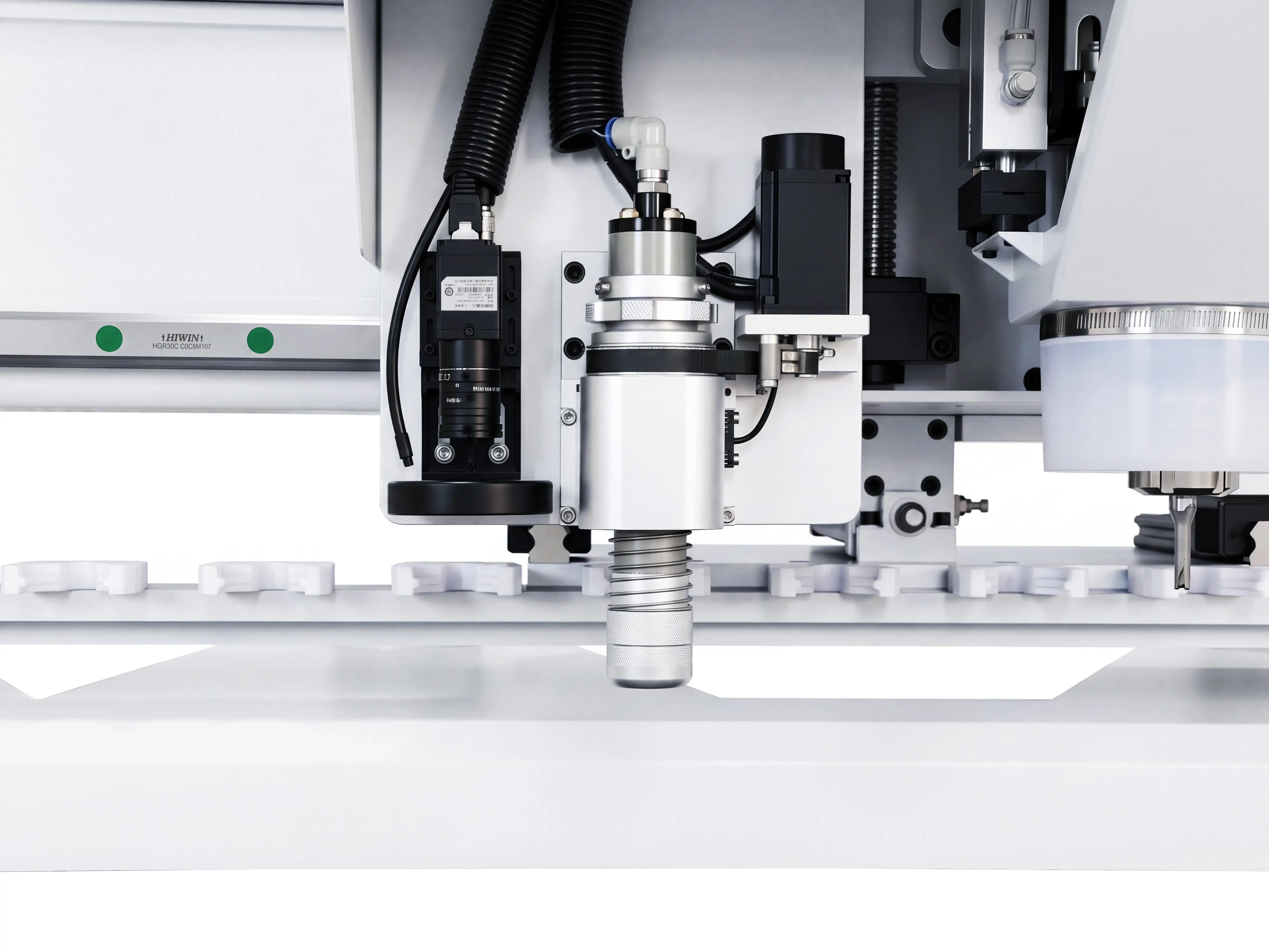
The pneumatic oscillating knife system features a maximum vibration frequency of up to 18,000VPM, driven by compressed air to achieve high-frequency reciprocating blade motion. This significantly improves cutting efficiency and material penetration capability. Compared with electric oscillating knives, it supports a maximum cutting thickness of up to 100mm. Even when processing multi-layer composites or high-density boards, it maintains stable feed and continuous cutting performance, greatly enhancing industrial batch processing efficiency and production continuity.
This oscillating knife system is suitable for a wide range of flexible and semi-rigid materials, including EPE foam, foam board, honeycomb cardboard, KT board, and various acoustic and insulation materials. It offers excellent material adaptability and stable processing performance. During high-frequency reciprocating cutting, the blade quickly shears the material fiber structure, achieving clean cuts without pulling, tearing, or burrs. It also effectively reduces material deformation and edge cracking, resulting in smoother and more refined contours, making it particularly suitable for packaging inserts, carpets, and thick composite materials.
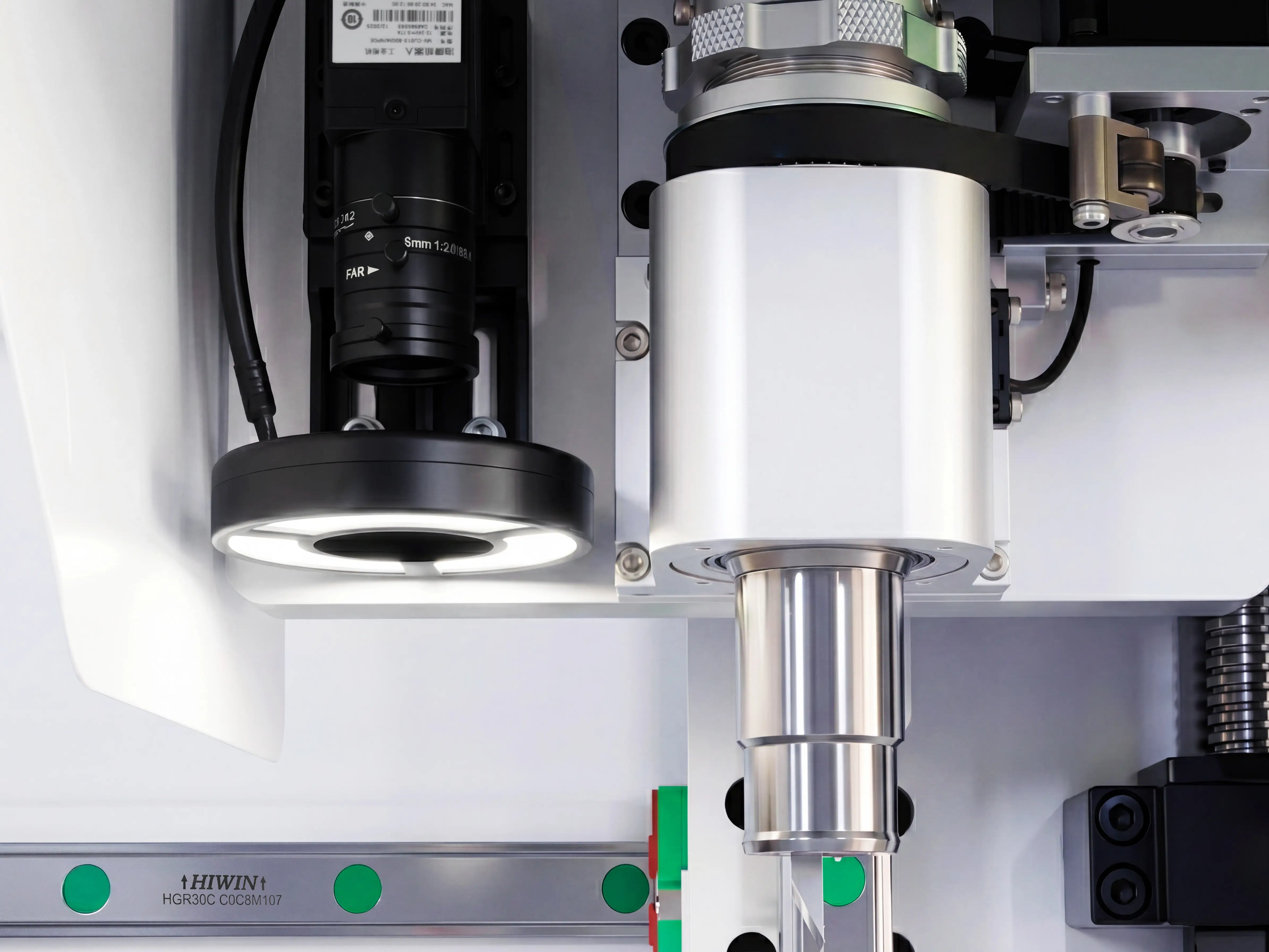
The system is equipped with a high-precision CCD vision positioning system, which can automatically identify the outer contour of printed graphics and perform automatic contour-following cutting. During operation, it enables real-time path tracking and offset correction, significantly improving accuracy and consistency in complex graphic processing while further enhancing overall production efficiency.
Click the icon labels to view different machine
parts
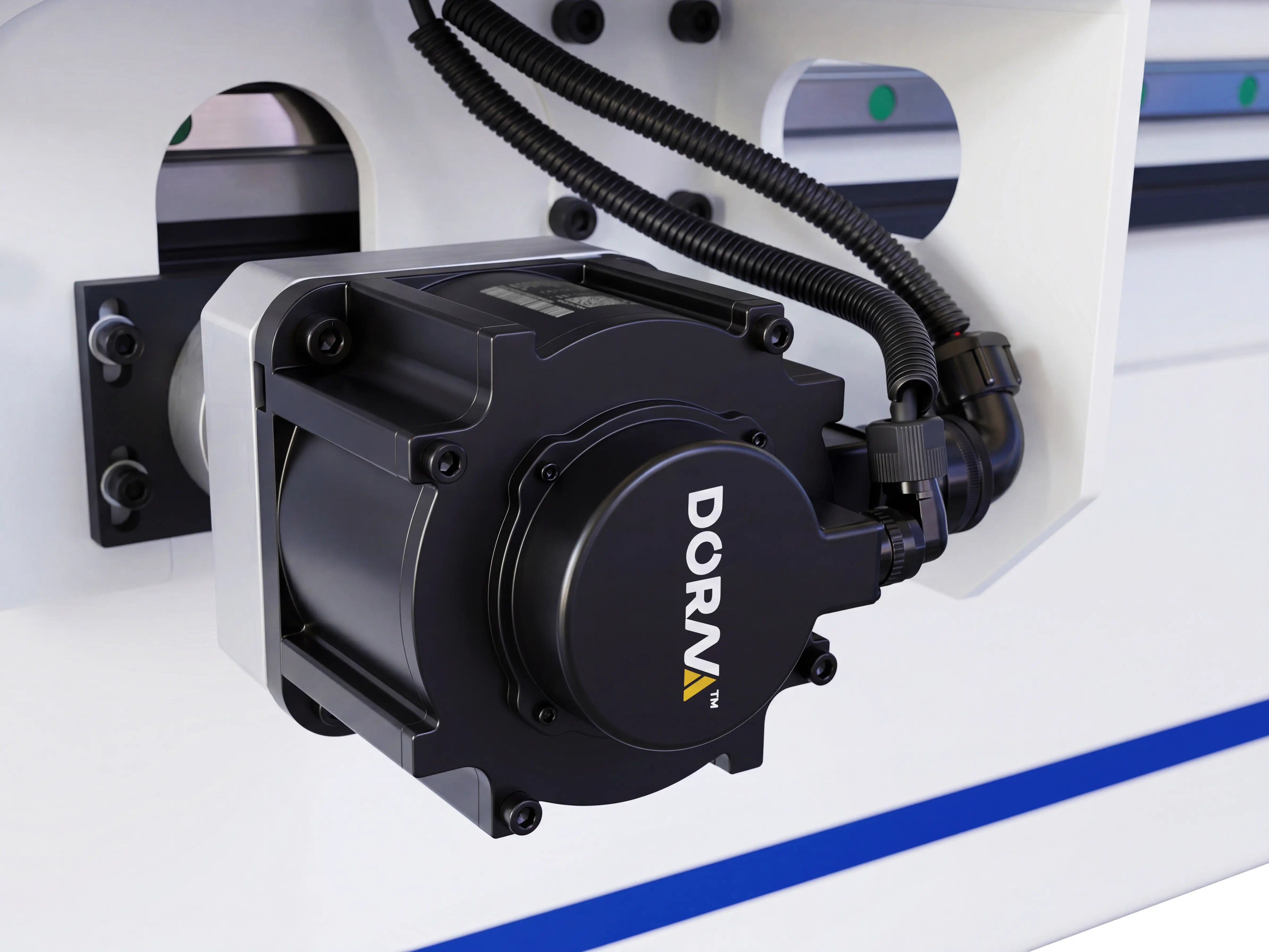
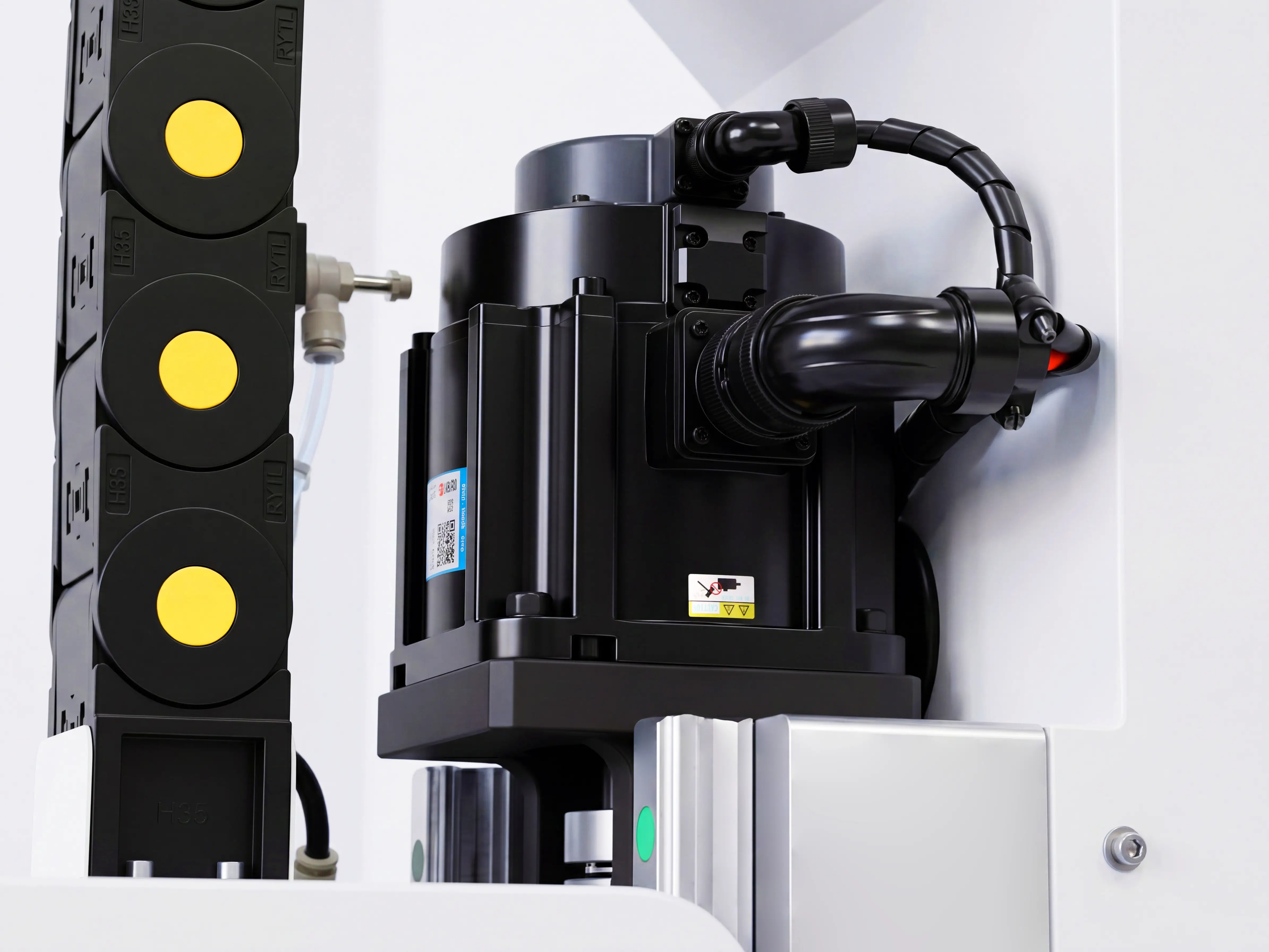
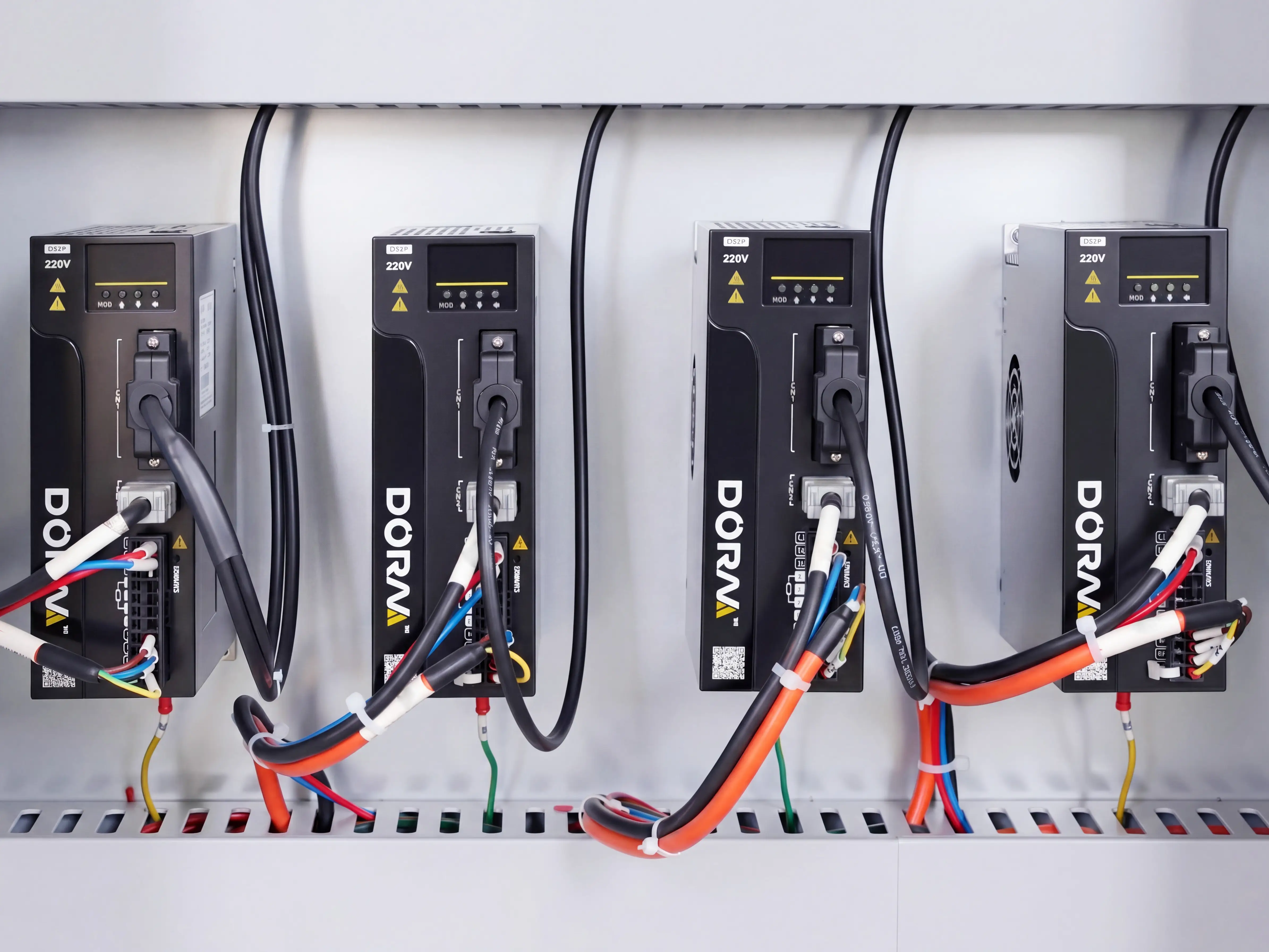
The machine is equipped with four sets of Dorna 1500W high-performance servo motors, delivering high responsiveness, high torque output, and highly stable motion control. Even under high-speed operating conditions, the system achieves precise positioning and smooth acceleration/deceleration control, providing a reliable power foundation for the Spire multi-functional CNC router and meeting the demands of long-duration, high-load machining.
The Y-axis adopts a dual-servo synchronous drive configuration, with two servo motors installed at both ends of the gantry. This layout effectively balances gantry loading conditions, enhances overall structural rigidity, and improves operational stability. It prevents issues such as uneven loading, skewing, or mechanical deflection, ensuring smoother and more reliable performance during large-span, high-speed motion.
The Z-axis is equipped with a servo motor featuring a brake function, which automatically locks the axis position in the event of a power failure or emergency stop, effectively preventing spindle drop caused by gravity. In addition, the XY-axis servo system is paired with planetary gear reducers, which not only increase torque output but also improve low-speed precision and high-speed responsiveness. This ensures that the machine maintains high rigidity, high accuracy, and reliable performance even under complex machining conditions.
Multi-Function CNC System, Offering a User-Friendly Operating Experience
XDW VC-324C Multi-Functional CNC System
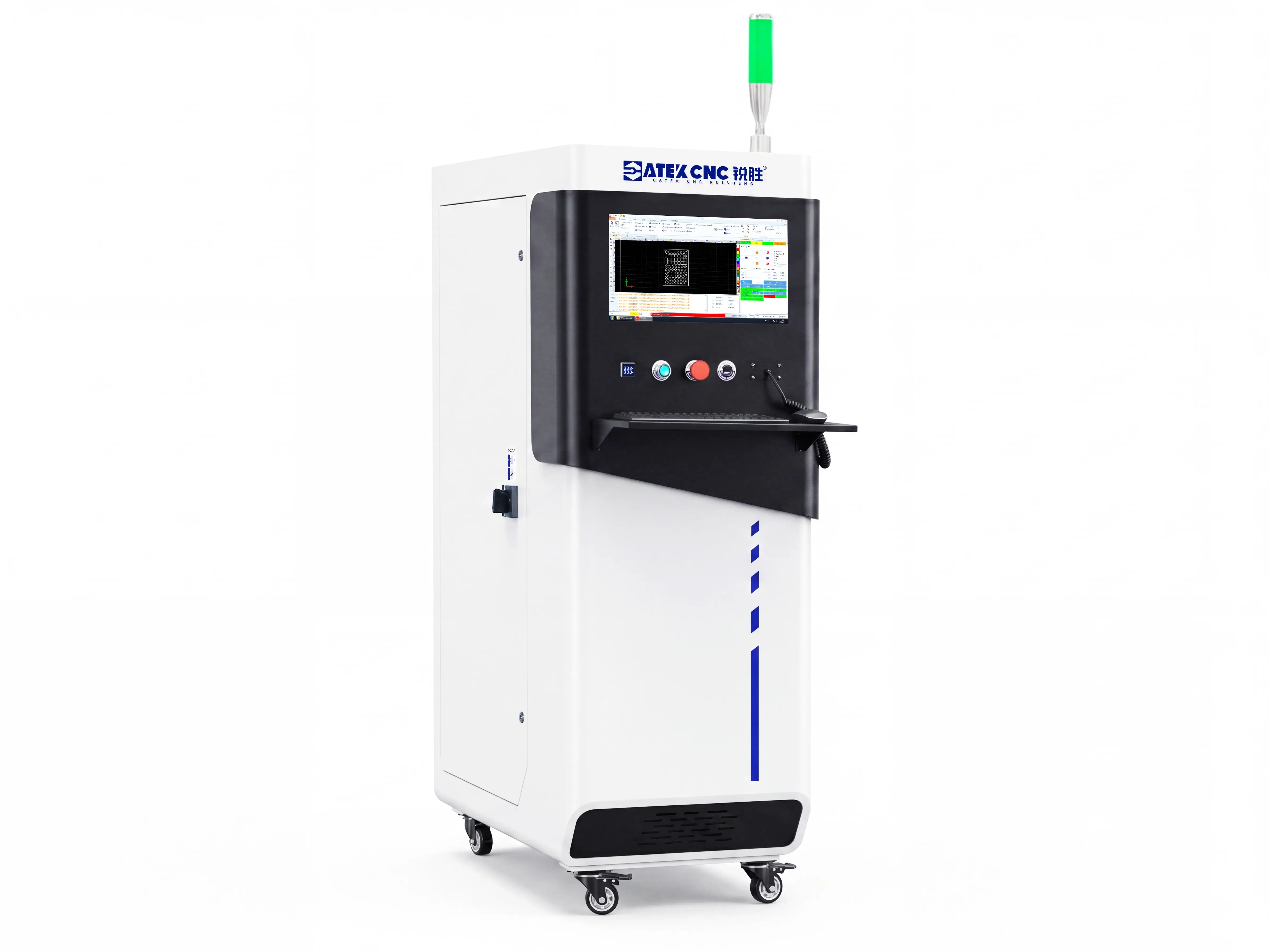
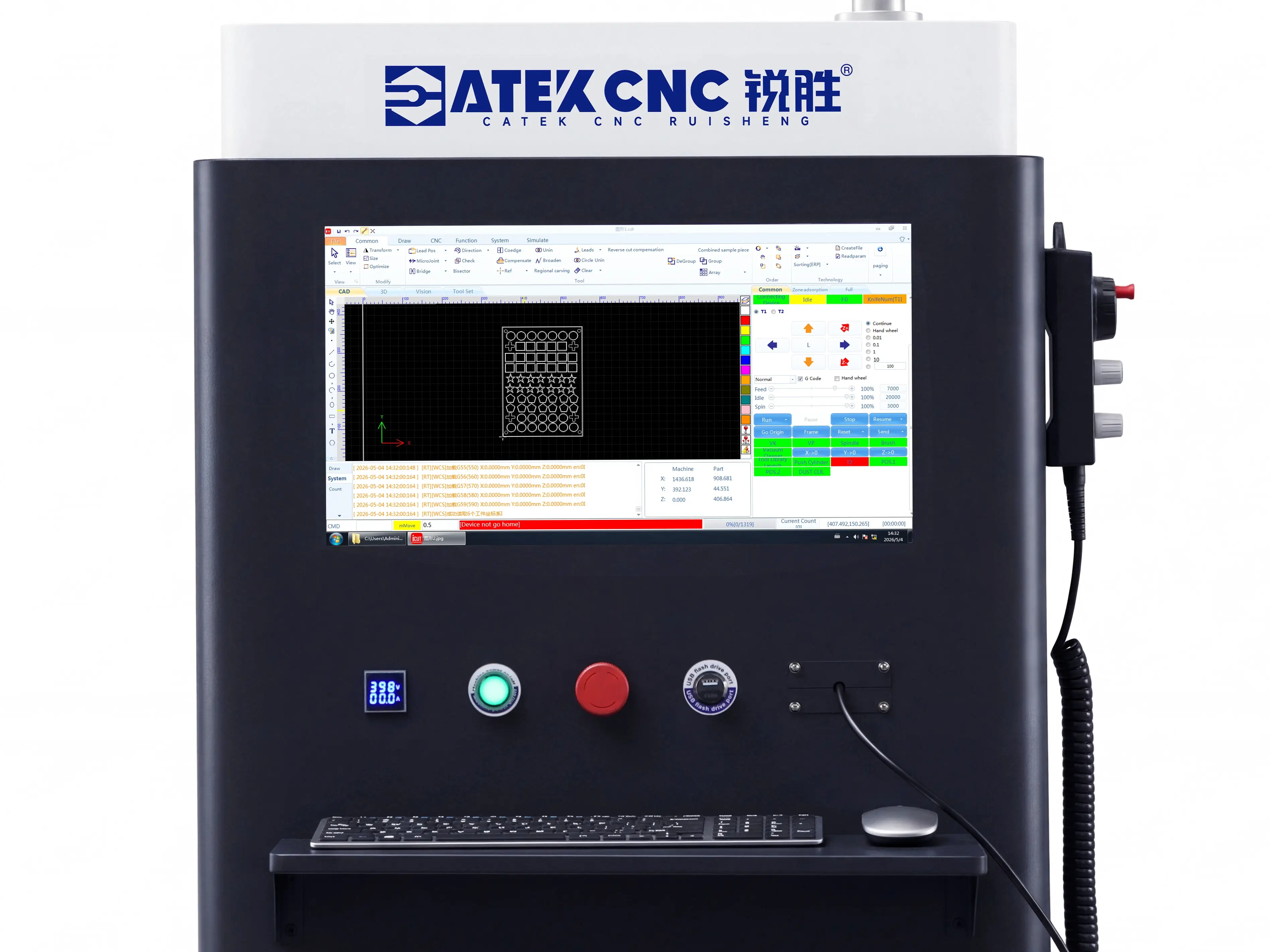
The equipment adopts the XDW VC-324C multi-functional CNC system (control software: iCut), integrating spindle machining, automatic tool changing, and oscillating knife vision cutting functions. The system supports one-click switching between machining modes, significantly improving production flexibility and meeting diverse processing requirements for both rigid and flexible materials across different process scenarios.
The control system supports both Chinese and English interface switching. Its clear layout and well-organized functional sections allow even beginners to quickly master operational procedures, effectively reducing training costs and user entry barriers. In addition, the system supports an external four-axis pulse handwheel, enabling manual micro-adjustments of each axis. This further improves on-site setup efficiency and machining accuracy, making overall operation more efficient and convenient.
The system offers strong compatibility and can directly run standard G-code generated by various CAD/CAM software, as well as processing files generated by multiple nesting software packages for driving automatic tool-changing spindle machining. In oscillating knife mode, the system can directly recognize image formats such as JPG and PNG, automatically convert them into machining paths, and enable contour recognition and edge-following cutting. Based on this capability, the Spire CK-2030-RSP-TK CNC Router achieves multi-material cutting and batch processing of complex graphics, significantly improving overall production efficiency and equipment utilization.
Electronic Pulse Handwheel
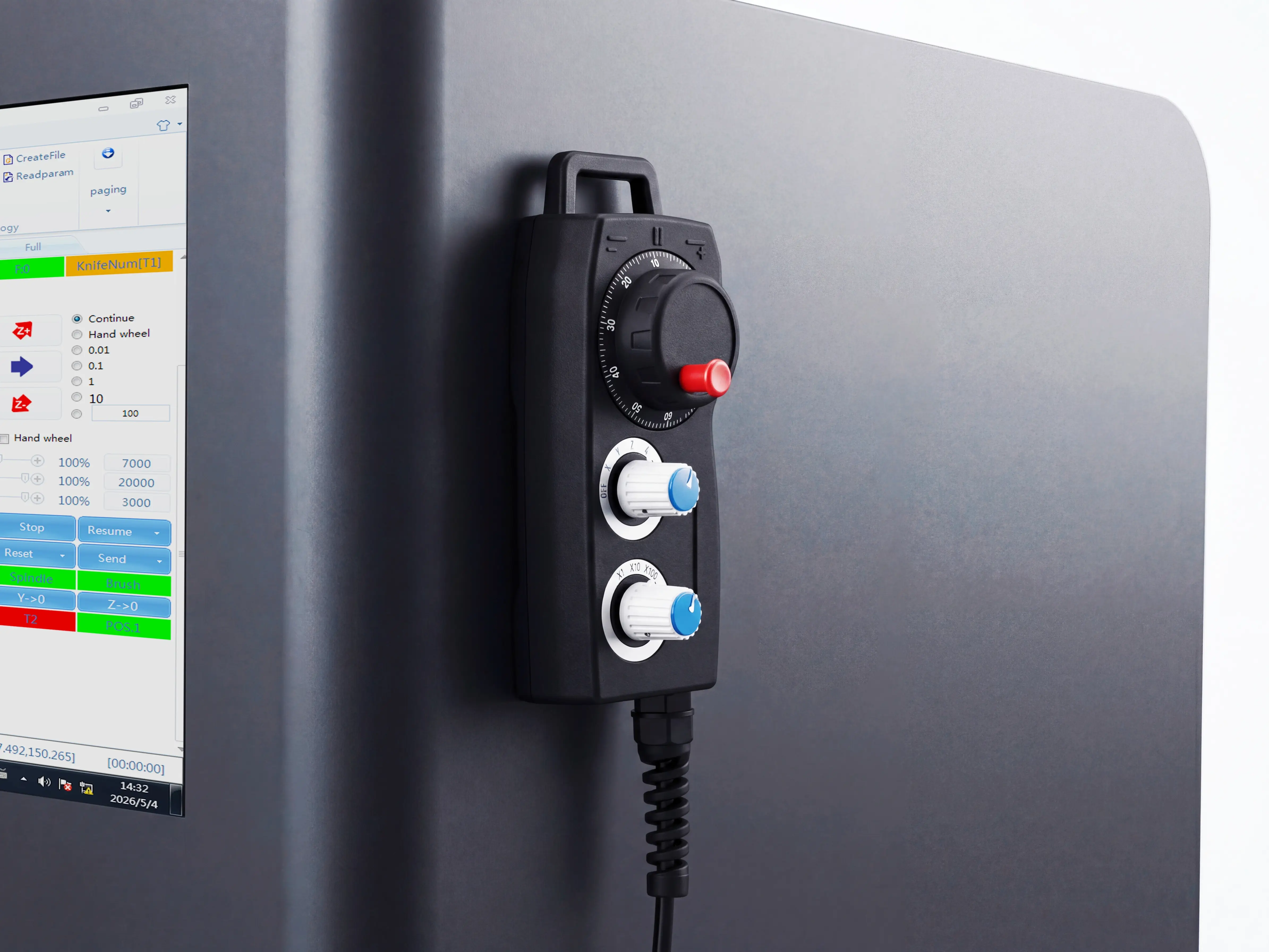
The control system is equipped with a four-axis electronic handwheel (manual pulse generator, MPG), enabling high-precision jog control of the X, Y, and Z axes for tool setting, workpiece alignment, and position calibration. Utilizing electronic pulse signal control, the handwheel provides fast response and precise movement control, allowing fine-position adjustments at low speeds and improving both setup efficiency and positioning accuracy.
The handwheel also supports trajectory simulation, allowing operators to perform a trial run of the machining program before actual production. This enables verification of tool paths, machining trajectories, and potential interference risks in advance. By validating the program before cutting, users can reduce material waste, minimize operational errors, and further improve machining safety and reliability.
Fully integrated with the XDW control system, the four-axis electronic handwheel supports axis selection, feed-rate multiplier switching, and manual feed functions. It is widely used for tool setting, program verification, tool positioning, and machine commissioning. Its intuitive and user-friendly operation not only enhances the human-machine interaction experience but also significantly improves setup efficiency, meeting the dual requirements of operational convenience and equipment safety in high-precision industrial manufacturing environments.
Wireless Keyboard / Mouse
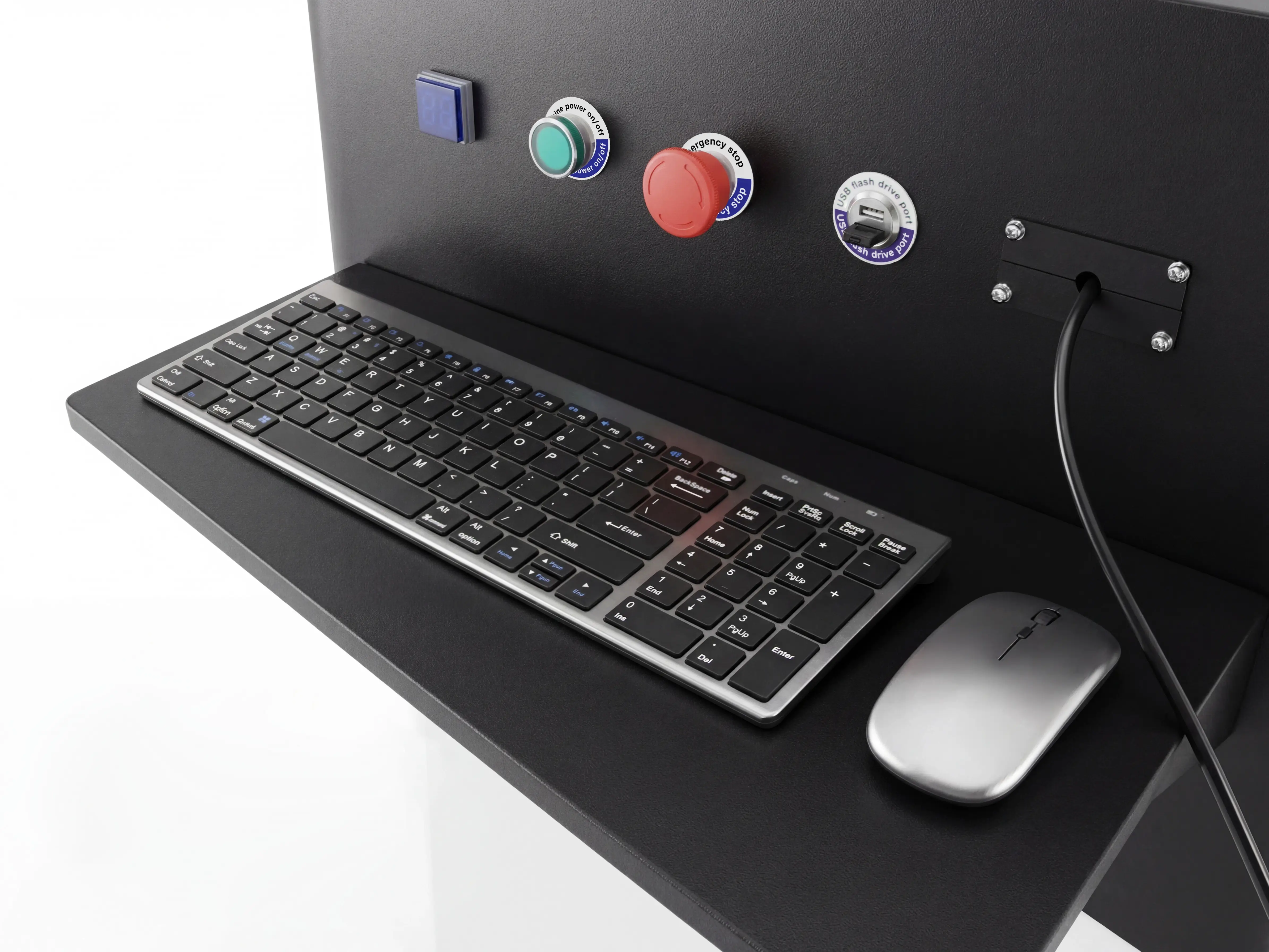
The control system is equipped with a 2.4GHz wireless keyboard and mouse, utilizing stable and reliable wireless transmission technology. This effectively reduces cable clutter around the operating area, creating a cleaner and more organized workspace while improving operational flexibility and space utilization. The 2.4GHz wireless connection offers fast response, stable data transmission, and strong anti-interference performance, ensuring smooth and reliable operation during parameter input, program editing, and system control.
The keyboard and mouse feature a plug-and-play design, allowing quick setup and operation without the need for complex driver installation. This reduces machine deployment time and lowers the learning curve for operators. When used in conjunction with the control system and electronic handwheel, they provide a more flexible and convenient approach to machine setup, program editing, and production management, further enhancing the overall human-machine interaction experience and on-site operational efficiency.
Based on 2.4GHz wireless communication technology, the system is well-suited for the complex electromagnetic environments commonly found in CNC machining workshops, maintaining stable connectivity even during long-term operation. In addition, the keyboard and mouse feature a rechargeable design, eliminating the need for frequent battery replacement. This not only reduces operating costs but also provides a more environmentally friendly and energy-efficient solution.
Click the icon labels to view different machine
parts
Elite Electrical Parts, Engineered for Stability & Extended Life
Hpmont Variable Frequency Drive
Interlock and
Short-Circuit Protection Switch
High-Quality
Power Switches
Schneider
Electrical Components
High-Reliability Aviation Plugs
Fully
Enclosed High-Strength Cable Carrier
High-Quality
Terminal Blocks
Hpmont Variable Frequency Drive
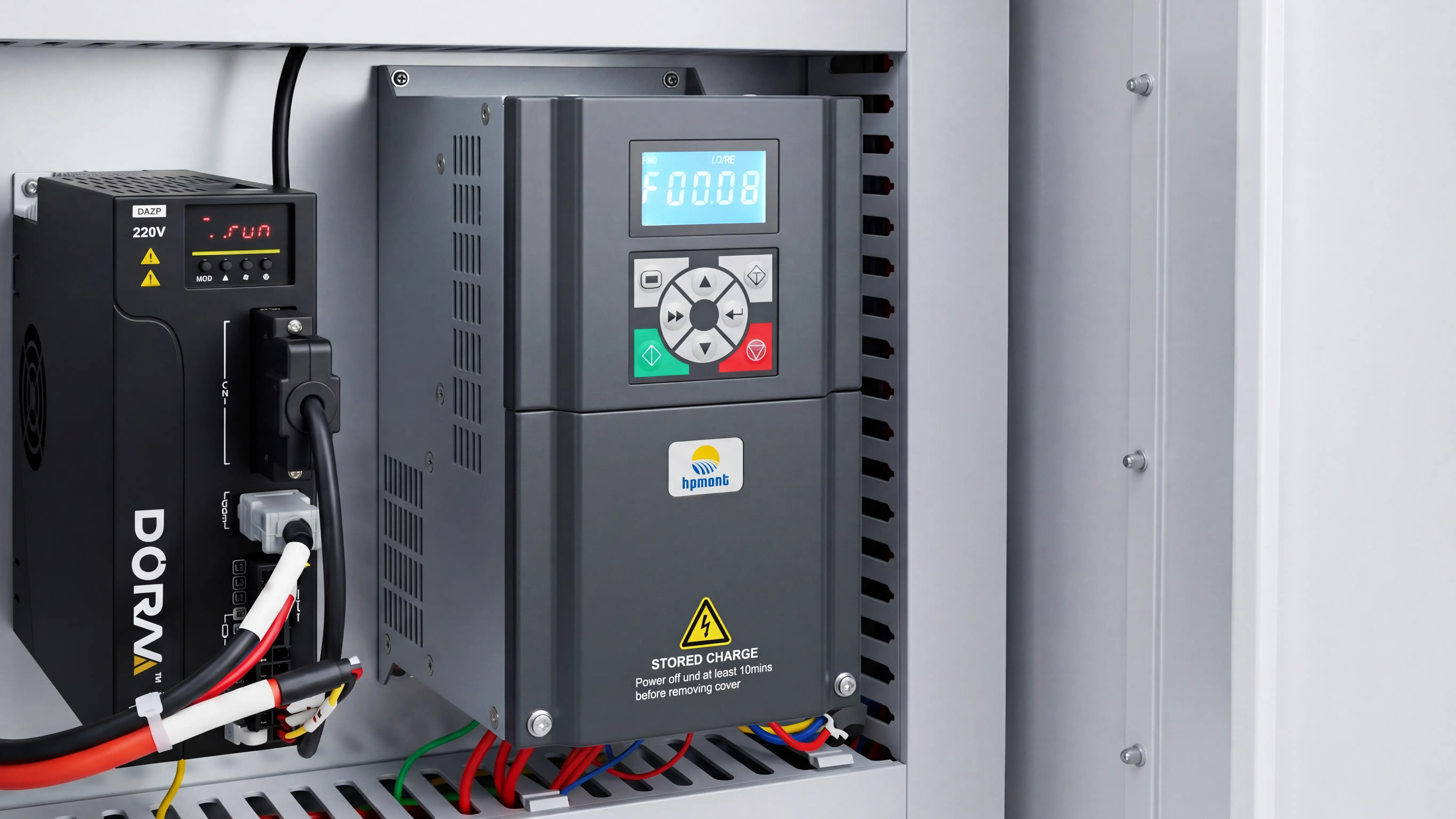
The 9kW automatic tool-changing spindle is driven by an11 kW Hpmont variable frequency drive (VFD), providing ample power reserve and excellent vector control performance. This enables smooth spindle acceleration and deceleration, as well as precise speed regulation under various machining conditions. Whether performing heavy-duty cutting or high-speed finishing operations, the spindle maintains stable power output, improving machining efficiency, cutting stability, and surface finish quality.
The VFD incorporates multiple intelligent protection functions, including overcurrent protection, overvoltage protection, overload protection, and phase-loss protection. These mechanisms respond rapidly under abnormal operating conditions, effectively protecting both the spindle and the electrical system. In addition, its strong anti-interference capability and excellent load adaptability ensure stable performance during long-term continuous operation, reducing the risk of equipment failure and extending the service life of critical components.
The combination of an 11kW VFD driving a 9kW spindle provides additional power headroom for the system. This configuration improves operational stability during high-load machining, reduces stress on the drive system, and allows the spindle to maintain consistent performance under demanding cutting conditions. As a result, the machine achieves greater reliability, smoother operation, and enhanced long-term durability.
Control Cabinet Interlock and
Short-Circuit Protection Switch
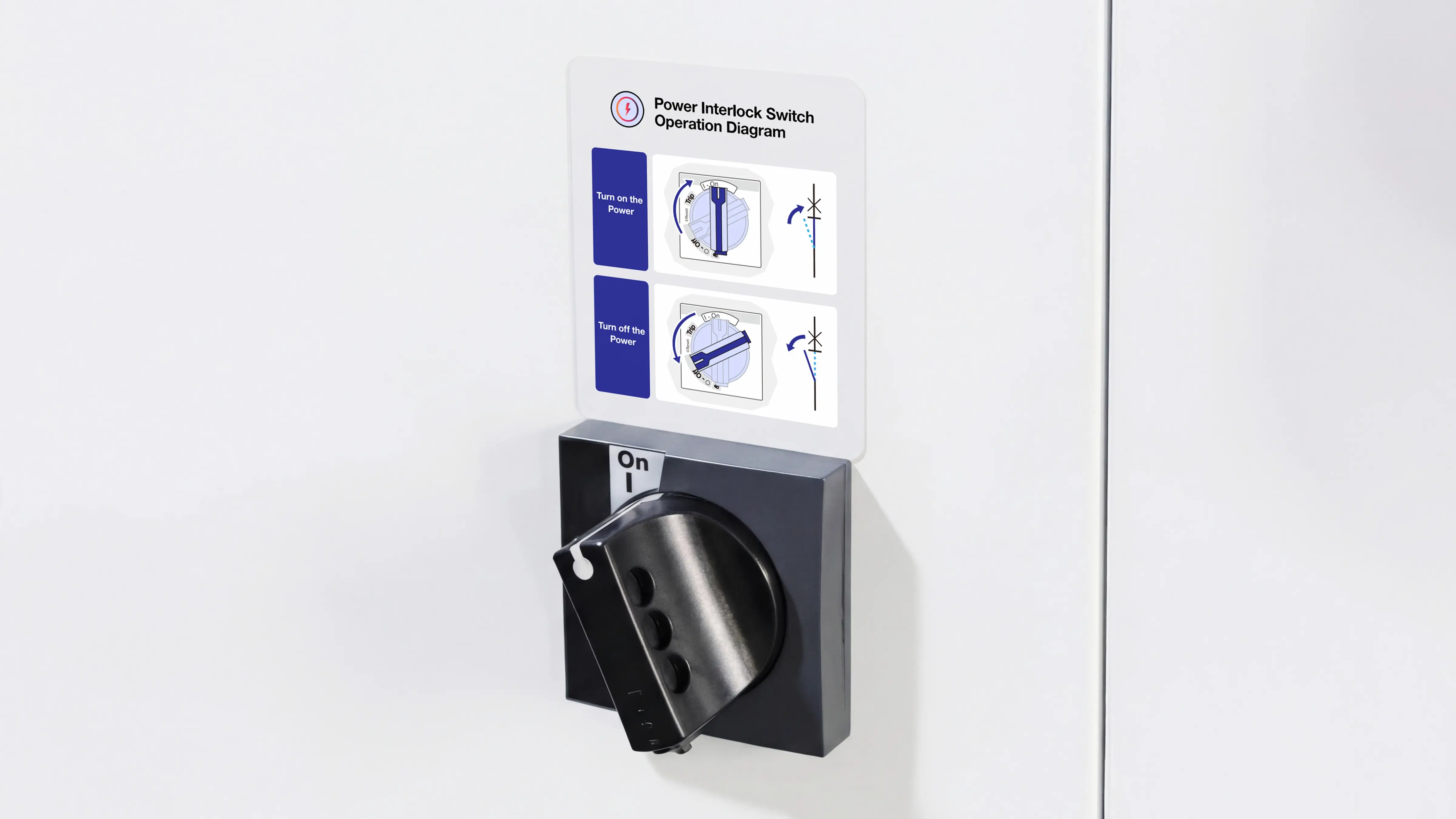
The electrical control cabinet is equipped with a Schneider Electric industrial-grade interlock power switch, serving as a key electrical safety protection feature in the Spire Series. Leveraging the high reliability of Schneider Electric components, this device provides a stable electrical foundation under long-term high-frequency start-stop cycles and continuous mass-production machining conditions, effectively reducing the likelihood of circuit failures and improving overall machine durability and operational safety.
The interlock switch adopts a mechanical electrical interlocking safety logic, implementing a hardware-level safety mechanism of "power off to open, power on only when closed." When the switch is in the OFF position, power is forcibly cut off and the cabinet door can be opened. Only after the door is closed and the switch is turned ON does the system restore power while simultaneously locking the cabinet. This design fundamentally eliminates the risk of opening the cabinet under live conditions, effectively preventing safety hazards caused by human error.
This hardware interlock protection system provides multiple layers of safety for the electrical cabinet. During routine inspection, circuit troubleshooting, and maintenance operations, it significantly reduces the risks of electric shock, short circuits, and damage to electrical components. As a result, it enhances both operator safety and equipment protection, greatly improving the overall safety and reliability of the machine.
High-Quality Power Switches
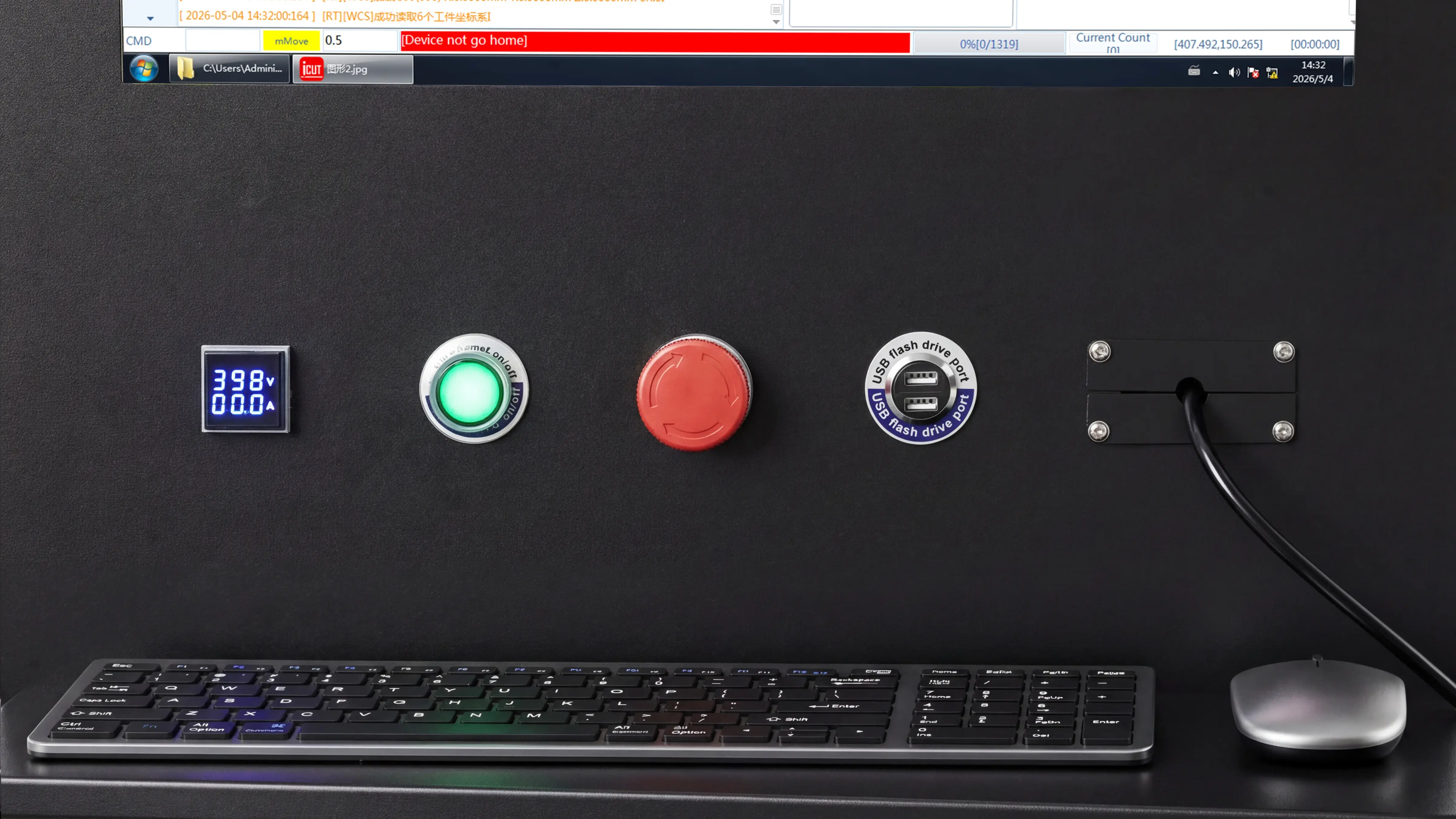
The control panel is equipped with Schneider Electric industrial-grade start and emergency stop buttons, offering excellent reliability, durability, and operational stability. With clear tactile feedback and fast response, these controls provide dependable machine start-up, shutdown, and emergency stop functionality.
The control panel integrates a digital voltage and current meter, enabling real-time monitoring of the machine's electrical operating conditions. This allows operators to quickly assess machine load status and power supply quality during operation. Continuous monitoring of critical electrical parameters helps identify abnormal fluctuations at an early stage, improving operational safety and enhancing preventive maintenance capabilities.
The panel is equipped with two USB ports for program import, file transfer, and peripheral device connectivity. This allows operators to efficiently manage machining files and production tasks while simplifying data exchange. The convenient data transfer capability not only improves workflow efficiency but also enhances the machine's flexibility across a variety of production environments.
Schneider Electrical Components
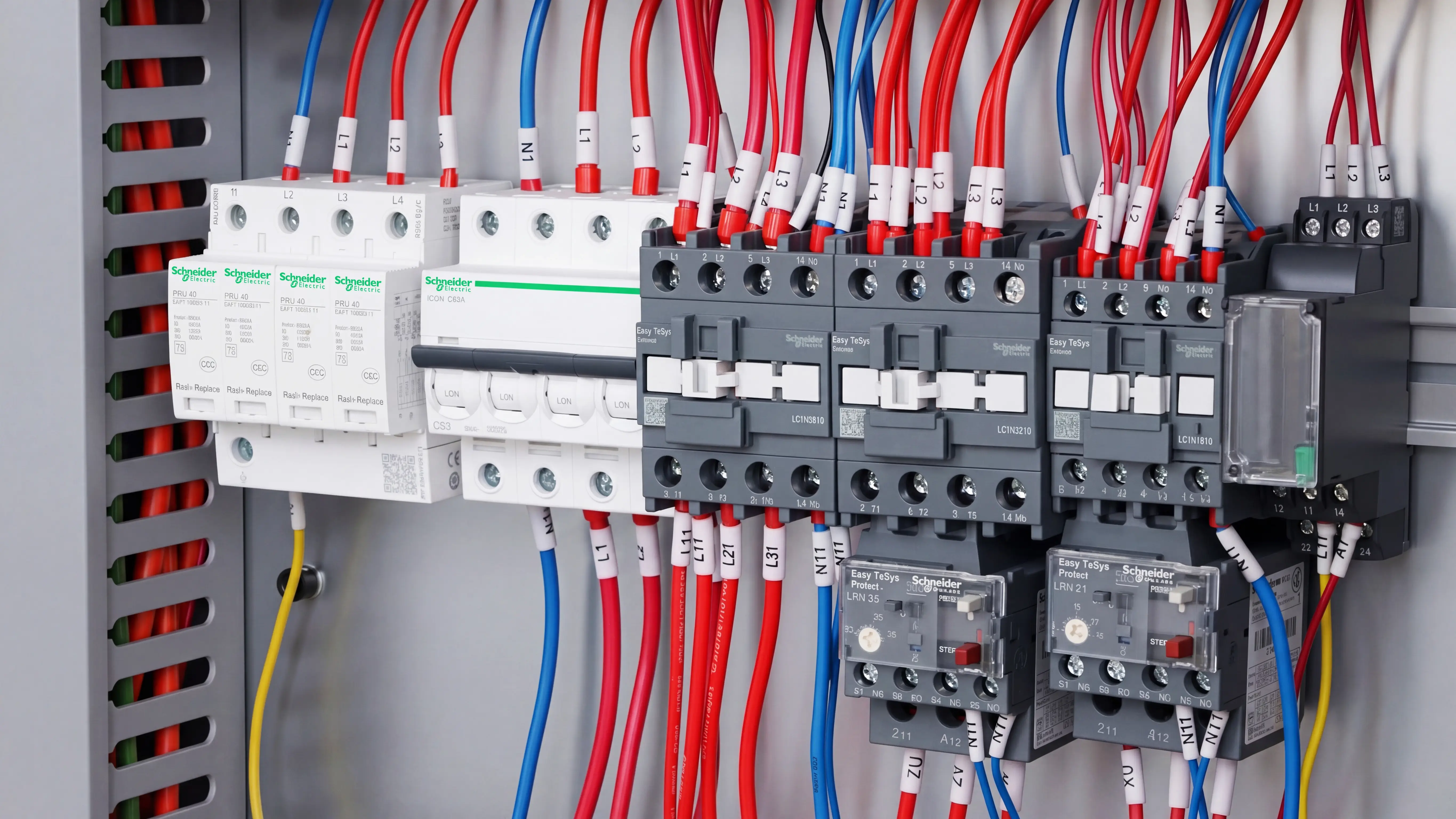
The machine’s electrical system is built with Schneider Electric industrial-grade components, including circuit breakers, AC contactors, relays, 24 V switching power supplies, phase sequence protectors, surge protection devices, and interlock safety switches. All components are designed for industrial reliability and are capable of withstanding heavy loads and long-term continuous operation, ensuring stable electrical performance and providing a solid foundation for machine operation.
The Schneider circuit breaker is used for main power control, offering high breaking capacity and stable switching performance. It effectively reduces electrical impact during power on and off cycles, thereby improving overall system stability. The relay module provides reliable signal switching and load-driving capability for the control system, while the 24 V switching power supply delivers stable DC power to the controller and related low-voltage components, ensuring continuous and dependable operation of the control system.
The dust collection system and vacuum pump system are both controlled by independent AC contactors, enabling separate start/stop management for each subsystem. This improves operational flexibility and optimizes energy efficiency. In addition, the phase sequence protector, surge protection device, and interlock safety switch collectively form a multi-layer safety protection system, providing comprehensive redundancy for the electrical system. As a result, the Spire CNC Router maintains safe, stable, and efficient operation even in complex industrial environments.
High-Reliability Aviation Plugs
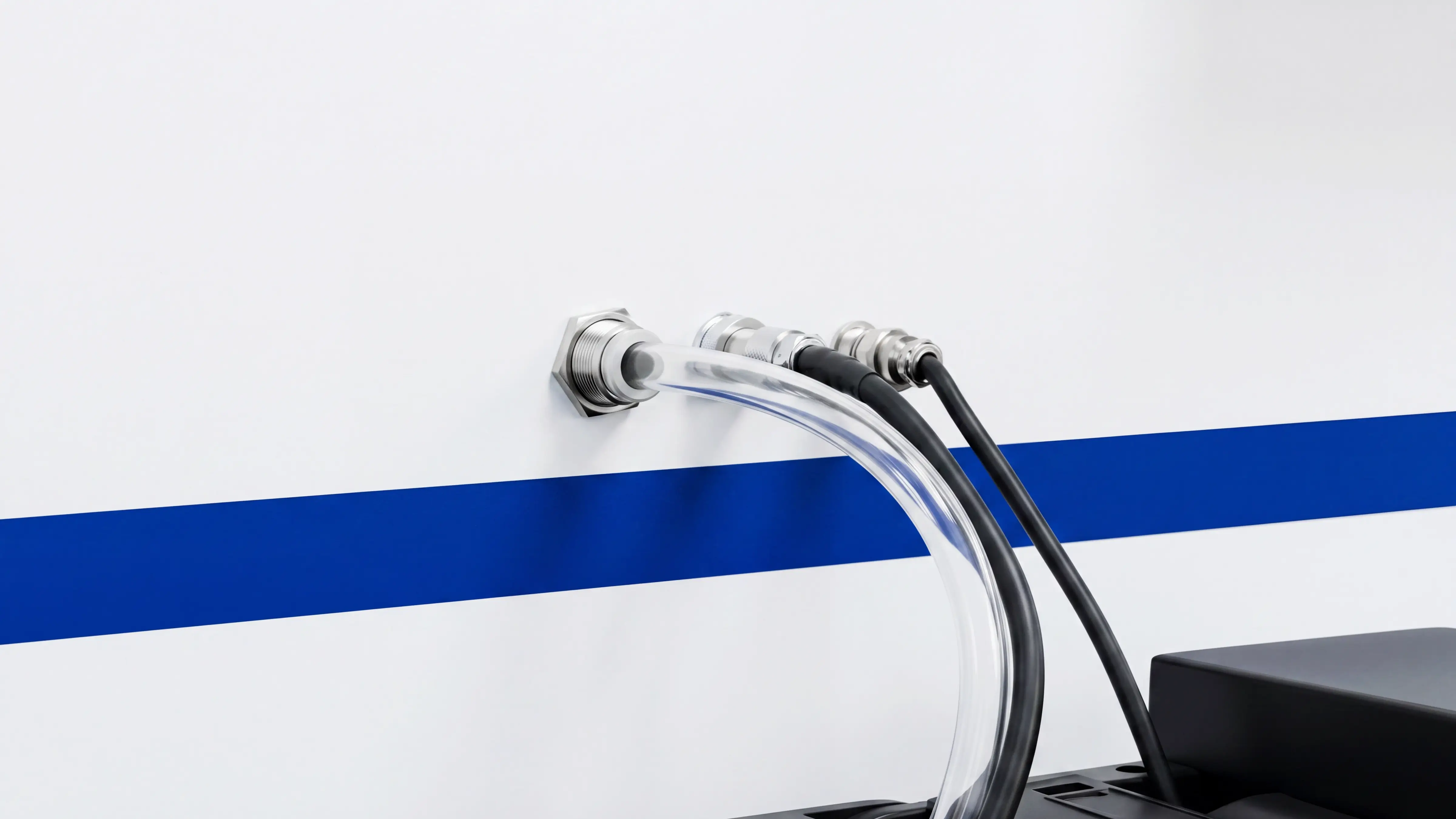
The machine body is equipped with industrial-grade aviation connectors on the side, used for centralized connection of key lines such as air hoses and control signal cables. This design ensures a more organized and structured wiring layout, effectively preventing cable disorder and poor contact issues, while significantly improving overall wiring professionalism and system integration.
The aviation connectors feature excellent dustproof and waterproof performance, effectively blocking the intrusion of workshop dust, moisture, and machining debris into the interface. This reduces the risk of short circuits, signal interference, and pneumatic leakage caused by harsh working environments, ensuring stable and continuous long-term machine operation.
The connectors adopt a standardized quick-connect design for easy operation. During maintenance, debugging, or machine relocation, they enable fast assembly and disassembly without complex rewiring procedures. This significantly improves maintenance efficiency and enhances on-site service convenience.
Fully Enclosed High-Strength Cable
Carrier
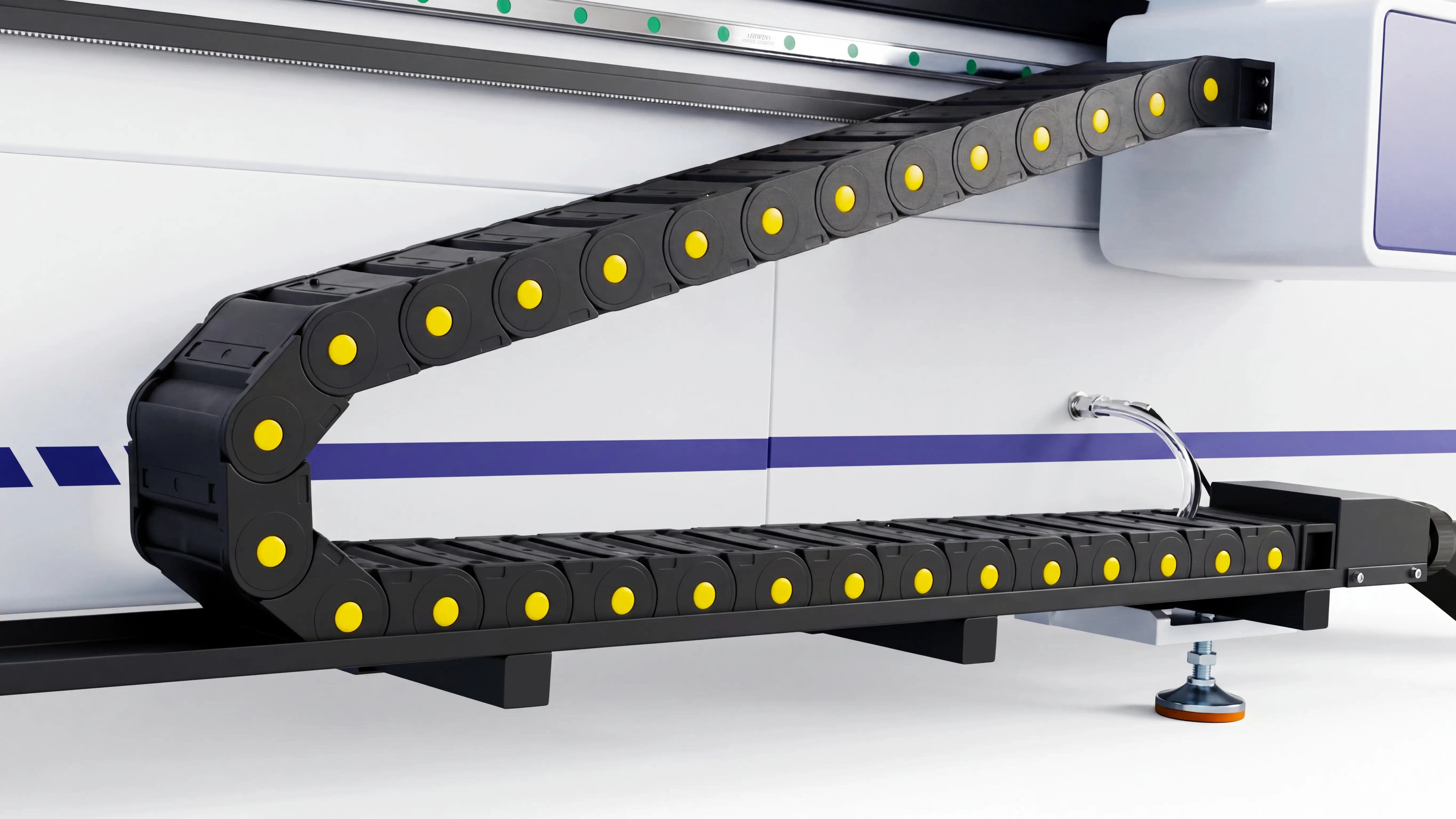
The X, Y, and Z axes are all equipped with fully enclosed, high-strength industrial cable carrier systems, designed for integrated management of cables, air pipes, oil lines, and signal wiring. This system provides reliable physical protection and guided motion for internal lines during high-speed operation and long-term continuous machining, effectively preventing stretching, abrasion, and fatigue damage caused by repeated movement.
The cable carrier effectively isolates internal wiring from wood chips and dust, reducing risks such as short circuits and signal interference caused by cable wear or contamination. This ensures long-term stable operation of the electrical system even in harsh machining environments.
In addition, the cable carrier system improves maintenance and servicing efficiency. The cable layout is organized and clearly structured, allowing for quick troubleshooting and replacement. The cable carrier links feature a modular, segmental detachable design, making localized repair and replacement more efficient and convenient, thereby reducing maintenance time and overall operating costs.
High-Quality Terminal Blocks
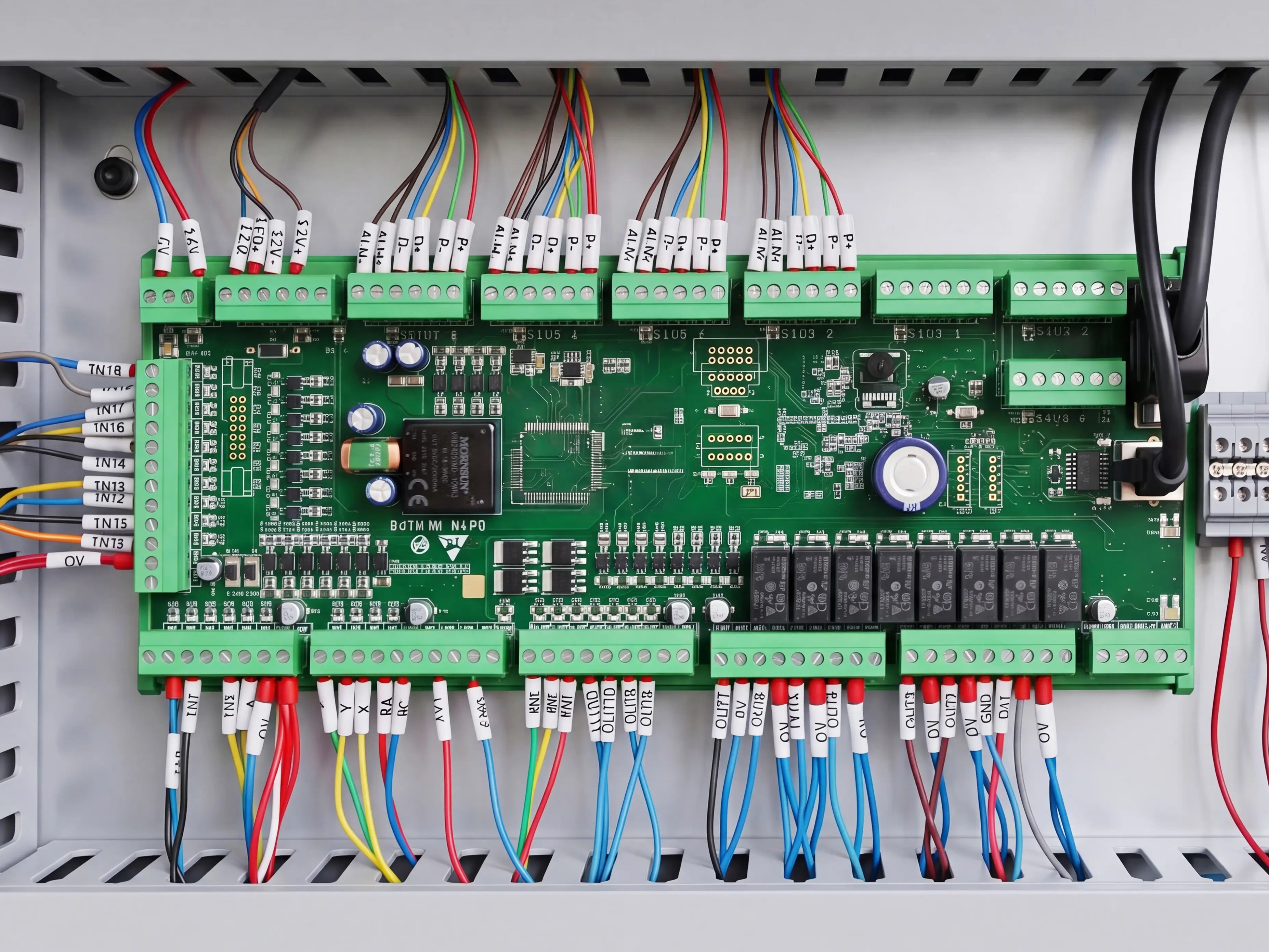
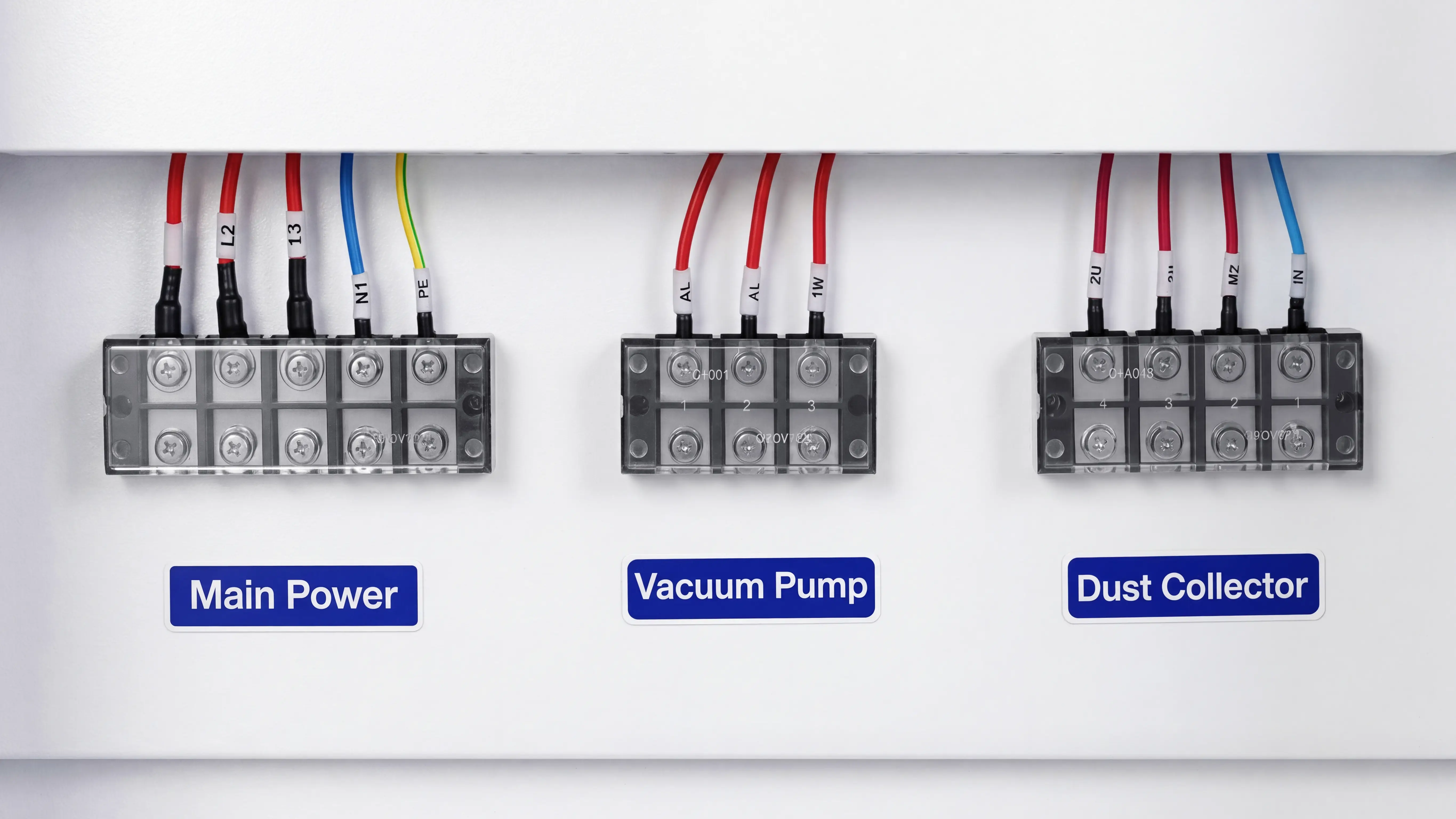
The control cabinet is designed with three independent terminal block groups, used respectively for the main power supply, dust collection system, and vacuum pump system. This configuration enables electrical isolation between functional subsystems, effectively preventing interference and cross-coupling between different loads, thereby improving overall power stability and operational safety.
With three separate terminal block groups, the electrical circuits of each subsystem are clearly isolated. Even if one system experiences a fault or abnormal condition, it will not affect the normal operation of the other systems. This enhances overall system reliability and fault tolerance, ensuring continuous stable operation under complex working conditions.
From a maintenance and servicing perspective, the independent terminal block layout provides a clear and well-organized wiring structure. This allows technicians to quickly identify fault points and carry out targeted repairs, significantly reducing troubleshooting time while improving maintenance efficiency and overall equipment utilization.
Automatic Tool Change & Setting, Streamlined and Hassle-Free Machining
Linear Automatic Tool Changer (ATC) Magazine
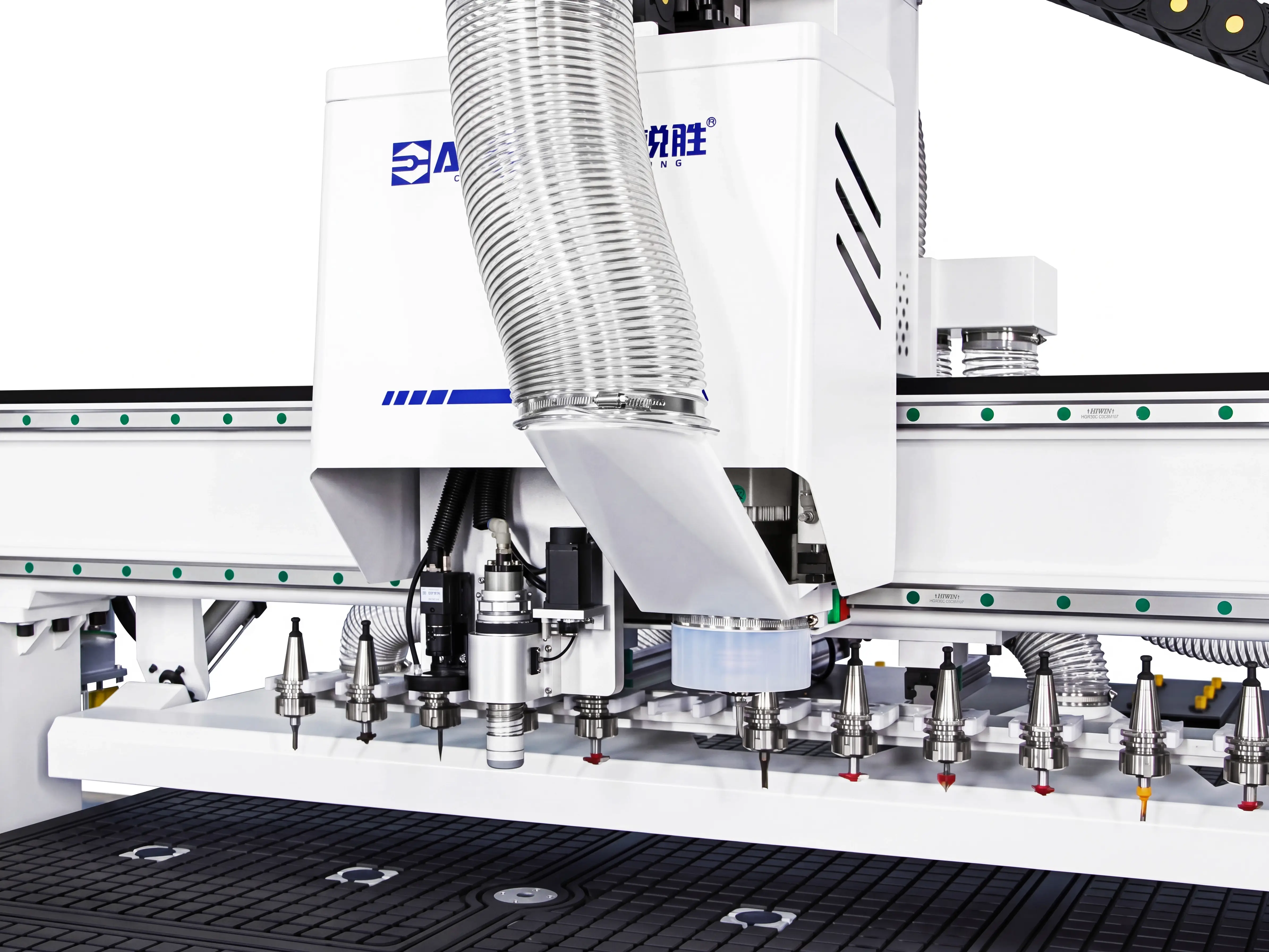
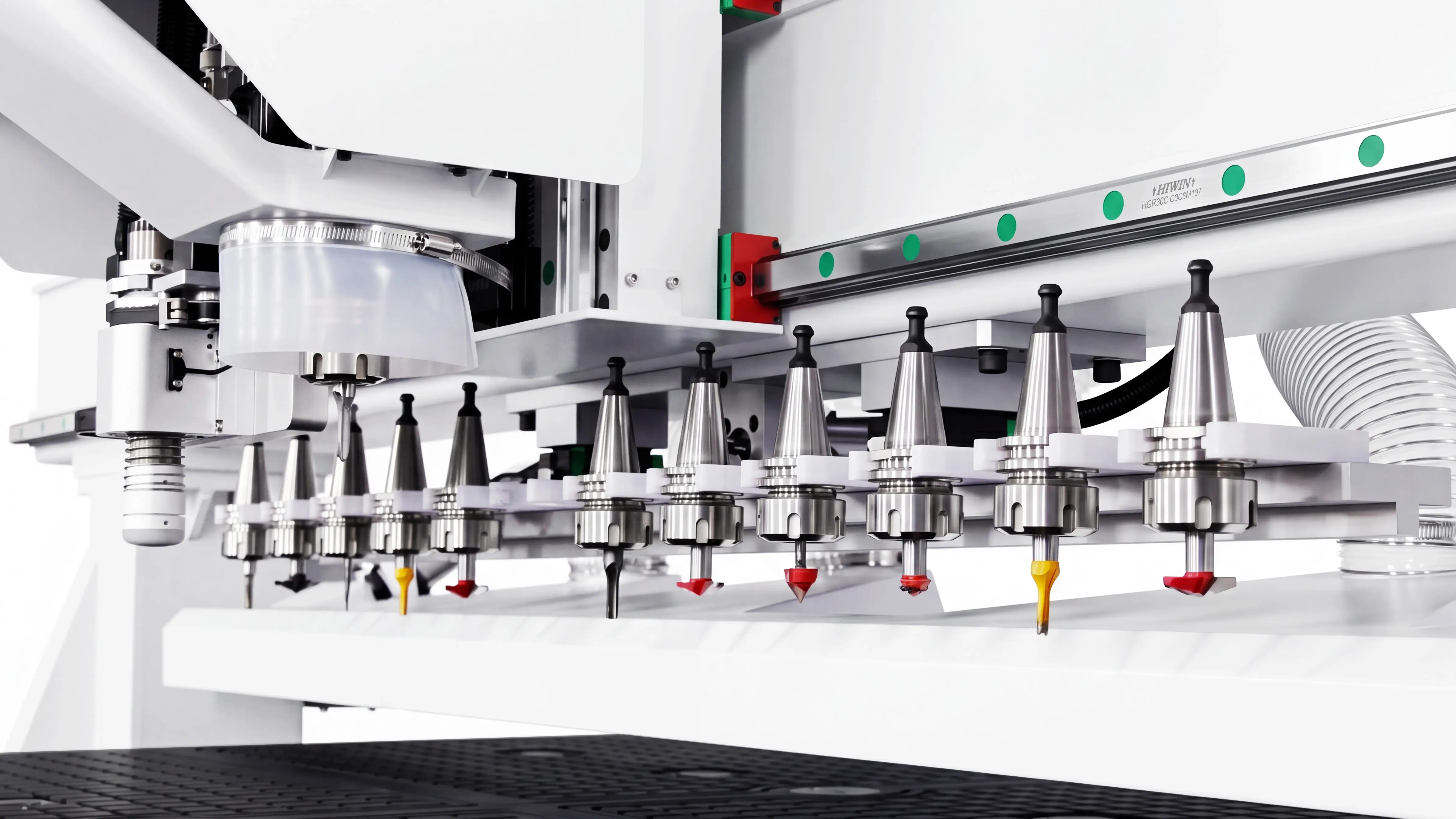
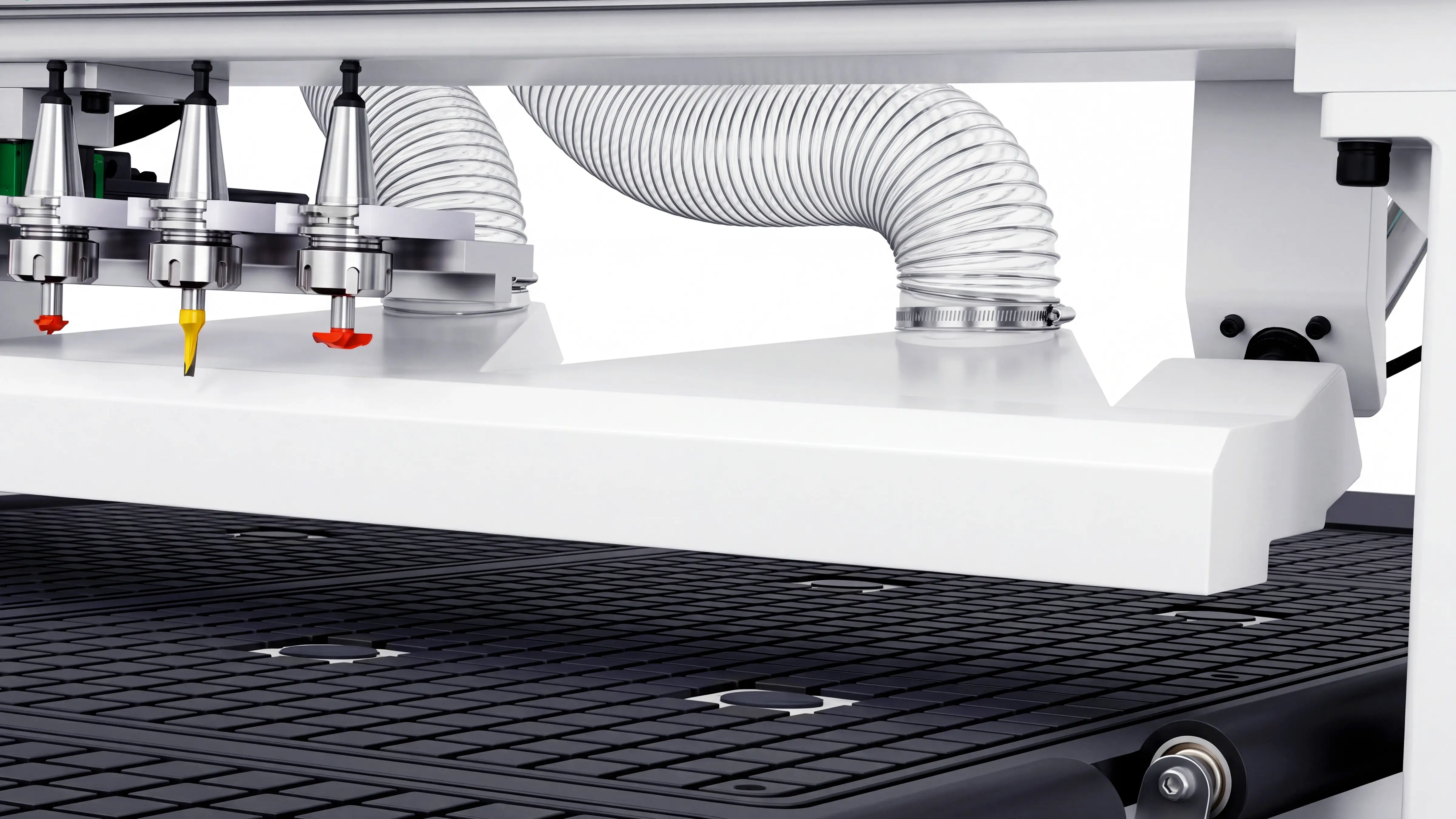
The linear tool magazine can accommodate up to 12 tools, meeting the requirements of various machining processes such as cutting, drilling, grooving, and engraving. Installed beneath the gantry, it adopts a pneumatic retractable structure. When not in use, the tool magazine automatically retracts to the underside of the gantry to avoid interference with the machining area; during tool change operations, it quickly extends to the designated position, significantly reducing spindle travel distance and improving overall tool change efficiency.
The tool magazine is compatible with ISO30 tool holders and works in conjunction with ER32 collet systems, enabling stable clamping of tools with shank diameters up to ≤20 mm. It offers strong versatility and reliable clamping performance, making it suitable for a wide range of industrial applications, including woodworking, signage production, acrylic processing, and composite material machining.
This linear tool magazine can operate in coordination with the automatic tool-changing spindle and fully automatic tool setting system, enabling fully automated tool changing and tool management throughout the entire machining process. With no manual intervention required, it significantly enhances multi-process continuous machining capability and production efficiency, greatly improving the overall automation level of the machine.
Automatic Tool Setter
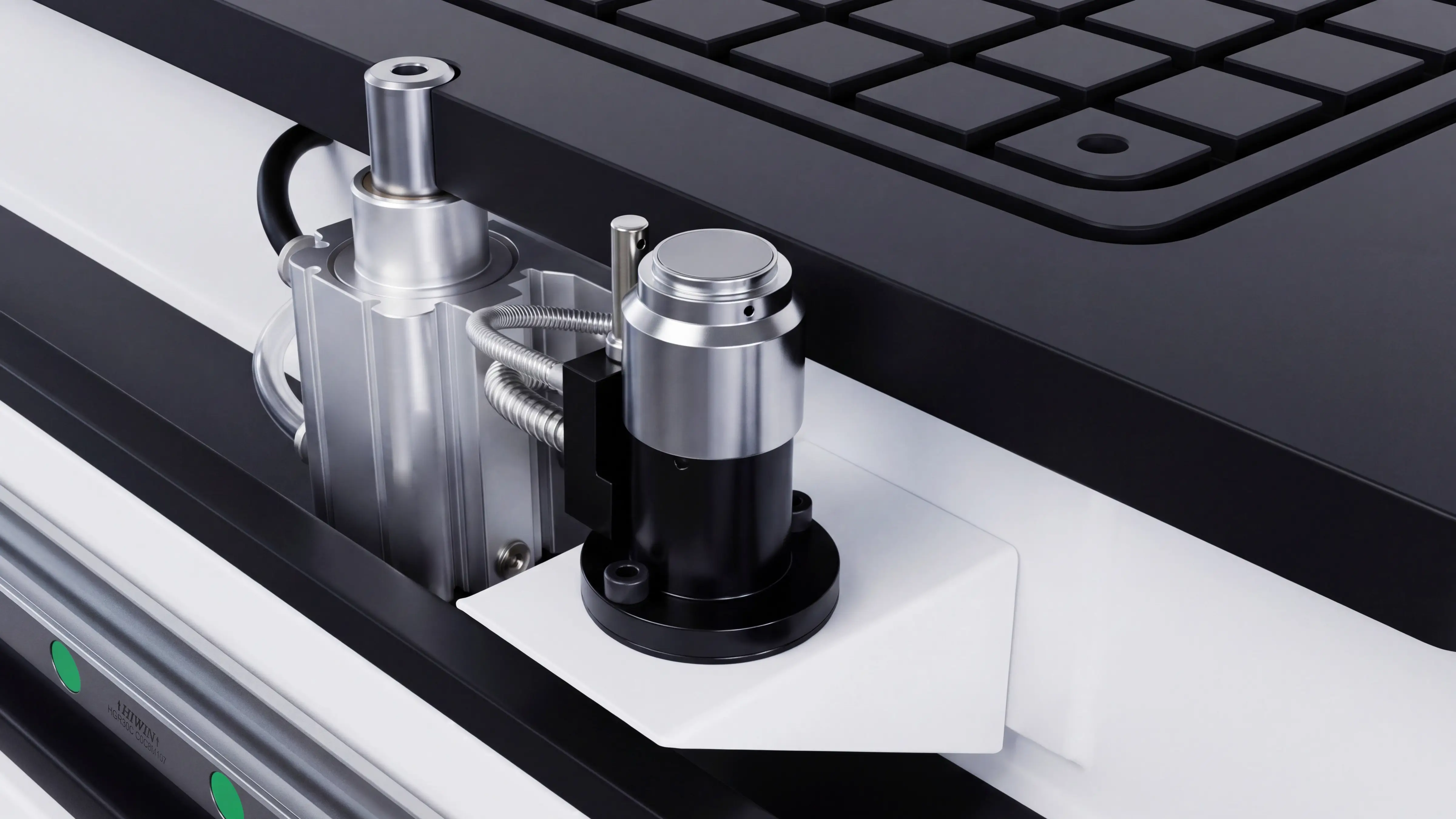
The automatic tool setter enables automatic measurement and compensation of tool length and can be seamlessly integrated with the automatic tool changer system. After each tool change, the system automatically performs tool probing without manual intervention, improving machining continuity and overall production efficiency.
The automatic tool setter is equipped with a self-cleaning function. Before each probing cycle, a high-pressure directional air jet automatically removes wood chips, dust, and machining residues from its surface, ensuring a clean contact area. This improves the accuracy and stability of tool length measurement data.
This device is particularly suitable for CNC routers equipped with automatic tool changers. In high-frequency tool change applications, the fully automated tool setting process significantly reduces manual intervention, minimizes operational errors, and further enhances overall machining efficiency and process consistency.
ISO Tool Holder Disassembly Station
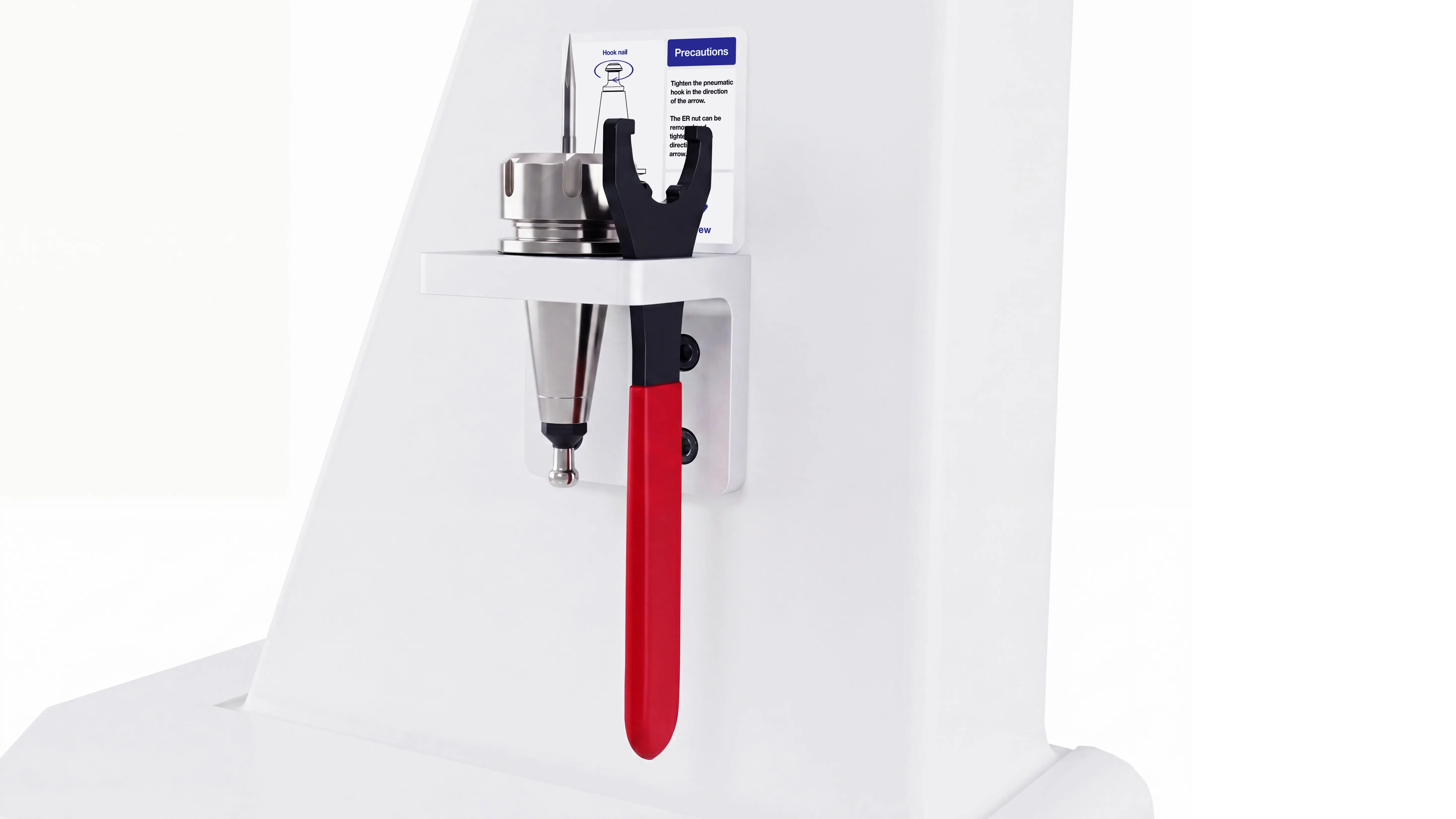
An ISO tool holder disassembly device is integrated on the left vertical gantry column. It is manufactured from a one-piece aluminum alloy structure, offering excellent rigidity and corrosion resistance. The built-in dedicated tool holder slot securely positions the ISO tool holder, allowing fast installation and removal using an ER32 wrench. This improves tool maintenance convenience and operational safety, making the tool change process more efficient and standardized.
During operation, the device provides uniform support and force distribution to the taper surface of the tool holder, effectively preventing wear or micro-deformation caused by uneven stress. This ensures repeatable clamping accuracy and extends the service life of the tool holders.
The tool holder disassembly device significantly improves daily maintenance efficiency, enabling operators to complete standardized tool installation and removal procedures quickly. It reduces manual effort while enhancing operational safety and overall workflow efficiency. This makes it particularly suitable for industrial applications involving frequent tool changes and multi-tool machining processes.
From Loading to Unloading, Optimizing Your Entire Workflow
Vacuum Worktable
Vacuum Zone Control Switches
4+3+4 Positioning Cylinders
Auxiliary Loading Rollers
Rear Automatic Panel Pusher
Rear Control Switches
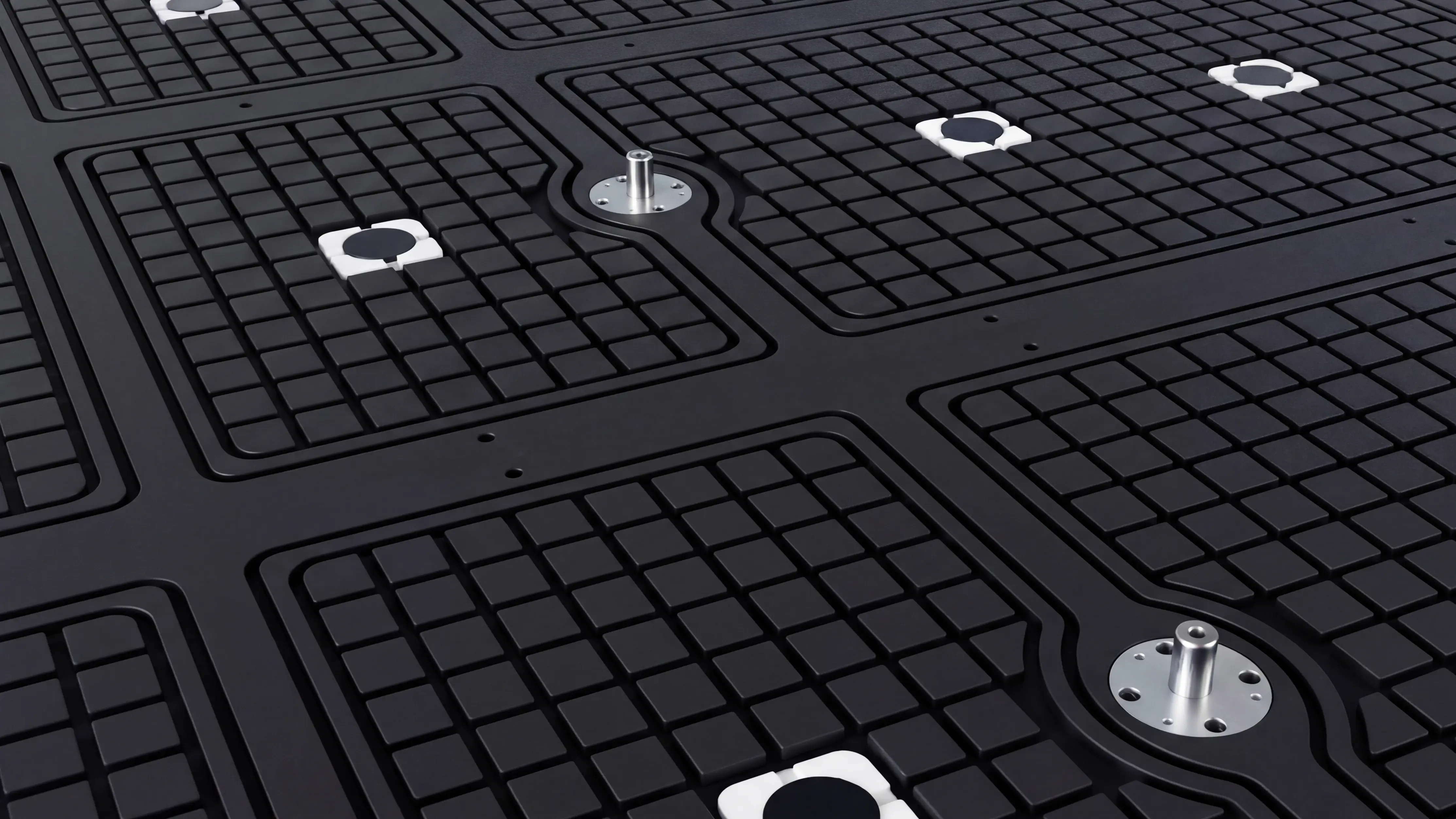
The vacuum table enables fast and stable workpiece hold-down. Simply placing the material and activating the vacuum switch is sufficient to secure the workpiece, eliminating the need for additional fixtures or pressing devices. This design avoids interference risks between the spindle and clamps or fixtures, improving both machining safety and operational convenience.
The table surface is machined from a PVC board using precision milling. It offers high flatness and structural stability, along with excellent wear resistance and corrosion resistance. This ensures long service life while maintaining consistent machining accuracy over extended use.
The vacuum table features a zoned control design, allowing each vacuum section to be independently activated or adjusted via separate valves. For large-format materials, multiple zones can be enabled to provide stronger holding force; for smaller workpieces, a single zone can be used to minimize vacuum leakage and reduce energy consumption. This ensures stable and efficient workholding across different material sizes and processing requirements.
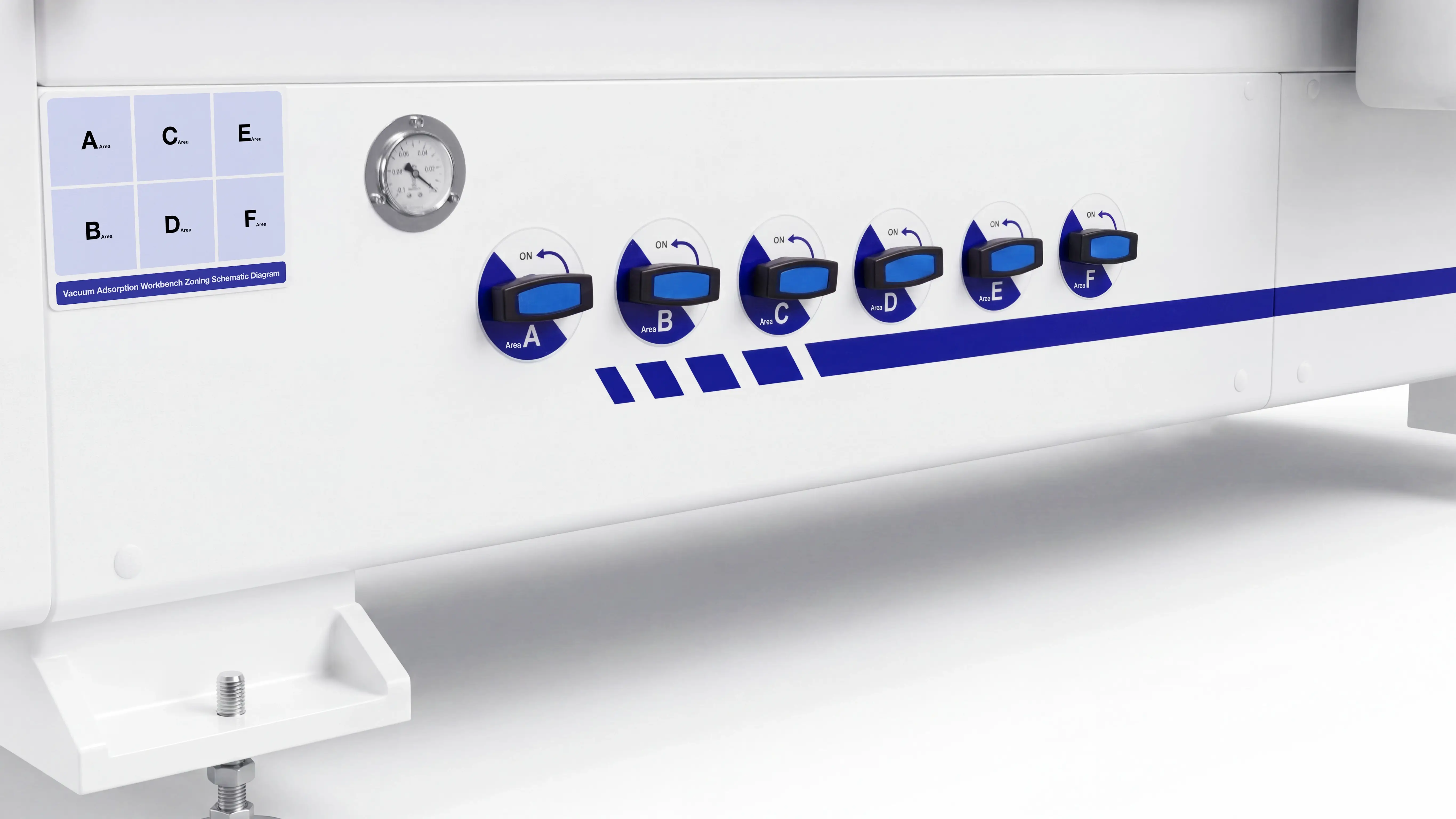
The side of the machine is equipped with a vacuum valve group system consisting of nine independent valves, each corresponding to one of the nine zones of the vacuum table. During machining, operators can activate the required zones based on the size and position of the workpiece, ensuring stable workpiece holding while minimizing unnecessary vacuum consumption and improving energy efficiency.
A vacuum pressure gauge is integrated above the valve group, providing a quantitative real-time display of vacuum pressure. This allows operators to clearly monitor the current vacuum holding status, replacing experience-based judgment with data-driven feedback, thereby improving clamping stability and consistency.
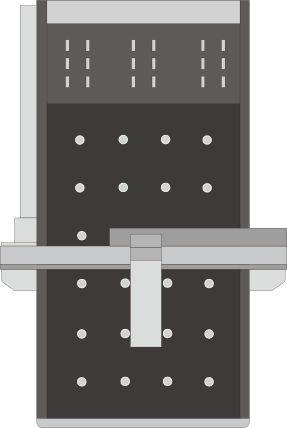
A clear vacuum zoning diagram is installed on the right side of the valve group, visually indicating the correspondence between each valve and its respective table zone. This allows operators to quickly select the correct zones without repeated testing or memorization, improving operational efficiency and reducing the learning curve for new users.
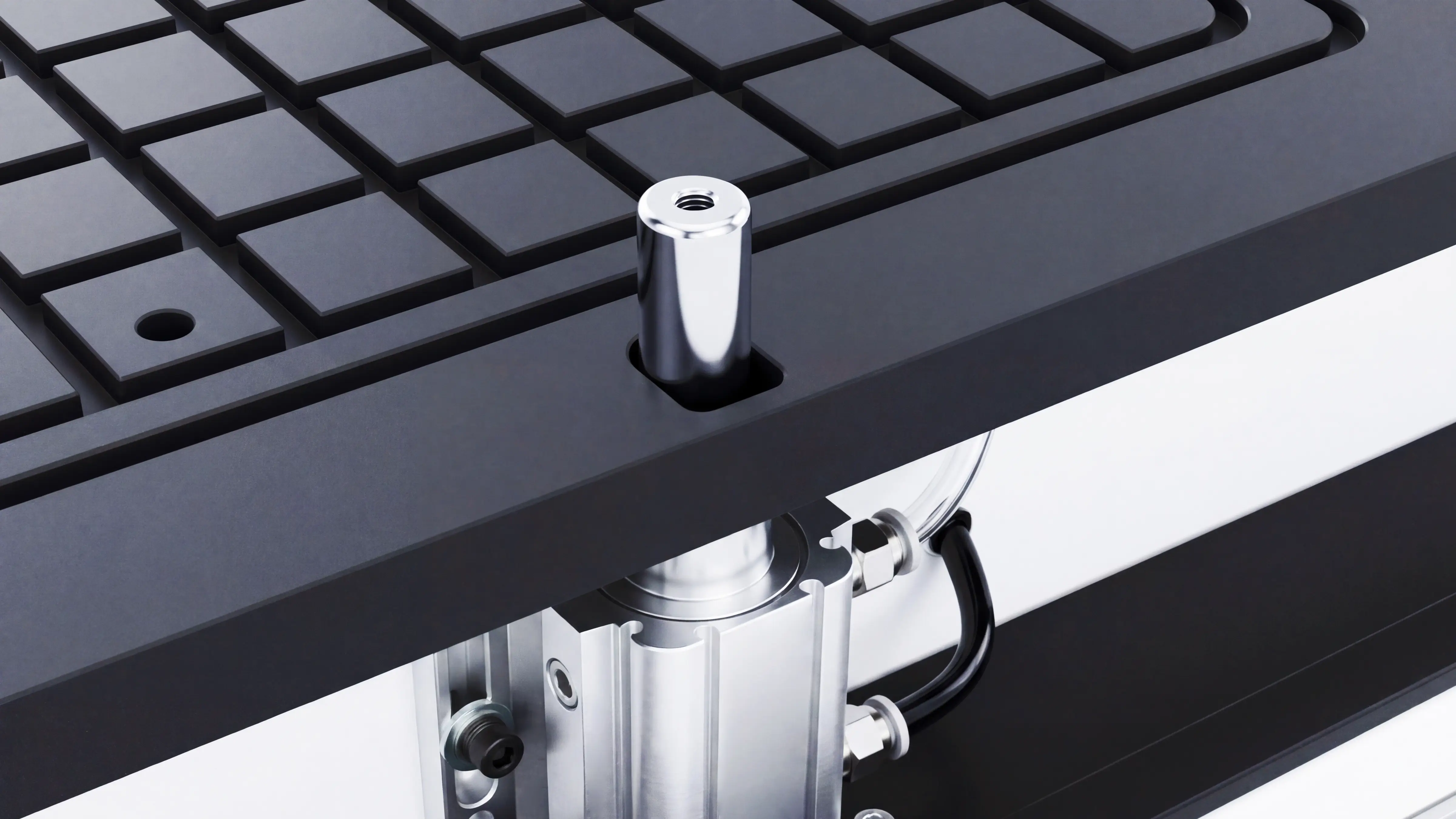
The CNC router is equipped with a rapid board positioning and alignment system consisting of nine pneumatic locating cylinders (pneumatic pop-up pins), designed to assist in quickly establishing machining reference positions. Among them, seven positioning cylinders are arranged in an L-shape along the edge of the table, while four additional cylinders are installed in the central area of the worktable, enabling fast positioning and coordinate alignment for workpieces of different sizes.
During operation, once the sheet material is placed on the table, the positioning cylinders rise simultaneously. The gantry then moves the material against the reference stops, quickly completing positional correction and coordinate alignment. This approach significantly reduces setup time in batch production, minimizes manual measurement errors, and improves machining accuracy and consistency.
The positioning system is adaptable to different sheet sizes. The outer L-shaped cylinder layout is suitable for large-format 2000 × 3000 mm panels, while the central positioning cylinders can be activated for standard 1220 × 2440 mm sheets. This allows fast switching between different workpiece formats and enables unified reference establishment, thereby improving overall production efficiency and operational flexibility.
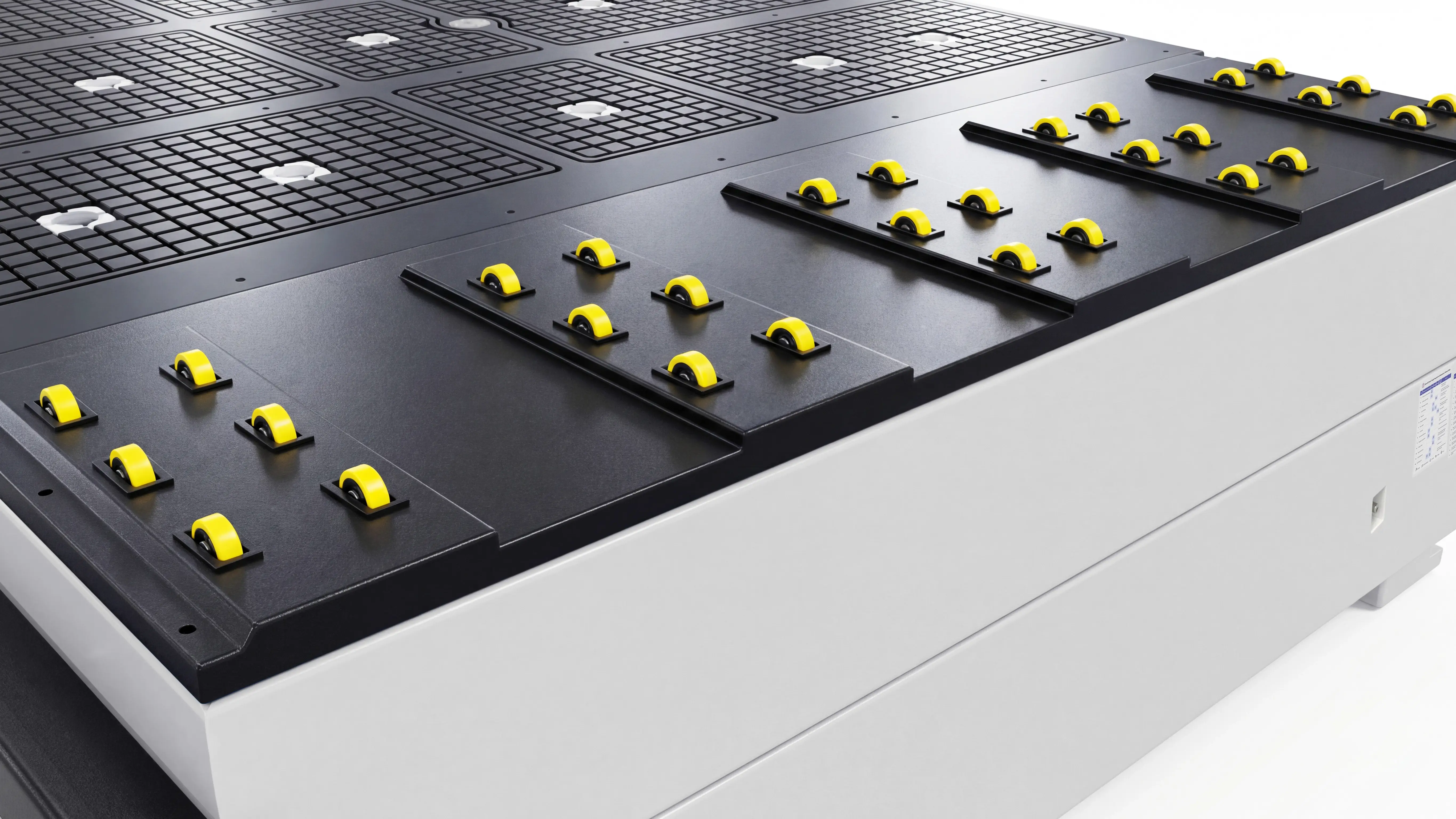
The rear of the machine is equipped with a five-row, ten-column roller array designed to assist in loading and supporting large-format sheet materials. The rollers are made from high-strength, wear-resistant materials with a low friction coefficient and strong load-bearing capacity. They effectively support the weight of the panels while reducing sliding resistance. During loading, operators only need to place the sheet on the rollers and push it forward, significantly reducing manual labor effort.
Two sets of rubber rollers are installed on the right side of the machine to provide lateral loading assistance. These rollers are made of high-elasticity industrial-grade rubber, which effectively protects the surface of the material and prevents scratches, or abrasion. This makes them particularly suitable for materials with high surface quality requirements, such as melamine boards, wood veneer panels, and laminated decorative boards.
This auxiliary loading system enables a single operator to efficiently handle large-format sheet loading operations, significantly reducing labor intensity and operational cost while improving overall loading efficiency and safety. The combination of rear rollers and side rubber rollers ensures smooth and flexible handling of panels of different sizes and materials.
The rear side of the gantry is equipped with a pushing device driven by a cylinder-controlled lifting mechanism. During machining, the device remains retracted. Once processing is completed, the gantry moves to the end position of the workpiece, and the cylinder activates the pusher, which extends and works in coordination with gantry movement to smoothly push the finished workpiece off the table, enabling an automated unloading process.
This pushing system can be seamlessly integrated with an optional conveyor-based unloading platform to form a complete automated discharge workflow. After being pushed off the table, the workpiece can be directly transferred onto the conveyor and transported to the downstream area, effectively improving overall production cycle efficiency while reducing the risk of collision damage during manual handling.
The system can also be connected to the dust collection unit. When the pushing action is triggered, the dust extraction system automatically activates to perform secondary cleaning of the worktable surface, effectively removing residual wood chips, dust, and debris. This prevents material buildup from affecting subsequent workpiece positioning, vacuum clamping, and machining.
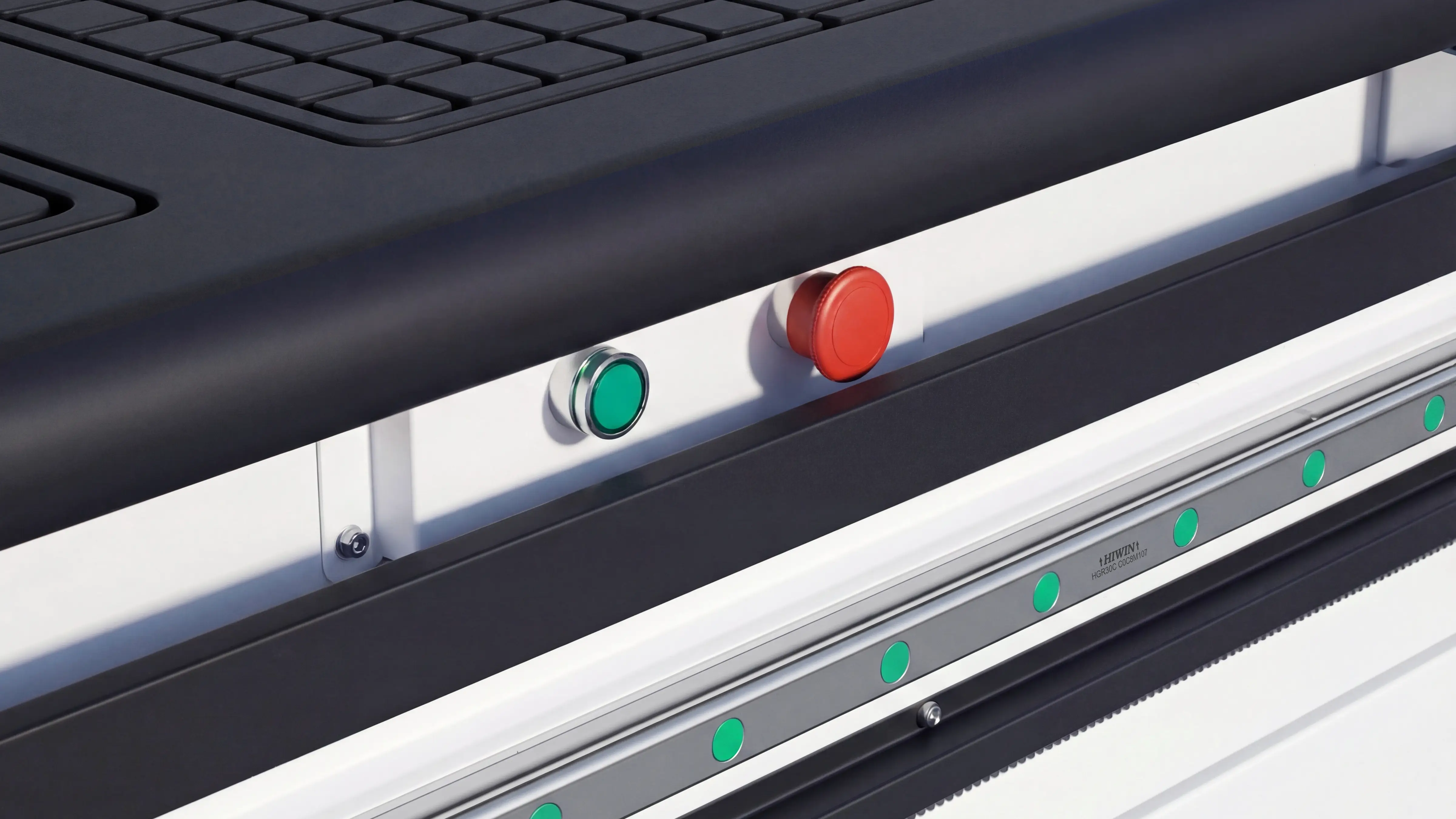
An additional set of commonly used control switches is installed at the rear of the machine bed, also built with Schneider Electric industrial-grade components. These switches feature a robust dust-resistant design along with high reliability and durability, making them suitable for frequent operation in long-term industrial environments.
This rear control unit includes a "Start" button and an "E-stop" button. The "Start" button is used to initiate a new machining cycle, while the "E-stop" button allows for immediate shutdown in critical situations, ensuring fast and reliable safety protection.
In practical operation, after loading the material, operators do not need to return to the main control cabinet. They can directly start the machining cycle from the rear of the machine. This significantly improves on-site operational convenience and production efficiency. In addition, in case of unexpected events, the nearby emergency stop enables immediate power cutoff, effectively reducing accident risks and minimizing potential losses.
Pursuit of Perfection, Fitted with Premium-Class Auxiliary Equipment
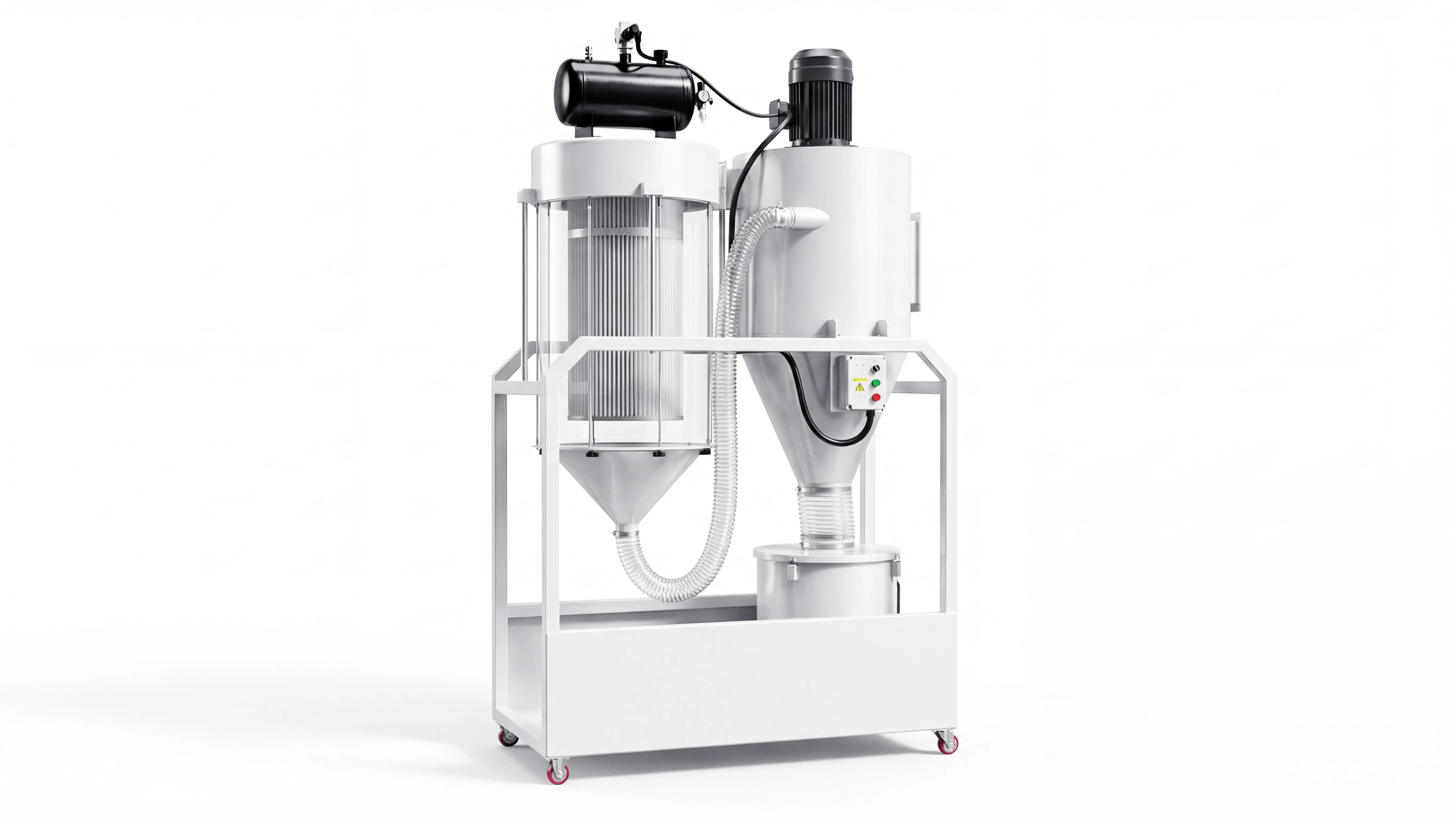
7.5kW Pulse Cyclone Dust Collector
This dust collection system adopts high-efficiency cyclone dust separation technology, providing strong continuous suction capability and stable airflow management. During high-speed machining, it quickly captures wood chips and dust, effectively reducing airborne particle dispersion and improving overall workspace cleanliness and operational safety. The system is equipped with a 150 mm large-diameter industrial suction duct, ensuring smooth airflow with lower resistance for high-volume dust transport and improved overall dust removal efficiency.
The system is equipped with a pulse reverse-jet self-cleaning function, which automatically removes accumulated dust from the filter surface to maintain stable suction performance. This prevents airflow reduction caused by filter clogging, extends continuous operating time, and reduces the frequency of manual maintenance.
The dust extraction piping is connected to key components such as the ATC spindle and the pushing device, enabling continuous dust capture during both machining and unloading processes. With an overall dust removal efficiency of over 98%, the system significantly improves workshop air quality and machine operating conditions, ensuring that the Spire 2030 CNC Router maintains a clean, efficient, and stable production state even under high-intensity continuous operation.
Pulse cleaning
Cyclone dust collection
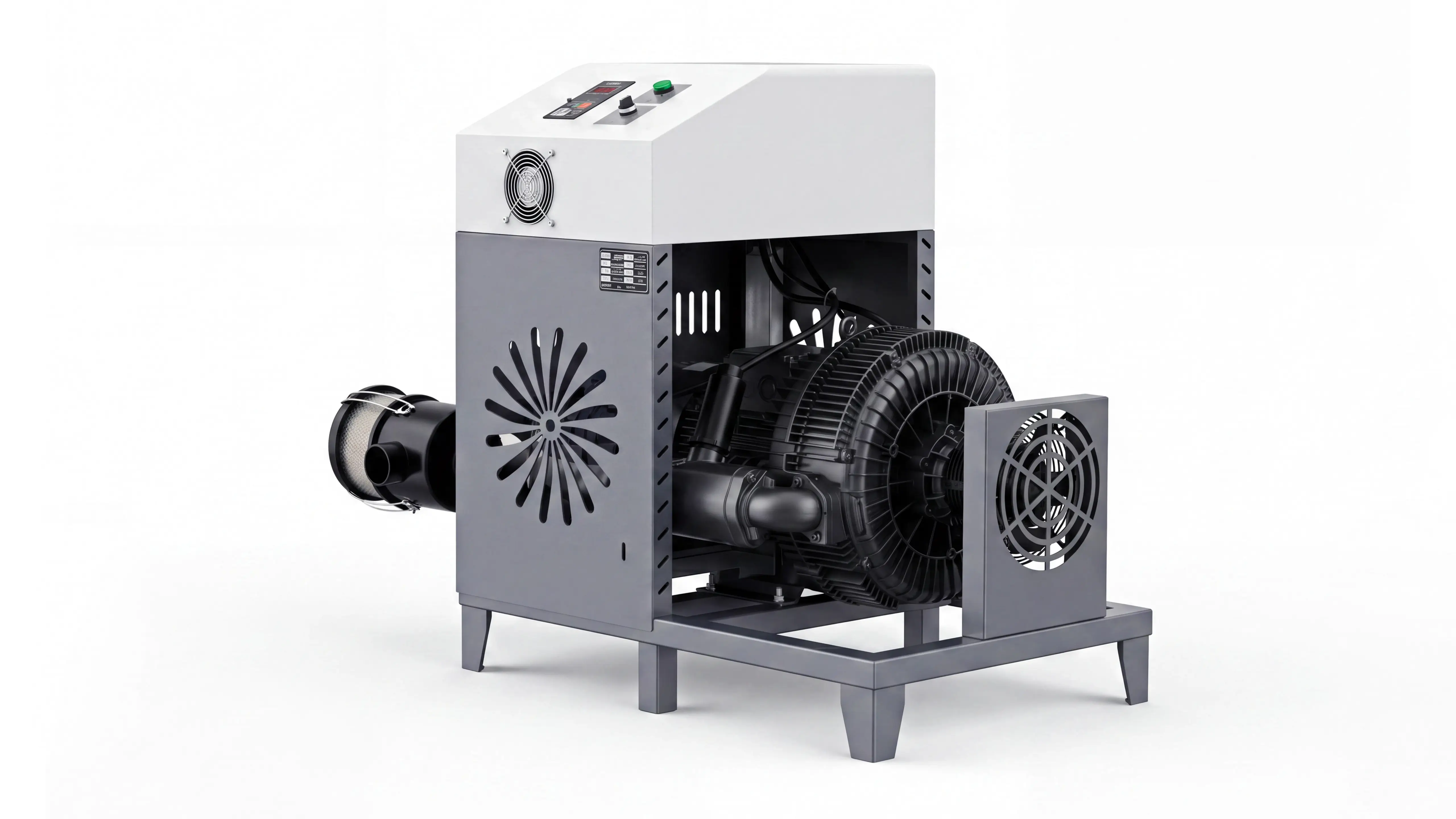
11kW High-Power Variable Frequency Constant Pressure Vacuum Pump
This vacuum pump adopts variable-frequency control technology, enabling real-time dynamic adjustment of output power based on actual suction requirements. The system maintains a stable negative pressure state at all times, ensuring consistent and reliable workpiece holding during high-speed machining. In addition, the variable-frequency technology enables more efficient energy management and reduced power consumption.
The pump features an oil-free and water-free environmentally friendly design, eliminating the need for lubricating oil or cooling water during operation. This fundamentally avoids issues related to oil contamination and water system maintenance, making the system simpler, more reliable, and significantly reducing long-term maintenance costs and operational workload.
The air inlet is equipped with a high-precision protective filter element that effectively prevents external dust and contaminants from entering the pump body. This helps avoid pipeline blockage and airflow restriction, protecting the core components of the vacuum system at the source, reducing failure risks, and extending the overall service life of the machine.
Variable Frequency
-50KPa
880m³/h
Automatic Lubrication, Set It, and Forget It
Large-Capacity Automatic Lubrication System
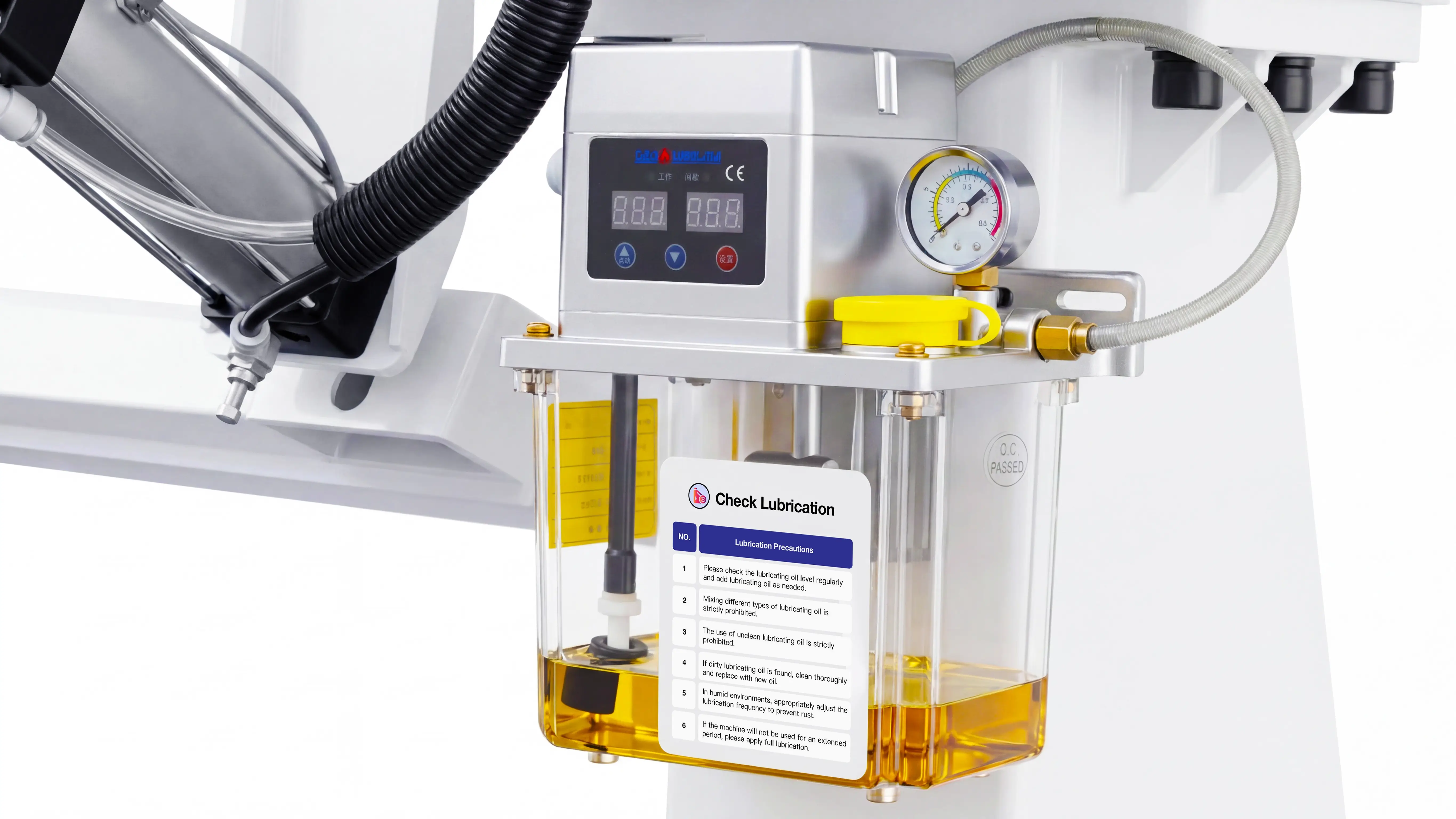
The lubrication system is equipped with a 1.5L high-capacity oil reservoir, allowing a single fill to support long-duration continuous operation. The system supports user-defined lubrication timing and intervals, enabling automatic timed and metered lubrication control. This ensures that linear guideways and ball screws remain consistently well-lubricated, reducing mechanical wear and improving overall machine stability.
The automatic lubrication system provides continuous and automated lubrication for linear guideways, ball screws, and other key transmission components, eliminating issues caused by delayed or insufficient manual lubrication. As a result, the CNC router maintains smooth motion and stable precision during long-term continuous machining. In addition, the system supports lubrication during active machining without stopping production, further improving overall operational efficiency without affecting production cycle time.
The system is equipped with an oil pressure monitoring gauge that displays real-time lubrication pressure status. This allows operators to continuously monitor system performance and quickly determine whether lubrication is operating normally, ensuring long-term stable and reliable operation of the lubrication system.
Premium Service, Spire Will Absolutely Impress You
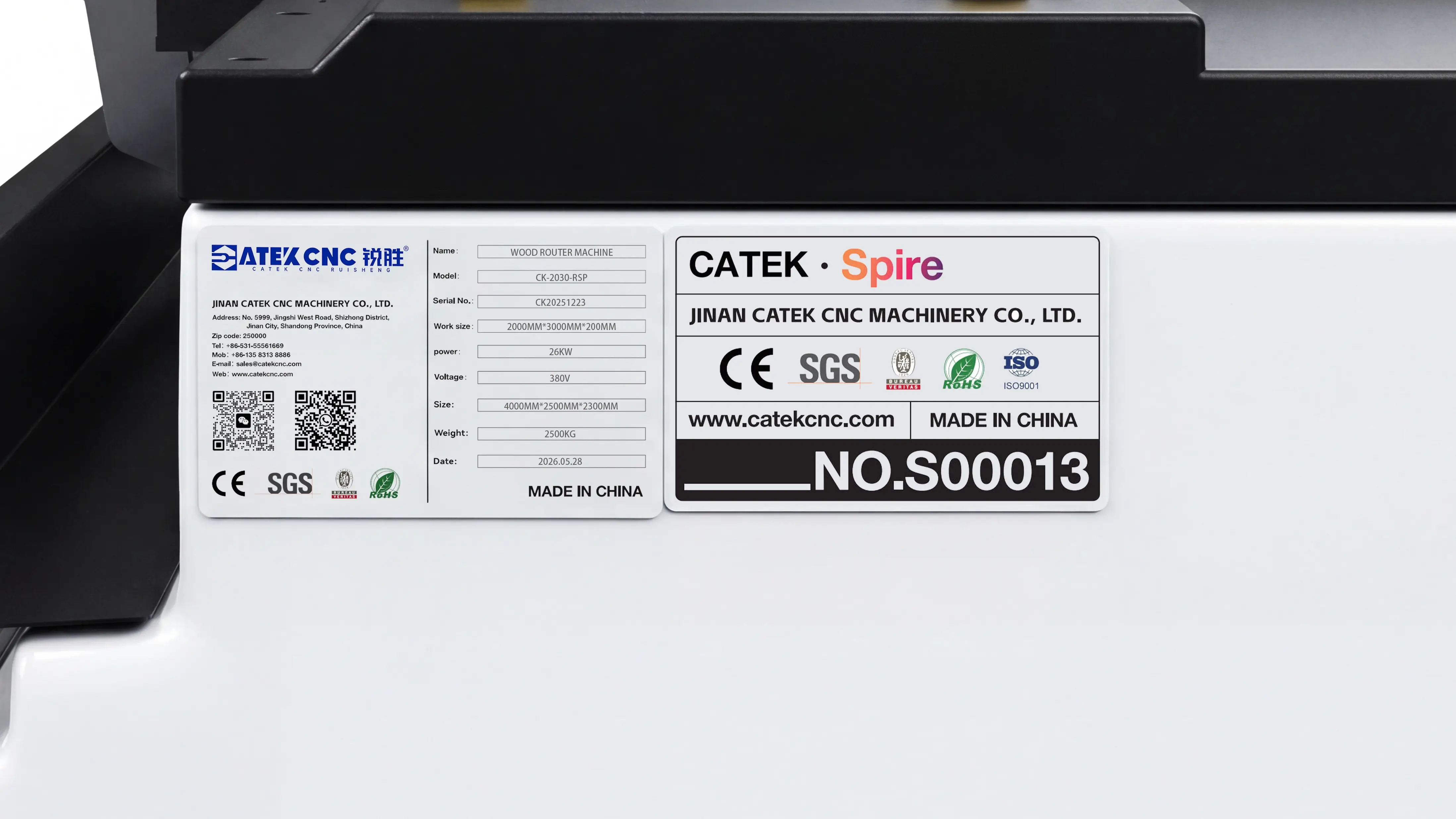
Spire Series Exclusive Machine ID & Service
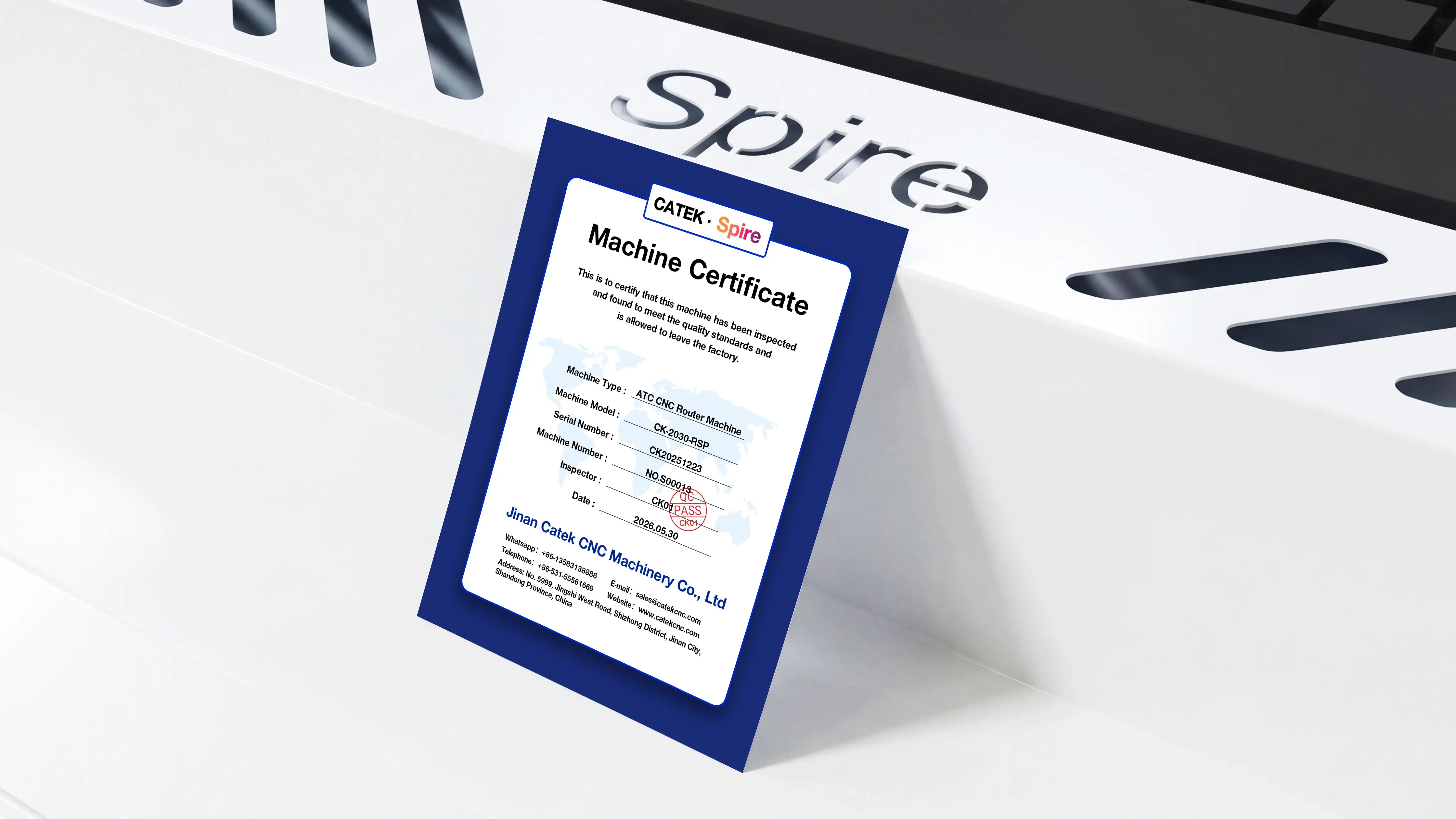
The Spire Series has established a comprehensive standardized service system. Each CNC router is assigned a unique equipment identification number, enabling full lifecycle traceability management. This mechanism ensures consistent and standardized equipment management across multiple models and configurations within the Spire product family, further enhancing brand professionalism and system reliability.
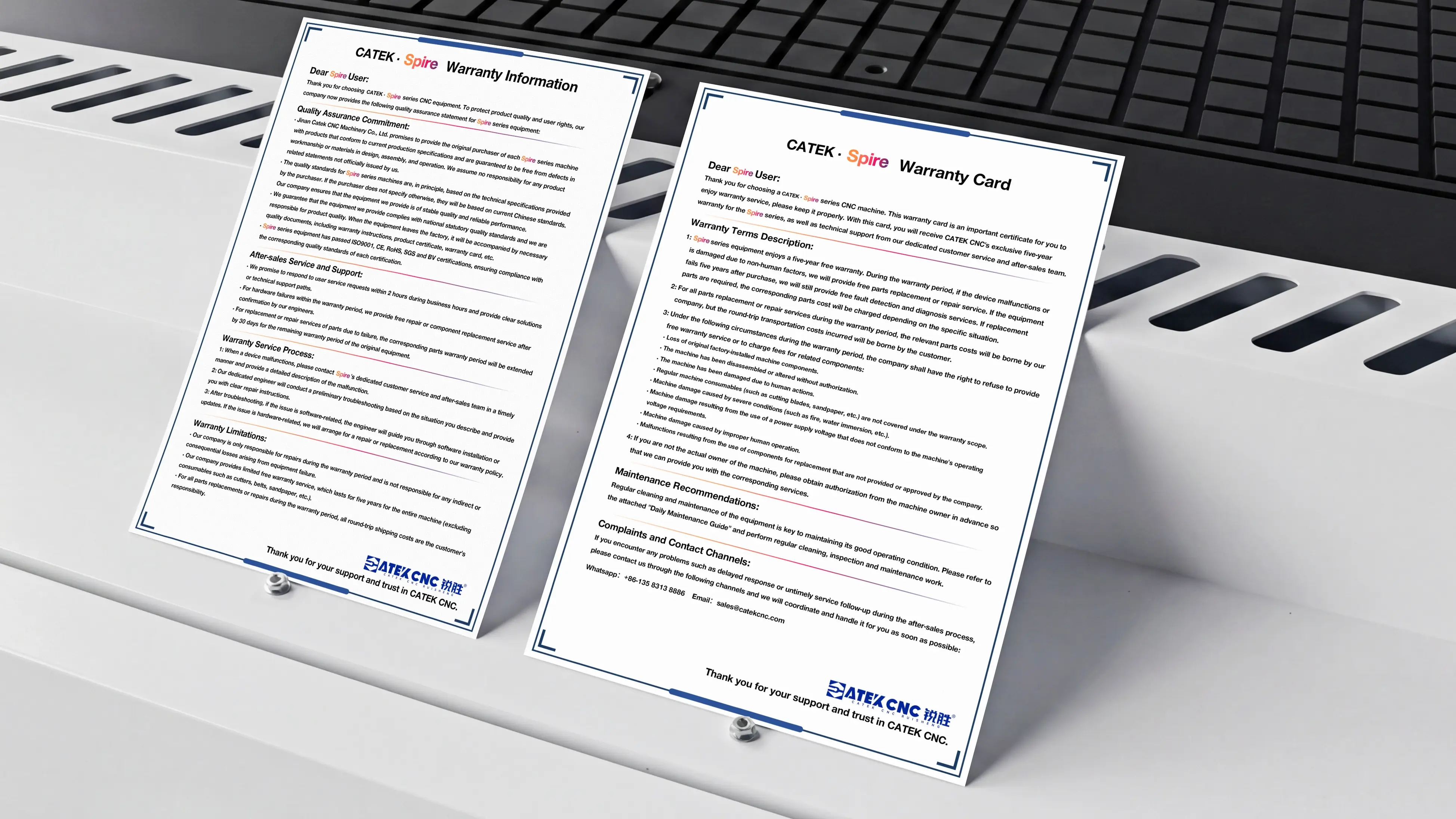
All Spire CNC Routers are covered by a high-standard after-sales service program, including a five-year full-machine warranty and dedicated technical support. Services include remote technical guidance, fault diagnosis and analysis, maintenance and repair support, as well as daily operational consultation. In addition, lifetime maintenance support and free software updates are provided, ensuring that the machine maintains stable performance and continuous technological upgrades throughout its entire lifecycle.
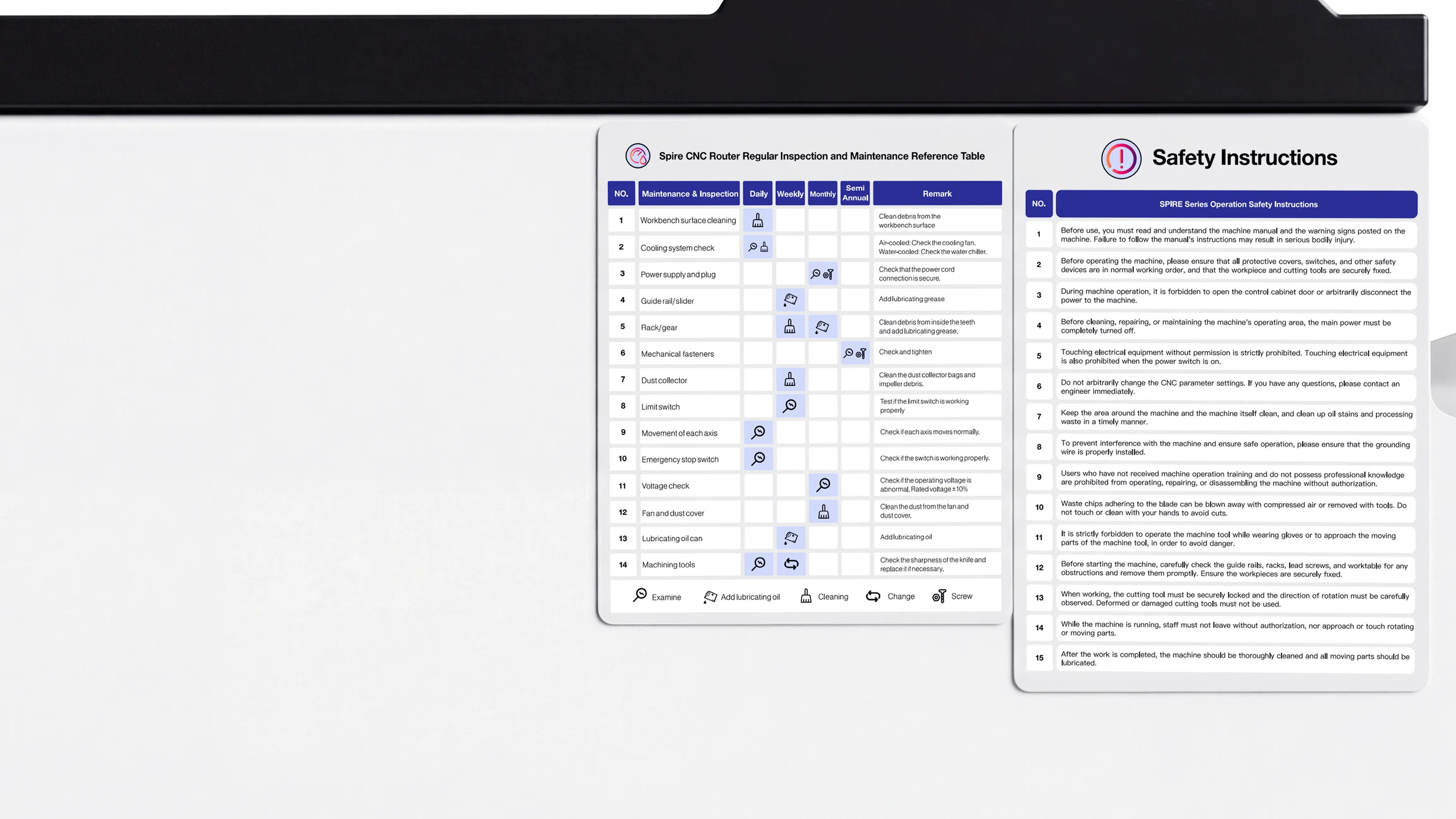
Furthermore, all Spire CNC Routers are equipped with standardized maintenance instruction labels, covering key component cleaning methods, lubrication cycles, routine inspection items, and standard maintenance procedures. This helps users develop standardized operation and maintenance practices, effectively extending machine service life and reducing long-term operational failure risks.
Spire Series Complete Documentation Kit
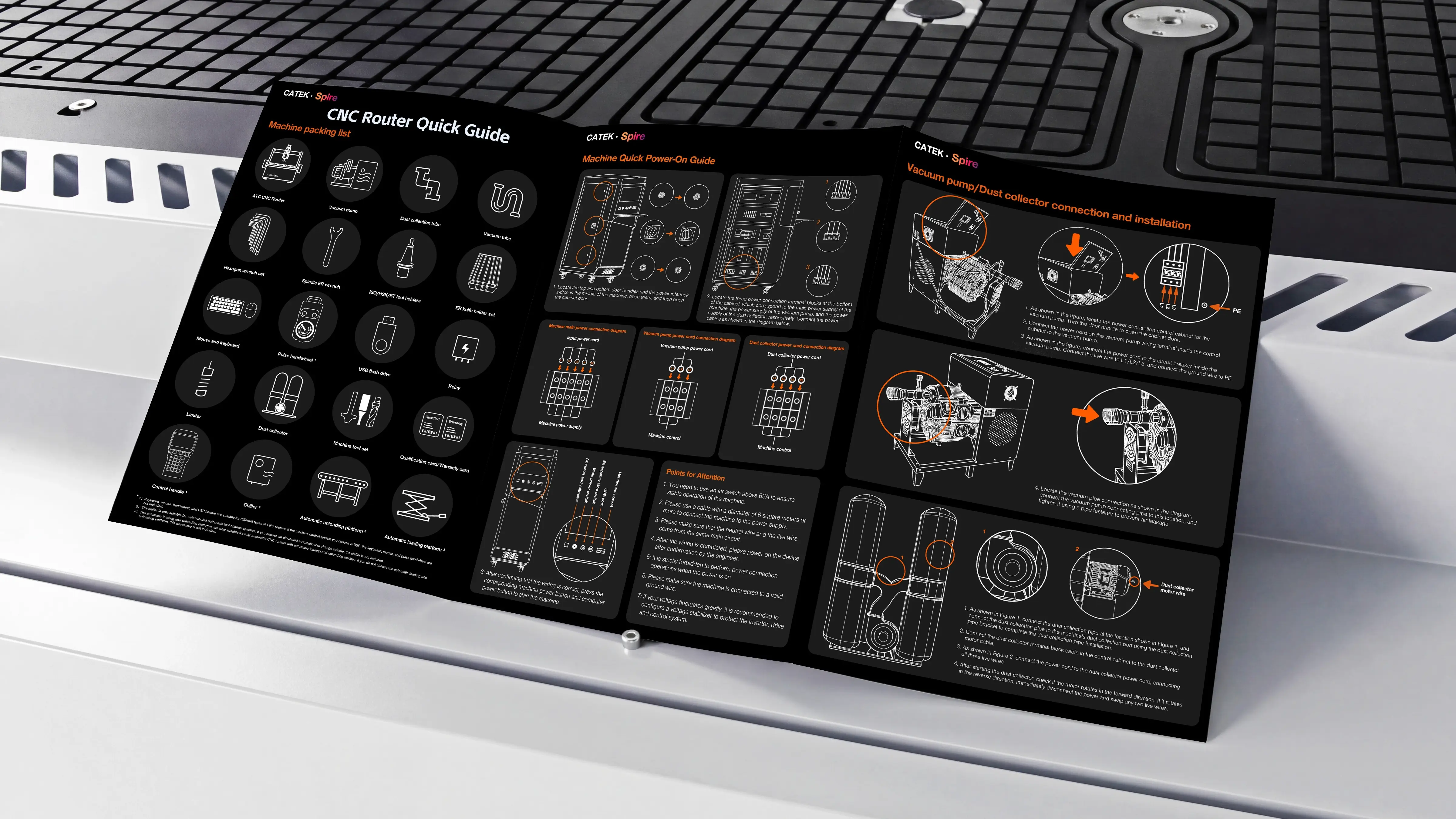
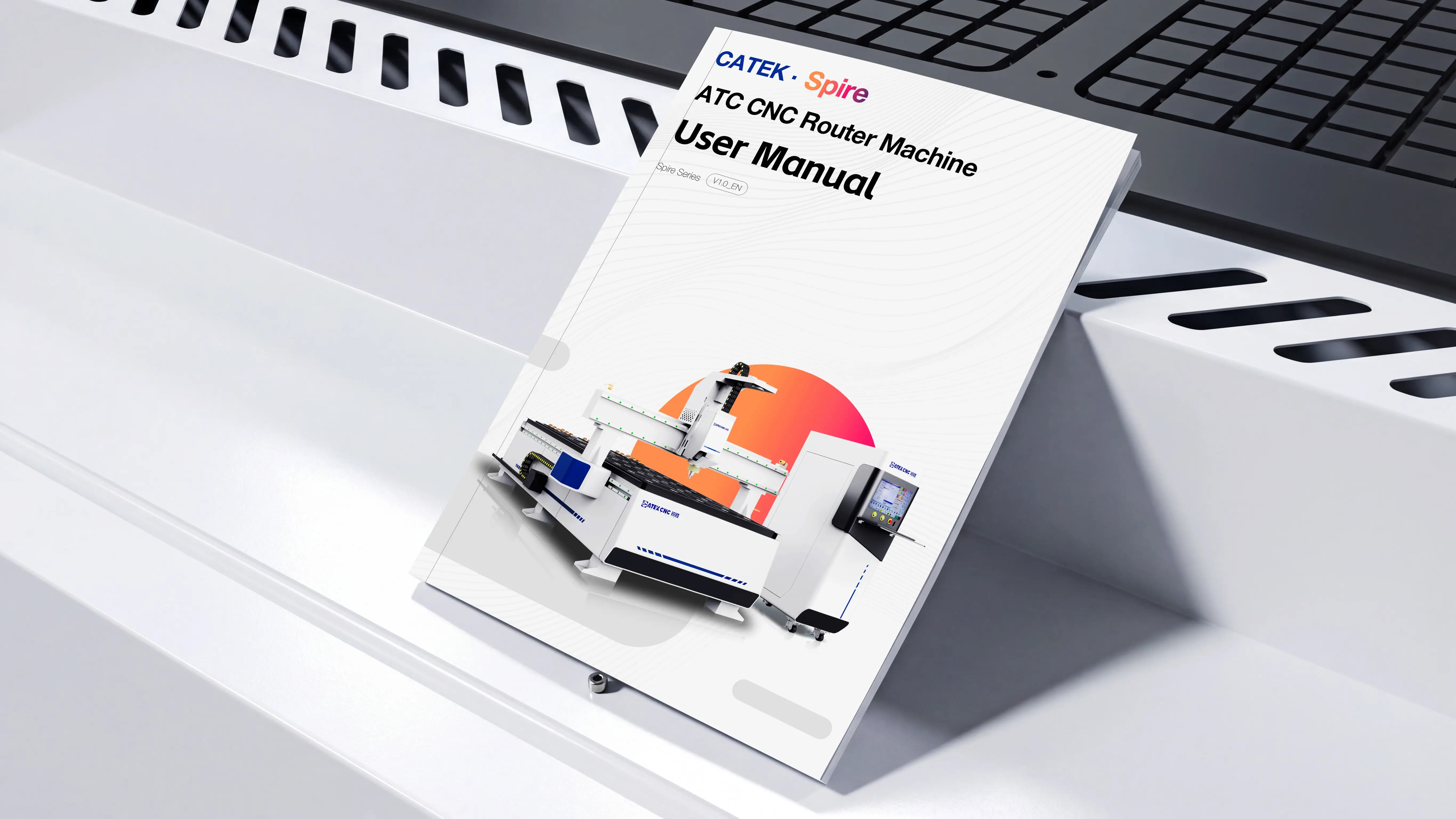
Each Spire machine is delivered with a complete standardized documentation package, including a certificate of conformity, warranty card, warranty manual, quick start guide, and user manual. This documentation system helps users fully understand the machine structure and operating procedures, effectively reducing the learning curve and entry barriers while improving operational standardization and safety.
The certificate of conformity records the factory inspection results, ensuring that each Spire machine has passed strict quality control and meets all factory acceptance standards. The warranty card and warranty manual clearly define the warranty period, service coverage, and applicable conditions, providing users with a clear and comprehensive understanding of their after-sales rights and benefits.
The quick start guide is designed for efficiency and practicality, covering parts checklist verification, power connection setup, vacuum pump and dust collection system integration, basic operating procedures, and common troubleshooting steps. It enables users to complete installation and initial operation in a short time. The user manual provides a more systematic and in-depth technical reference, covering machine structure, installation steps, standard operating procedures, daily maintenance methods, and fault diagnosis and troubleshooting solutions. Presented in a clear text-and-picture format, it makes complex structures and operational logic easier to understand, allowing even non-professional users to quickly become proficient.
Out of the Box, Spire Has It All Ready
Free Accessory Kit for Diverse Machining Needs
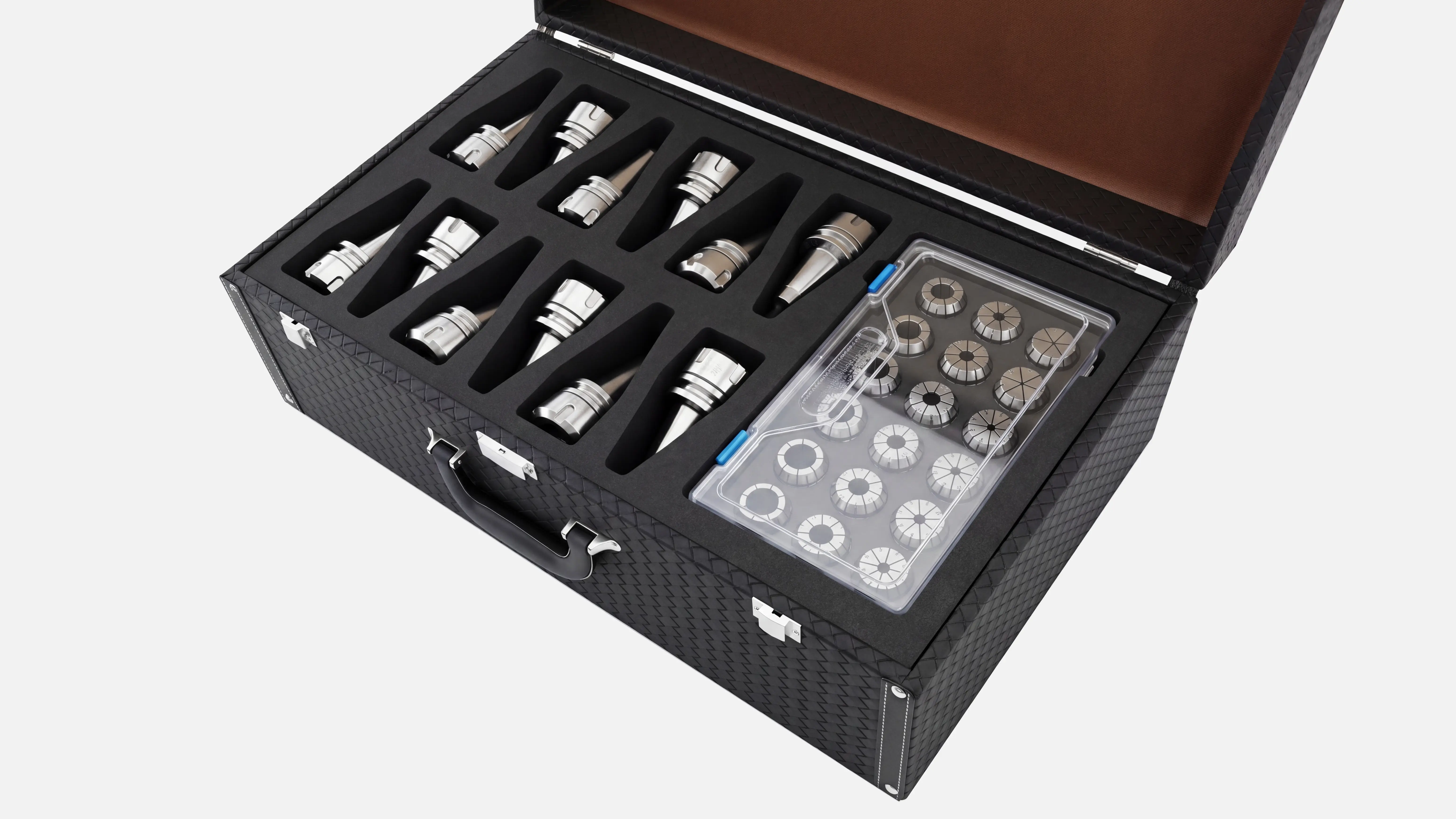
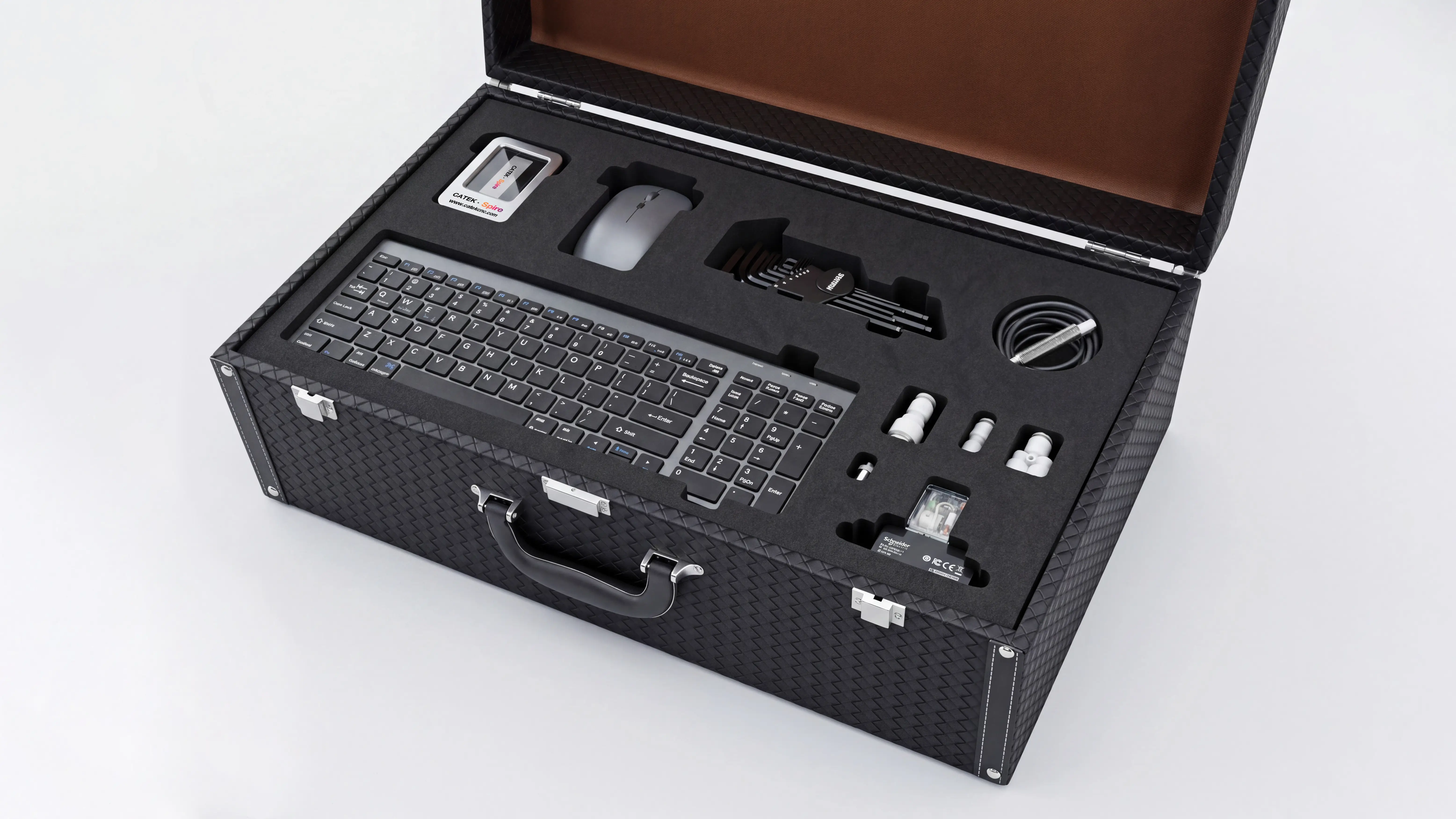
All Spire CNC Routers are shipped with a premium tool kit as standard, designed to support installation, commissioning, and daily maintenance. The kit includes a wireless keyboard and mouse set for computer operation control, a set of hex key wrenches for routine setup, adjustment, and maintenance tasks, as well as critical spare parts such as air nozzles, relays, and limit switches. These spare components enable rapid replacement in case of unexpected failures, effectively reducing downtime and improving machine uptime and on-site maintenance efficiency. In addition, a USB drive package is included, containing operation training videos, user manuals, test machining files, and system backup files, helping users quickly master machine operation and complete basic setup while lowering the learning curve.
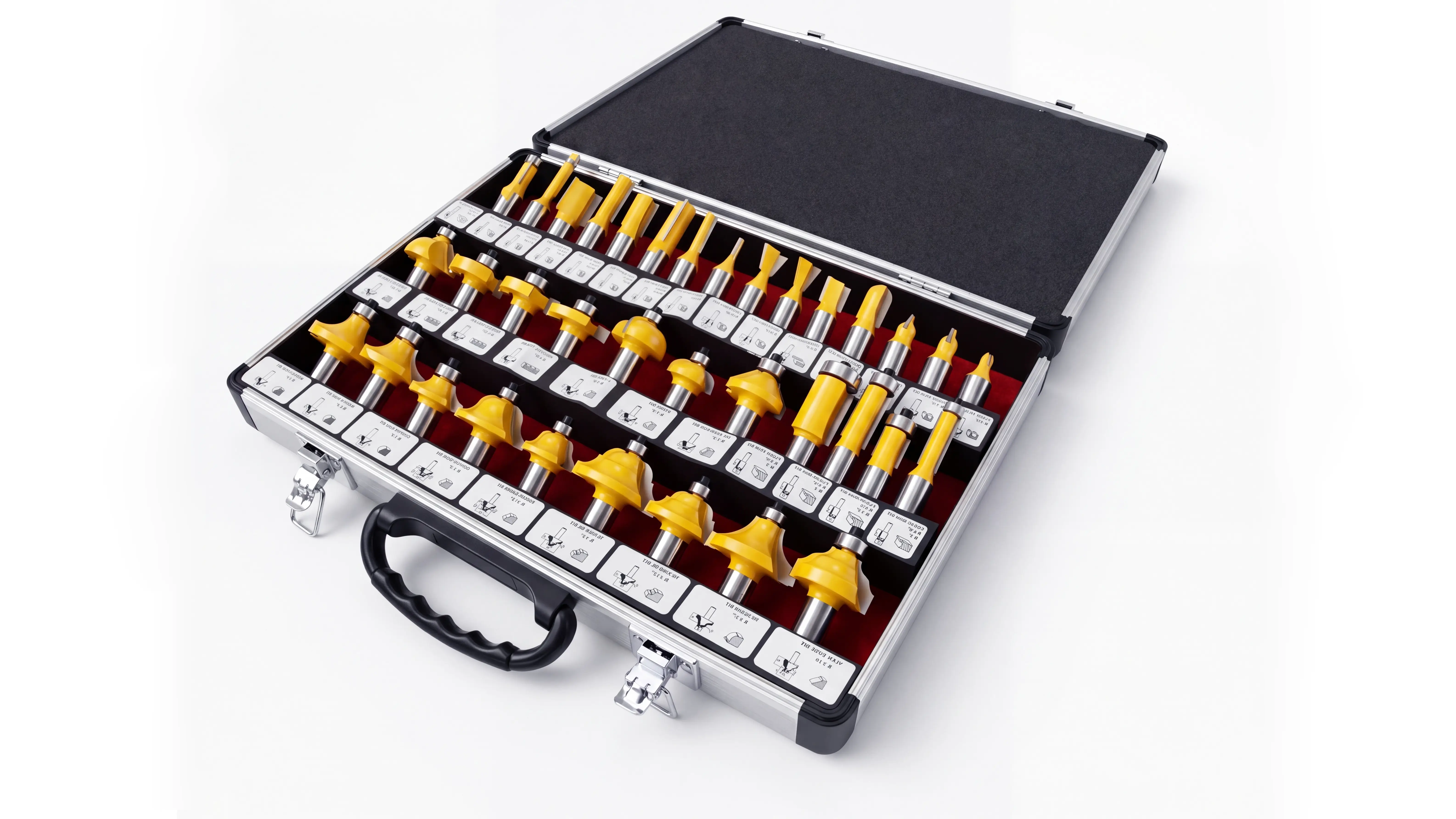
The package also includes 12 ISO30 tool holders, 18 ER32 collets, and 35 professional machining tools, covering a wide range of tool types such as cutting tools, engraving tools, ball nose cutters, and end mills. These tools are suitable for various industrial applications including woodworking panels, acrylic processing, signage production, and composite material machining, enabling complete machining workflows from roughing to finishing.
With this comprehensive tool and cutter configuration, the machine is fully equipped for immediate production upon delivery, eliminating the need for additional procurement of consumables or basic tools—everything has been prearranged by Spire to ensure a seamless startup.
Toolbox First LayerToolbox Second
LayerMachining Tool Set
Applicable Industries
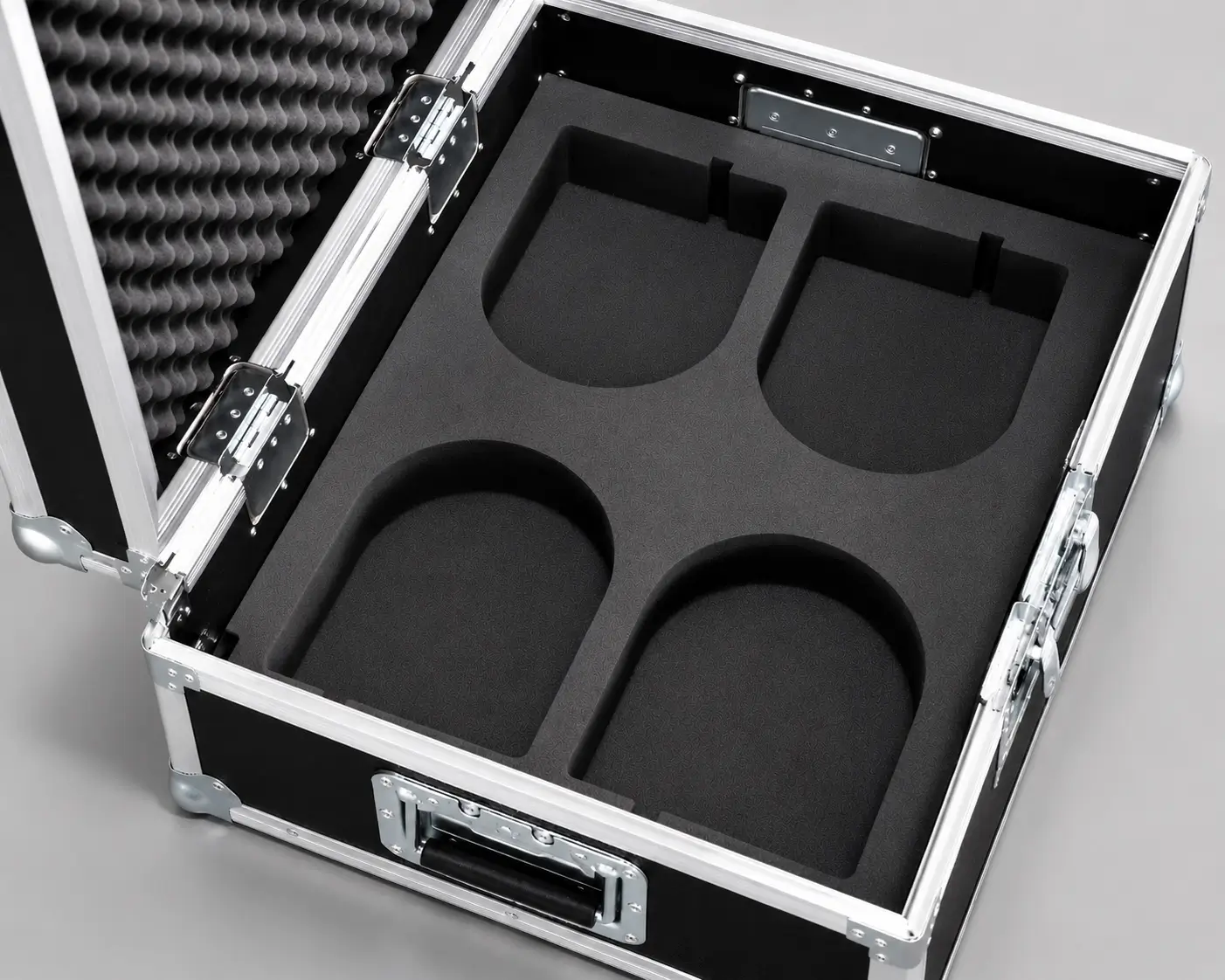
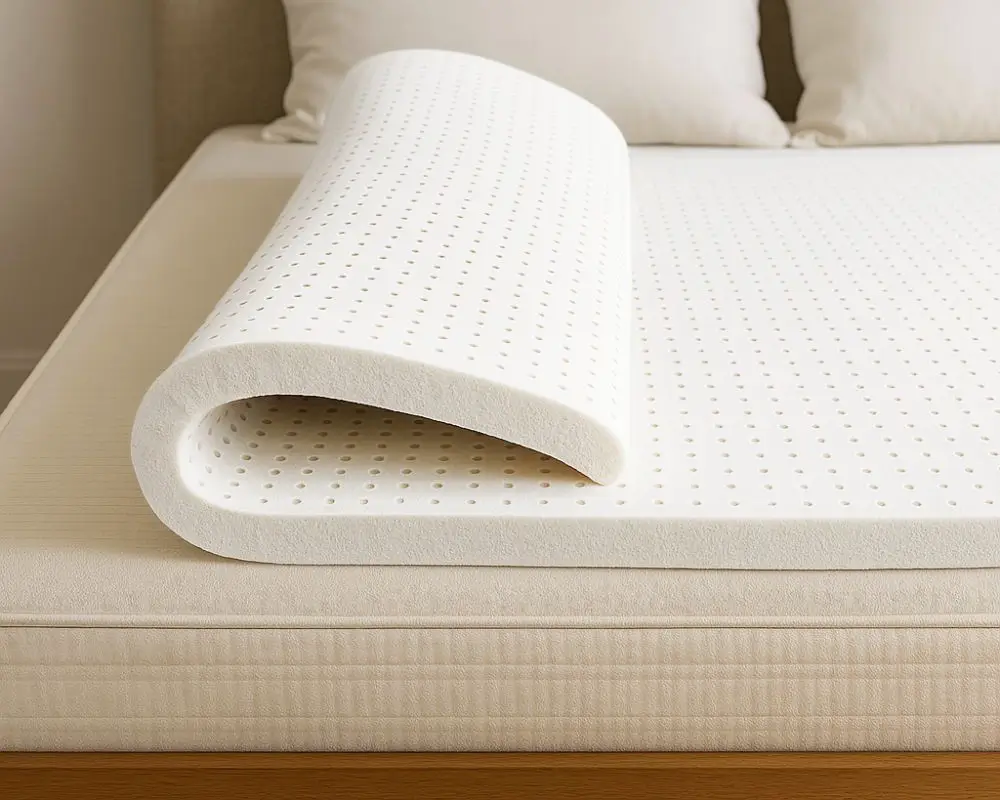
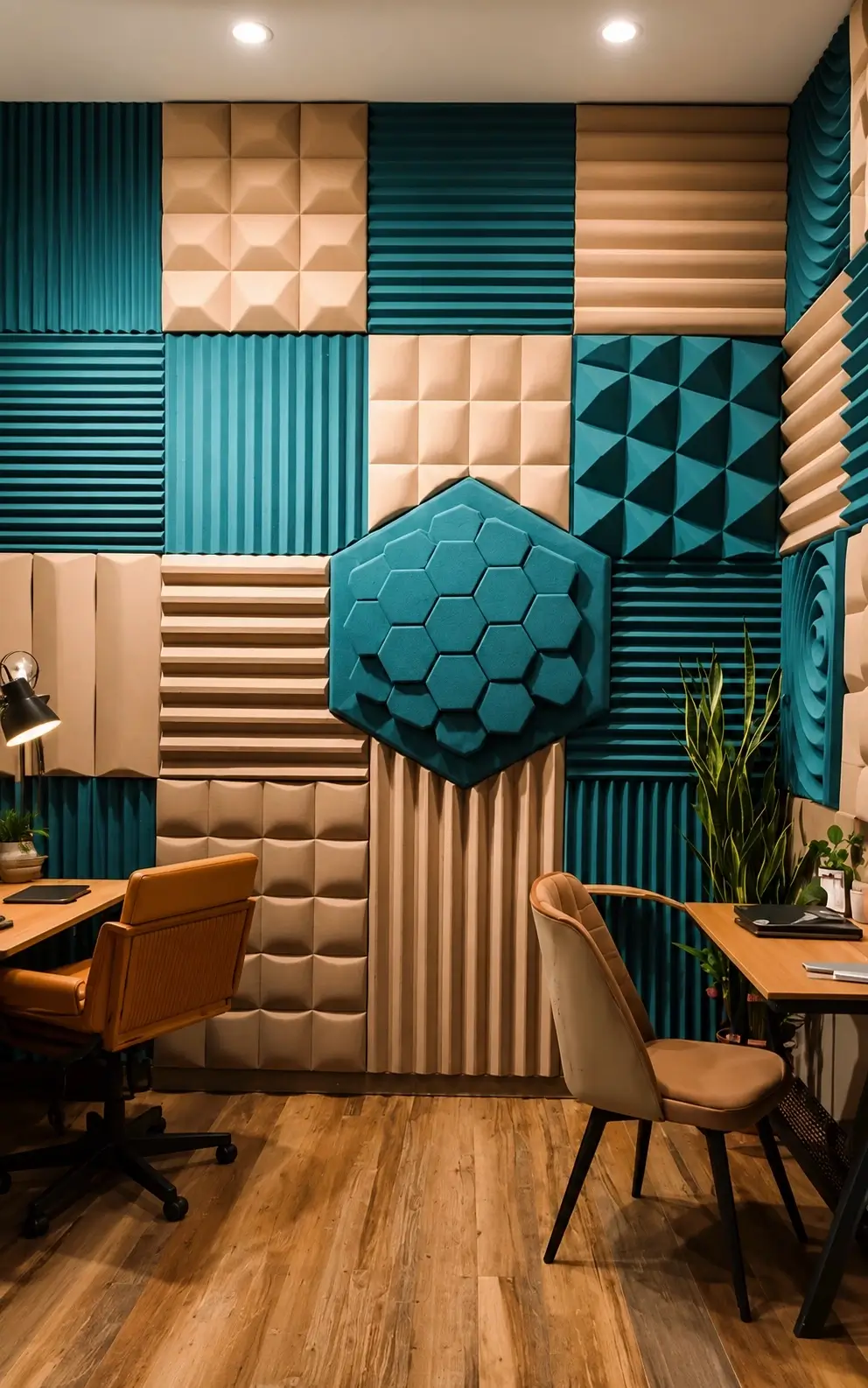
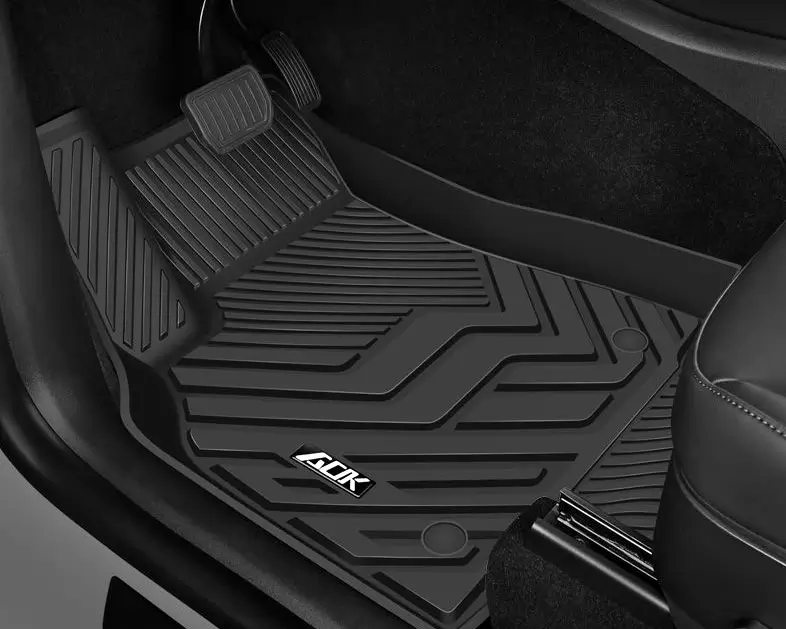
Whether it is cabinet manufacturing, signage lettering, furniture production, or cutting automotive floor mats, carpets, acoustic insulation materials, foam mattresses, and rubber shoe soles, the Spire can handle all of these applications with ease.
Easily explore helpful answers to the questions our users ask
most,so
you can understand the Spire better
and get support instantly.
Contact Us Now!
+86 135 8313 8886
1. What are the advantages of a multi-functional CNC router equipped with ATC, oscillating knife, and CCD vision system compared to a standard CNC router?
Traditional only-spindle CNC routers are typically limited to machining rigid materials. When processing flexible materials such as fabric, leather, or foam, they are often unable to achieve effective cutting performance. In addition, multi-tool machining operations still rely on manual tool changes, which results in lower efficiency and increased operator workload.
In contrast, this multi-functional CNC router integrates an automatic tool changer (ATC), an oscillating knife system, and a CCD vision recognition system, enabling unified processing of both rigid and flexible materials on a single machine. The ATC system allows automatic tool switching for multi-process machining, significantly improving production efficiency. The oscillating knife system is capable of high-efficiency cutting of soft and semi-rigid materials. Meanwhile, the CCD vision system enables automatic pattern recognition and contour-following cutting, making it suitable for complex shapes and customized production requirements.
As a result, one machine can replace multiple single-function machines, greatly improving equipment utilization while reducing investment cost and floor space. This solution is especially well-suited for diversified production, small-batch manufacturing, and highly flexible production environments.
2. What materials can a pneumatic oscillating knife cut, and what is the maximum cutting thickness?
The oscillating knife cuts through a high-frequency up-and-down reciprocating motion, similar to "high-frequency sawing." This cutting method effectively severs the fiber structure of materials, preventing deformation issues commonly caused by conventional cutting forces when processing flexible materials. The process produces no heat-affected zone (HAZ), resulting in clean and smooth cutting edges, while blade replacement remains simple and convenient. It is therefore well-suited for efficient batch processing of various flexible materials.
The high-frequency pneumatic oscillating knife operates at a maximum vibration frequency of up to 18,000VPM, providing strong high-speed reciprocating cutting performance. It is capable of reliably cutting flexible and semi-flexible materials with a maximum thickness of approximately 100mm under stable operating conditions.
3. What is the function of the CCD vision system in a multi-functional CNC router, and what production scenarios is it suitable for?
The CCD vision system uses an industrial CCD camera to automatically recognize and locate pre-printed patterns, logos, and text on sheet materials. Based on the recognition results, it automatically generates cutting paths, enabling precise contour cutting and automatic edge-following machining.
Compared with traditional manual alignment methods, this system effectively eliminates positioning errors caused by human operation, significantly improves machining consistency and accuracy, and greatly enhances overall production efficiency while reducing material waste.
Therefore, this system is particularly suitable for applications such as signage production, foam lettering cutting, printed fabric processing, customized pattern manufacturing, and sticker or adhesive label cutting.
4. What materials and products can be processed by the spindle and oscillating knife of a multi-functional CNC router?
9 kW Automatic Tool-Changing Spindle:
Machinable materials: Various types of wood, plywood, MDF, LDF, MDO, HDPE (high-density polyethylene), HDU (high-density polyurethane), PVC, Sintra board, Ultra board, aluminum composite panels, Dibond, acrylic, Gator board, aluminum, copper, plastics, ceramics, wax, and various engineering composite materials.
Machinable products: Wardrobes, cabinets, wooden doors, beds, wine cabinets, background walls, display racks, wave panels, relief carvings, furniture components, advertising illuminated letters, logos, signage panels, light boxes, display boards, guitars, violins and other musical instrument parts, wood crafts, wooden molds, toys, and other wooden products. It also supports surface engraving, grooving, sheet nesting, and 2.5D carving applications.
High-frequency Pneumatic Oscillating Knife:
Machinable materials: EPS foam, Corafoam, Gator Foam, various foam core boards, advertising foam, sponge, acoustic panels, corrugated cardboard, cork, fabric, leather, rubber, Seadek, vinyl, Coroplast hollow boards, KT board, and other soft, lightweight, and deformable materials.
5. In what situations is it necessary to choose a CNC nesting machine equipped with an oscillating knife and a CCD vision system?
When your production requirements involve processing both rigid and flexible materials, it is recommended to choose a multi-functional CNC nesting machine integrated with an oscillating knife and a CCD vision system. Such equipment can complete multiple machining processes on a single machine, eliminating the need to purchase separate dedicated machines, thereby significantly reducing equipment investment costs, saving floor space, and improving overall production efficiency.
Typical rigid material processing scenarios include cutting, nesting, drilling, and engraving of MDF boards, acrylic, plastic sheets, composite panels, and certain soft metal materials.
Typical flexible material processing scenarios include batch cutting and shaping of foam, sponge, rubber, corrugated cardboard, leather, and fabric.
In addition, when production involves automatically cutting printed graphics, spray-painted images, or irregular contours, the CCD vision system can automatically recognize image edges and perform precise contour-following cutting, effectively eliminating issues caused by manual positioning errors and low efficiency.
6. How many axes does a CNC nesting machine with an oscillating knife belong to?
Strictly speaking, this multi-functional CNC nesting machine equipped with an oscillating knife system is typically classified as a 4-axis CNC router machine.
Unlike a traditional spindle that performs milling through high-speed rotation, an oscillating knife cuts via high-frequency vertical reciprocating motion. Because the blade has a defined cutting edge direction, it must remain aligned with the tangent direction of the cutting path during machining to ensure cutting quality and path stability.
Therefore, such machines are generally built on a standard XYZ linear motion system (3 axes), with an additional independent servo rotary axis as the fourth axis. This extra axis is used to control blade orientation adjustment. During operation, the XYZ axes handle spatial positioning and movement, while the fourth axis continuously adjusts the tool direction so that the blade remains aligned with the cutting trajectory. This enables coordinated 4-axis motion control for stable and accurate cutting performance.
Last Updated:
2026-06-25 14:06:06
Technical Parameters
Series
CATEK ·Spire
Model
CK-2030-RSP-TK
XYZ Working Travel
2000*3000*200mm
Max. Cutting Thickness (Oscillating Knife)
100mm
Bed
Spire-specific machining center processed reinforced bed base, independent anti-interference control cabinet
We use cookies to personalise content and ads, to provide social media features and to analyse our
traffic. We also share information about your use of our site with our social media, advertising and
analytics partners who may combine it with other information that you’ve provided to them or that
they’ve collected from your use of their services.
You may modify your privacy preferences at any time by accessing the "Your Privacy Choices" link
located at the bottom of the page.


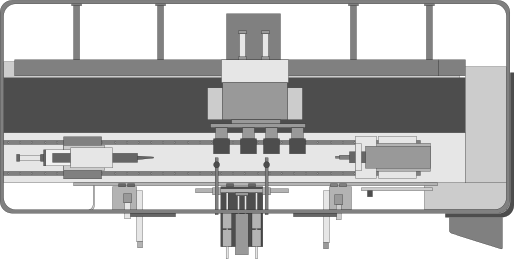

















 Five-years free warrantyEnjoy Spire VIP service, providing free warranty and maintenance for the entire machine, bringing you a worry-free experience.
 Exclusive private customer service and after-sales team7*24 hours online service, on duty around the clock, to solve any problems for you as soon as possible.
 The matching CNC software is given for freeEnjoy lifetime free software upgrades, supporting software updates and free programming services.